Your documents are ready, and your CAS now depends on one interview. Among the 11 questions a student was asked in a real Sheffield Hallam interview was this one: “If you were going to an island, which three things would you take?”
Most preparation lists are guesses. This one comes from inside the interview room.
A student recently sat a Sheffield Hallam pre-CAS interview and shared exactly what they were asked. All 11 questions in this guide come from that one conversation, and each is explained the way you would want it explained: what the interviewer is really listening for, and how to answer in your own words.
Yes, that last one was the island. You will find it, with a calm way to answer it, in Part 4.
Every interview is different, so treat this as one student’s experience, not a promise of your exact questions.
3 of the 11 questions have nothing to do with your documents
No file can prove these answers, so the interviewer listens for something else:
- Your Englishhow clear and natural you sound
- Your confidencehow you handle a surprise
- Your characterwhat kind of student you will be
That is why the way you answer matters as much as what you say.
A rehearsed answer lasts until the first follow-up. A genuine reason lasts the whole interview.
Sheffield Hallam University pre-CAS interview questions look simple on paper: why this course, who is paying, where will you live. Yet this is the stage where a memorised script is exposed, because the interviewer is not testing your memory. They are testing whether your plan is real. If you want to study in UK at Sheffield Hallam, the way you answer these questions can affect how smoothly your CAS arrives.
Here is what you will get: the 11 questions one student was asked, including that surprising one about an island, what the interviewer is quietly checking behind each, one full worked example, quick facts about the university, and a 5-day plan. By the end, you will know what to say, and why it works.
Pre-CAS Interview or Credibility Interview: Know the Difference
A Pre-CAS interview is run by the university before it issues your CAS. A credibility interview is run by the Home Office during your visa process, usually at your biometrics appointment, and not every applicant is selected. The questions overlap heavily, so preparing for one prepares you for both.
If something goes wrong later, an honest, consistent file makes it far less likely. To see why this has become a bigger concern, read how UK universities are withdrawing CAS for Pakistani students. Whether a Pre-CAS interview applies depends on your profile, so confirm it with the admissions team or your consultant.
Topics Sheffield Hallam says a credibility interview may cover
- Immigration history
- Education and employment history
- Financial circumstances
- Chosen course and university
- Living arrangements in the UK
- Post-study plans
Source: Sheffield Hallam University’s credibility interview page. The interview also assesses your English, so speak naturally and clearly. The university also shares a short list of sample questions (PDF), though it still uses the old term “Tier 4”.
The 11 questions below follow those six topics closely, so organise your preparation around them. For guided practice, see our CAS interview preparation in Lahore.
Part 1: Why the UK, Why Sheffield Hallam and Why This Course (Questions 1 to 4)
These four questions test whether your decision was researched or recommended, so give them the most practice.
1Why the UK? Did you consider other countries, and which attracted you most?
The interviewer wants to see that you compared options. Name one or two alternatives, such as the Russell Group (see our list of best Russell Group universities), then say what the UK offered that they did not. Avoid answers that fit any student, like “the UK has good education”.
Answer directionI compared [country] and the UK. For my field of [subject], the UK degree is [specific reason], and the course at Sheffield Hallam fits that goal.
2Why did you choose to study at Sheffield Hallam University?
Specifics win. Pick two or three facts from the course page that genuinely matter to you: a module, the teaching style, employer links or the city. Compare at least two universities before you answer. Our page for UK universities helps you shortlist, and Aberdeen vs Strathclyde shows how to compare fairly.
HookI chose Sheffield Hallam because it teaches the way I learn best: by doing. Her storyIn my BBA in Lahore, my strongest work came from practical projects, like the campaign my team built for a local bakery.
ProofOn the MSc International Marketing page I saw that students complete a consultancy project with a real business, and that the course is linked to the Chartered Institute of Marketing. Career linkBoth matter to me, because I want to return to Pakistan with real project experience and a recognised qualification.
3Why did you choose this course, and how will it help your future?
Connect three things: what you studied before, why this course is next, and the role you want afterwards. Three or four sentences are enough.
Why they askThere is no document to check here. The interviewer listens to how clearly and confidently you explain your own plan in English, and whether it sounds like your own thinking.
4How will you contribute to the university?
Keep it realistic: class discussions, a subject society, diverse groups and a perspective from your background.
Why they askIt lets the interviewer hear your English in a relaxed, open answer and get a sense of what kind of student you will be.
Answer directionI want to contribute in seminars and group projects by sharing examples from [your background], and I plan to join [type of society] to learn from other students.
Part 2: Money, Sponsors and Working While You Study (Questions 5 to 7)
Here your spoken answers and documents must match exactly. A small mismatch raises more doubt than a weak answer.
5What does your financial sponsor do, and why are they sponsoring you?
State who your sponsor is, what they do and why they support you, exactly as your documents show. Do not guess figures, and keep our UK study documents checklist for Pakistani students beside you.
Answer directionMy [relationship] works as [occupation]. They are sponsoring me because they want me to gain a [degree] that will help me build a career in [field].
6How will you manage your expenses while studying in the UK?
Mention tuition, accommodation, food, travel and living costs, and who covers them. For realistic figures, see the cost of studying in the UK for Pakistani students in 2026. If you are relying on a scholarship, say so clearly. Present part-time work as a small supplement, not the plan.
7What difficulties do international students face with part-time work in the UK?
Show you know the rules: visa conditions limit your hours, your timetable comes first, and suitable jobs take time. Read the work conditions on your own visa first. If unsure, our UK visa assistance service covers document preparation, filing and interview coaching.
Write your sponsor’s name, occupation, income source and the tuition amount on one page, using the same wording as your documents. Read it aloud the night before and again an hour before the interview.
Want Someone to Test Your Answers Before the Interviewer Does?
Send Global Migration Advisors your course page, your sponsor details and a short voice note of your answers. Our team will point out where an answer sounds rehearsed, vague or different from your documents.
- Answers match documents
- Spoken English check
- Honest feedback
Part 3: Where You Will Live and What Comes After (Questions 8 and 9)
8What is your accommodation address, and where would you like to live?
If housing is arranged, know the address and distance to campus. If not, name your preferred type (halls or a shared house), the area of Sheffield and a short reason. Guessing creates doubt.
9What is your post-study plan after graduating from the UK?
Be specific and honest: the role you want, the skills you will gain and how you will use them in your home market. Do not make your whole plan depend on staying in the UK.
Answer directionAfter graduating I plan to work as [role] in [field]. The skills I gain in [course area] will help me [specific contribution], which is why I chose this course.
Part 4: The Personal Questions That Catch Students Off Guard (Questions 10 and 11)
10If you were going to an island, which three things would you take, and why?
Almost everyone is surprised, which is the point. There is no correct list. The interviewer listens for natural thinking, clear English and composure. Pick three genuine items, give one reason each, and stop.
Why they askNo one can memorise an answer to this, so it shows how well you speak English, how confident you sound when surprised, and what kind of person you are.
Answer directionI would take a water purifier because safe water is essential, a book because I enjoy learning when I am alone, and a family photograph because it keeps me motivated.
11Have you had a visa refusal from any country?
Be honest and brief. If you had a refusal, name the country, year and reason, and what has changed. Never hide it, because your history is visible and a mismatch hurts more than the refusal. Knowing the common reasons behind a UK student visa rejection helps you answer consistently.
All 11 Questions at a Glance
| Area | Questions | What it checks | How to prepare |
|---|---|---|---|
| Your reasons | 1, 2, 3, 4 | Research, comparison and a clear link between course and career. Questions 3 and 4 also show how clear and confident your English is | Collect two or three real facts about the course and the university |
| Your finances | 5, 6, 7 | Whether funding is clear, realistic and matches your documents | Fill in a one-page sponsor and cost sheet |
| Your life in the UK | 8, 9 | Housing plans and a believable path after graduation | Know your address or area and write a specific career plan |
| Your honesty | 10, 11 | Natural English, composure and a truthful immigration history | Practise unexpected questions and prepare a short, honest refusal answer if needed |
Know Your University: 9 Quick Facts to Have Ready
The university’s own sample list asks “Where is the university?” and “Roughly how large is it?”, so the basics are fair game. Here are the questions applicants ask most.
Where is Sheffield Hallam University?
Quick answerIn the city of Sheffield, South Yorkshire, England.
The main City Campus is in the city centre on Howard Street, with a second site called Collegiate Campus. Naming the campus makes your answer sound lived-in.
Is Sheffield Hallam a public or private university?
Quick answerPublic. It is a public university in England, not a private one.
It is a recognised UK university, but the interviewer will still want to hear why you chose it.
How big is it, and is it any good?
Quick answerOne of the UK’s larger universities, with more than 30,000 students.
It holds a Gold rating in the 2023 Teaching Excellence Framework, and reports that 95% of graduates are in work or further study. These are the university’s own figures.
Is admission easy or difficult?
Quick answerNeither. It depends entirely on your course.
Each course page lists its own entry requirements, and some add a portfolio or subject grades. An offer is never automatic.
What is the acceptance rate?
Quick answerThere is no official figure to quote.
Sheffield Hallam does not appear to publish an overall rate, so any percentage online is an estimate. What matters is whether you fit your course and your plan is real.
Is IELTS required?
Quick answerFor most courses, yes, and the score depends on the course.
Course pages show 6.0, 6.5 or 7.0 overall, with at least 5.5 in each skill. Other tests, such as TOEFL iBT, Pearson and Duolingo, are accepted at equivalent scores, and for a student visa the university advises IELTS for UKVI. Check your course page for the exact level, and if you still need to reach it, structured IELTS coaching in Lahore can help you build the score step by step.
What is the tuition fee for international students?
Quick answerFor 2026/27, £18,000 a year for undergraduate courses, and £18,600 to £21,375 for the whole postgraduate taught course.
The MBA is £21,375, and a placement year carries a reduced fee, capped at 20% of the standard year fee. These come from the university’s own fees page, so check your course before answering a money question. For wider costs, see how much it costs to study in the UK from Pakistan.
Are scholarships available for international students?
Quick answerYes, the university runs Transform Together Scholarships, but they are not automatic.
For the January 2027 intake, international full-time postgraduate taught students can get a half fee waiver (50%) for the first year only. You must be self-funded, hold an offer and apply separately, and that round closes on 1 November 2026. Other UK universities offer a similar scholarship too, for example the University of Dundee. Rules change each year, so read the university’s current scholarship terms before you plan around it.
Source: Sheffield Hallam University, Transform Together Scholarships page (shu.ac.uk), January 2027 round, as published at the time of writing.
When can I start?
Quick answerCourses commonly start in September, and some also start in January or February.
Your course page lists exact options. Apply early, so you have time for your CAS, funding and visa steps.
Practise speaking before the real interview
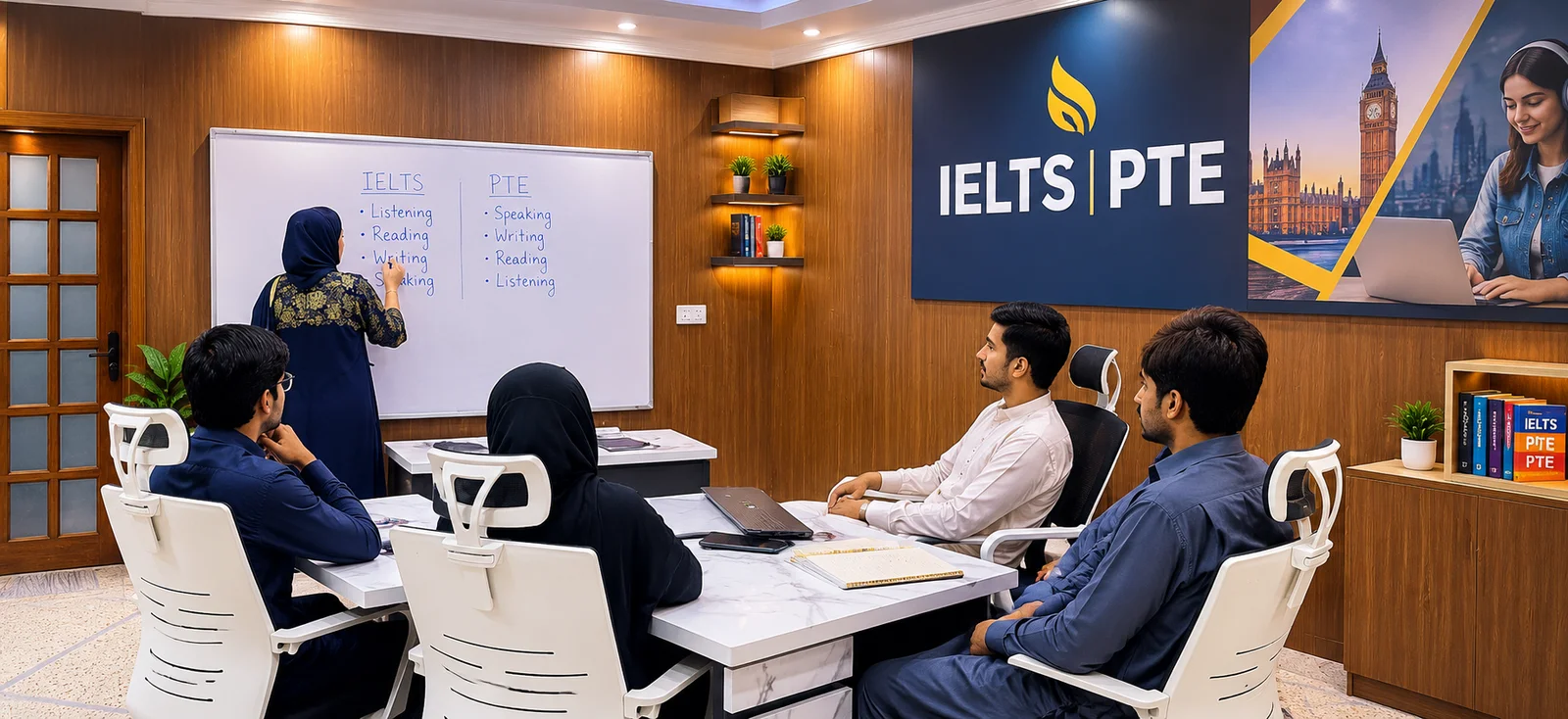
Clear, confident English makes every answer stronger. If you want guided practice and honest feedback, you can explore Global IELTS and PTE in Lahore, where students work on speaking fluency in small groups. You can also read about IELTS preparation in Lahore and attend a free demo class online or on campus.
Global IELTS and PTE | globalmigration.pk | Lahore, Pakistan
Five Habits That Weaken a Pre-CAS Answer
- Reciting a script word for wordLearn the reasons, not the sentences.
- Giving answers that fit every student“Good education” tells the interviewer nothing. Add one detail only you would know.
- Guessing facts about your own fileCheck your documents before the interview, not during it.
- Talking too longThree to four sentences is usually enough. Longer answers give more to challenge.
- Hiding a weak pointA gap or refusal is easier to explain honestly than to defend later. If it was a UK refusal, the UK student visa rejection reasons guide shows what to fix first.
Your 5-Day Pre-CAS Preparation Plan
A few focused sessions, in the right order, are enough.
- DAY 1Read the course page. Note three facts you genuinely find interesting.
- DAY 2Write short answers to the Part 1 questions.
- DAY 3Complete the sponsor and cost sheet, and confirm your address or area.
- DAY 4Write your post-study plan and honest visa history, then practise the island question.
- DAY 5Do a full mock with a friend or a consultant, such as one of our interview preparation sessions, test your camera, and rest well.
Record yourself on your phone and listen once. If it sounds like reading, say it again from the reasons.
Frequently Asked Questions
Is the Sheffield Hallam pre-CAS interview compulsory for Pakistani students?
It depends on your profile and the university’s checks, and not every applicant is selected. Confirm with the admissions team or your consultant.
How will I know the format and timing of the interview?
The university shares the format and timing when it invites you, so check your email and applicant portal and reply promptly.
What if my UK visa decision takes longer than expected?
Check the standard processing time first. If it has clearly passed, our UKVI paid enquiry guide for 2026 explains when an enquiry makes sense.
What should I do if I do not know the answer to a question?
Stay calm, ask politely for the question to be repeated, and answer honestly with what you know.
Why does the interviewer ask questions 3, 4 and 10?
They are not about your documents. The interviewer uses them to hear how well you speak English, how confident you sound and what kind of student you are. Answer in your own words, clearly and calmly.
Why do they ask about an island and three things?
It tests natural thinking, clear English and composure. There is no right list, so give three genuine items with one reason each.
How should I answer if I have had a visa refusal before?
Be honest and brief: name the country, year and reason, and what has changed since.
Does passing the pre-CAS interview guarantee my UK student visa?
No. It helps the university decide on your CAS, but UK Visas and Immigration decides the visa from your full application. See UK study visa success rate for Pakistanis: what the data shows.
Final Thoughts: Be Prepared, Be Specific, Be Yourself
The Sheffield Hallam University pre-CAS interview questions are not designed to trick you. They confirm that your reasons, funding and plans are real and consistent. Understand your course, explain your finances clearly, and answer in your own words.
If you want your answers and sponsor papers reviewed before the interview, speak with professional UK study abroad consultants who handle UK applications every day.