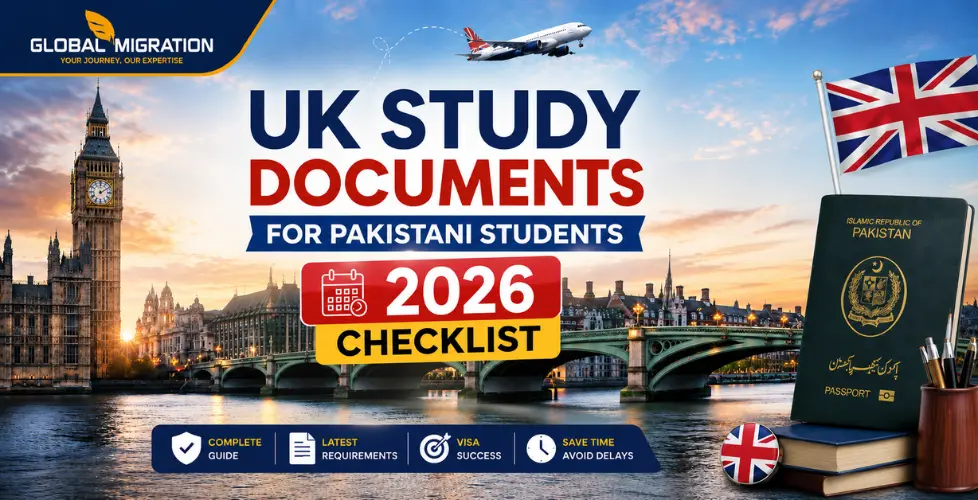
The United Kingdom is one of the most preferred study destinations for Pakistani students because of its world-class universities, internationally recognized degrees, shorter course durations, and excellent career opportunities. Every year, thousands of students from Pakistan apply to UK universities for undergraduate, postgraduate, and doctoral studies.
However, one of the biggest challenges students face is understanding the documentation process. Many students become confused because different documents are required at different stages of the application journey.
The process is generally divided into three major stages:
- Documents required for university admission
- Documents required for CAS (Confirmation of Acceptance for Studies)
- Documents required for UK student visa application
Understanding these stages properly can help students avoid delays, admission issues, and visa refusals.
In this complete guide, Global Migration Advisors explains all the important documents Pakistani students need to successfully study in the UK in 2026.
Why Proper Documentation is Important
The UK study process is highly documentation-based. Universities assess your academic profile before granting admission, while UK Visas and Immigration (UKVI) carefully reviews your financial and personal documents before approving a student visa.
Incomplete or incorrect documentation can lead to:
- Admission rejection
- Delay in CAS issuance
- Visa refusal
- Additional verification checks
Many Pakistani students lose valuable time because they do not prepare their documents properly from the beginning.
This is why professional guidance is extremely important during every stage of the process.
Read More: How Much Fee for UK Study from Pakistan?
Do UK Universities Require MOFA-Verified Documents?
Many Pakistani students ask whether UK universities require MOFA-attested or MOFA-verified documents during the admission or visa process.
In most cases, UK universities do not specifically require MOFA (Ministry of Foreign Affairs) attestation for admission applications. Universities usually evaluate:
- Original academic documents
- Official transcripts
- English language test results
- Passport copies
- Supporting documents
However, some universities may request additional verification depending on:
- The student’s educational background
- The institution attended in Pakistan
- The course level
- The university’s internal verification policies
Documents Required for UK University Admission
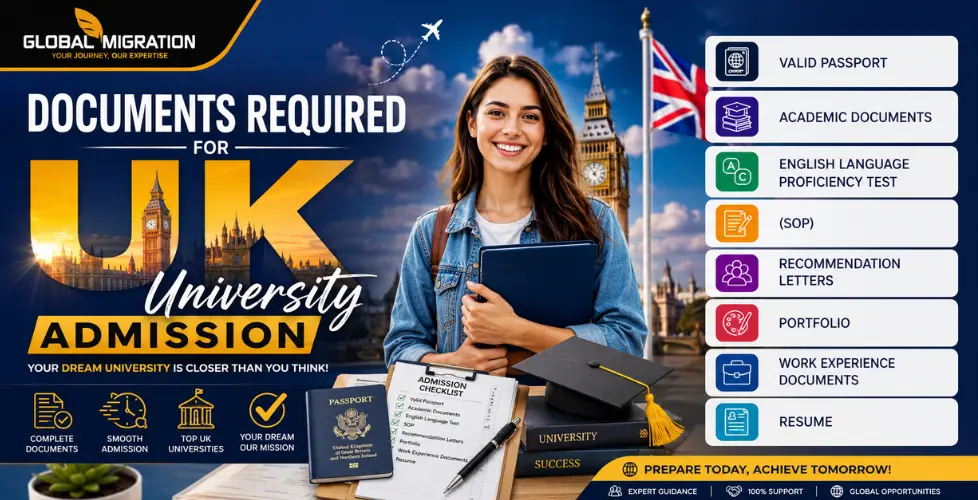
The first step to studying in the UK is applying to a university. Universities evaluate your academic qualifications, English language proficiency, and overall profile before issuing an offer letter.
Below are the most important documents required for admission applications.
1. Valid Passport
A passport is the primary identification document for international students.
Your passport should:
- Be valid for the entire duration of studies
- Have correct personal information
- Contain sufficient blank pages
Students whose passports are near expiry should renew them before starting the application process.
 Your passport must be valid for a minimum of 6 months at the time of your UK student visa application. Ideally, it should cover your full period of study in the UK.
 If your passport is due to expire soon, renew it before you apply — an invalid or soon-to-expire passport can result in an automatic visa refusal, delaying your entire application.
2. Academic Documents
Universities require academic documents to determine eligibility for admission.
Undergraduate Applicants Usually Need:
- Matric certificate and marks sheet
- Intermediate certificate and transcript
Master’s Applicants Usually Need:
- Bachelor’s degree
- Academic transcripts
- Degree completion certificate (if applicable)
PhD Applicants May Need:
- Master’s degree documents
- Research proposal
- Research experience documents
Students should ensure:
- Documents are clear and readable
- Names match passport details
- Transcripts are complete
Some universities may also ask for HEC attestation or equivalence certificates.
3. English Language Proficiency Test
Most UK universities require proof of English language proficiency.
Accepted tests include:
- IELTS for UKVI
- PTE Academic UKVI
- Other approved SELT tests
The required score depends on:
- University requirements
- Course level
- Degree program
Some universities may waive IELTS requirements if:
- Previous education was completed in English
- The student passes an internal interview
- Alternative English qualifications are accepted
Strong English language scores improve both admission and visa success chances.
4. Statement of Purpose (SOP) / Personal Statement
The SOP is one of the most important admission documents.
It explains:
- Why you want to study in the UK
- Why you selected the course
- Your academic background
- Future career goals
A strong SOP should:
- Be personalized
- Clearly explain academic goals
- Show genuine motivation
- Avoid copied content
A poorly written SOP can negatively affect admission decisions.
Universities are placing greater emphasis on the Statement of Purpose (SOP) than ever before. A strong SOP must be compelling, relevant to your chosen field, and flow coherently from start to finish — and above all, it must be original.
Pro Tip: Use AI as a starting point to structure your ideas, then rewrite it entirely in your own voice, adding personal experiences, specific goals, and genuine motivations. This gives you the best of both worlds — a well-structured foundation that truly reflects who you are.
5. Recommendation Letters
Some universities require recommendation letters from:
- Teachers
- Professors
- Employers
These letters help universities evaluate:
- Academic abilities
- Professional potential
- Character and communication skills
Recommendation letters play a vital role in your UK university application. To meet university standards, each letter must be:
 Dated, signed, and stamped by the issuing faculty member
 Written on official institutional letterhead
 Include the referee’s email address and phone number so the university can verify authenticity if needed
A strong recommendation letter not only vouches for your academic ability but also gives admissions officers confidence in your credibility as a candidate.
6. CV or Resume
Postgraduate applicants may need to submit an updated CV or resume containing:
- Educational background
- Work experience
- Certifications
- Internships
- Skills and achievements
Your CV is more than just a formality — UK universities use it to get a complete picture of who you are as a candidate. Make sure your CV includes the following:
 Full name, address, email address, and phone number at the top
 Academic qualifications listed in reverse chronological order (most recent first)
 Work experience, internships, or voluntary roles — especially important for explaining any gaps in your education
A well-structured CV not only meets university requirements but also strengthens your overall application profile.
7. Portfolio (For Creative Courses)
Students applying for courses such as:
- Fashion design
- Architecture
- Fine arts
- Graphic design
may need to provide a portfolio showcasing their work.
8. Work Experience Documents
MBA and professional course applicants may need:
- Experience letters
- Salary slips
- Appointment letters
These documents support professional experience claims.
Read More: Want to Study in the UK With Your Family? Here’s What You Need to Know
Documents Required for CAS (Confirmation of Acceptance for Studies)
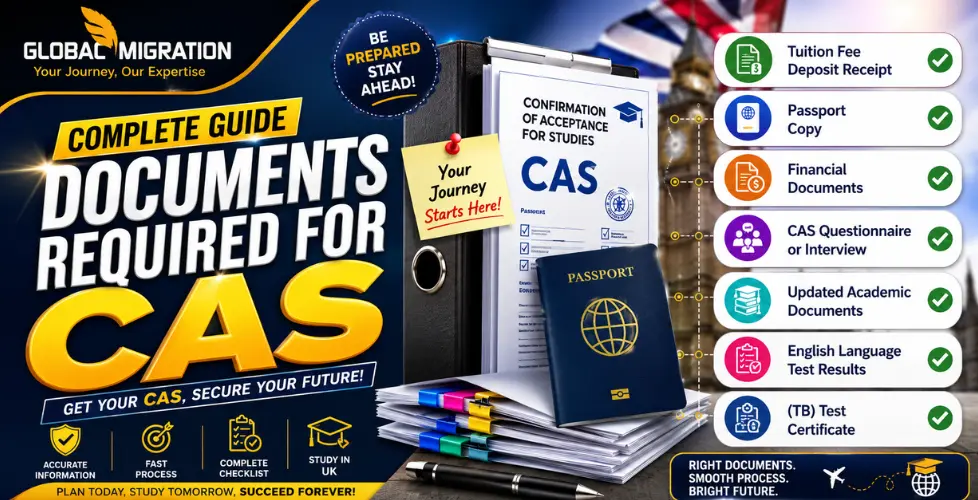
After receiving admission and accepting the university offer, students must fulfill CAS requirements before applying for a UK student visa.
The CAS is an official electronic document issued by the university confirming your enrollment.
Universities usually request additional documents before issuing the CAS.
1. Tuition Fee Deposit Receipt
Most UK universities require students to pay a tuition fee deposit before issuing the CAS.
Students should provide:
- Fee payment receipt
- Bank transfer confirmation
- Proof of payment
The paid amount is usually mentioned in the CAS letter.
2. Passport Copy
Universities require an updated passport copy before generating the CAS.
Students should ensure:
- Passport details are correct
- Passport remains valid
- All information matches admission records
3. Financial Documents
Many universities conduct financial checks before issuing the CAS.
Students may need:
- Bank statements
- Bank maintenance certificates
- Sponsorship documents
- Education loan documents
The university verifies whether the student can meet UKVI financial requirements.
4. CAS Questionnaire or Interview
Some universities ask students to complete:
- Credibility interviews
- CAS questionnaires
The purpose is to confirm:
- Genuine study intentions
- Course understanding
- Career plans
- Financial awareness
Poor interview performance may delay or affect CAS issuance.
5. Updated Academic Documents
If results were pending during admission, universities may request:
- Final transcripts
- Degree completion certificates
- Updated mark sheets
Students must submit these documents before CAS issuance.
6. English Language Test Results
Universities may require official IELTS or PTE results before generating the CAS.
Students should ensure:
- Test scores meet requirements
- Test validity has not expired
Tuberculosis (TB) Test Certificate
Pakistani students must provide a TB test certificate from a UK-approved clinic.
The certificate:
- Confirms the student is free from tuberculosis
- Is usually valid for six months
- Must remain valid during visa application
Without a valid TB certificate, the visa application may be refused.
As part of your UK student visa application, you may be required to undergo a Tuberculosis (TB) test. This test must be conducted at a UKVI-approved centre — results from any other facility will not be accepted by UK Visas and Immigration.
In Pakistan, UKVI-approved TB testing centres are currently located in:
 Lahore
- Islamabad
- Mirpur
- Karachi
Make sure to book your appointment well in advance, as slots can fill up quickly during peak application seasons.
You can know about UKVI approved TB Testing centres in Pakisan by clicking on the below UKVI Approved Testing Centres in Pakistan
Documents Required for UK Student Visa Application
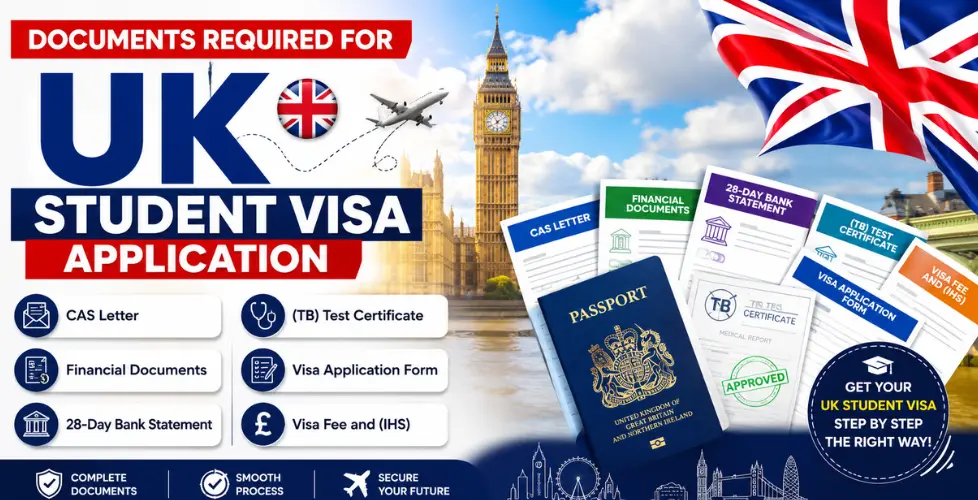
After receiving the CAS, students can apply for the UK student visa.
This is the most critical stage because UKVI carefully reviews all submitted documents.
1. CAS Letter
The CAS contains:
- CAS number
- Course details
- Tuition fee information
- University sponsor details
- Course duration
Students must carefully review all details before submitting the visa application.
2. Financial Documents
Financial evidence is one of the most important parts of the visa application.
Students must show sufficient funds for:
- Tuition fees
- Living expenses in the UK
Required financial documents may include:
- Bank statements
- Bank maintenance certificates
- Fee payment receipts
- Sponsorship letters
- Education loan documents
3. 28-Day Bank Statement Requirement
UKVI requires the required funds to remain in the account for at least 28 consecutive days before visa application submission.
Common mistakes include:
- Sudden large deposits
- Insufficient balance
- Using outdated statements
Students using parents’ bank accounts must also provide:
- Birth certificate
- Affidavit of support
- Consent letter
One of the most common reasons UK student visa applications get refused is suspicious financial activity on bank statements. UKVI carefully scrutinises your statements, so it is important to avoid making large, sudden deposits close to your application date.
If a large deposit is unavoidable, always back it up with a source of funds letter explaining:
 Where the money came from (salary, business, property sale, family gift, etc.)
 Supporting documents such as pay slips, sale agreements, or a gift letter
The goal is to show UKVI that these funds are genuinely yours — not borrowed or staged for the purpose of the bank statement.
Remember, UKVI is not just looking at your balance — they are looking at the history and consistency of your finances.
4. Tuberculosis (TB) Test Certificate
Pakistani students must provide a TB test certificate from a UK-approved clinic.
The certificate:
- Confirms the student is free from tuberculosis
- Is usually valid for six months
- Must remain valid during visa application
Without a valid TB certificate, the visa application may be refused.
5. Visa Application Form
Students must complete the online UK student visa application carefully.
All details should match:
- Passport
- CAS
- Financial documents
- Academic records
Incorrect information may create delays or refusal risks.
You can start UK student visa application here.
6. Visa Fee and Immigration Health Surcharge (IHS)
Students are required to pay:
- UK student visa application fee
- Immigration Health Surcharge
The IHS gives students access to healthcare services in the UK.
7. Biometric Appointment Documents
Students must attend a biometric appointment at a Visa Application Centre (VAC).
VAC locations in Pakistan include:
- Lahore
- Islamabad
- Karachi
Students usually carry:
- Passport
- CAS letter
- Financial documents
- Academic documents
- TB certificate
- Visa application confirmation
Organized documentation helps make the process smoother.
8. Additional Supporting Documents
Depending on the student profile, additional documents may include:
- Scholarship letters
- Accommodation details
- Previous travel history
- Employment documents
- Sponsor documents
These can strengthen the visa application.
Read More: The Most Affordable UK Universities for International Students
Common Reasons for UK Student Visa Refusal
Some common reasons for refusal include:
- Fake or unverifiable documents
- Weak financial evidence
- Inconsistent information
- Poor SOP
- Missing documents
- Weak credibility interview performance
Students should always submit genuine and properly organized documents.
Consequences of Submitting Fake Documents
Submitting fake or altered documents to UK universities or UKVI is considered a very serious violation. Universities and immigration authorities in the UK have strict anti-fraud policies and advanced verification systems to identify forged or misleading documents.
Fake documents may include:
- Forged academic certificates
- Altered bank statements
- Fake IELTS or PTE results
- False work experience letters
- Fake sponsorship documents
- Misleading personal statements
Some students mistakenly believe that minor alterations or incorrect information will not be detected. However, UK universities and UKVI regularly verify documents directly with:
- Educational institutions
- Testing organizations
- Banks
- Employers
The consequences of submitting fake documents can be severe.
- Immediate Admission Rejection
- CAS Cancellation
- UK Student Visa Refusal
- Possible UK Immigration Ban
- Loss or Confiscation of Tuition Fee Deposits
Importance of Submitting Genuine Documents
Students should always provide:
- Genuine academic records
- Real financial evidence
- Authentic test scores
- Accurate personal information
Honesty and transparency significantly improve the chances of successful admission, CAS issuance, and UK student visa approval.
At Global Migration Advisors, we strongly advise students to avoid shortcuts or fraudulent practices. Our team helps students prepare genuine, professional, and properly organized applications that meet UK university and UKVI requirements.
How Global Migration Advisors Helps Students
Global Migration Advisors as a trusted study in UK consultant supports Pakistani students throughout every stage of the UK study process.
Our services include:
- University selection guidance
- Admission application support
- SOP and personal statement assistance
- CAS documentation guidance
- Financial documentation support
- UK student visa file preparation
- Mock interview preparation
- Pre-departure guidance
We help students avoid common mistakes and improve their chances of successful admission, CAS issuance, and visa approval.
Final Thoughts
Studying in the UK from Pakistan is a valuable opportunity for Pakistani students seeking quality education and international exposure. However, proper documentation is essential at every stage of the process.
Understanding the difference between:
- Admission documents
- CAS documents
- Visa documents
can help students prepare more effectively and avoid unnecessary delays.
If you are planning to study in the UK from Pakistan, contact Global Migration Advisors today for professional guidance regarding admissions, CAS processing, and UK student visa applications.