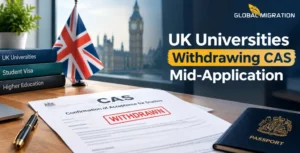

Thousands of Pakistani students dream about heading to Britain every year. The plan usually feels simple. Get admission. Apply for a visa. Pack your bags. But 2026 broke that simple picture completely.
Visa approval numbers moved sharply this year. Anyone who wants to study in UK needs to understand what actually happened, not what social media claims happened. Rumors spread fast in visa groups. Real data spreads slower.
This blog walks through verified UK Home Office figures. We explain why approval rates dropped, how Pakistan compares with other countries, and what you can do to protect your own application. If you plan to study in UK, this data will shape your entire strategy.
Numbers alone don’t tell the full story though. Behind every statistic is a real student, a real family, and a real financial commitment. That is exactly why this guide avoids guesswork. Every figure below is traceable to an official or industry-verified source, so you can plan your own application with confidence rather than fear.
By the end of this article, you will know exactly where the approval rate stands today, why it moved, and how it compares across the region. More importantly, you will know what separates an approved file from a refused one this year.
What Is the UK Study Visa Success Rate for Pakistanis Right Now?
For years, Pakistan enjoyed a strong and stable success rate. Grant rates stayed high through 2023 and 2024, sitting between 90% and 95%. Applications kept rising too. In 2024 alone, over 35,500 new sponsored study visas went to Pakistani nationals.
Early 2025 looked even better. In the first quarter of 2025, the refusal rate for Pakistani applicants was just 6%. That meant roughly 94 out of every 100 applicants got approved. Students who wanted to study in UK from Pakistan had strong odds.
Then everything changed. Between October 2025 and March 2026, the refusal rate for Pakistani nationals jumped to around 41%. That is nearly seven times higher than the same period one year earlier. Visa volumes fell just as sharply, dropping close to 90% in some monthly comparisons.
By April to June 2026, the rate cooled slightly to a 34% refusal rate, meaning about 66% of applicants were approved. That is still far below the historical norm, but it shows a small recovery compared to the worst months.
Always check the latest quarter’s data before applying. A rate from 2024 tells you almost nothing about your chances today.
A Year-by-Year Look: How the Grant Rate Has Changed
Numbers are easier to understand side by side. The table below shows how the approval picture moved from 2023 through mid-2026. This is the clearest way to see the real trend for anyone who wants to study in UK this year.
| Period | Approval (Grant) Rate | Refusal Rate |
|---|---|---|
| 2023 (full year) | ~95% | ~5% |
| 2024 (full year) | ~90% | ~10% |
| Q1 2025 | ~94% | ~6% |
| Year ending Sept 2025 | ~92% | ~8% |
| Oct 2025 – Mar 2026 | ~59% | ~41% |
| Apr – Jun 2026 | ~66% | ~34% |
Source: UK Home Office sponsored study visa datasets; later-period figures (2025–2026) reported via ICEF Monitor, Times Higher Education, and the British Council.
Look closely at the jump between the “Year ending Sept 2025” row and the “Oct 2025 – Mar 2026” row. That six-month window is where the real damage happened. Anyone researching how to study in UK from Pakistan should treat that period as a turning point, not a temporary blip.
Why Did the Refusal Rate Jump So Suddenly?
The Home Office did not target Pakistan specifically. It changed a rule that applies to every UK university. This rule is called the Basic Compliance Assessment, or BCA.
Before September 2025, universities could keep their sponsor licence even with a visa refusal rate up to 10%. After the update, that threshold dropped to just 5%. Universities with too many refusals risk losing the right to sponsor international students at all.
Because of that pressure, several universities paused recruitment from countries with historically higher refusal rates. The University of Chester suspended admissions from Pakistan until autumn 2026. The University of Hertfordshire paused recruitment from Pakistan too. London Metropolitan University halted Bangladeshi admissions after refusals there hit 60% of its total.
This created a chain reaction. Fewer universities accepting Pakistani applicants meant fewer strong, well-matched applications. Visa officers also grew stricter on financial proof and genuine student checks. Both factors pushed the refusal rate higher for anyone trying to study in UK this cycle.
There is another layer to this story. Visa volumes themselves collapsed alongside the refusal rate. Between April and June 2025, the UK issued 5,812 study visas to Pakistani nationals. In the same three months of 2026, that number fell to just 575. That is a drop of roughly 90% in a single year.
A falling refusal rate combined with a falling application volume usually points to one thing. Weaker applicants and less-prepared consultants stepped back from the process, while genuinely strong candidates kept applying. This is actually good news for serious students who want to study in UK from Pakistan with a well-prepared file.
Choose a university with a strong compliance record. A university’s own refusal history can affect how your file gets reviewed.
How Pakistan Compares With Other Countries
Pakistan was not alone in facing higher refusals. Several major source countries saw similar spikes during the same October 2025 to March 2026 window. But Pakistan’s jump was among the steepest.
| Country | Refusal Rate | Change vs Same Period Last Year |
|---|---|---|
| Pakistan | ~41% | Up from ~6% |
| Ghana | ~26% | Up from ~15% |
| Bangladesh | ~25% | Up from ~17% |
| Nigeria | ~20% | Up from ~4% |
| India | ~7% | Up from ~4% |
| Nepal | ~5% | Down from ~11% |
Source: UK Home Office data via ICEF Monitor and qualification verification analysis, 2026.
Notice something important. Nepal actually improved during this same period. That proves refusal rates are not fixed by nationality alone. Application quality still matters enormously for students who plan to study in UK from Pakistan.
China and the United States kept refusal rates near 1% throughout this period. That gap isn’t about nationality bias alone. It reflects years of consistent, well-documented applications from those markets, something Pakistan can rebuild too with the right preparation.
Top Reasons Pakistani Applications Get Refused
Visa officers rarely reject an application for one single reason. Most refusals come from a combination of small issues. Understanding these patterns helps anyone preparing to study in UK avoid the same traps.
Some of these issues sound minor on paper. A statement dated a few days too early, a sponsor letter missing one signature, a personal statement that reads like a template. On their own, each mistake seems small. Combined, they build a picture of an unprepared or unclear applicant.
This is why experienced advisors always recommend a full document review before submission. Catching one weak point early is far easier than appealing a refusal after the fact. The goal for anyone hoping to study in UK from Pakistan is a file with zero avoidable gaps.
- Weak financial evidence: Bank statements that don’t match the required 28-day holding period, or funds that appear suddenly without explanation.
- Unclear study plans: A course choice that doesn’t connect logically to previous education or career goals.
- Poor research before applying: Students picking a course or university without properly checking entry requirements, university reputation, or compliance history, which leads to a mismatched or weak application.
- Genuine student doubts: Officers questioning whether the real intent is study or long-term settlement.
- Sponsor documentation gaps: Missing or inconsistent sponsor letters when a parent or relative is funding the trip.
Keep your funds in one account for at least 28 consecutive days before applying. Sudden large deposits are a common red flag.
How to Improve Your Approval Chances
You cannot control Home Office policy. You can control the quality of your own file. Small corrections often make the difference between a grant and a refusal for students hoping to study in UK from Pakistan.
| Common Mistake | Better Approach |
|---|---|
| Choosing a course unrelated to past studies | Pick a course that clearly builds on your academic background |
| Submitting funds just before applying | Hold required funds for a full, uninterrupted 28-day period |
| Copying a generic study plan online | Write a personal, specific reason tied to your own goals |
| Ignoring university refusal history | Apply to universities with strong compliance records |
| Applying without professional review | Get your file checked by experienced consultants before submission |
These fixes sound simple, but they matter. Visa officers are trained to spot patterns, not just individual documents. A clean, consistent file tells a believable story about why you want to study in UK.
Is the UK Still Worth It for Pakistani Students in 2026?
This is the honest question every applicant should ask. The answer is yes, but with more caution than before. The UK still offers globally ranked universities, shorter degree durations, and a large multicultural student community.
The Graduate Route, the UK’s post-study work visa, is still active. Scholarships like Chevening and Commonwealth still fund outstanding Pakistani candidates every year. These opportunities have not disappeared.
What has changed is the margin for error. A weak application that might have passed in 2023 could easily fail in 2026. Anyone serious about planning to study in UK now needs a stronger, more carefully built file than before.
Career outcomes also remain a strong argument in the UK’s favor. Pakistani graduates from UK universities often report faster promotions and higher starting salaries compared to peers who studied locally. A UK degree still opens doors across the Gulf, Europe, and North America, not just within Britain itself.
Academic prestige plays a role too. Two of the world’s top three universities sit in the UK, and 26 UK institutions rank in the global top 200. That level of recognition rarely fades, even during a tougher visa cycle.
Scholarships add another layer of value. Chevening awards cover full tuition, living costs, and travel for outstanding candidates. Commonwealth Scholarships offer similar support for postgraduate study. Over 2,000 Pakistanis already hold Chevening alumni status, which shows this path is real and achievable, not just marketing language.
Apply early in the intake cycle. Later applicants often face more scrutiny once refusal quotas start affecting a university’s compliance numbers.
What This Means If You’re Applying Right Now
If you are mid-application today, don’t panic over headline numbers. Averages describe large groups, not individual files. A well-documented, genuine application still has a strong chance of approval, even inside a tougher climate.
Focus on the things you can actually control. Your bank statement, your CAS accuracy, and your study plan matter more than the national average ever will. These are the details that decide your own outcome when you study in UK.
It also helps to pick your intake carefully. January and May intakes sometimes see less pressure on university compliance quotas than the busy September intake. Discussing timing with an experienced advisor before you apply can genuinely change your odds.
Ask your university directly about its current visa refusal rate. Admissions teams often know this number even if it isn’t published.
It also pays to stay updated after you submit. Home Office processing times and requirements can shift mid-cycle. Following official UKVI guidance, rather than second-hand forum posts, keeps your application aligned with the latest rules while you wait for a decision.
The Bigger Picture: UK Immigration Policy in 2026
None of this happened in isolation. The UK government has been tightening net migration policy across the board, not just for students. Work visas, dependant rules, and the Graduate Route have all faced review in the past two years.
Student visas remain one of the most visible parts of that policy. Because international students count within net migration figures, any government under pressure to show falling numbers often looks at study visas first. Pakistan’s high volume made it an easy target for extra scrutiny.
This context matters for anyone comparing the UK against Canada, Australia, or other destinations. Every major English-speaking country has tightened rules recently. The UK is not uniquely difficult anymore, but it is also no longer the easiest option it once was for students who want to study in UK from Pakistan.
Frequently Asked Questions
1. What is the current UK study visa success rate for Pakistani students?
Between April and June 2026, roughly 66% of Pakistani applicants were approved. That is a big drop from the 90–95% range seen in 2023 through mid-2025.
2. Why did refusals suddenly increase in 2026?
The Home Office lowered the allowed refusal threshold for universities from 10% to 5%. This pushed many universities to tighten recruitment and scrutinize applications more closely.
3. Which universities paused admissions from Pakistan?
The University of Chester and the University of Hertfordshire both paused Pakistani student recruitment during 2026 due to compliance concerns.
4. Does a visa refusal affect future applications?
A refusal itself does not automatically block future attempts. But repeated refusals with similar issues can raise doubts in later reviews, so it’s worth understanding the exact refusal reason before reapplying.
5. What single document causes the most refusals?
Financial evidence causes the largest share of refusals, especially bank statements that don’t meet the 28-day holding requirement.
6. Is it still smart to study in UK from Pakistan in 2026?
Yes, if your file is strong. The UK still offers excellent universities, respected degrees, and post-study work options through the Graduate Route, but approval now depends heavily on application quality rather than just meeting the minimum requirements.
Final Thoughts
The data tells a clear story. The UK study visa journey for Pakistani students got harder in 2026. Refusal rates rose sharply, universities grew more cautious, and margins for error shrank fast.
None of this means the door is closed. It means the process now rewards preparation over hope. Students who build strong, honest, well-documented files still get approved every single day.
If your goal is to study in UK, treat this data as a warning and a guide. Build your file the right way, choose your university carefully, and give yourself the best possible chance.
Policy will keep shifting in the months ahead. Quarterly Home Office data will keep moving up or down. What won’t change is the value of a genuine, well-documented, carefully planned application.
Students who understand the real numbers, not just the rumors, are the ones who succeed. Use this data as your starting point, then build a file that matches the standard the UK now expects.
Planning your application? Talk to professional study abroad consultants for UK before you submit anything.