If you’re planning to study in UK from Pakistan, there’s a troubling trend you need to understand before you apply: universities are increasingly withdrawing a student’s CAS after the visa application has already been submitted — sometimes weeks into the process, after fees have been paid and plans have been made.
This isn’t a rare glitch. It’s becoming a defining feature of the 2026 UK admissions cycle, and it’s hitting Pakistani applicants harder than almost any other nationality. At Global Migration Advisors, we’ve seen firsthand how devastating a CAS withdrawal can be — not just financially, but emotionally, for students who had already committed to a UK future. This guide explains exactly what’s happening, why it’s happening, and how to protect yourself if you want to study in UK.
What Is CAS?
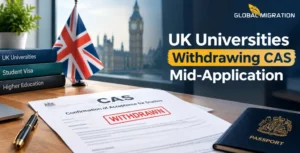
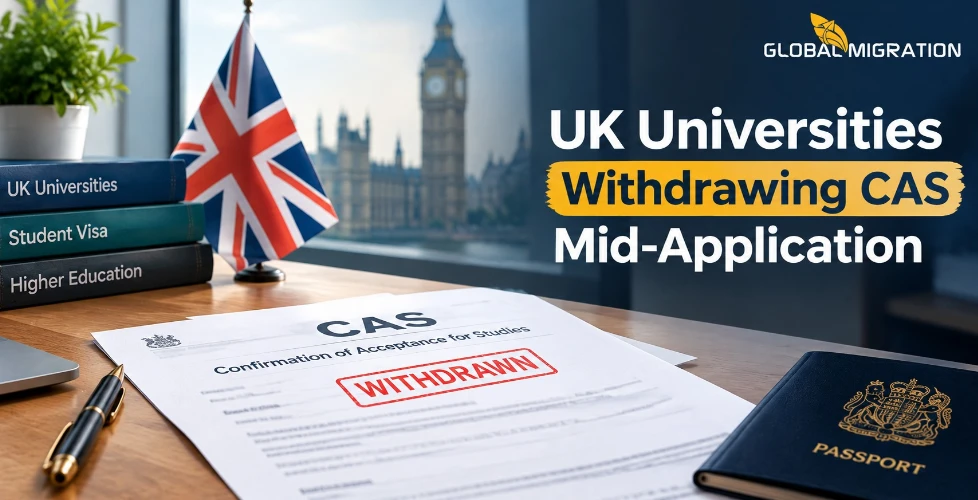
Before diving into the problem, let’s clarify the basics. CAS stands for Confirmation of Acceptance for Studies — a unique reference number issued by a UK university once you’ve accepted your offer and met all the conditions required to begin your course. Your CAS is not a visa itself, but it’s a mandatory document you need to apply for your UK study visa.
Without a valid CAS, UK Visas and Immigration (UKVI) will not process your visa application at all. In short: no CAS, no visa application. And critically — as thousands of Pakistani students are now discovering — a CAS can be withdrawn even after you’ve submitted your visa application, leaving you stranded mid-process, which is a risk every student who wants to study in UK should know about.
The Scale of the Problem in 2026
This isn’t a small or isolated issue. According to data from Enroly, a student compliance platform used across UK university partner networks, CAS issuance to Pakistani students fell by nearly 58% year-on-year for the September 2026 intake — the steepest decline of any major recruitment market, ahead of Nigeria, Ghana, and Sri Lanka. At the same time, visa refusals across all nationalities have jumped roughly 30% year-on-year, with the refusal rate for Pakistani applicants specifically running above 10% when measured against actual visa outcomes. This combination — fewer CAS being issued, more visa refusals, and universities growing increasingly cautious — is exactly the environment where CAS withdrawals become common for anyone chasing a UK study visa.
| Indicator | Figure | Applies To | Comparison | Why It Matters |
|---|---|---|---|---|
| CAS issuance | Fell by nearly 58% year-on-year | Pakistani students | September 2026 intake | Fewer CAS are being issued |
| Market ranking | Steepest decline of any major market | Pakistan | Ahead of Nigeria, Ghana and Sri Lanka | Pakistani applicants are hit hardest |
| Visa refusals | Up roughly 30% year-on-year | All nationalities | Across all markets | Universities grow more cautious |
| Refusal rate | Above 10% | Pakistani applicants | Measured against actual visa outcomes | Higher visa risk for applicants |
| Sponsor thresholds | 5% (sanctions) / 4% (Green rating) | UK universities | Under the newer 2026 framework | Universities protect their licence |
Why Do UK Universities Withdraw CAS While a Visa Application Is Pending?
This is the question every affected student asks, and the answer comes down to one word: compliance. Understanding it is the first step for anyone who wants to study in UK from Pakistan safely.
Universities Are Held Accountable for Their Students’ Visa Outcomes
Every UK university that sponsors international students operates under a Student Sponsor Licence issued by UKVI. To keep that licence, universities must meet strict performance benchmarks — and one of the most important is the visa refusal rate among their sponsored students. Under UKVI’s core compliance framework, sponsors must keep their visa refusal rate below a set threshold to remain in good standing, alongside minimum enrolment and course completion rates — something every student who plans to study in UK should be aware of.
Want to see how visa outcomes look for Pakistani applicants? This guide breaks down the data behind refusal and success rates.
Under the newer, tighter compliance framework introduced this year, universities risk sanctions if their visa refusal rate goes beyond just 5% — and those aiming for a top “Green” compliance rating must stay under an even stricter 4%. Exceed the threshold, and a university doesn’t just get a warning — it risks having its ability to sponsor any international students suspended entirely, which directly affects every UK study visa applicant.
This is the single biggest reason UK universities withdraw CAS applications mid-process: they are actively trying to protect their licence by minimizing their own recorded refusal rate. Keep this in mind when you plan to study in UK from Pakistan.
Weak documentation raises both refusal risk and the chance of extra checks. Keep your financial evidence, academic documents and English proficiency proof complete before you submit your UK study visa application.
When UKVI Delays a Decision, Universities Get Nervous
Here’s where it gets especially frustrating for students. In many documented cases, the trigger for a CAS withdrawal isn’t a visa refusal at all — it’s simply UKVI taking longer than usual to make a decision. When a student’s visa decision is delayed beyond the typical processing window, or when UKVI requests an interview, some universities interpret this as a signal that the application is being viewed unfavourably — a real concern for anyone hoping to study in UK.
Rather than wait for an actual outcome, these universities choose to withdraw the CAS preemptively — removing the application from their own compliance statistics before a potential refusal can count against them. From the university’s perspective, this protects their sponsor licence. From the student’s perspective, it can end a UK study plan that was already fully in motion, often without warning, explanation, or any formal appeal process, even when the student has done everything right to study in UK from Pakistan. Similar experiences have been shared by other applicants, such as this Reddit discussion about a university withdrawing CAS before UKVI made a decision.
Delays and refusals are what make universities nervous. Learn the common reasons behind UK student visa rejections and how to avoid them.
Which UK Universities Have Recently Been Withdrawing CAS Mid-Application?
Based on cases our team has tracked directly this admissions cycle, the following universities have been particularly active in withdrawing CAS after students had already submitted their visa applications for a UK study visa:
- University of Bradford
- University of the West of England (UWE)
- University of the West of Scotland
- University of East London
- University of South Wales
- Oxford Brookes University
This isn’t a definitive or exhaustive list, and compliance behaviour can shift from one intake to the next as universities adjust their risk posture. But the pattern is consistent with what the wider data suggests: institutions that sit closer to their UKVI refusal-rate threshold, or that have seen a recent spike in refusals from a particular market, tend to act more cautiously — and that caution often translates into pulling CAS applications rather than waiting out a delayed UKVI decision. Students who want to study in UK should keep this in mind.
Treat any document request or interview invitation as urgent. Delays on your side can extend processing time and make a university uneasy while you study in UK from Pakistan plans are in motion.
Why Higher-Ranked Universities Tend to Be Safer
If there’s one practical takeaway from this year’s compliance environment, it’s this: students should prioritize well-established, higher-ranked universities when shortlisting their UK study options. Here’s why this matters more in 2026 than in previous years for anyone who wants to study in UK:
Stronger applicant pools mean lower refusal rates. Higher-ranked universities typically attract applicants with stronger academic profiles, English proficiency, and financial documentation — which keeps their overall visa refusal rate naturally lower and further from UKVI’s compliance thresholds, an advantage for any UK study visa applicant.
Shortlisting your universities? See which UK institutions are open to Pakistani students for the January and February 2027 intakes.
More buffer against compliance sanctions. A university operating well under the 5% or 4% refusal-rate threshold has more room to absorb a delayed decision or a borderline case without panicking and withdrawing a CAS preemptively, which helps when you study in UK from Pakistan.
Greater institutional resources for compliance monitoring. Larger, more established universities often have dedicated international compliance teams that can assess a case properly rather than defaulting to withdrawal as the safest option — good news for students who want to study in UK.
Avoid last-minute applications, because rushed submissions leave no buffer if processing runs long. Keep every message with your university and UKVI while you apply for a UK study visa.
Reputational incentive to support students through delays. Universities with strong global rankings and reputations to protect are generally more invested in seeing genuine applicants through the process, rather than treating every delay as a red flag, which matters if you plan to study in UK from Pakistan.
This doesn’t mean every mid-ranked or newer university withdraws CAS unfairly, or that every top-ranked university is risk-free — but as a general pattern, students aiming to minimize this specific risk should weigh university reputation and compliance track record as seriously as course content or tuition fees when making their final decision to study in UK.
Curious why universities are acting more cautiously this cycle? This article explains the wider shift affecting Pakistani applicants.
The Financial Damage of a CAS Withdrawal
This is the part that hits students hardest. If your CAS is withdrawn while your UK study visa application is still pending, here’s what you can — and can’t — recover:
IHS (Immigration Health Surcharge): This is generally refundable if your visa application is withdrawn or refused as a result of the CAS being pulled, which softens the blow for students who study in UK from Pakistan.
Visa application fee: This is typically non-refundable, even though the application can no longer proceed, so every student who wants to study in UK should plan for this risk.
Priority visa service fee: If you paid for priority or super-priority processing to get a faster decision, this fee is also usually non-refundable — meaning students lose this money even though the university’s decision, not the student’s, ended the process for their UK study visa.
On top of these direct losses, many students have already paid university deposits, arranged accommodation, and made family and financial commitments based on a start date that no longer exists. For a process that was supposed to lead to a UK degree, the financial and emotional cost of a sudden CAS withdrawal can be significant for anyone trying to study in UK from Pakistan.
| Cost Item | Type | Refund Status | Reason | Impact on Student |
|---|---|---|---|---|
| IHS | Immigration Health Surcharge | Generally refundable | Visa application withdrawn or refused because the CAS was pulled | Money can be recovered |
| Visa application fee | Visa cost | Typically non-refundable | Application can no longer proceed | Direct financial loss |
| Priority visa service fee | Faster processing | Usually non-refundable | University’s decision ended the process, not the student’s | Direct financial loss |
| University deposits | Paid in advance | Confirm with your university | Paid based on a start date that no longer exists | Financial commitment at risk |
| Accommodation and other plans | Family and financial commitments | Confirm with your provider | Arranged around the original start date | Financial and emotional cost |
What Makes This Especially Difficult for Students
Unlike a visa refusal — which at least comes with a formal decision letter and, in some cases, a right to reapply or seek administrative review — a CAS withdrawal often happens with little to no communication. This is what makes the UK study visa process so stressful this year.
Universities are not currently required to notify students in writing before withdrawing a CAS, and there is no standardized appeals process available to challenge the decision. Students frequently learn about the withdrawal only when they log into their university portal or contact the international office directly. This lack of transparency is why understanding the risk before you apply — and working with an advisor who tracks these patterns closely — matters so much if you want to study in UK from Pakistan.
How Pakistani Students Can Protect Themselves
While you can’t control a university’s internal compliance decisions, there are steps that meaningfully reduce your risk when you study in UK:
- Target higher-ranked, well-established universities with stronger compliance buffers, rather than choosing purely on tuition cost or ease of admission.
- Submit a complete, well-documented visa application the first time — financial evidence, academic documents, and English proficiency proof should all be airtight, since weak documentation increases both refusal risk and the chance UKVI requests further checks or an interview.
- Respond quickly to any UKVI request — additional document requests or interview invitations should be treated as urgent, since delays on your end can extend processing time and increase the chance a university grows uneasy.
- Research a university’s recent compliance behaviour before applying, not just after receiving an offer. An experienced advisor can help you assess this before you commit.
- Avoid last-minute applications. Rushed applications submitted close to intake deadlines leave no buffer if UKVI processing takes longer than expected — exactly the scenario that triggers preemptive CAS withdrawals.
- Keep records of all communication with your university and UKVI throughout the process, in case you need to raise a formal complaint or seek guidance later.
How Global Migration Advisors Can Help
Navigating a UK Student visa application in 2026 requires more than just submitting paperwork — it requires understanding which universities are under compliance pressure, which institutions have a track record of withdrawing CAS mid-process, and how to build a visa application that minimizes delay risk from the outset. At Global Migration Advisors, we guide Pakistani students through every stage of the study in UK journey with current, realistic insight into exactly the kind of risks covered in this guide — including up-to-date visibility into which universities are behaving cautiously this cycle — not generic advice that ignores what’s actually happening on the ground in 2026.
FAQs: UK Universities Withdrawing CAS
What is CAS in a UK student visa application?
CAS stands for Confirmation of Acceptance for Studies — a reference number issued by a UK university confirming you meet the conditions to start your course. It’s a mandatory requirement for submitting a UK study visa application.
Can a university withdraw my CAS after I’ve applied for my visa?
Yes. UK universities can withdraw a CAS at their own discretion even while a visa application is pending, most commonly when UKVI processing is delayed or an interview is requested, as universities try to protect their sponsor licence compliance rates. Keep this in mind if you plan to study in UK.
Why do UK universities withdraw CAS applications?
Mainly out of fear of visa rejection. Universities must keep their visa refusal rate below strict UKVI thresholds to retain their sponsor licence, and a delayed decision or interview request can be seen as a sign of a likely refusal, prompting a preemptive withdrawal for students who study in UK from Pakistan.
Will I get my money back if my CAS is withdrawn?
The IHS (Immigration Health Surcharge) is typically refundable, but the visa application fee and any priority service fee are usually non-refundable, even if the CAS withdrawal ends your UK study visa application before a decision is made.
Is there an appeals process if my CAS is withdrawn?
Currently, there is no standardized appeals process for students who lose their CAS mid-application, and universities are not required to notify students in writing before withdrawing it — making it critical to work with an advisor who can help minimize this risk from the outset when you study in UK.
Final Thoughts
CAS withdrawals after a visa application has been submitted are driven by university compliance pressure, not by anything you did wrong. If you want to study in UK from Pakistan, choose well-established, higher-ranked universities, submit a complete and well-documented application the first time, respond quickly to UKVI, and avoid last-minute applications. Understanding these risks before you apply is the best protection for your UK study visa journey.
Planning to study in UK? Speak to our team before you apply to minimize your CAS and visa risk.
Contact Global Migration Advisors Trusted Guidance professional study abroad consultants for UKSources: Enroly data via The PIE News, “CAS issuances down 27% as UK visa refusals jump 30%” (September 2026); UK Government student sponsor guidance (gov.uk).