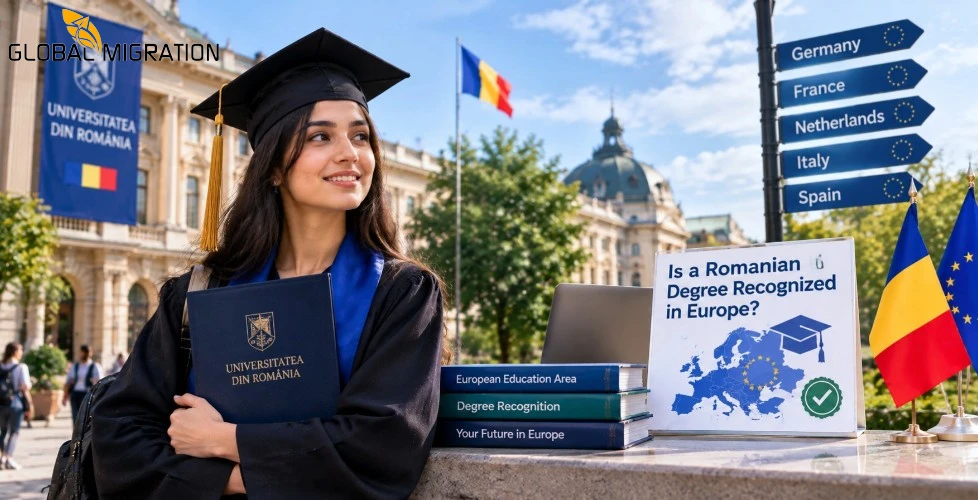
Your diploma will be printed in Romania. But it has to work in Berlin, Paris, Madrid and maybe back home in Lahore. So does it?
Picture the family WhatsApp group the night before you pay your first tuition instalment. Someone types the question every parent eventually asks: “Beta, but will anyone outside Romania actually accept this degree?” It is the smartest question you can ask before you study in Romania, and the honest answer has two layers: one that is genuinely excellent news, and one that many agents skip.
This guide gives you both layers, in plain language, with the official systems behind them, so you can decide with confidence instead of promises.
Yes, with one detail that changes everything.
See how the two destinations compare before you commit to either one.
Is a Romanian Degree Recognized in Europe? The Framework Behind the Paper
Romania has been part of the Bologna reforms since day one.
Romania joined the Bologna Process in 1999 by signing the Bologna Declaration. The reforms helped shape the European Higher Education Area (EHEA), which aims to make higher education systems and qualifications easier to compare across participating countries. Romania introduced a three-cycle structure for university studies (bachelor’s, master’s and doctoral degrees) through Law No. 288/2004, and its provisions began applying to first-year students in the 2005/06 academic year.
Two tools support international academic recognition. The first is the Lisbon Recognition Convention, adopted in 1997 by the Council of Europe and UNESCO. It sets out principles for fair recognition of qualifications, including the principle that recognition should generally be granted unless a substantial difference can be demonstrated. However, recognition is not automatic in every country or for every purpose, and national rules or profession-specific requirements may still apply. Even where it is granted, it is not a licence or a job offer. The second tool is the Diploma Supplement, a document that explains your qualification, level of study, course content and learning outcomes. Bologna Process countries committed to issuing it automatically and free of charge in a widely spoken European language, and Romanian law requires universities to provide it to every graduate free of charge. Keep it with your degree documents, because it helps universities, recognition authorities and employers understand your qualification.
It travels with your diploma and helps any foreign authority understand your studies. Romania’s CNRED also asks for the transcript or Diploma Supplement when it authenticates a degree for use abroad.
Who Guarantees the Quality of Your Degree? Meet ARACIS
A degree is only as strong as the body that accredited it.
In Romania, external quality evaluation of universities and study programmes is carried out by the Romanian Agency for Quality Assurance in Higher Education (ARACIS), or by another agency registered in the European Quality Assurance Register for Higher Education (EQAR). ARACIS was created by law in 2005. It is a full member of ENQA, the European Association for Quality Assurance in Higher Education, and has been registered on EQAR since 2009. For engineering programmes it can also award the EUR-ACE label.
Why should you care? ARACIS assesses both institutions and individual study programmes, so a famous university name is not enough. Before you pay a deposit, check that your specific programme is accredited or authorised to operate.
Compare universities before you decide where to apply.
The Journey of a Romanian Diploma: From Classroom to Career
Your diploma has a journey. Know every stop before you pack.
CNRED, the National Centre for Recognition and Equivalence of Diplomas, is part of Romania’s Ministry of Education and is the country’s ENIC-NARIC centre. It authenticates documents issued by Romanian universities for countries that require the Hague Apostille or superlegalisation, and it is Romania’s assistance centre for professional qualifications. Stops 4 and 5 sit in the destination country, and that is where the real difference between two kinds of recognition appears.
Not sure where your degree can take you?
Tell Global Migration Advisors your subject and your plan for after graduation. We will help you check the recognition steps for your profession before you commit.
- 1Share your subject
- 2We map the steps
- 3Get your free check
Academic Recognition vs Professional Recognition: Two Doors, Two Doormen
Your degree has to open two different doors, and each one has its own doorman.
Many families mix the two up. A degree can be academically recognised and still need further steps before you are allowed to practise a regulated profession. Here is the difference at a glance:
Academic recognition
“Is this degree comparable to one here?”
- Who decides
- Usually the receiving university, with advice from the ENIC-NARIC centre.
- It opens
- A master’s or PhD, or jobs that only ask for a certain level of education.
- It does not give
- A licence to practise a regulated profession.
- Choose this door if
- You plan a master’s, a PhD or further study abroad.
Professional recognition
“May this person practise this profession here?”
- Who decides
- The profession’s regulator, such as a medical or dental council.
- It opens
- Practice as a doctor, dentist, pharmacist or architect.
- It often needs
- Registration, exams or an adaptation period.
- Choose this door if
- You plan to work as a doctor, dentist, pharmacist or architect.
Academic recognition says your degree is real. Professional recognition says you may practise.
Weighing Baltic options too? Compare Romania against Lithuania first.
Which Professions Get Automatic Recognition Across the EU?
EU Directive 2005/36/EC sets the rules, and only a short list of professions travels automatically. Find your lane:
| Profession group | EU route | What it means for you |
|---|---|---|
| Doctors, dentists, general-care nurses, midwives, vets and pharmacists | Automatic | Your qualification must be listed in Annex V and meet the minimum training standards. |
| Architects | Automatic, with conditions | A listed qualification whose training meets the Directive’s conditions, including the academic year it began. |
| Craft, trade and industry occupations | By experience | Annex IV occupations are recognised through years of professional experience, not through your diploma. |
| Other regulated professions, such as teachers or physiotherapists | General system | The host country compares your training with its own. Substantial differences can mean an aptitude test or an adaptation period. |
| Non-regulated professions | Employer decides | No recognition procedure applies. The job market judges the value of your degree. |
Source: European Commission, User Guide to Directive 2005/36/EC (2020). For a complete application, decisions should come within three months for automatic recognition and four months under the general system.
Does This Apply to Pakistani Students? The Honest Reality Check
This is the part many agents skip, so let’s say it clearly.
Here is the line that changes the whole plan: the EU’s automatic recognition system was written for EU, EEA and Swiss citizens. In general, the Directive applies to nationals of EU member states, Iceland, Norway and Liechtenstein, and to Swiss nationals under an EU-Swiss agreement. It does not generally apply to nationals of other countries, including Pakistan. There are exceptions where other EU laws give equal treatment, for example family members of an EU citizen exercising free movement, long-term residents, EU Blue Card holders (for employment), single-permit holders, seasonal workers and refugees, and the details vary by country.
That does not make a Romanian degree weak, and it does not close doors. The Directive itself says member states may still recognise the qualifications of third-country nationals under their own rules, so many countries run national routes. It is also designed for professionals who are already fully qualified in one country, which means recognition becomes a live question after you graduate. If you plan to study in Romania from Pakistan, decide early where you want to work: Romania, another EU country, or back home. Each path has its own checks, and the right time to learn them is before you enrol, not after you graduate.
For regulated careers, ask the destination country’s professional body what it requires from a non-EU national before you commit.
Planning to Practise in Pakistan? The PMDC Rules You Cannot Skip
For future doctors and dentists, Pakistan adds its own gatekeeper, the Pakistan Medical and Dental Council (PMDC). In 2026 it issued three notices that every Pakistani student heading abroad for MBBS or BDS should read:
- 14 May 2026Criteria for foreign admission
PMDC set three criteria for undergraduate medical and dental admission abroad: at least 60% in FSc Pre-Medical or equivalent, at least 50% in MDCAT or an equivalent test abroad, and mandatory online registration at srf.pmdc.pk to become eligible for provisional registration and the National Registration Examination (NRE). The MDCAT part was later exempted, as the 5 October entry below explains.
- 31 July 2026Who can sit the NRE
Pakistani nationals whose primary medical or dental qualification comes from a foreign institution recognised by the Educational Commission for Foreign Medical Graduates (ECFMG) can appear in the NRE, subject to all other requirements. The notice names institutions in Afghanistan as not included at present.
- 5 October 2026MDCAT exemption
After its Council meeting of 14 September 2026, PMDC issued a public notice exempting Pakistani students seeking admission to foreign medical and dental institutions from the mandatory MDCAT pass requirement. The exemption applies only to admission abroad, and MDCAT remains the entry test for colleges in Pakistan. It does not remove PMDC’s other requirements, such as the National Registration Examination and registration to practise in Pakistan. The 60% FSc Pre-Medical criterion and the online registration at srf.pmdc.pk from the 14 May notice are reported as still applying, so confirm both on pmdc.pk before you pay.
PMDC also states that foreign medical graduates must pass the NRE before they can obtain full registration, and it publishes a list of foreign medical institutions on its website, so check that your university appears on it. Conditions, effective dates and the groups they apply to can change, so open each notice on pmdc.pk, read the exact wording and confirm with PMDC in writing before you pay a university. Re-check on the day you apply.
Weigh the pros and cons before you shortlist universities.
How to Verify a Romanian University Before You Pay: Five Checks That Protect Your Degree
Five minutes of checking can save six years of doubt.
A polished brochure is not proof of status, so before you pay any deposit, work through five checks in order. Start with the university’s accreditation: ask for its status and confirm it with the Romanian Agency for Quality Assurance in Higher Education (ARACIS) or the Ministry of Education. Then check the programme itself, because your exact course must be accredited or authorised, not just the university behind it. Next, ask in writing whether you will receive the Diploma Supplement and in which language, since foreign authorities use it to understand what you studied.
The last two checks look beyond graduation. If your career is regulated, study your profession’s regulator: find out what it requires from non-EU nationals in the country where you want to work and, for medicine, read PMDC’s notices. Finally, plan your path after graduation, because work permits, residence and language requirements are separate from the degree. Keep every answer in writing.
Recognition is only half the picture — see what the visa process actually requires.
Common Myths About Romanian Degrees in Europe, Busted
Three things families often hear, checked one by one.
“A degree from an EU country is automatically valid for any job in any EU country.” It sounds so logical that it travels from cousin to cousin faster than the visa news does. The catch is that a diploma and a licence are two different things. Academic recognition and professional recognition are separate steps, and regulated careers add their own requirements on top of your degree.
“EU recognition rules protect every student who studies in Romania.” This one feels reassuring, but it is only half true. The Directive applies to EU, EEA and Swiss nationals, and to third-country nationals only in specific cases such as family members of EU citizens or long-term residents. For most Pakistani graduates, the destination country’s own rules will decide.
“My agent said it is 100 per cent recognised, so I do not need to check.” This is the most expensive myth of the three. No one can guarantee recognition, because universities, regulators and authorities make the decision, not agents. Verify with the university, the regulator and, for medicine, PMDC, and keep every answer in writing.
If anyone promises recognition, ask which authority confirmed it and keep that answer on record.
Frequently Asked Questions
1Is a Romanian degree recognized in Europe?
Yes. Romania is part of the European Higher Education Area, its quality agency ARACIS is a full ENQA member registered on EQAR, and degrees are assessed academically under the Lisbon Recognition Convention principle of recognition unless a substantial difference is shown. Professional recognition for regulated careers is a separate step that depends on your nationality, profession and destination country.
2Is a Romanian medical degree valid across the EU?
Doctors’ basic medical training from an EU member state is among the qualifications the EU Directive recognises automatically, provided it is listed in the Directive’s Annex V and meets the minimum training requirements. The Directive generally covers EU, EEA and Swiss nationals. For non-EU graduates, each country’s own rules, immigration status and medical regulator decide.
3Will a Romanian degree be recognised in the UK?
The UK is outside the EU, so EU recognition rules no longer apply there. Academic recognition is handled by UK ENIC, and regulated professions are decided by their own UK regulators, so check the one for your career.
4Is a Romanian degree recognised in Pakistan?
For medicine and dentistry, PMDC’s 2026 notices apply, including registration at srf.pmdc.pk, the ECFMG condition for the NRE and the NRE itself for full registration. Read the notices on pmdc.pk before you pay. For other degrees, check the equivalence and attestation requirements of Pakistan’s Higher Education Commission.
5How do I check that a Romanian university is accredited?
Ask the university for its institutional and programme accreditation details and confirm them with the Romanian Agency for Quality Assurance in Higher Education (ARACIS) and the Ministry of Education. Do this for your specific programme, not just the university.
6What is a Diploma Supplement and will I get one?
It is a standard document describing the nature, level and content of your studies. Under Romania’s Law 288/2004, universities must issue it to every graduate free of charge in a widely spoken foreign language. Ask your university for yours.
7Can I work in another EU country after graduating from Romania?
It depends on your nationality, that country’s immigration rules and, for regulated professions, its recognition rules. A European degree helps, but it is not a work permit.
8Can anyone guarantee that my degree will be recognised?
No. Recognition is decided by universities, regulators and authorities, not by agents. Verify each step yourself and keep the answers in writing.
Final Thoughts
So, is a Romanian degree recognized in Europe? Academically, yes: it belongs to the same European system as degrees from Paris, Vienna and Madrid, with a quality agency that is registered in Europe. Professionally, it depends on your career, your nationality and the country where you want to work, which is exactly why checking early beats hoping.
The students who do well are the ones who ask these questions before enrolling. If you want help checking accreditation, recognition steps and your plan after graduation, talk to professional study abroad consultants for Romania before you pay any university.
This article is for general information only and does not constitute legal, immigration or professional advice. Recognition rules, accreditation status and PMDC notices change, and each authority makes its own decisions. Please confirm current requirements with your chosen university, ARACIS, the Ministry of Education, the relevant professional regulator, PMDC and the destination country’s authorities before making any payment or decision. Global Migration Advisors does not guarantee recognition, admission or visa approval. Information last reviewed in October 2026.