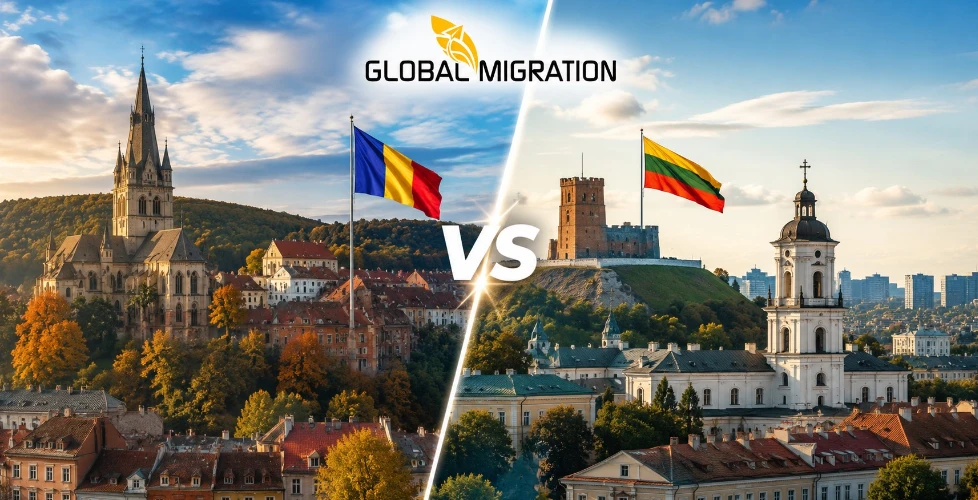
Every year, thousands of Pakistani students look beyond the usual UK–Canada–Australia route and turn their attention to Europe’s more affordable, visa-friendly study destinations. Two names come up again and again in these conversations: Romania and Lithuania. Both are European Union member states, both offer tuition fees far lower than Western Europe, and both have become increasingly popular among Pakistani applicants over the past few years.
But which one is actually the better fit for you?
At Global Migration, we’ve guided hundreds of students through both pathways, and the honest answer is: it depends on what matters most to you — program availability, visa success rate, cost, processing speed, or how tough the interview process is. This guide breaks down every major factor so you can make an informed decision instead of a rushed one. If you’re still exploring your options, our detailed pages on study in Romania and study in Lithuania are a good starting point.
Quick Overview: Romania vs Lithuania at a Glance
| Factor | Romania | Lithuania |
|---|---|---|
| Program variety | Wide range, offered by many universities | Limited, offered by a handful of universities |
| MBBS / Dentistry | Available | Not available |
| Tuition (Bachelor’s/Master’s) | €2,000 – €4,500/year | €3,500 – €6,000/year |
| Embassy presence in Pakistan | Yes (Islamabad) | No (biometrics via Thailand, Malaysia, or Azerbaijan) |
| University interview difficulty | Relatively easy | Very tough |
| Ministry approval required | Yes (up to 60 working days) | No |
| Document attestation | Apostille required | MOFA sufficient (except Klaipėda University) |
| Visa interview | In-person at Islamabad embassy, very tough | Online (Migris), not very tough |
| Visa success ratio | Under 5% | 90%+ |
| Financial proof required | Tax returns | Bank statement |
| Intakes | September only | September + limited February intake |
Now let’s unpack each of these points in detail.
1. Program Diversity: Romania Offers More Choices
If you’re looking for a specific specialization, Romania is likely to have more options. Romanian universities have a long history of teaching international students in English, and this shows in the sheer number of institutions and disciplines available — from engineering and business to sought-after fields like MBBS (Medicine) and Dentistry. You can see the full range of options on our study in Romania page.
Lithuania, on the other hand, has a much smaller pool of universities that accept international students, and the range of English-taught programs at each is comparatively limited. MBBS and Dentistry are not offered to international students in Lithuania at all — if your goal is to study medicine or dentistry abroad, Romania is really your only option between the two. That said, Lithuania remains a strong choice for business, IT, engineering, and social sciences, where its universities have solid, internationally recognized programs — details are on our study in Lithuania page.
2. Tuition Fees: Romania Is More Budget-Friendly
Cost is often the deciding factor for Pakistani families, and here Romania has a clear edge. On average, Romanian tuition can be almost half the cost of Lithuanian tuition for a comparable program. Over a 3–4 year degree, this difference adds up significantly — often the equivalent of an entire extra year’s fees. For cost-conscious families, this alone can tip the scale toward Romania.
3. Embassy Access and Biometrics: A Major Practical Difference
This is one of the most underrated factors in the decision-making process, and it deserves serious attention. Romania has a resident embassy in Islamabad, so the entire visa process — biometrics, interview, and document submission — happens within Pakistan, without any international travel.
Lithuania does not have a visa-processing facility in Pakistan. Applicants must travel to Thailand, Malaysia, or Azerbaijan to complete their biometrics, which adds flight, accommodation, and time-off costs that many families don’t initially budget for. What’s more, the process typically requires two separate international trips: one to give biometrics at the nearest designated visa center, and a second to collect the Temporary Residence Permit (TRP) once approved, since it isn’t couriered to Pakistan. When comparing costs, weigh Lithuania’s “lower tuition, higher travel cost” model against Romania’s “higher tuition, zero travel cost” model.
4. University Interviews: Lithuania Is Tougher to Crack
Once you’ve applied, the next hurdle is the university-level interview (separate from the visa interview). Lithuanian universities are known for genuinely rigorous academic interviews — many students, even strong candidates on paper, fail to clear them. Universities use these interviews to assess English proficiency, subject knowledge, and genuine intent to study, and the bar is set high.
Romanian universities, by contrast, typically conduct much lighter interviews, if any at all. The admission process leans more heavily on document review than interview performance, which makes it comparatively easier to secure an offer letter. If you’re not confident in your interview skills or English communication under pressure, this is a meaningful factor to weigh.
5. Admission Processing Time: Lithuania Is Faster
Here’s where Lithuania pulls ahead. In Romania, admission is a two-stage process: the student’s file is first reviewed and approved by the university faculty, and once faculty approval is granted, the file goes to the Romanian Ministry of Education, which issues the official Letter of Acceptance — a step that can take up to 60 working days. This ministry-level approval is mandatory for every applicant and is often the single biggest bottleneck in the whole timeline.
In Lithuania, there is no such ministry approval requirement. Universities can issue admission decisions directly, which significantly shortens the overall timeline. For students working against a tight intake deadline, Lithuania’s streamlined process can be the deciding factor.
6. Document Attestation: Apostille vs MOFA
Document requirements differ significantly between the two countries. Romania requires apostilled academic documents — a more rigorous (and costlier) form of authentication, and in recent times students have faced delays due to limited apostille slot availability, adding both cost and waiting time to an already lengthy admission process.
Lithuania generally only requires standard MOFA-attested documents, with the exception of Klaipėda University, which does ask for apostille. For most other Lithuanian universities, this makes document preparation faster and cheaper.
7. Visa Interview: Islamabad Embassy vs Migris
This is arguably the single most important — and most talked-about — difference between the two pathways. Romania’s visa interview takes place in person at the Romanian Embassy in Islamabad, and it has developed a reputation as one of the toughest visa interviews for Pakistani applicants. According to feedback from multiple students, interviewers can be quite strict, and there are reports of significant pressure during questioning. Preparation, confidence, and a clear, consistent story about study intent are absolutely essential.
Lithuania’s visa process (Migris) is conducted online, and while it’s still an official interview, it is widely reported to be far less stressful. Most well-prepared students find it manageable.
8. Visa Success Ratio: Lithuania Leads by a Wide Margin
This is the number that matters most to most families: Lithuania’s approximate visa success ratio sits at 90%+, while Romania’s is under 5%. This is a striking gap. While Romania offers cheaper tuition, more programs, and easier university interviews, its visa refusal rate for Pakistani applicants is extremely high. Lithuania, despite tougher university-level interviews and higher fees, has a dramatically better visa approval track record. For many of our clients, this single statistic is often the deciding factor — there’s little value in securing a Letter of Acceptance from a Romanian university if the visa application is likely to be refused.
9. Financial Proof: Bank Statement vs Tax Returns
The financial documentation requirements also differ substantially. Lithuania asks for a bank statement showing sufficient funds to cover living expenses — a relatively straightforward requirement for most sponsoring families. Romania requires tax returns to demonstrate a traceable, sustainable source of income, which has proven to be a genuine obstacle for many Pakistani applicants, particularly those whose sponsors work in the informal economy or don’t file regular tax returns. Students often find this requirement harder to satisfy than a simple bank balance, and it’s a contributing factor to Romania’s low visa approval rate.
10. Intake Seasons
Romania offers only one main intake per year — September. Lithuania offers the September intake plus a limited February intake, though only a handful of universities and programs are available in the February session. If you miss the September deadline, Lithuania gives you a second chance; Romania does not.
So, Which One Should You Choose?
There’s no universal right answer — it comes down to your priorities:
- Choose Romania if: you want to study MBBS or Dentistry, need the lowest possible tuition fees, want to avoid international travel for visa processing, and are confident about presenting traceable income documentation and handling a tough embassy interview.
- Choose Lithuania if: visa approval certainty is your top priority, you’re comfortable with a rigorous university interview, your finances are easier to demonstrate through a straightforward bank statement, and you’re open to a February intake as a backup option.
Final Word from Global Migration
Both Romania and Lithuania offer genuine, EU-recognized education at a fraction of the cost of Western Europe — but the path to get there looks very different for each. The right choice depends on your academic goals, budget, risk tolerance, and how comfortable you are navigating a demanding interview process.
At Global Migration, we help Pakistani students evaluate these trade-offs based on their individual profile — academic background, financial documentation, and personal comfort with interviews — rather than a one-size-fits-all recommendation. If you’re still unsure which destination fits your situation, talk to the best study abroad consultants for Romania and Lithuania for a personalized consultation before you commit to an application.
Fees, visa ratios, and requirements change frequently — always confirm current figures with the relevant embassy or university admissions office before applying.