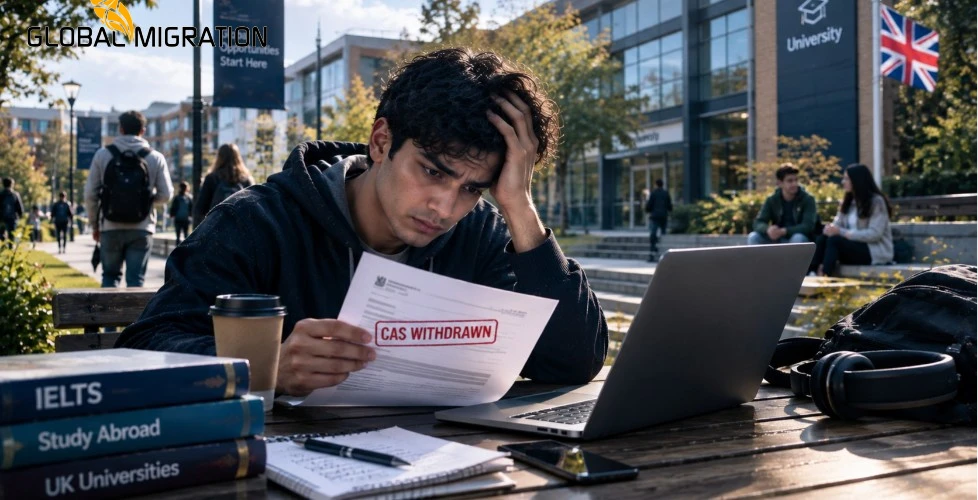
You paid the visa fee. You paid the NHS healthcare charge (IHS). You gave your fingerprints, told your family and maybe even looked at flights. Then you opened your portal and saw it: your university had withdrawn your CAS.
No phone call. No warning. Just a changed status, and a visa application with nothing left to stand on.
Status changed just now. No call. No email.
The next 24 hours decide how much money and record damage you walk away with.
This guide explains why universities withdraw CAS, what to do in the first day and how to avoid the problem before you apply. If you plan to study in UK from Pakistan, the prevention sections matter most. This is general information, not legal advice.
Short answer: screenshot everything and email the university the same day. Ask for the reason in writing and for your university fee to be refunded or moved to the next intake. Then decide, before UKVI does, whether to withdraw your visa application yourself. Your NHS healthcare charge comes back either way, but your visa fee is usually lost. If you do nothing, a refusal may follow and it goes on your record.
CAS Withdrawn? Here Is What Just Happened to Your Application
A CAS, or Confirmation of Acceptance for Studies, is the reference your university issues so you can apply for a Student visa. Without a valid one, UKVI cannot grant your visa. A university can withdraw it while your application is pending, and reporting by The PIE News says there is no formal appeals process for a CAS lost mid-application. Most students never read the offer terms that allow this, so read yours now.
The 6-Step Trap: How a CAS Disappears Mid-Application
- You apply and payFees paid, biometrics booked for your UK study visa.
- You waitThe standard decision time outside the UK is about three weeks.
- The wait stretches or an interview is requestedThe university sees a possible refusal.
- The university actsIt withdraws the CAS before UKVI decides, so no refusal is recorded against it.
- You find outOften from the portal, not by email.
- The application endsDo nothing and expect a refusal citing the withdrawn CAS.
Why Universities Withdraw CAS, and Which Applicants Are Targeted
The plain answer: universities mostly withdraw CAS for applicants from countries with high visa refusal rates, often called high-risk countries. Pakistan is currently one of them. It is a decision about the country’s numbers, not a judgement of your personal file.
Here is why. From 1 June 2026, the refusal limit in the university compliance check dropped from 10% to 5%. A refusal counts against a university, but a CAS withdrawn before a decision does not. So when applicants from a high-refusal country face long waits or interviews, universities protect their sponsor licence by withdrawing early. Universities with a high refusal ratio do this most, and so do tight-budget ones that recruit in high volume from those markets.
So which universities are affected? Pakistani applicants and advisers have recently reported CAS withdrawals or tighter restrictions at the University of Bradford, the University of the West of England, the University of the West of Scotland, the University of East London and the University of South Wales. Policies change fast and differ by course and intake, so confirm your own CAS status with your university in writing rather than relying on any list.
Seven Warning Signs Your CAS Is About to Vanish
You rarely get a formal warning, but the pattern repeats. Here are seven signs, from calm to red alert.
Early clouds
- Your wait passes three weeksA long wait is when a university starts to worry about a refusal.
- You get an interview invitationIt is another moment of doubt for the university.
Storm warning
- The university goes quietReplies become slow or vague.
- You are asked to withdraw your own applicationOften with no clear reason.
Red alert
- Recruitment from your country is pausedCheck the university’s website and ask in writing.
- Your offer terms allow discretionary withdrawalLook for wording about visa compliance.
- Your portal status changesCheck it weekly, because you may not get an email.
Your Money Map: What You Lose, What Comes Back
| What you paid | Comes back? | The detail |
|---|---|---|
| Visa application fee | Usually not | Treat it as non-refundable, even if the university withdrew your CAS. |
| NHS healthcare charge (IHS) | Yes, in full | Refunded if you withdraw before a decision or are refused, usually within 6 weeks, to the account you paid from. See the official GOV.UK refund page. |
| University fee or deposit | Often | Many universities refund it or move it to the next intake when they withdraw the CAS themselves. Some keep deposits, so ask in writing and check your offer terms. |
| Agent fees, flights, rent | Rarely | Check each contract before you pay more. |
Fee amounts change, so confirm current figures on the official GOV.UK fee pages before paying.
Withdraw or Wait? The Refusal Trap That Catches Most Students
This is the decision most students get wrong. If your CAS is gone and you wait, UKVI can refuse the visa because the CAS was withdrawn, and you will have to disclose that refusal on future visa forms.
You can withdraw your application only while you are waiting for a decision, and once UKVI receives the withdrawal you cannot undo it. Withdrawing is generally the cleaner exit, but it is not guaranteed to avoid problems, because UKVI may decide first. If your case is complicated, ask a regulated immigration adviser before you click.
Use the withdrawal option in your UKVI account or the link from your sign-up email, and follow the steps on the official GOV.UK Student visa page. Withdraw your visa centre appointment too, and save the confirmation.
The First 24 Hours: Your Rescue Mission
Screenshot the portal, your emails, the CAS number and every payment receipt.
Ask it to confirm the CAS status and the reason in writing, and say whether your university fee is refunded or moves to the next intake. Copy this template and fill the brackets.
Subject: Urgent, CAS status for [Your Name], [Student ID]
Choose between withdrawing your visa application and waiting. Silence is also a decision, and usually the costly one.
Do it through your UKVI account and keep the confirmation.
The NHS healthcare charge should return within about 6 weeks. If it has not, contact UKVI, and follow up in writing on your university fee.
Do not pay for a new visa application until you know your refunds and hold a valid CAS. Keep every request in writing, because email is your evidence.
Can You Get Your Money Back and Try Again?
Your NHS healthcare charge comes back, your visa fee usually does not, and your university fee depends on the university, so get its answer in writing. To move to a new university you need a new CAS and a new visa application, because a CAS can only be used once. First ask whether that university is currently issuing CAS to your country.
Already Refused? What to Do Next
If UKVI has already refused your visa, whether because your CAS was withdrawn or for another reason, do not reapply in a rush. A second refusal on the same weak file makes things harder.
- Read the refusal letter closelyIt names the exact reason. Check whether it cites the withdrawn CAS, funds, documents or credibility, and whether it mentions any right of review. Most Student visa refusals for applications made outside the UK carry no right of appeal, so do not count on one.
- Claim your refundsThe NHS healthcare charge (IHS, Immigration Health Surcharge) is refunded in full after a refusal, usually within about 6 weeks. Your visa fee is not. Ask the university in writing about your tuition deposit.
- Fix the cause before you reapplyIf the CAS was the problem, you need a new CAS, ideally from a lower-refusal university or a later intake. If it was funds or documents, correct the gap and keep the proof.
- Disclose the refusal honestlyYou must declare it on every future visa application. Hiding it is far more damaging than the refusal itself.
- Get your file reviewedHave a regulated adviser check the new file against the refusal reasons before you pay again.
How to Avoid CAS Withdrawal
Start by choosing a university with a low visa refusal ratio. This is the single best way to avoid a withdrawn CAS. A university with a high refusal ratio is under pressure to protect its numbers, and a CAS is the first thing it removes.
Ask in writingAsk whether the university is issuing CAS to your country now, and what its withdrawal terms are.
Check the ratioAsk for its visa refusal rate. Lower is safer, and 5% is the line universities watch.
Be careful with tight-budget recruitersUniversities that rely heavily on international fees and recruit in volume from high-refusal countries carry more risk.
Protect your moneyBook nothing non-refundable until the visa is granted.
Apply Early and Prepare Early
Think of your visa file as an exam you can start revising six months ahead. Applications made outside the UK can go in up to 6 months before your course starts, so a normal three-week decision leaves you plenty of room if something goes wrong. Use that time to gather your documents and keep your funds in the account for 28 consecutive days with no unexplained deposits (check the GOV.UK Student visa requirements). Then read your file the way the case worker will and ask what they could question. Finally, practise short, honest answers on why this course, why this university and how you will pay. A calm, complete file moves faster, and a fast file gives the university no reason to panic. If your wait passes three weeks, read our guide to the UKVI paid enquiry.
Build a Strong and Genuine Profile
A strong profile lowers your refusal risk and gives the university less reason to withdraw your CAS. Show a clear, honest story.
- Show leadership and achievementsProjects, teams, volunteering, distinctions and related work, with results you can prove.
- Match your course and purposeYour programme should follow from your past studies and work, and you should be clear on why the UK and what you will do afterwards.
- Justify any gapsExplain study or work gaps plainly and back them up with evidence.
- Stay consistent and honestYour CV, statement, documents and interview answers must tell the same story. A fabricated certificate can mean a refusal and a long-term ban.
How Global Migration Advisors Helps When Things Go Wrong
Professional guidance at every stage of your application.
Most CAS problems begin before the application, through an unsuitable university, incomplete documents or limited interview preparation. We support you from your first shortlist to any issue after you apply.
No adviser can guarantee a visa, but a patient, well-prepared strategy makes a real difference. Botany graduate Rimsha Khan needed three rounds of supervisor outreach, a refined research proposal and interview preparation before receiving her UK student visa in October 2026. Read Rimsha Khan’s UK student visa success story, our own account of her journey, to see what a structured plan looks like.
Speak to a Global Migration advisorFrequently Asked Questions
Q1Can my university withdraw my CAS after I paid the visa fee?
Yes, while the application is pending. The visa fee is usually lost, but the NHS healthcare charge comes back, and your university fee may be refunded or transferred depending on its policy.
Q2What should I do first if my CAS is withdrawn?
Screenshot everything and email the university the same day. Ask for the reason in writing and for your university fee to be refunded or moved, then decide whether to withdraw your visa application before UKVI decides.
Q3Will withdrawing my visa application count as a refusal?
Withdrawing is generally treated differently from a refusal, but nothing is guaranteed. A refusal can follow if UKVI decides first, so act quickly.
Q4Will I get my visa fee and NHS healthcare charge (IHS) back?
The NHS healthcare charge comes back in full if you withdraw before a decision or are refused, usually within 6 weeks. The visa fee is usually not refunded.
Q5My visa is already refused. Can I reapply?
Yes, but fix the refusal reason first. You will usually need a fresh CAS, you must declare the refusal, and the NHS healthcare charge (IHS) is refunded in full.
Final Thoughts
A withdrawn CAS feels personal, but it is usually a university protecting its own numbers. Before you apply, choose a low-refusal university, apply early and build an honest profile. After a withdrawal, document everything, ask in writing and withdraw your visa application before a refusal can be recorded.
If you want an honest second opinion before you apply, speak with professional study abroad consultants who will review your profile and your university’s CAS terms with you.