Every consultancy has stories about students who got everything right the first time. This is not one of them.
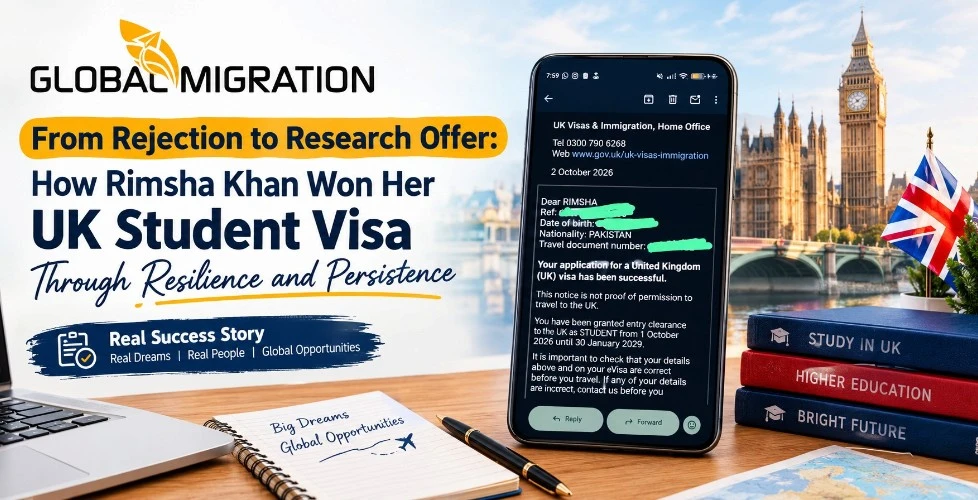
This is the story of Rimsha Khan, a Botany graduate from Pakistan who was refused, ghosted and turned down more than once on her way to a UK student visa. She never gave up. It took nearly twenty months, three supervisor approaches, one painful credibility interview failure and a hands-on lab training course. In October 2026 she received her UK study visa for a research programme that matches her academic background, with her spouse able to travel alongside her.
If you are dreaming of admission to MRes courses in the UK, and especially if you hope to study in UK with your spouse, Rimsha’s journey shows what the process really takes and what it rewards.
January 2025: The Australia Plan That Never Took Off
Rimsha first contacted Global Migration Advisors in January 2025 with one destination in mind: Australia.
The timing was difficult. Australian student visa grant rates were at some of their lowest levels in years, and the system was tightening. Our counsellors told her this honestly. We presented several pathways, including different universities, course levels and intake options, and talked through the risks and benefits of each.
For one reason or another, none of them felt right to Rimsha. That is a perfectly legitimate decision. A student who is not convinced by a plan will struggle to carry it through, and a good consultancy doesn’t push someone into a pathway they don’t believe in. We kept the door open.
After weighing her options, Rimsha came back with a new decision: she would apply for a UK study visa. She also made it clear that she wanted to travel with her spouse, which meant she needed a route to study in UK from Pakistan that allowed dependants.
Why MRes Is the Route for Students Who Want to Study in UK With a Spouse
UK dependant rules changed in January 2024. Most international students on taught Master’s courses can no longer bring a spouse or children. The exceptions are students on postgraduate research programmes (such as MRes, MPhil and PhD) and students on certain government-funded scholarships.
That is why the MRes (Master of Research) has become one of the most important routes for Pakistani students who want to study in UK from Pakistan with their spouse. It is a postgraduate research degree, so it can carry dependant rights, and it is a UK Master’s that builds real research skills.
Broadly speaking, there are two ways into an MRes:
- MRes without a research proposal. Some universities offer MRes programmes, often in broader fields such as Education or Business, that do not ask for a detailed proposal or a named supervisor at the application stage. This is the faster and simpler route to an offer.
- MRes with a research proposal and supervisor approval. Here the student writes a proposal, finds an academic who works in that area, and secures that academic’s consent to supervise before the university will issue an offer. It is slower, harder and far less predictable, but it lets the student study a subject closely aligned with their degree.
Global Migration Advisors works with several universities on the first route. We presented those options to Rimsha, but she wanted something different. With a BS in Botany behind her, she wanted a programme that built on her own education and her own field of expertise.
We told her the truth: the second route is much harder for anyone who wants to study in UK on their own terms.
MRes Admission in the UK: Study With Your Spouse Safely
A deeper look at both MRes routes and which one genuinely fits your situation.
The Supervisor Wall: Why Supervisor Approval Is So Difficult
Securing a supervisor’s agreement is one of the least understood parts of UK postgraduate research admissions, and one of the hardest. Academics receive large numbers of unsolicited emails every week. Many are generic. Many come from applicants who haven’t read the supervisor’s published work. Most go unanswered.
Getting a positive reply takes:
- A thorough understanding of how research actually works
- A well-built proposal that fits the supervisor’s current work
- Targeted, personalised outreach rather than mass emailing
- Persistence, patience and realistic expectations
Only a handful of UK study consultants take this on. It is time-consuming, there is no guaranteed outcome, and it demands genuine academic knowledge. At Global Migration Advisors, it is a service we have deliberately built.
Rimsha developed a research proposal with our guidance, and we contacted a range of supervisors on her behalf. We received no response. Not a refusal, not a “not at this time”. Nothing. It was a hard moment. It is also, unfortunately, a normal one on this route to study in UK from Pakistan.
The Detour: A Gloucestershire MRes Application and a Credibility Interview Setback
After the silence from supervisors, Rimsha reconsidered. She also has teaching experience, so she decided to explore an MRes in Education at the University of Gloucestershire. It was a reasonable pivot, and a route she was qualified to pursue.
We prepared and submitted her application. On paper, her profile was impressive:
- A strong academic record with good grades
- A very good PTE score
- Excellent spoken English
- Relevant teaching experience
Then came the credibility interview, the university’s check on whether a student’s study plans are genuine and their reasons for choosing a course are convincing. UK universities now use these interviews widely because of increased Home Office scrutiny of sponsor institutions.
Despite her background, the university did not clear her. Rimsha was devastated. Nobody had expected it, least of all her. She had done everything right, and she was still refused on her path to a UK study visa.
If you have ever been rejected at a stage where you felt certain of success, you’ll know how hard this moment is. It is also where many students quietly drop the plan and say the UK was never meant to be.
The Turning Point: “I Want an MRes in My Own Field”
After a period of disappointment, Rimsha came back to us with something that struck our entire team: renewed determination.
How to Avoid UK Student Visa Rejection
See the common patterns behind credibility interview failures, and how to prepare properly.
She did not want just any admission anymore. The setback had made her more certain of what she wanted. She wanted an MRes in her own field, one that honoured her Botany degree and her research potential.
We went back to the drawing board together:
- We shortlisted supervisors whose research interests matched her background.
- We discussed each option in detail with Rimsha so she could choose the ones that truly excited her.
- She selected a few and refined a new, stronger research proposal.
- We approached the supervisors again with targeted outreach.
This time, one supervisor replied, a small but genuine step forward on her journey to study in UK from Pakistan.
The First “Yes”, With a Condition
A supervisor expressed willingness to supervise Rimsha, on one condition: an interview.
During that interview, he asked about her lab training. He explained that he could only supervise students who already had hands-on experience. Rimsha assured him that she would get trained, and he promised to review her application once she had.
She could have stopped there. She didn’t. Rimsha enrolled at the NIBG Institute in Faisalabad and completed practical training in core molecular biology techniques, including:
- PCR (Polymerase Chain Reaction)
- Gel electrophoresis
- DNA/RNA extraction
She invested time, money and effort into building exactly the skills the supervisor had asked for. When she finished and we contacted him, he declined to accept her.
We will not sugarcoat this. It was the second major blow of her journey. She had done everything that was asked of her and still did not get the answer she had worked for. Many applicants would have given up after this. Rimsha asked us a different question: “What’s next?”
Round Three: A Bigger List, a Sharper Proposal
We rebuilt the strategy with the lessons of the first two attempts behind us:
- We compiled an extensive list of supervisors working in the same research stream, so one refusal would not be a dead end.
- We reviewed Rimsha’s research proposals line by line and shared detailed tips to improve their quality, clarity and fit.
- We sent a new round of carefully tailored emails seeking supervisor consent.
This time, a supervisor from a renowned university responded and invited Rimsha to an interview, the next real step toward her UK study visa.
Preparing for the Interview That Mattered
Because of the earlier credibility interview failure, Rimsha was understandably nervous. Her confidence had been shaken.
Global Migration Advisors prepared her thoroughly. We walked her through the kinds of questions a supervisor is likely to ask, including:
- Why this research topic, and why this supervisor?
- How does your Botany background connect to your proposed work?
- What methods will you use, and what practical experience do you have with them?
- What are the limitations of your proposal?
- What are your career goals after the programme?
We had used the same approach before her first supervisor interview, and now we applied it with even more care. Rimsha practised her answers, refined her explanations and went into the interview calm and prepared. The supervisor asked her to proceed with the application.
UK Student Visa Rejection Reasons
Understand the kinds of patterns that cause refusals, including at the interview stage.
October 2026: The UK Student Visa Is Granted
After the offer, the remaining steps came together: the university’s credibility process, financial documentation, the CAS and the visa application. In October 2026, Rimsha received her UK student visa.
Nearly twenty months after her first email to us about Australia, a Botany graduate from Pakistan who had been silenced by supervisors, failed at a credibility interview and turned down after completing extra training is now heading to the UK to do research in her own field.
| Date | Event | Outcome | What Happened Next | Note |
|---|---|---|---|---|
| January 2025 | Initial Australia plan | No pathway felt right to Rimsha | Decided to pursue a UK student visa instead | Wanted a route that allowed her spouse to join |
| First supervisor outreach | Proposal sent to multiple academics | No response at all | Explored an MRes in Education as a detour | A normal, if discouraging, part of the process |
| Gloucestershire credibility interview | MRes in Education application | University did not clear her | Returned to pursuing her own field, Botany | A strong profile still failed this stage |
| Supervisor conditional yes | Lab training requested, then completed | Supervisor declined after training | Rebuilt the strategy with a bigger supervisor list | Second major setback of the journey |
| October 2026 | New supervisor interview succeeded | UK student visa granted | Travelling to the UK with her spouse | Nearly twenty months after the first enquiry |
How Global Migration Advisors Supported Rimsha at Every Stage
Rimsha’s success belongs to her. But a complex route like this is much harder to navigate alone. Here is how Global Migration Advisors supported her on her path to study in UK from Pakistan:
- Honest guidance from day one. We told her plainly when the Australia visa climate was unfavourable and when the supervisor route would be hard.
- Multiple pathway options. We offered the easiest route to an MRes (no proposal required) alongside the more demanding subject-specific route, and respected her choice.
- Research proposal development. We guided her through creating and refining proposals that matched specific supervisors’ work.
- Supervisor identification and outreach. We researched academics whose interests aligned with hers and handled targeted communication, a service few UK consultants offer.
- Interview coaching. We prepared her for both supervisor interviews with likely questions and practice.
- Resilience through setbacks. After each rejection we reviewed what happened, adjusted the strategy and moved forward.
- Visa-stage support. Once the supervisor approved, we guided her through the offer, documentation and student visa process.
Key Takeaways for Aspiring MRes Students
If you are planning to study in UK, apply for a UK study visa or secure admission to MRes courses, Rimsha’s story offers several practical lessons:
UK Graduate Route Visa Expiry Options
Planning your next step after a research degree? See what your options look like once your visa nears expiry.
- Setbacks are part of the process, not the end of it. She faced silence, a failed credibility interview and a supervisor withdrawal, and still got her visa.
- Supervisor approval is genuinely hard. Expect many emails to go unanswered. Success requires strong proposals and targeted outreach, not volume.
- Your proposal must match your background. A research proposal that connects to your previous degree is far more convincing than a generic one.
- Practical skills matter. If your field needs hands-on techniques, build them early. Supervisors want to know you can do the work.
A few more lessons worth keeping in mind when you study in UK from Pakistan:
- Interview preparation changes outcomes. Both credibility and supervisor interviews test your genuineness, clarity and knowledge. Prepare for them seriously.
- A spouse route exists, but only through the right programme. Postgraduate research courses like MRes can allow dependants, while most taught Master’s courses no longer do. Always check current rules before applying.
- Have a Plan B and a Plan C. Keep a long list of supervisors and universities so one refusal doesn’t stop your progress.
- Choose guidance that has done this before. Research admissions require real academic understanding, not just paperwork.
| Lesson | What Happened | Why It Matters | Applies To | Takeaway |
|---|---|---|---|---|
| Setbacks aren’t the end | Silence, a failed interview, a withdrawal | Shows persistence can still succeed | Anyone who wants to study in UK | Keep going after a single refusal |
| Supervisor approval is hard | Many emails went unanswered | Volume doesn’t work, targeting does | MRes applicants with a proposal | Build a strong, specific proposal |
| Proposal must match background | Botany degree connected to her research plan | Generic proposals convince nobody | Research-based applications | Tie your proposal to your real history |
| Practical skills matter | Completed hands-on lab training | Shows you can actually do the work | Science and research fields | Build relevant skills early |
| Interview prep changes outcomes | Practised thoroughly before the final interview | Tests genuineness and clarity | Both credibility and supervisor interviews | Prepare seriously, every time |
Dreaming of an MRes in the UK? Let Global Migration Advisors Guide You.
Whether you want an MRes without a research proposal for a faster route, or a research-based MRes with supervisor approval in your own field, Global Migration Advisors has the experience to take you through every step to study in UK from Pakistan.
What we offer MRes aspirants:
- Programme and university shortlisting that fits your profile
- Research proposal development and review
- Supervisor identification, outreach and interview coaching
- Credibility interview preparation
- Financial documentation and UK student visa guidance
- Honest advice on studying in UK with your spouse
Don’t let a rejection be your final answer. Rimsha’s wasn’t.
FAQs: Rimsha’s UK Student Visa Journey
Yes, generally. Postgraduate research courses like MRes, MPhil and PhD are among the few routes still exempt from the January 2024 dependant visa restrictions when you study in UK.
Yes. Academics receive many unsolicited emails, and most go unanswered. Success depends on a strong, targeted proposal rather than the number of emails sent.
It’s a university’s check on whether a student’s study plans are genuine and their course choice is convincing, used widely now because of increased Home Office scrutiny for anyone who wants to study in UK from Pakistan.
Yes, if your field needs hands-on techniques. Supervisors want evidence you can actually do the work, not just academic knowledge on paper.
Keep a long list of other supervisors and universities. A single refusal, even after meeting specific conditions, shouldn’t be the end of your UK study visa plan.
Final Thoughts
Rimsha’s story is not about luck. It is about a student who kept showing up after being told no, and a team at Global Migration Advisors that stayed alongside her through every revision, every email and every disappointment.
Admission to MRes courses and a UK student visa can be earned, even when the path is longer than anyone planned. If you’re ready to take the first step, we’re ready to walk it with you. Get personal advice today on your study in UK plans.