Your Romanian city decides your budget. Choose it before the university.
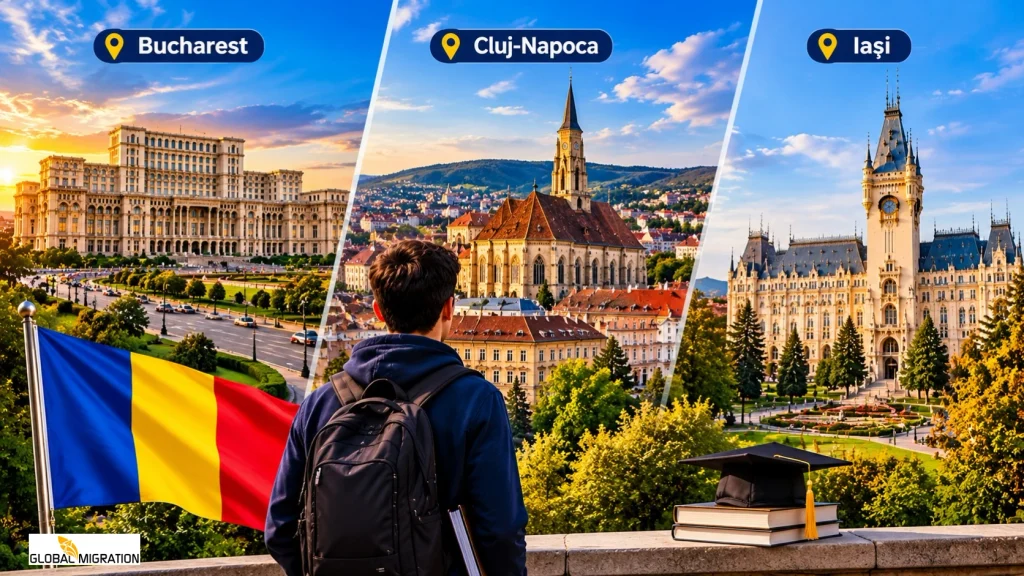
If you are planning to study in Romania, one of your first decisions is the city, and it affects far more than the address. It shapes your rent, your part-time options, your access to halal food, how you travel and how quickly you settle in. This guide sets out what every student should know and consider before choosing between Bucharest, Cluj-Napoca and Iași, the three cities Pakistani students ask about most.
Iași suits students with a limited budget who want an easier start. Cluj-Napoca suits IT, business and medical students who want stronger part-time options. Bucharest offers the widest choice of courses and the largest city, at a higher cost of living.
Bucharest, Cluj-Napoca and Iași: Side-by-Side Comparison
The table below compares the three cities on the factors that matter most to international students. Budget figures are approximate estimates for a student sharing a room or living in a dorm, and they vary by university, course and lifestyle.
| Factor | Bucharest | Cluj-Napoca | Iași |
|---|---|---|---|
| Monthly budget (shared room or dorm) | €550–850 | €500–750 | €350–550 |
| Rent level | High | High, often close to Bucharest | Lowest of the three |
| Part-time work | Widest range | Very good, especially IT | Moderate |
| Housing | Plentiful but pricey | Book early for autumn | Generally easier to find |
| Halal food | Largest choice, as the biggest city | Available | Available |
| Best suited to | Business, variety | IT, business, medicine | Medicine, tight budgets |
Monthly budgets are estimates based on typical student rent, food and transport costs in each city. Component costs such as dorm, shared-room and flat rents are outlined in the living-cost guidance on the official Study in Romania portal. Actual spending depends on your accommodation, lifestyle and course.
City Profiles: Location and Overview
Bucharest is the national capital in the south-east and the country’s main administrative and business centre. Cluj-Napoca lies in Transylvania in the north-west and is regarded as the leading student and technology city. Iași is in the north-east, near the border with the Republic of Moldova, and is a long-established academic and cultural centre. The practical details below apply to everyday life in each city.
| Detail | Bucharest | Cluj-Napoca | Iași |
|---|---|---|---|
| Location | South-east Romania; the national capital | Transylvania, north-west | Moldavia, north-east |
| Population (2021 census) | About 1.7 million | About 286,000 | About 272,000 |
| Airport | Henri Coandă International Airport, the country’s largest hub | Avram Iancu International Airport, usually called Cluj International Airport | Iași International Airport |
| Public transport | Metro, buses and trams | Buses and trolleybuses | Trams and buses |
Population figures are rounded from the 2021 census. Transport services may change, so check current details with the local operator.
Cost of Living: Monthly Budget by City
Rent accounts for most of the difference between the three cities. Food, at roughly €150 to €250 a month, and public transport, at roughly €7 to €20 with a student pass, are broadly similar everywhere. The ranges below assume a shared room or a dorm, and renting a studio or one-bedroom flat on your own can push rent alone above €400.
Iași is the most affordable, with most students spending roughly €350 to €550 per month. Cluj-Napoca is in the middle at around €500 to €750, and rents there are often close to Bucharest levels. Bucharest is generally the most expensive at around €550 to €850, although a room further from the centre lowers the cost in exchange for a longer commute.
In every city, monthly costs should be planned together with the bank statement requirements for a Romania student visa, since the funds you document should be consistent with the living costs you expect to meet. Families in Pakistan should also budget in euros and keep a margin for exchange-rate movement, as tuition and rent are charged in euros or Romanian lei.
Universities and Courses: Match the City to Your Degree
The course should be selected first, because not every programme is offered in every city and some are taught only in Romanian. Confirm the language of instruction on the university’s own page, and use the list of English-taught programmes in Romania to build a shortlist.
Bucharest offers the widest selection, including the University of Bucharest, the National University of Science and Technology POLITEHNICA Bucharest (formerly Politehnica University of Bucharest, which merged with the University of Pitești in 2023), the Bucharest University of Economic Studies and “Carol Davila” University of Medicine and Pharmacy. It is well suited to business, engineering and medicine, and the University of Bucharest covers one of its principal options.
Cluj-Napoca is centred on Babeș-Bolyai University, the Technical University of Cluj-Napoca and “Iuliu Hațieganu” University of Medicine and Pharmacy. It is a strong choice for IT, business and medicine, and the Technical University of Cluj-Napoca page sets out fees and entry requirements.
Iași is home to Alexandru Ioan Cuza University, “Grigore T. Popa” University of Medicine and Pharmacy and “Gheorghe Asachi” Technical University. It is best known for medicine, pharmacy and engineering at a lower cost of living. Applicants to medicine should compare MBBS in Romania options by tuition as well as by city.
The Strongest Universities in Each City, and What They Charge
For many Pakistani applicants the deciding factor in each city is its medical university, since this is what draws the largest number of international students to all three. The table below gives the university most commonly chosen in each city and its published tuition for the English-taught Medicine programme.
| City | Leading medical university | Programme | Annual fee, non-EU students |
|---|---|---|---|
| Bucharest | “Carol Davila” University of Medicine and Pharmacy | Medicine, English-taught | €10,000 a year |
| Cluj-Napoca | “Iuliu Hațieganu” University of Medicine and Pharmacy | Medicine, English-taught | €10,000 in years 1–2, stepping down to €8,500 (year 3), €8,000 (year 4) and €7,500 (years 5–6) |
| Iași | “Grigore T. Popa” University of Medicine and Pharmacy | Medicine, English-taught | €8,500 a year in the published 2025/26 schedule; confirm the 2026/27 figure with the university |
Fees shown are indicative annual tuition for non-EU students on the Medicine bachelor’s programme and vary by programme and intake. Official fee schedules: Carol Davila University fee schedule, Iuliu Hațieganu tuition fees for 2026/27 and Grigore T. Popa fees for international students. Please confirm the current figure with the university before you commit.
Pakistani applicants to medicine should also check Pakistan’s current requirements for foreign medical graduates, including licensing examinations, before choosing a university. Language rules differ by university: the medical university in Iași, for example, lists Pakistan among the countries whose applicants are exempt from the English-language certificate for English-taught programmes, but other universities set their own requirements.
Beyond Medicine: A Leading General University in Each City
Students of business, IT and the social sciences have strong options in every city as well. The table below adds a well-established general university in each city.
| City | General university | Main fields | Tuition for non-EU students |
|---|---|---|---|
| Bucharest | University of Bucharest | Sciences, humanities, law, social sciences and business | About €2,600 to €3,150 a year for bachelor’s programmes, depending on the faculty |
| Cluj-Napoca | Babeș-Bolyai University | Business, economics, computer science, mathematics and social sciences | Depends on the programme. For 2026/27, for example, English-taught Political Sciences is €2,700 a year, while Mathematics for Computer Science is €7,000 a year |
| Iași | Alexandru Ioan Cuza University | Economics and business, computer science, sciences, humanities and law | €2,070 to €3,500 a year for bachelor’s programmes, depending on the faculty (2026/27) |
Fees shown are indicative and vary by faculty, programme and year of admission. Official fee information: University of Bucharest tuition fees, Babeș-Bolyai fee regulation for 2026/27 and Alexandru Ioan Cuza study fees for 2026/27. Please confirm the current figure for your course with the university.
Need Help Choosing the Right City for Your Course?
Global Migration Advisors in Lahore advises Pakistani students on choosing between Romanian cities and universities, based on course, budget and academic profile. Our team also supports the university application and offers visa assistance to prepare a complete visa file.
- City and university shortlist
- Admission support
- Visa file review
Part-Time Work: Opportunities and Limits
According to the EU Immigration Portal, non-EU students in Romania may work part-time during their studies without a separate work authorisation, for a maximum of four hours per day. Rules can change, and part-time income should never be the plan for paying tuition or meeting visa funds, so verify the current conditions before relying on any job.
Bucharest offers the widest range of roles across corporate and service centres, hospitality, retail and delivery, although many positions require some Romanian. Cluj-Napoca is strongest in IT support, service centres and hospitality, which suits students of technology and business. Iași has fewer openings than the other two, with hospitality, retail, call centres and some IT work as the usual options.
Halal Food and Student Community
For many Pakistani students, the first few months determine whether a city feels welcoming, so community support, halal food and access to a place of prayer near home are worth checking in advance.
Halal restaurants, butchers and grocery stores are available in all three cities. Bucharest, as the largest city, generally offers the widest choice and the most varied international communities, although commutes there can be long. Cluj-Napoca and Iași are both established student cities with a sizeable international population, including students of medicine. Pakistani students often settle more easily where a student community from home already exists, so ask your university or current students about Pakistani student groups in your city. Because shops open and close, it is advisable to ask students already living in the city about the nearest halal store before signing a rental agreement.
Accommodation: Dorms, Rent and Booking Timeline
Iași generally offers the easiest housing search of the three, with dorms and shared apartments at lower prices. Bucharest has plenty of supply, but prices vary considerably by area, and a cheaper flat far from campus costs time every day. Cluj-Napoca is a popular student city where rents are often close to Bucharest levels, so early booking is advisable for the autumn intake.
A low tuition fee has little value if suitable housing cannot be found near campus. Ask your university about dorm availability, and review the refund policy of Romanian universities before making any payment, along with the common Romania student visa refusal reasons, so that you understand your position if a visa is refused. At the medical university in Iași, for example, the payment that confirms a seat (two-thirds of the first-year fee) is non-refundable, while a refund is considered if the letter of acceptance or the study visa is refused, with proof of refusal from the embassy.
Wifi, Transport and Everyday Life
Internet and wifi. Romania has good fixed broadband coverage, and dorms and rented flats in all three cities usually include wifi. Before renting, confirm whether internet is included in the rent or billed separately. Mobile SIM cards and data plans are inexpensive and easy to buy on arrival.
Getting around. Bucharest has a metro, buses and trams, while Cluj-Napoca relies on buses and trolleybuses and Iași on trams and buses. Students can often obtain reduced-fare passes, so ask your university or the city’s transport operator about the current student fare.
Language and climate. English is widely spoken among younger people in all three cities, but basic Romanian helps with housing, shops and offices. Expect four seasons, with cold winters and warm to hot summers, so a proper winter coat is necessary.
Admission and Visa: A Brief Overview
The admission and visa process is the same whichever city you choose, so start several months ahead. Pakistani applicants should plan carefully for three things: attested documents, proof of funds and the embassy application.
| Requirement | What Pakistani applicants should know |
|---|---|
| Academic documents | Attested by HEC (or IBCC for school certificates) and then by the Ministry of Foreign Affairs. Pakistan joined the Apostille Convention in March 2023, so confirm with your university whether an apostille is also required. |
| Letter of Acceptance | Issued by Romania’s Ministry of Education, usually through the university you applied to. |
| Proof of funds | A bank statement showing at least Romania’s minimum monthly wage for each month of the visa period. Confirm the current wage figure before preparing it. |
| Visa application | Long-stay student visa (D/SD) through the Romanian embassy in Islamabad, well before your planned travel date, as appointments and processing take time. The visa fee is USD 350. |
| Other documents | Proof of tuition payment, a criminal record certificate and travel medical insurance. |
Requirements and fees are subject to change. Please confirm them with your university and the Romanian Ministry of Foreign Affairs before applying. After arrival, the student residence permit is applied for at the General Inspectorate for Immigration office in your city of study, ideally at least 30 days before your visa expires.
If there is a break between your last qualification and your application, it helps to know how long a study gap is accepted in Romania before you submit your file.
Once you hold your Letter of Acceptance, the embassy interview is the next step. Reviewing the real Romania embassy interview questions helps you know what to expect, and a mock session through interview preparation can build confidence.
Each stage of the application is explained in the Romania student visa process for Pakistani students.
Decision Checklist: What to Verify Before You Commit
Before you commit to a city, make sure you can answer these questions.
- Is my course taught in this city, and in English? Confirm it on the university’s own page.
- Can my family fund the full monthly budget? Plan for rent, food, transport and insurance, not only tuition.
- Have I confirmed housing? Ask about dorm availability and the booking date before you pay.
- Is halal food close to my campus? Ask students already living there.
- Am I treating part-time work as a bonus? It should not be what pays tuition or visa funds.
Final Recommendation: Which City Suits Which Student
No single city is best for every student, so match the decision to your course, budget and the kind of environment you prefer.
Iași is the better choice for students whose priority is a lower monthly budget, an easier housing search and a smoother first semester, particularly in medicine, pharmacy or engineering.
Cluj-Napoca is the better choice for students of IT, business or medicine who want stronger part-time options in a student-focused city and can plan for mid-range rent.
Bucharest is the better choice for students who want the widest selection of universities and courses and the largest city, and who can manage higher rent and longer commutes.
Frequently Asked Questions
Which is the best city to study in Romania for Pakistani students?
It depends on your priorities. Iași is usually best for budget, Cluj-Napoca for IT and part-time work, and Bucharest for choice of courses.
Which Romanian city is the cheapest for students?
Iași is generally the cheapest of the three, mainly because of lower rent. Bucharest is usually the most expensive.
Is halal food available in Bucharest, Cluj-Napoca and Iași?
Halal shops and restaurants are available in all three, and Bucharest usually has the widest choice. Check the area around your campus before you rent.
Can international students work part-time in Romania?
Non-EU students may work part-time for up to four hours per day without a separate work authorisation, according to the EU Immigration Portal. Rules change, so do not depend on a job to fund your studies.
How much is the Romania student visa fee, and where do I apply?
The long-stay visa fee is USD 350. Pakistani students apply through the Romanian embassy in Islamabad, well before your planned departure, as appointments and processing take time.
Which city is best for MBBS in Romania?
All three have medical universities. Compare each university’s tuition, language of teaching and recognition, then add the city’s living cost.
Final Thoughts
There is no single perfect city, only the right city for your course, budget and comfort. Iași keeps costs low, Cluj-Napoca rewards students focused on technology and work, and Bucharest offers the most choice. Compare housing, halal food and work options early, then prepare your visa file carefully. Professional study abroad consultants can review your profile and help you select the city and university that fit it.
This article is for general guidance only. Fees, living costs, work rules and admission requirements vary by university, city and year, and may change. Please verify current details with the university and official Romanian authorities before making any payment or application.