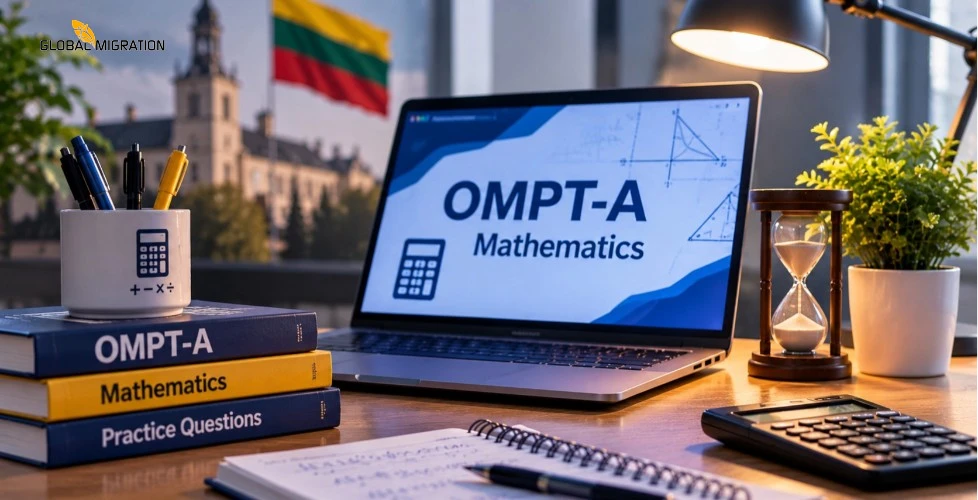
OMPT-A is a speed test on school mathematics. Practise it that way.
OMPT-A is the mathematics test that several Lithuanian universities set for selected programmes, so it is worth preparing for as part of your OMPT test for Lithuania admission. The questions are not advanced, but there are many of them and the time is short. This guide is built for mathematics preparation for Lithuania. It explains the format and the rules of test day, maps the eight chapters of the syllabus into three study levels, and gives 24 original OMPT-A practice questions with answers and worked solutions.
What Is OMPT-A?
OMPT-A is one version of the Online Mathematics Placement Test. It covers school-level mathematics from basic numbers to introductory calculus, and you take it online under remote supervision. Universities decide which version, if any, applies to each programme, so confirm this with your university before you register.
| Detail | OMPT-A |
|---|---|
| Questions | 52 |
| Time | 120 minutes, which is about 2.3 minutes per question |
| Curriculum | Eight chapters covering 176 topics, from numbers to differentiation |
| Recommended study time | About 80 hours, which OMPT describes as an estimate that differs by learner |
| Calculator | A basic digital calculator is provided during the test, and personal calculators are not allowed |
| Supervision | Online proctoring through ProctorU, with a webcam, microphone and photo ID |
Format details are as published by OMPT at the time of writing and may change. Please confirm them on the official OMPT website before you book.
OMPT-A Syllabus: Eight Chapters in Three Study Levels
The official OMPT-A syllabus is divided into eight chapters. The table summarises what to revise in each.
| Chapter | What to revise |
|---|---|
| 1. Numbers | Integers, absolute value, fractions, decimals, powers and roots, and the order of operations |
| 2. Algebra | Simplifying expressions, exponent and root rules, expanding brackets, factorisation, notable products and algebraic fractions |
| 3. Linear formulas and equations | Slope and intercept, linear equations and inequalities, intersection points |
| 4. Systems of linear equations | Substitution, elimination, and consistent, inconsistent and dependent systems |
| 5. Quadratic equations | Factorisation, completing the square, the quadratic formula, the discriminant, parabolas and quadratic inequalities |
| 6. Functions | Domain and range, power, polynomial, root and fractional functions, transformations and inverse functions |
| 7. Exponentials and logarithms | Exponential and logarithmic equations, logarithm rules, change of base and transformations |
| 8. Differentiation | The derivative, rules (power, sum, product, chain, quotient), standard functions, and maxima and minima |
To make planning easier, we group the chapters into three study levels. The levels are our own planning aid and are not an OMPT classification. Level 1 (Foundation) covers Numbers and Algebra, with 17 and 26 topics. Level 2 (Core) covers Linear equations, Systems of equations and Quadratic equations, with 17, 10 and 21 topics. Level 3 (Advanced) covers Functions, Exponentials and logarithms, and Differentiation, with 35, 14 and 34 topics. Functions and Differentiation carry the most topics, so give them proportionally more study time.
Topic counts are as published for each chapter in the official OMPT-A syllabus.
OMPT-A Practice Questions
There are three questions for each chapter, arranged by study level. Attempt all 24 in one sitting at about two minutes each, using only a basic calculator or no calculator, then check your answers in the next section.
Chapter 1: Numbers Level 1
- Calculate 3/4 + 5/6 − 1/3. Give the answer as a simplified fraction.
- Calculate 3 + 4 × 23 − 10 ÷ 5.
- Calculate |−7| − |3 − 8|.
Chapter 2: Algebra Level 1
- Simplify (x2y3 · x4y) ÷ (x y2).
- Expand (2x − 3)(x + 5).
- Factorise x2 − 5x − 14.
Chapter 3: Linear formulas and equations Level 2
- Solve 3(2x − 1) = 5x + 4.
- Find the equation of the line through the points (1, 3) and (3, 11).
- Solve the inequality 5 − 2x > 11.
Chapter 4: Systems of linear equations Level 2
- Solve the system x + y = 10 and x − y = 4.
- Solve the system 2x + 3y = 12 and x − y = 1.
- For which value of k does the system 2x + 3y = 6 and 4x + 6y = k have infinitely many solutions?
Chapter 5: Quadratic equations Level 2
- Solve x2 − 5x + 6 = 0.
- How many real solutions does 2x2 + 3x + 5 = 0 have?
- Find the vertex of the parabola y = x2 − 6x + 5.
Chapter 6: Functions Level 3
- State the domain of f(x) = √(x − 4).
- Find the inverse function of f(x) = 2x + 1.
- State the vertical and horizontal asymptotes of f(x) = 3/(x − 2) + 1.
Chapter 7: Exponential functions and logarithms Level 3
- Solve 2x+1 = 32.
- Evaluate log2 8 + log2 4.
- Solve log5(x + 1) = 2.
Chapter 8: Differentiation Level 3
- Find the derivative of f(x) = 3x4 − 2x2 + 7.
- Find the derivative of f(x) = x2ex.
- Find the local minimum of f(x) = x2 − 4x + 1.
These questions were written for practice and follow the topics of the syllabus. They are not questions from the real test, and the real test may differ in format and difficulty.
Practise against the clock
Time yourself from the first question. Aim for about two minutes per question, and note which chapters take longest. Speed is the main difficulty in OMPT-A, so slow accuracy still costs marks.
OMPT-A Practice Questions with Answers
Check each answer, and read the working even when you were right, because a shorter method saves time in the real test. A few questions include a diagram where a picture makes the idea easier to see.
Chapter 1: Numbers Level 1
- 5/4. Use a common denominator of 12: 9/12 + 10/12 − 4/12 = 15/12 = 5/4.
- 33. Powers first, then multiplication and division, then addition and subtraction: 3 + 4 × 8 − 2 = 3 + 32 − 2 = 33.
- 2. |−7| = 7 and |3 − 8| = |−5| = 5, so 7 − 5 = 2.
Chapter 2: Algebra Level 1
- x5y2. The numerator is x6y4. Subtract the exponents of the denominator: x6−1y4−2.
- 2x2 + 7x − 15. 2x · x + 2x · 5 − 3 · x − 3 · 5 = 2x2 + 10x − 3x − 15.
- (x − 7)(x + 2). Find two numbers with product −14 and sum −5: they are −7 and 2.
Chapter 3: Linear formulas and equations Level 2
- x = 7. 6x − 3 = 5x + 4, so x = 7.
- y = 4x − 1. The slope is (11 − 3)/(3 − 1) = 4. Then y − 3 = 4(x − 1), which gives y = 4x − 1.
- x < −3. −2x > 6. Dividing by a negative number reverses the inequality sign.
Chapter 4: Systems of linear equations Level 2
- x = 7, y = 3. Add the equations: 2x = 14. Then y = 10 − 7 = 3.
- x = 3, y = 2. From the second equation x = y + 1. Substitute: 2(y + 1) + 3y = 12, so 5y = 10 and y = 2, x = 3.
- k = 12. The second equation must be exactly twice the first: 4x + 6y = 12. For any other k there is no solution.
Chapter 5: Quadratic equations Level 2
- x = 2 or x = 3. Factorise: (x − 2)(x − 3) = 0.
- None. The discriminant is 32 − 4 · 2 · 5 = −31, which is negative.
- (3, −4). The x-coordinate is −b/2a = 3, and y = 9 − 18 + 5 = −4.
Chapter 6: Functions Level 3
- x ≥ 4. The expression under the root must not be negative.
- f−1(x) = (x − 1)/2. Write y = 2x + 1, swap x and y, then solve for y.
- Vertical asymptote x = 2, horizontal asymptote y = 1. The denominator is zero at x = 2, and the fraction tends to 0 for large x, leaving +1.
- f(x) = 2x + 1
- f−1(x) = (x − 1) ÷ 2
- mirror line y = x
Chapter 7: Exponential functions and logarithms Level 3
- x = 4. 32 = 25, so x + 1 = 5.
- 5. log2 8 = 3 and log2 4 = 2, so the sum is 5.
- x = 24. log5(x + 1) = 2 means x + 1 = 52 = 25.
Chapter 8: Differentiation Level 3
- f′(x) = 12x3 − 4x. Apply the power rule to each term. The constant disappears.
- f′(x) = ex(x2 + 2x). Product rule: 2x · ex + x2 · ex.
- Minimum at x = 2, value −3. f′(x) = 2x − 4 = 0 gives x = 2. The second derivative is 2, which is positive, and f(2) = 4 − 8 + 1 = −3.
How to Use These Questions
Mark your score out of 24 and note the time you took. Treat the result as a practice indicator only, because these questions are original and are not taken from the real test. Look at the levels where you lost marks, revise those chapters in the syllabus and attempt similar questions again after a day. Your own pattern of errors is more useful than the total, so repeat the set after a week and compare both the score and the time.
OMPT-A Time Budget: A Pace Guide for 120 Minutes
This is an average pace for planning. Spend longer on harder questions and shorter on easy ones, then use the checkpoints to recover time.
With 52 questions in 120 minutes, the average time available is about 2.3 minutes per question. Checking your position at four points keeps you from spending too long on one hard question.
 OMPT guidance
Need Help Choosing and Preparing for the Right OMPT Version?
Global Migration Advisors in Lahore helps Pakistani students check which OMPT version their programme needs and plan the test around the application deadline. Our team also supports the university application and offers visa assistance to prepare a complete file.
- OMPT version check
- Application timeline
- Document review
What Score Do You Need?
The required score is set by each university and programme, not by OMPT. For example, the VMU OMPT test requirements list different minimum scores by programme, and some programmes do not require the test at all. The examples below show how different universities publish their requirements for applicants from Pakistan. Requirements can change from one intake to the next, so confirm them for your own programme.
| University | What the official admission page states |
|---|---|
| Mykolas Romeris University | Where OMPT is required, OMPT-A applies to all programmes with a minimum of 55%. Two attempts are allowed per intake, and the result must reach the university within 2 weeks of the application fee payment. |
| VILNIUS TECH | Bachelor’s applicants from secondary or vocational schools in Pakistan, Bangladesh or Nepal take the OMPT mathematics exam. The grade replaces the school mathematics grade in the entrance score, with at least 60% for university bachelor’s programmes and 50% for professional bachelor’s programmes. |
| Vilnius University (Global Marketing) | Applicants from Bangladesh, Nepal and Pakistan submit an OMPT-A certificate with a minimum passing grade of 55%. |
Always confirm the version, the minimum score and the deadline for your own programme in writing with the university.
Test Day Rules: What You Can and Cannot Use
OMPT is taken under remote supervision, and the rules are strict. A violation can lead to the test being invalidated, so go through the full rules in your ProctorU dashboard and on the OMPT test rules page before test day. You may use a government-issued photo ID in the Latin alphabet, such as a passport or national ID, up to three sheets of A4 scratch paper with three pencils and an eraser, the digital calculator provided in the test, a drink in a clear, transparent bottle, and a mirror or phone for the pre-test room check. You may not use your own calculator, pens, headphones or a watch. Food, toilet breaks and other breaks are not allowed during the test, no other person may be in the room, you must not speak aloud, and a mobile hotspot may not be used as your internet connection.
You also need a computer or laptop with a working webcam, microphone and speakers, a stable internet connection, full-screen mode and a quiet, closed, well-lit room with the door visible behind you. The pre-test procedure, such as showing your ID and securing your room, does not count towards your test time, and the timer starts only when you open the test.
Practise without a personal calculator
Because only a basic digital calculator is provided, train your fractions, powers and mental arithmetic now. Do not rely on a scientific calculator at home, as it will not be available in the test.
Booking, Scheduling and Results: Key Timings
The OMPT process runs in six steps: you buy an attempt in the OMPT store, register with the proctoring partner ProctorU, check the rules and your equipment in your ProctorU dashboard, schedule the test, take the 52 questions in 120 minutes, and receive your results. Two of these steps involve waiting time that you should plan around, which is why the timings below decide how early you should book. OMPT advises test takers to allow enough time for grading, technical problems and a possible additional attempt, because it cannot guarantee availability at short notice.
| Item | What OMPT states |
|---|---|
| Scheduling | At least 72 hours in advance. Short-notice appointments carry an extra fee. |
| Login before the test | Around 15 minutes before your appointment, through the ‘Go to ProctorU’ button. |
| Results | By email within 8 business days, counted from the day after submission. Weekends and Dutch public holidays are excluded. |
| Fast grading | An optional service, with results within 4 business days where available. |
| Cancelling or rescheduling | Possible, with an administration fee of 50 EUR. |
| Special accommodations | Requests need supporting evidence and at least 2 weeks’ notice before the test. |
Your certificate lists your score for each topic, which shows where to improve before a resit. Not every university programme allows three attempts, so check the limit that applies to you.
Mathematics Preparation for Lithuania: An Eight-Week Study Plan
One chapter a week is a simple and realistic plan. OMPT estimates about 80 hours of study for OMPT-A, which across eight weeks is about 10 hours a week, and it leaves the last week for mixed practice under timed conditions. The OMPT website also offers study material and practice tests, which are worth using alongside these questions. The same steady approach applies to passing the OMPT test for Lithuanian universities as a whole, from choosing the version to booking a date.
- Weeks 1 and 2: Numbers and algebra (Level 1). Fractions, powers, brackets and factorisation. These are used in every later chapter.
- Weeks 3 and 4: Linear equations and systems (Level 2). Slope, inequalities, substitution and elimination.
- Weeks 5 and 6: Quadratics and functions (Levels 2 and 3). The discriminant, vertex, domain and inverse functions. Functions is the largest chapter, so give it extra time.
- Week 7: Exponentials, logarithms and differentiation (Level 3). Log rules and the standard derivative rules.
- Week 8: Timed mixed practice. Full-length attempts, then revision of your weakest chapters.
Common Mistakes in OMPT-A
Most lost marks come from a small set of habits: forgetting to reverse an inequality sign when dividing by a negative number, mixing up the order of operations, and dropping a negative sign in the quadratic formula. Others are spending too long on one hard question, leaving a topic such as logarithms until the last week and booking a paid attempt before checking that the programme needs OMPT-A. Revise the rules, work neatly and move on when a question takes more than a few minutes.
Keep an error log
Write each mistake in a notebook with its cause: a calculation slip, a forgotten rule or a misread question. After two weeks, the pattern shows you exactly what to fix.
Frequently Asked Questions
What is OMPT-A?
OMPT-A is the Online Mathematics Placement Test version that covers numbers, algebra, equations, functions, exponentials and logarithms, and differentiation, in 52 questions over 120 minutes.
Can I use my own calculator in OMPT-A?
No. Personal calculators are not allowed, and a basic digital calculator is provided during the test.
Do all Lithuanian universities require OMPT-A?
No. It depends on the university, the programme and the version. The Lithuanian universities with OMPT test differ by programme, so the exact programme page is the final guide.
How long should mathematics preparation for Lithuania take?
OMPT estimates about 80 hours of study for OMPT-A, which varies by learner. Many applicants plan about eight weeks, covering one chapter a week and finishing with timed practice. Start earlier if your basics are weak.
Are these practice questions from the real test?
No. They are original questions written to match the syllabus topics, so use them to practise, not to predict the real test.
How and when are the results given?
OMPT sends your results by email within 8 business days, counted from the day after you submit the test, and your certificate shows your score per topic. An optional fast grading service may give results within 4 business days.
Can I take a break during the test?
No. Toilet and other breaks are not allowed, and unapproved interruptions can lead to the test being terminated, so prepare before you start.
How far in advance must I schedule the test?
At least 72 hours in advance. Cancelling or rescheduling carries an administration fee of 50 EUR, so choose your date carefully.
Final Thoughts
OMPT-A rewards steady preparation. Revise the eight chapters in order, practise under time and keep a record of your mistakes, then repeat the questions above until you finish them comfortably within the time. Confirm the right version and the minimum score with your university, and plan your test date around your application deadline. For personal guidance on admissions, documents and the OMPT requirement of your programme, you can speak with professional study abroad consultants for Lithuania.
This article is for general guidance only. The practice questions are original and are not from the real test. Test format, scoring, fees and university requirements vary and may change. Please confirm current details on the official OMPT website and with your university before you book a test.