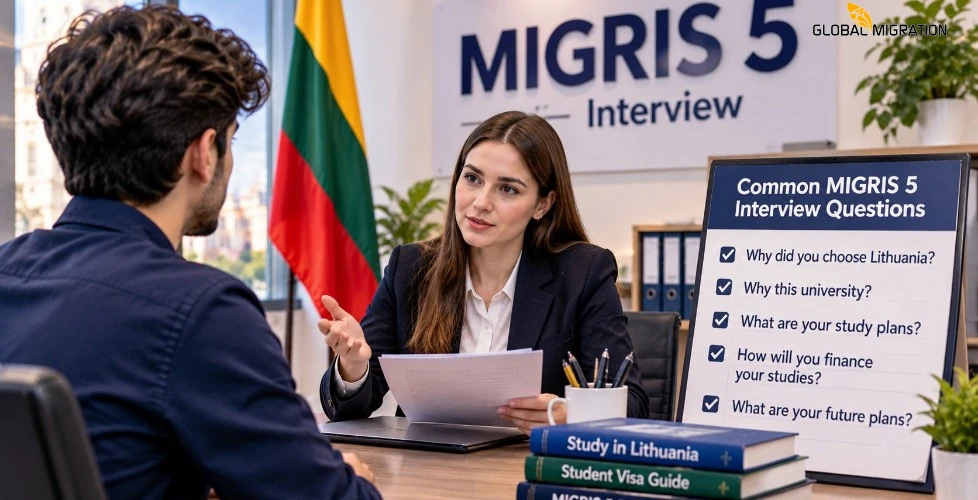
These are real questions from a real Migris 5 interview. One of our students, who had applied to study in Lithuania, sat this online interview a few days ago. He shared the questions with our team, and we are publishing them so that other applicants can prepare. The session lasted about 30 minutes, much longer than the short chat many students expect, and the officer used the time to examine his background, his study plans and his finances in detail.
If you plan to study in Lithuania, you have probably heard the word “Migris” more times than you can count. For Pakistani students, the interview is often the moment that decides whether months of preparation turn into an approved file or an unexpected setback. That is why we collect real interview experiences from our students and share them openly. This one was shared by a student applying for the BA Film Business Management programme at KSU, and it lasted about 30 minutes. Personal details are removed, and we do not state the outcome, because this guide is about preparation.
Here Are the Questions He Was Asked
Here are the questions from that interview, in the order asked and grouped by topic. They are worded exactly as the student was asked.
Identity and settingQuestions 1 to 3
- 1.What is your name?
- 2.Show me your passport.
- 3.Are you sitting alone? Show me your room.
Education and current activityQuestions 4 and 5
- 4.What is your educational background?
- 5.After completing intermediate in 2022, what are you currently doing?
University and programme choiceQuestions 6 to 8
- 6.Why KSU?
- 7.Why Film Business Management?
- 8.How is your programme related to your experience?
Finances and sponsorshipQuestions 9 and 10
- 9.Who is your sponsor?
- 10.If you have a job, why are you not sponsoring yourself?
Visa history and familyQuestions 11 to 15
- 11.Do you have any rejection?
- 12.How many members are in your family?
- 13.How many siblings do you have?
- 14.What was your appointment date?
- 15.In which country was your appointment?
Personal interests and cross questionsQuestions 16 and 17
- 16.What do you do in your free time?Follow-up: The student said he watches movies. The officer asked whether he remembered the names of the movies. He named two movies, and she then asked for the names of their directors.
- 17.You are already doing a job, so why do you need a degree?
Sample Answers to Every Question
The answers below are examples written by our team with invented details, because the student’s own answers are private. Replace every detail with your own true story, and use the brackets to see where your real information goes. After the answers, we explain what the officer was really testing.
Identity and settingQuestions 1 to 3
Sample answerMy name is [full name], exactly as it appears in my passport.
How to answer: speak slowly and clearly, with the same spelling as your passport.
Sample answerOf course. This is my original passport.
How to answer: keep the original within reach before the call starts, and hold the photo page steady in front of the camera.
Sample answerYes, I am alone in a quiet room. Let me show you around.
How to answer: pan the camera slowly around the room and show that the door is closed. Never let anyone prompt you, because that can lead to refusal.
Education and current activityQuestions 4 and 5
Sample answerI completed my matriculation in 2020 and my intermediate in 2022 at [college name].
How to answer: give years and institutions that match your certificates exactly.
Sample answerAfter my intermediate, I started working as a video editor at a small production house in [city], and I have been preparing for my studies abroad at the same time.
How to answer: account for every year since 2022 with no unexplained gaps, and keep it consistent with your CV.
University and programme choiceQuestions 6 to 8
Sample answerKSU offers an English-taught programme that combines film and business, which suits my work in video production. The tuition and living costs are manageable for my family, and the programme starts in February 2027.
How to answer: give two or three specific reasons, and avoid “it is affordable” as your only answer.
Sample answerI enjoy the creative side of film, but I noticed that many projects struggle because of weak budgeting and marketing. This programme teaches both sides.
How to answer: show your own reasoning, in your own words, with one real observation.
Sample answerMy job in video production showed me the creative side. This degree adds the business side: budgeting, distribution and project management.
How to answer: link your past work to the course content. If your background is unrelated, explain what changed and why.
Finances and sponsorshipQuestions 9 and 10
Sample answerMy father is my sponsor. He runs a business in [city], and he will pay my tuition and living costs.
How to answer: name the sponsor, the relationship and the source of funds in one clear sentence, matching your documents.
Sample answerMy salary covers my daily expenses, but tuition and living costs abroad are much higher. My father has agreed to support me, and his documents show his income.
How to answer: be honest about your income and never exaggerate it. The officer is checking whether your finances are realistic.
Visa history and familyQuestions 11 to 15
Sample answerNo, I have never had a visa rejection. [If you have, say so honestly: “Yes, I was refused once for [reason], and I have corrected it by [action].”]
How to answer: tell the truth. Hiding a refusal damages your credibility far more than the refusal itself.
Sample answerThere are six of us: my parents, my three siblings and myself.
How to answer: the number must match your family documents and your sponsor’s dependants.
Sample answerI have two brothers and one sister.
How to answer: keep it short, and make sure it agrees with your answer to the previous question.
Sample answerMy appointment was on [date], and I attended on time with all my documents.
How to answer: check the exact date in your booking confirmation before the interview.
Sample answerMy appointment was in [country], at the [visa application centre or embassy].
How to answer: state the country and place exactly as your confirmation shows them.
Personal interests and cross questionsQuestions 16 and 17
Sample answerI watch movies, mostly dramas and thrillers. Recently I watched Inception, directed by Christopher Nolan, and Parasite, directed by Bong Joon-ho.
Follow-up in the interview: the student said he watches movies. The officer asked whether he remembered the names of the movies. He named two movies, and she then asked for the names of their directors.
How to answer: only mention hobbies you can discuss in detail. For a film degree, be ready with titles, directors and one reason you like each film.
Sample answerMy job taught me production basics, but I have no formal training in film business. A degree will give me skills in budgeting, distribution and management that I cannot learn on the job, and Lithuania offers it at a reasonable cost inside the EU.
How to answer: a weak answer says “to go abroad”. A strong answer names the skills you lack and how the course supplies them.
Students planning the same university can also read our guide on KSU fees and admission, so that the answer to “Why KSU?” rests on real facts.
Pro tip: only claim interests you can defend. If a hobby appears in your answers, prepare three specific details about it: a title, a name and one reason you like it. The officer will test it. Also, do not copy the sample details above, such as the movies or the job, into your own answers. Use only your real story.
What Is a Migris Interview, and Who Is Migris 5?
Migris is the system through which Lithuanian migration authorities handle applications from foreign nationals, including international students. When you apply for a student permit, an officer may hold an online video interview to check that the story told on paper matches the person on the screen. Documents can look perfect, but the interview is where the officer confirms that the applicant understands their own application.
Migris 5, Migris 16 and Migris 22 are the caseworkers who conduct these interviews, and each name refers to one caseworker. You cannot choose or predict yours, so it helps to see how different caseworkers question applicants. If you met another officer, compare this case with the Migris 16 interview questions.
 Mock interview support
Want to Hear Your Answers Before the Officer Does?
At Global Migration Advisors, we run realistic mock interviews based on real experiences like this one. We cross-question you, check that your answers match your documents, and tell you honestly where you are strong.
- Cross-question practice
- Answers matched to documents
- Honest feedback
What the Migris 5 Officer Was Really Testing
A student who only memorises answers will struggle with an interview like this. The questions were built around three concerns.
Money is the area where mismatches hurt most. To plan it properly, see how paying tuition for Lithuania from Pakistan works, and check whether scholarships in Lithuania for Pakistani students can ease the budget.
How the Officer Judges Whether Your Finances Are Sound
In this interview, money was not a side topic. Questions 9 and 10 (who is your sponsor, and why are you not sponsoring yourself), together with the family-size questions that followed, all fed one assessment: are the student’s and the sponsor’s finances genuinely sound enough to support the full stay? The officer is not looking for a wealthy family. She is looking for a believable, consistent and sustainable funding story.
- Who is paying, and is the relationship clear? The sponsor should be named, with their relationship to you, and this must match your documents. If you are working yourself, be ready to explain why your family is funding your studies.
- Where does the money come from? Salary, business income, savings or property: say the source in one clear sentence, in line with the bank statements and tax records you submitted.
- Is it enough for the whole stay? Tuition is only the first line. Accommodation, food, transport and insurance run for the full duration, so be able to say how each one is covered, not only the first fee.
- How many people does the sponsor support? Questions about family members and siblings help the officer judge the sponsor’s real capacity after their other commitments.
- Do your words match your papers? Income figures, relationships and the number of dependants you state aloud must agree with your documents. A mismatch hurts more than a modest income does.
- Is the money traceable? Many universities ask for several months of bank history, so keep the history clear and be ready to explain any large or sudden deposit.
Pro tip: honest and modest beats impressive and inconsistent. A sponsor with a smaller, well-documented income is more convincing than an inflated figure that does not match the file. The required amount and the way it must be shown can change, so confirm the current funds requirement with your university and on migracija.lt before you plan.
To plan the numbers properly, read our guide on how to pay tuition and fees for Lithuania, and check the financial documents required for the Lithuania study visa so that what you say and what you submit tell one story.
The Toughest Cross Questions, Explained
Cross questioning is where scripted answers fall apart. The officer does not stop at your first answer. She follows it with another question, then another, until she is sure you understand your own story.
How one hobby became a cross question
Caseworker: What do you do in your free time?
Student: I watch movies.
Caseworker: Do you remember the names of the movies?
Student: He named two movies.
Caseworker: Who directed them?
This is the real test. He had to name the directors, because a hobby claimed in a film-degree interview gets tested.
Paraphrased from the student’s account.
Four cross questions, and what each one tests
What do you do in your free time?
Tests: genuine interestThis looks like small talk, but it opens a door. If you say you watch movies, expect the officer to follow that thread. When she asked about the movies, she was not really interested in cinema. She wanted to see whether a student applying for a film-related degree genuinely engages with the subject. Naming two movies is easy. Naming their directors shows that you actually follow the field.
You are already doing a job, so why do you need a degree?
Tests: motivation and fundingThis is a test of motivation and funding at once. A weak answer sounds like “to go abroad”. A strong answer explains how the degree will move your career forward and what skills you lack today. Tie your answer to your actual work experience and to the course content.
If you have a job, why are you not sponsoring yourself?
Tests: realistic financesThe officer is checking whether your finances are realistic. Be honest about your income, explain why your family is supporting your education, and make sure your sponsor’s documents match what you say.
Show me your room
Tests: verificationThis is a verification step. The officer wants to confirm that you are alone and answering freely. Sit in a quiet, well-lit room with your passport ready, and do not allow anyone to prompt you.
How to Prepare for Your Own Migris Interview
Here is the approach we recommend at Global Migration Advisors for every student planning to study in Lithuania from Pakistan.
- Know your own fileRead every document you submitted. You should be able to explain your education timeline, any gap years, your work experience and your sponsor’s details without hesitation.
- Research your university and programmeKnow the curriculum, the city and at least two or three reasons you chose it over alternatives.
- Connect your past to your futureBuild a clear story: what you did after intermediate, why you chose this subject, and what you plan to do after graduation.
- Prepare your financesUnderstand who is paying, where the money comes from, and how it covers tuition and living costs. Answer in your own words.
- Practise with cross questionsAsk a friend or counsellor to interrupt your answers with “why?” and “can you give an example?”, or book a guided interview preparation session.
- Test your setupCheck your internet, camera, microphone and lighting. Keep your original passport within reach.
Common Mistakes Students Make
Many interview mistakes come from how answers are given, not from what the student knows. The most common one is giving identical, word-for-word answers that sound memorised, which is exactly what cross questions are built to expose. Close behind are claiming interests that cannot be discussed in detail, being unable to explain gaps after intermediate, and contradicting the financial documents. Some students hide previous visa rejections or stay vague about them, which is why it helps to understand the Lithuania student visa rejection reasons and the Lithuania study visa rejection rate. Finally, taking the interview in a setting where others can hear or help can lead to refusal, so keep the room private and answer alone.
The officer is not trying to trick you. She is trying to confirm that your application is real. Honest, clear and consistent answers are always your best strategy.
Documents to Keep Ready
While the interview is important, your documents form the foundation of the whole file. Requirements can change, so always confirm the latest list before submitting, and make sure your attestation chain is complete. The full list of documents required for Lithuania study visa from Pakistan shows what to gather, and the IBCC verification steps explain the attestation of your academic papers.
Insurance is also part of a complete file, so check what the travel insurance for Lithuania student visa must cover.
Key Takeaways from This Migris 5 Interview
- Migris 5 is the caseworker who conducted this interview, and these questions were really asked to a real student.
- The interview ran for about 30 minutes, so be ready for depth, not just basics.
- The officer’s main concern was a genuine intention to study, followed by sufficient and consistent funds.
- The officer also assessed whether the student’s and sponsor’s finances were sound: the source of funds, whether they cover the whole stay, and whether they match the documents.
- Follow-up questions were designed to separate scripted answers from reason-based opinions.
- Your interests, work history and programme choice must all fit together.
Frequently Asked Questions
What is Migris 5?
Migris 5 is the caseworker at Lithuania’s Migration Department who conducted this online interview. It is not a visa type or a stage of the process.
Are these Migris 5 interview questions real?
Yes. They were asked to a real student on 3 November 2026 and shared with us. Only the sample answers are examples with invented details.
How long does a Migris interview last?
It varies. This student’s interview lasted around 30 minutes, which shows that you should prepare for a detailed conversation.
Does the officer check my finances during the Migris interview?
Yes. Expect questions on who your sponsor is, what they do, how many people they support and how tuition and living costs are covered. The officer compares your answers with your documents, so the figures you speak must match the file exactly. The funds requirement can change, so confirm it with your university and on migracija.lt.
Can I memorise answers for the Lithuania student visa interview?
Memorising key facts is fine, but memorising full scripted answers is risky. Cross questions are designed to expose rehearsed responses, so understand your answers instead of reciting them.
What if I have a previous visa rejection?
Be honest. The officer asks directly, and hiding it can damage your credibility far more than the rejection itself.
Do I need a related background for my programme?
Not necessarily, but you must clearly explain how your experience, interests and goals connect to the course you chose.
Final Thoughts
The most useful lesson from this Migris 5 interview is how little of it was about reciting facts. It was about reasoning: why this programme, why this sponsor, why a degree when you already work. Know your file, connect your story from start to finish, and answer in your own words. If you want your answers and documents reviewed before the call, speak with professional study abroad consultants who guide Pakistani students through the Lithuania process.
Disclaimer: This article shares one student’s interview experience for educational purposes. The questions are real, but the sample answers are examples. Interview questions and requirements vary between applicants and may change.