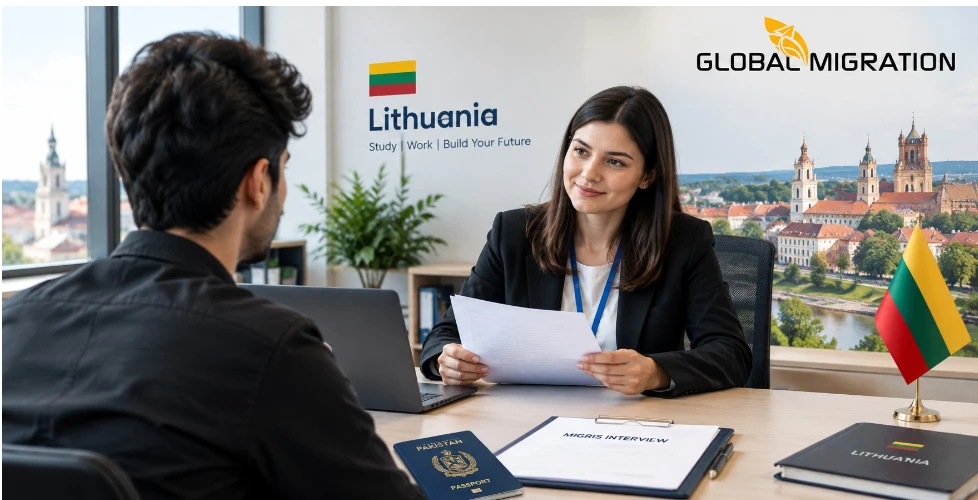
If you’re a Pakistani student who has applied to a university abroad, and specifically if you’re planning to study in Lithuania, you’ve probably already come across the word “Migris” more than once — in your visa checklist, in Facebook groups, in WhatsApp study-abroad communities, or in conversation with your consultant. For many students, the Migris interview is the single most nerve-wracking step in the entire process.
It’s the last real hurdle between an admission letter and an actual student visa — and, unlike your university application, it’s not something a document can fix on its own. Anyone planning to study in Lithuania from Pakistan eventually has to sit through this interview, and it comes down to you, a camera, and a set of questions.
At Global Migration Advisors, we’ve guided dozens of Pakistani students through this process, and we’ve noticed the same questions coming up again and again: What is Migris? What do the different “Migris numbers” mean? Does the interviewer number affect my chances? Why does everyone talk about specific interviewers like they’re characters in a story? Students who want to study in Lithuania deserve a clear, honest answer to all of these questions in one place.
This blog is our attempt to do exactly that — to walk you through the entire Migris process so that anyone hoping to study in Lithuania from Pakistan can go into their interview prepared instead of anxious, informed instead of guessing.
Pro Tip #1
Before your interview, write down the top three reasons you personally chose to study in Lithuania and say them out loud a few times. Interviewers can tell the difference between a genuine answer and a copy-pasted forum response within seconds.
What Exactly Is the Migris Interview?
Migris is the name of Lithuania’s official Migration Information System — the digital platform through which the Migration Department of the Republic of Lithuania manages visa and residence permit applications, including those submitted by international students who intend to study in Lithuania. As part of the national visa (D visa) or temporary residence permit process, applicants are often required to go through an online video interview conducted through or in connection with this system.
This interview is not a formality. It exists so Lithuanian immigration authorities can verify that your intentions are genuine — that you are actually planning to study, that your documents are authentic, and that you understand what you’re applying for. In short, it’s a screening step designed to filter out fraudulent applications and confirm that real, motivated students are the ones receiving visas to study in Lithuania from Pakistan.
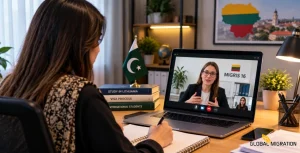
For most Pakistani applicants, the interview is conducted online, usually over a video call, and typically lasts somewhere between 5 and 15 minutes. That range matters — a short interview isn’t necessarily a bad sign, and a longer one isn’t necessarily a red flag either. Some interviewers move quickly through a standard checklist; others take a bit more time to probe your answers or clarify something in your file.
The duration on its own tells you very little about the outcome. What matters far more is how consistent, calm, and genuine your answers sound — regardless of whether you’re being interviewed for five minutes or fifteen, the goal is the same for every student trying to study in Lithuania: to prove that your plan is real.
Pro Tip #2
Don’t judge how well the interview went based purely on how long it lasted. A quick interview often just means the officer found your file clear and consistent — which is exactly what you want when your goal is to study in Lithuania from Pakistan without complications.
The “Migris Interview Types”: What Are They and Why Do Students Talk About Them?
If you’ve spent any time in Pakistani study-abroad forums or WhatsApp groups, you’ve likely seen students refer to their interview using a number — “I had Migris 7,” “My friend got Migris 13,” “Has anyone had Migris 22 before?” This naming convention can be confusing at first, but the explanation is fairly simple.
These numbers are informal codes that the student community has come to use to identify specific interviewers. Since applicants don’t usually know their interviewer’s name in advance, students started labeling them by number based on shared experiences reported in groups and forums — essentially building a crowdsourced reference system for anyone preparing to study in Lithuania.
Each numbered interviewer tends to have their own style, pace, and set of preferred questions, and because so many students pass through the same pool of interviewers, patterns start to emerge. Over time, this turned into an informal way of saying “this is the interviewer who tends to ask about X” or “this is the one known for Y” — useful context, but not a rulebook, for students hoping to study in Lithuania from Pakistan.
It’s worth being clear about what this numbering system is and isn’t. It is not an official classification used by the Lithuanian Migration Department, and it doesn’t represent different “types” or “levels” of interview difficulty in any formal sense. It’s simply a community-driven way of talking about which individual conducted the interview, based on shared, informal observation.
Pro Tip #3
Use forum “Migris numbers” for context only — never as a script. Every officer is assessing the same core things for every applicant who wants to study in Lithuania, so prepare your own honest answers rather than someone else’s.
What Do These Different Interviewers Actually Focus On?
While the core purpose of every Migris interview is the same — verifying that you’re a genuine student with real plans to study in Lithuania — different interviewers do sometimes have slightly different emphases based on student-reported experiences.
Migris 13, for example, is often mentioned by students as someone who places more focus on financial questions — how your studies are being funded, who your sponsor is, and whether your financial documentation matches what you’ve stated. If you’re preparing and you’re not sure who your interviewer will be, it’s worth having a clear, confident, and consistent explanation of your finances ready regardless, since financial credibility is central to any application to study in Lithuania from Pakistan.
Migris 22 comes up frequently in student discussions in relation to accent and pronunciation — some students have found this interviewer’s English harder to follow than others. This isn’t something you can control, but it’s useful to know in advance so it doesn’t catch you off guard. If you don’t understand a question, it is completely acceptable — and far better — to politely ask the interviewer to repeat or rephrase it rather than guessing and giving an answer that doesn’t match what was asked.
Migris 7, Migris 4, and other numbered interviewers are mentioned in similar ways throughout student communities, generally in reference to their pace, tone, or particular areas of interest. None of this changes the underlying requirements for anyone hoping to study in Lithuania — it’s simply useful context.
The most important thing to understand is this: regardless of which interviewer you get, the substance of what’s being assessed doesn’t change. The core questions, the purpose of the interview, and the standard you’re being held to remain consistent for every applicant who wants to study in Lithuania from Pakistan. Minor differences in style or accent shouldn’t be treated as a sign that your chances are better or worse — they’re simply differences in delivery, not in what’s actually required of you.
The Questions You Should Actually Prepare For
Regardless of which interviewer you’re assigned, the substance of the Migris interview tends to revolve around a fairly consistent core set of themes. If you prepare thoughtfully for these, you’ll be ready no matter who ends up conducting your interview for your plan to study in Lithuania.
1. Why Lithuania?
This is almost always one of the first questions, and it’s more important than students often realize. The interviewer wants to know that you’ve made an informed decision — not that you applied simply because it was cheaper or easier to get into than other destinations. Talk about specific, genuine reasons: the affordability of tuition and living costs relative to Western Europe, the quality and international recognition of Lithuanian degrees, the safety of the country, the presence of an established Pakistani or South Asian student community, or specific strengths of the university or program you’ve chosen. Avoid vague or rehearsed-sounding answers — specificity signals sincerity when you explain why you want to study in Lithuania.
2. Why this course, and why this university?
Be ready to explain your program in your own words — not just the title, but what it actually involves, why it interests you, and how it connects to your academic background or career goals. If there’s a gap between your previous field of study and your chosen course, be ready to explain that gap honestly and logically. Interviewers are experienced at noticing when an answer sounds memorized versus when it reflects real understanding of your decision to study in Lithuania from Pakistan.
3. Why not other European countries?
This question can feel like a trap, but it isn’t meant to be one. The interviewer is trying to understand whether you did a genuine comparison or whether Lithuania was simply a backup option after being rejected elsewhere. A strong answer acknowledges that you considered other options and explains, specifically, why Lithuania came out ahead for your particular situation — whether that’s cost, program fit, visa process, or another concrete factor that made you decide to study in Lithuania.
4. What are your future plans?
This is where the interviewer is assessing whether you have a coherent, believable trajectory — and whether that trajectory suggests you intend to complete your studies and, in line with visa conditions, return to Pakistan or move on to further legitimate opportunities afterward. Think through this in advance: What do you plan to do with your degree? How does it connect to opportunities back home or to a legitimate next step? Vague answers like “I’ll see what happens” tend to raise more questions than they answer for someone who wants to study in Lithuania from Pakistan. A grounded, realistic plan is far more convincing than an answer that sounds uncertain.
5. Cultural adaptation
Interviewers often want to know that you’ve thought seriously about the practical reality of living in a new country — different climate, different food, different social norms, being away from family, and generally adjusting to daily life in Lithuania. This isn’t about giving a perfect answer; it’s about showing self-awareness. Mentioning that you’ve researched the culture, that you understand the climate will be different from Pakistan, or that you’re aware of student support services at your university all signal genuine preparation to study in Lithuania.
6. Who is your sponsor?
Financial sponsorship questions come up in almost every Migris interview, not just with interviewers known for focusing on finances. Be ready to speak clearly and confidently about who is sponsoring your studies — typically your father, another close family member, or in some cases yourself. Common follow-up questions include what your sponsor’s monthly income is, how many dependents your father (or sponsor) is currently supporting, and what the source of that income actually is. Your answers here need to match your submitted financial documents exactly, down to the figures. Before your interview, sit down with your sponsor and go through the numbers together so you’re not caught doing mental math on the spot — this preparation matters just as much as the paperwork for anyone planning to study in Lithuania from Pakistan.
A Few Practical Tips
Know your own file inside and out. Everything you say should match what’s in your application — your finances, your academic history, your sponsor’s details. Interviewers frequently cross-check answers against submitted documents, and inconsistencies are one of the fastest ways to raise doubt for applicants trying to study in Lithuania.
Speak naturally, not from a script. Memorized answers are easy to spot and tend to fall apart when a follow-up question comes. Understand the reasoning behind your answers rather than memorizing exact sentences — this is especially true for students planning to study in Lithuania from Pakistan, where consultants sometimes over-coach responses.
Test your setup in advance. Since the interview is conducted online, make sure your internet connection, camera, and microphone are working well ahead of time. Sit in a quiet, well-lit space, and treat the call with the same seriousness as an in-person interview, since technical issues can disrupt an otherwise strong case to study in Lithuania.
Stay calm regardless of the interviewer. Whether you get an interviewer known for a stronger financial focus, one with an accent you find harder to follow, or one who simply moves quickly through the questions, the fundamentals of a good answer don’t change. Composure and honesty go a long way for every student who wants to study in Lithuania.
Don’t over-rely on forum chatter. Community-shared experiences with numbered interviewers can be genuinely useful for setting expectations, but they shouldn’t replace real preparation. Treat this information as context, not as a script to memorize, when you’re getting ready to study in Lithuania from Pakistan.
Final Word
The Migris interview can feel intimidating, especially with all the talk of interviewer numbers, accents, and financial focus areas circulating in student communities. But at its core, it’s simply a conversation designed to confirm what should already be true if your application is genuine: that you understand your course, that you have a real reason for choosing Lithuania, that your finances are in order, and that you have a sensible plan for the future — the same fundamentals that matter for every applicant hoping to study in Lithuania.
If you prepare honestly rather than trying to give the “perfect” rehearsed answer, and if you understand your own application thoroughly, you’ll be in a strong position no matter which interviewer — Migris 4, 7, 13, 22, or any other — happens to be on the other side of the call during your journey to study in Lithuania from Pakistan.
Looking for professional study abroad consultants for Lithuania? Our team at Global Migration Advisors offers mock Migris interview sessions, document review, and guidance on how to answer even the trickier follow-up questions with confidence.
Ready to get started? Contact professional study abroad consultants for Lithuania on WhatsApp today.