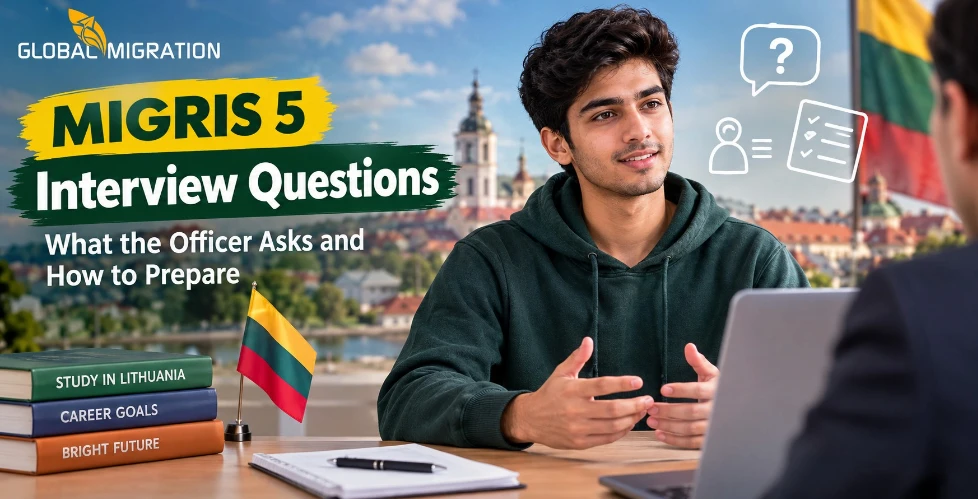
A Lithuania student migration interview often starts simply: your name, your university, your programme. Then comes the harder question: “Why did you choose Lithuania when you can study the same subject in Pakistan?” This is where preparation matters most.
Many students memorise answers, but an officer may ask follow-up questions to check that your plans are genuine and match your application. This guide covers what to expect and how to answer confidently without sounding rehearsed. If you plan to study in Lithuania from Pakistan, start here.
Take Hamza, who wants to study Sports and Tourism Management. Asked why he cannot study tourism in Pakistan, he repeats “affordable fees” and cannot link the programme to his career. His problem is not the country he chose. His answer lacks specifics.
What Is MIGRIS 5? Understanding the Interview Process
MIGRIS stands for Lithuania’s Migration Information System, the online system for immigration applications, including the temporary residence permit many students call a Lithuania student visa.
International students who want to study in Lithuania may need to complete several steps involving their university, application, documents and application centre. Depending on the procedure, an interview with a Migration Department specialist may also be part of the process.
- STEP 1University admission. Receive your confirmation and follow the university’s instructions.
- STEP 2MIGRIS application. Complete the online application with the required information.
- STEP 3Appointment and biometrics. Attend when required with your original documents.
- STEP 4Interview. Follow the official instructions on date, time and format.
- STEP 5Decision and travel. Travel only after confirming you have the necessary permission.
The order can vary, so follow the latest guidance from the Lithuanian Migration Department and your university.
You Must Have a Laptop With You During the Interview
Because the interview is held online, keep a laptop with you on the day. A laptop gives you a larger, steadier screen than a phone and makes it easier to follow the officer’s instructions.
- It keeps your camera steady when you are asked to show your room and passport.
- It runs the video call more reliably, with a stronger connection and battery.
- It lets you see the officer clearly and hear every question.
- It leaves your phone free as a backup if the call drops.
Charge your laptop, test the camera and microphone, and close other apps. Follow the device instructions in your official interview invitation.
Lithuania has announced changes to where certain temporary residence permit and national D visa applications may be submitted, including some VFS Global centres. Check current requirements with the Migration Department and the relevant VFS Global centre before booking travel.
A university interview tests academic motivation, while a migration interview concerns your application and eligibility. Our Klaipeda University interview guide shows what a university panel asks.
Four Main Areas to Prepare for the MIGRIS 5 Interview
Interview Room Setup: What the Officer May Check
Before the questions begin, the officer may verify your surroundings and equipment. Prepare these six things in advance.
- Quiet Room: The interviewer may ask you to rotate your camera 360 degrees to show the whole room. No other person should be in the room.
- Clean Desk: There should be no study notes, cheating material or papers in front of you or on the walls.
- Strong Internet & Camera: Your laptop or phone camera should be clear and your internet working, so the call does not drop.
- Glasses Off: During verification, the interviewer may ask you to take off your glasses.
- Laptop Required: Make sure you have a laptop for the interview.
- Eyes on the Camera: Do not look around during the interview. Focus only on the camera.
MIGRIS 5 Real Interview Questions and Answers for Lithuania
These sample answers are illustrations, not verified official questions. Replace the brackets with details that match your own documents.
1. Interview Rules and Personal Verification
Question 1Do You Know the Rules and Regulations of the Interview?
Sample answerYes. I will answer honestly, follow the instructions, and keep my answers consistent with my application.
Question 2Are You Alone?
Sample answerYes, I am alone in the room and ready to take the interview independently.
Answer truthfully. If someone is present, say so.
Question 3Can You Show Me Your Room?
Sample answerYes, certainly.
Choose a quiet, well-lit place with stable internet.
Question 4Can You Show Me Your Passport?
Sample answerCertainly. Here is my passport.
Keep it ready and hold it as instructed.
2. Personal Introduction and Background
Question 5Introduce Yourself With Your Name, Date of Birth, and Place of Birth.
Sample answerMy name is [full name], born on [date] in [city, country]. I am a Pakistani student and have applied to study [programme] at [university] in Lithuania.
Match your passport exactly.
Question 6Introduce Yourself in Detail.
Sample answerI am from [city]. I completed my [qualification] at [institution] in [year] and developed an interest in [field]. I chose [programme] in Lithuania because it fits my interests and career goals.
Question 7Do You Work in Pakistan?
If employedYes, as a [job title] at [company], and I want to build on this through further study.
If not employedNo. I have been focusing on [studies or admission] and want the qualifications my career needs.
Reflect your actual status.
Question 8Tell Me About Your Job Responsibilities.
Sample answerAs a [job title], I handle [responsibility one], [responsibility two] and [responsibility three]. This experience helps me see the practical side of my programme.
If you have never worked, say so honestly.
3. Questions About Lithuania and Your Study Plans
Question 9Why Did You Choose Lithuania Instead of Other Countries?
Sample answerI compared destinations on programme suitability, curriculum, fees and my family’s financial arrangements. [University name] offered a programme relevant to my background and goals.
Preparation tip: Be ready to explain what you researched.
Question 10What Is the Name of Your University?
Sample answerI have admission to [full university name] in [city], chosen after reviewing its programme, requirements and fees.
Question 11What Is the Name of Your Programme?
Sample answerIt is [full official programme name]. It relates to my interests and my intended career.
Use the exact title in your admission letter.
Question 12What Subjects Are Included in Your Programme?
Sample answerIt includes [subject one], [subject two] and [subject three], which I found relevant after reviewing the curriculum.
Memorise several subject names from the official curriculum.
Question 13How Will These Subjects Help You?
Sample answer[Subject one] will teach me [specific topic], while [subject two] builds [skill], preparing me for responsibilities in my intended career.
Connect subjects to your plans instead of listing them.
Question 14How Will This Programme Help You?
Sample answerIt will give me specialised knowledge and practical skills in [field], which I plan to use in opportunities related to my qualification.
Question 15Tell Me How You Got Admission to Your University.
Sample answerI researched universities, chose a matching programme, prepared my documents and applied through [actual method]. After assessment I received an offer and followed the university’s next steps.
If a consultant helped, explain their role accurately.
4. Questions About Graduation and Future Plans
Question 16What Will You Do After Completing This Programme?
Sample answerI intend to use what I learn to pursue opportunities in [career field], in line with the applicable immigration and employment rules.
If you will return to Pakistan, name the industry you will target.
Question 17What Are Your Future Plans?
Sample answerMy first priority is to complete my programme and build professional skills. After graduation I plan to build a career in [chosen field].
Link your education clearly to your career plan.
5. Questions About Visas and Travel History
Question 18Do You Have Any Other Visa or Temporary Residence Permit (TRP)?
Sample answerMy current status is [actual status]. I have [details, or “no other visa or permit”] and can explain my travel history.
Question 19Do You Have Any Other Visa Apart From a Visa for Baku?
Sample answerMy visa history includes [actual details]. If I have held no other visas, I will say so honestly.
Do not confuse a visa with a visit or appointment.
Question 20Did You Go to Baku Only for Your Appointment?
Sample answerI travelled to Baku for [actual purpose], arranged because [genuine reason].
Never invent a reason for travelling.
Question 21How Long Did You Stay in Baku?
Sample answerI stayed [number] days, from [arrival date] to [departure date], consistent with my travel records.
Check stamps and tickets for exact dates.
6. Accommodation and Living Expenses
Question 22Where Will You Live in Lithuania?
Sample answerAt [accommodation] in [city]. It is [confirmed, booked or being arranged], and its cost is in my financial plan.
For a dormitory, learn its name, location and booking details.
Question 23How Much Does Your Dormitory Cost?
Sample answerAbout [amount] euros per month, according to [provider], and it is included in my budget.
Preparation tip: Check current charges rather than guessing.
Question 24What Are Your Expected Living Expenses?
Sample answerMy budget covers accommodation, food, transport, internet, study materials and personal costs, about [amount] euros per month, alongside my tuition.
7. Financial Sponsorship and Banking
Question 25Who Is Your Sponsor?
Sample answer[Full name], my [relationship], who works as [occupation] and earns from [source]. They have agreed to support my tuition and living costs, as my documents show.
With several sponsors, explain each role.
Question 26Do You Have Your Own Bank Account?
If you doYes, with [bank name], and I can explain the source of the funds.
If you do notNo. My expenses are funded through [sponsor or arrangement], supported by my documents.
8. Personal and Family Information
Question 27Are You Married?
If unmarriedNo, I am not married.
If marriedYes, and I can provide the relevant details.
Answer truthfully, matching your application.
Common MIGRIS Interview Preparation Mistakes
Mistake 1: Reading too much into a short interview
A short interview does not mean rejection. The officer may simply have what they need.
Mistake 2: Trusting interviewer numbers
Such stories are not official rules. Prepare the subject matter, not rumours. For a similar walkthrough, read our MIGRIS 16 Interview guide.
Mistake 3: Memorising word for word
Scripts collapse under follow-ups. For each key question, prepare a reason, a supporting detail and an example from your own circumstances.
Mistake 4: Depending on a consultant
A consultant can explain the process, but you must understand your own application and answer for yourself.
Say this instead of giving vague answers
- “Everyone goes to Lithuania.”→“I researched this university’s programme, fees and fit with my goals.”
- “My consultant told me to apply.”→“I researched it myself, and my consultant explained the requirements.”
- “I am not sure about my sponsor’s income.”→“My sponsor’s monthly income is [actual amount], as in my documents.”
Never invent information just to make an answer sound convincing.
Seven-Day Preparation Plan for the MIGRIS 5 Interview
- DAY 1Review your application. Check university, programme, fees and sponsor details.
- DAY 2Research your programme. Prepare two or three specific reasons for choosing it.
- DAY 3Practise main answers. Why Lithuania? Why this programme? Why not Pakistan?
- DAY 4Review finances. Compare your sponsor’s details with your documents.
- DAY 5Practise follow-ups. Ask a friend to challenge every answer with “Why?”
- DAY 6Record a mock interview. Check that you speak clearly and calmly.
- DAY 7Check equipment and rest. Test your camera, microphone and internet.
MIGRIS 5 Interview Day Checklist
“Could you please repeat the question?” · “May I have a moment to think?” · “Let me explain that more clearly.”
Frequently Asked Questions About the MIGRIS 5 Interview
1. What does MIGRIS 5 mean?
It is an informal label students use, not an official category, and it does not guarantee your questions.
2. Is the MIGRIS interview compulsory?
That depends on the procedure for your application. Follow any official invitation.
3. How should I answer “Why did you choose Lithuania?”
Base it on your own research, such as the programme, university and fees, not a generic reason.
4. Do the 1 November 2026 changes affect the interview?
They concern application submission at certain locations, not the questions. Check official guidance.
Final Thoughts: Prepare for MIGRIS 5 With Confidence
Prepare by understanding your application, researching your university and knowing how your education is funded. If the officer challenges your reasons, stay calm and explain your thinking. A follow-up question is a chance to clarify, not a reason to panic.
Global Migration Advisors can help you review your plans, and you can also speak to professional study abroad consultants for Lithuania. No consultant can guarantee an immigration decision.
Need help preparing for your MIGRIS 5 interview?
Share your programme and documents with Global Migration Advisors. We will review your answers and practise follow-up questions in a mock interview session. No advisor can guarantee an interview result.
Chat on WhatsAppBased on published applicant guidance and student reports. Rules change, so confirm current requirements on migracija.lt before you apply.