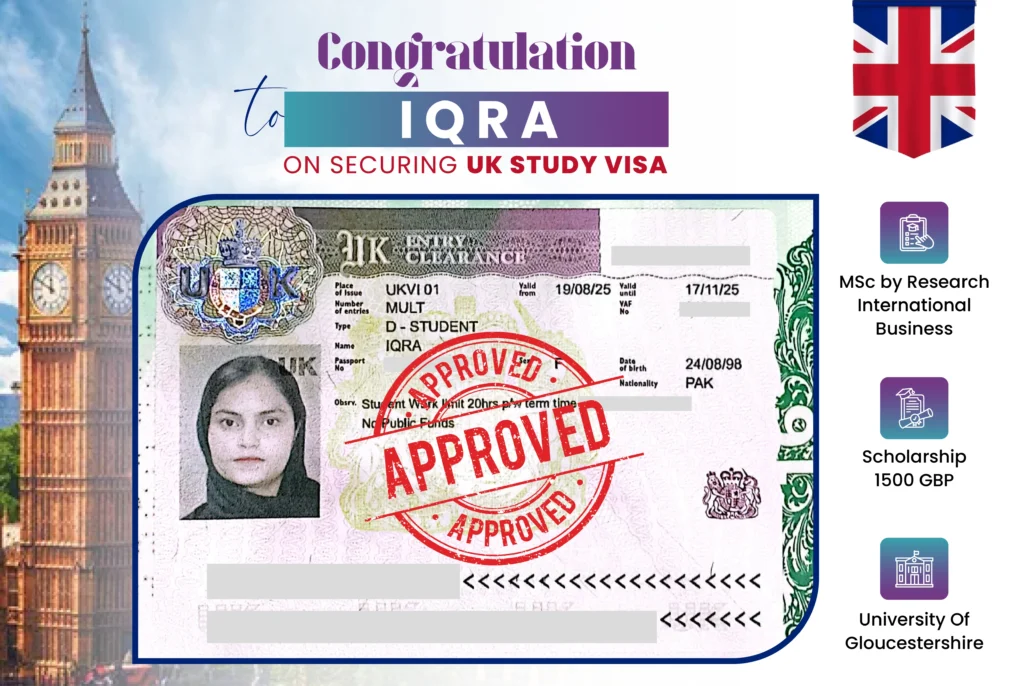

Thinking about an MRes in the UK? You’re not alone. It’s become one of the most searched postgraduate options among Pakistani and international students who want to study in UK right now, and for good reason.
But there’s a lot of confusing, half-correct information floating around about the UK study visa process. Let’s clear it up properly.
What Is an MRes in the UK?
MRes stands for Master of Research. It’s a postgraduate degree, but it’s built differently from a standard taught Master’s like an MSc or MA, for anyone who wants to study in UK.
Where a normal Master’s is mostly lectures and coursework with a short dissertation at the end, an MRes flips that balance. Most of your time goes into an actual research project, with far fewer taught modules. It’s designed for students who want to develop real research skills and knowledge, not just absorb existing material.
Think of it as sitting between a taught Master’s and a PhD. It’s often the natural next step if you’re seriously considering doctoral study later, or if you want research experience that stands out in a competitive job market, whenever you study in UK from Pakistan.
Who Can Apply to MRes Courses in the UK?
Generally, you’ll need the following to study in UK on an MRes:
- An undergraduate degree, usually a 2:1 or equivalent, in a subject related to your intended research area
- English language proficiency, typically IELTS 6.5 or equivalent, though this varies by university and subject
- For some programmes, a Master’s degree already, depending on the level of research expected
Beyond the paperwork, universities want to see genuine interest in research itself. This matters more for an MRes than it does for a standard taught Master’s, and it directly shapes which of the two application routes you’ll end up taking for your UK study visa.
The Two Types of MRes Programmes
This is the part that catches a lot of applicants off guard. Not all MRes courses work the same way when you study in UK from Pakistan.
MRes Without a Research Proposal
Some universities let you apply without submitting a research proposal upfront. You apply, get an offer, and start.
It sounds easier, and application-wise, it is. But here’s the honest trade-off: these programmes have become highly competitive and, more importantly, increasingly tricky at the visa stage.
A sudden concentration of applications from students choosing this route for reasons other than pure academic interest has drawn closer scrutiny from UK immigration authorities. Getting an offer doesn’t guarantee a smooth path to your Confirmation of Acceptance for Studies (CAS) or your UK study visa.
UK Universities Withdrawing CAS for Pakistani Students
Understand why some universities withdraw CAS after an offer, and how to protect your application.
MRes With a Research Proposal and Supervisor’s Consent
This route takes longer, sometimes considerably longer, if you want to study in UK safely. Here’s what it actually involves:
- Identifying academics whose current research genuinely overlaps with what you want to study
- Reaching out to them directly, with a clear, specific research proposal
- Waiting for their response, and often going back and forth to refine your proposal
- Getting their explicit written consent to supervise you before you formally apply
Realistically, this process can take well over a year from your first email to a confirmed supervisor agreement. That’s a long runway, and it’s exactly why fewer students attempt it when they study in UK from Pakistan.
The upside is real, though. A named supervisor who has agreed to take you on makes for a far stronger, more credible application, both to the university and later at your visa interview, than a generic application with no proposal attached.
MRes Admission in the UK: Study With Your Spouse Safely
See how a proposal-based MRes can also let you bring your spouse to the UK.
Universities Offering MRes Programmes
MRes courses are available at a wide range of UK universities for those who study in UK. Here’s a closer look at four that come up often, along with what they offer in physics, business, zoology, botany, mathematics, and computer science.
Bangor University
Based in North Wales, Bangor has strong research credentials in the biological and environmental sciences, alongside computing and business.
- Computer Science: MRes available, international fee around £19,000 a year (2024/25 banding; confirm current rate)
- Zoology: MRes available, international fee around £19,000 a year, part of Bangor’s strong Biological Sciences research base
- Business: MRes available through Bangor Business School, international fee around £18,000 a year
- Botany: Not offered as a standalone MRes title. Plant science and ecology research is generally covered within Bangor’s broader Biological Sciences and Environmental Science research programmes
- Physics and Mathematics: Bangor’s strength here leans toward applied and environmental science rather than standalone Physics or Mathematics MRes titles; check current listings directly for the latest offering
Robert Gordon University (RGU)
Based in Aberdeen, Scotland, RGU runs MRes programmes across multiple schools rather than concentrating in pure sciences, for students who study in UK from Pakistan.
- Business: MRes available through Aberdeen Business School, international fee around £16,660 a year (2026 entry)
- Computer Science: MRes available through the School of Computing, Engineering and Technology, similar fee range around £16,660 a year
- Physics, Mathematics, Zoology, Botany: Not part of RGU’s current MRes offering. RGU’s research strengths sit more in business, health sciences, engineering, law, and the built environment
University of Wales Trinity Saint David (UWTSD)
With campuses across Swansea, Carmarthen, London, and Birmingham, UWTSD offers a broad postgraduate portfolio, with a general international postgraduate fee of around £16,800 a year (2025/26).
- Business and Computer Science: Both areas are offered at postgraduate level, and MRes-style research routes are available; confirm current course listings for your specific interest area
- Physics, Mathematics, Zoology, Botany: UWTSD’s research focus leans toward business, education, humanities, and applied and creative disciplines rather than pure sciences, so these aren’t a strong fit here
University of Essex
Based in Colchester, Essex is genuinely one of the stronger research-focused options on this list, with a well-established MRes programme across multiple departments for anyone who wants to study in UK.
- Business (Management): MRes Management and Organization available, fees broadly in line with Essex’s postgraduate taught range of roughly £22,000 to £23,500 a year
- Finance: MRes Finance available, international fee around £23,500 a year
- Economics: MRes Economics available, a well-regarded route into PhD study in the field
- Computer Science: Offered as a Masters by Dissertation or MPhil research route rather than under the MRes title specifically; the two-year MPhil Computer Science route runs around £20,625 a year
- Physics and Mathematics: Offered as MSc by Dissertation in Applied Physics and Applied Mathematics respectively, Essex’s equivalent research-intensive route in these subjects
- Zoology and Botany: Not part of Essex’s current offering; the university’s science strength sits in computing, mathematics, physics, and health rather than biological sciences
| University | Location | Business Fee | Computer Science Fee | Note |
|---|---|---|---|---|
| Bangor University | North Wales | ~£18,000/year | ~£19,000/year | Strong in biological sciences |
| Robert Gordon University | Aberdeen, Scotland | ~£16,660/year | ~£16,660/year | Strong across business and computing |
| UWTSD | Swansea/Carmarthen/London/Birmingham | ~£16,800/year (general) | ~£16,800/year (general) | Broad postgraduate portfolio |
| University of Essex | Colchester | £22,000–£23,500/year | ~£20,625/year (MPhil route) | Strong research focus |
| Essex Finance/Economics | Colchester | ~£23,500/year (Finance) | Not applicable | Well-regarded route into PhD study |
How to Choose the Right MRes Programme
A few things worth thinking through before you commit, especially as a Pakistani or international applicant planning to study in UK:
- Match the subject to the university’s actual strength, not just its name recognition. A university that’s genuinely strong in your research area will offer better supervision, resources, and academic credibility than one where your subject is a minor offering
- Check whether the course requires a research proposal before you fall in love with a specific university. If you’re set on the safer, proposal-based route, build in the extra time this requires from the start
- Compare total cost, not just the headline fee. Location matters. Aberdeen, Colchester, and Swansea all have very different living costs compared to London or Manchester
- Look at supervisor availability in your specific research area, not just the department’s general reputation. A strong department with no active supervisor in your niche isn’t a good fit
- Verify the course’s current status before applying. MRes intake numbers and requirements have shifted quickly across UK universities recently, so don’t rely on information that’s more than a few months old
- Think about your visa pathway from the start, particularly if bringing a spouse or family is part of your plan. Not every MRes route carries the same visa implications, and this is worth mapping out before you apply, not after
Study in UK: Second Master’s After PSW Visa
See how an MRes compares to a standard second master’s if you’re already in the UK.
How Global Migration Advisors Helps You Through This
Choosing the right MRes isn’t just about finding a course that will accept you. It’s about finding one that fits your research interests, your budget, and your actual reasons for wanting to study in UK on a research degree in the first place.
At Global Migration Advisors, we help students who study in UK from Pakistan:
- Matching their research interests to universities and departments genuinely strong in that field, not just ones with an easy application process
- Understanding which MRes route, with or without a research proposal, fits their situation and timeline
- Approaching potential supervisors properly, with a research proposal that gives them a real chance of a yes
- Preparing financial documentation and visa applications that hold up to scrutiny
We’d rather help you choose the right MRes the first time than watch you discover the hard way that a course wasn’t the right fit, whenever you study in UK.
UK Student Visa Rejection Reasons
Learn the common mistakes that lead to refusals so your MRes application stays strong.
FAQs: MRes Courses in the UK
A Master of Research is a postgraduate degree focused mainly on independent research, with far fewer taught modules than a standard Master’s. It sits between a taught Master’s and a PhD for those who study in UK.
Typically, applicants need an undergraduate degree in a related field, usually a 2:1 or equivalent, and English language proficiency, commonly IELTS 6.5. Requirements vary by university and course when you apply for a UK study visa.
A no-proposal MRes is quicker to apply for but has become highly competitive and increasingly difficult at the visa stage. A proposal-based MRes takes longer, sometimes over a year to secure supervisor consent, but is generally the more stable, credible route to study in UK from Pakistan.
Fees vary widely by university and subject, roughly £16,000 to £24,000 a year among the universities covered here. Confirm the exact current fee directly with the university before you study in UK.
Yes, generally. An MRes builds the research skills, methodology experience, and often the supervisor relationships that make a strong foundation for doctoral study afterward, once you study in UK.
Final Thoughts
An MRes can be a genuinely strong choice, whether you’re building toward a PhD, strengthening your research credentials, or looking for a route to study in UK that fits your specific academic interests. But it’s not one-size-fits-all. The right university depends entirely on where your subject is actually strong, and the right application route depends on how much time you have and how much risk you’re willing to take on.
If you want help matching your research interests to the right MRes programme, and choosing the application route that actually fits your situation, Global Migration Advisors works through exactly this decision with students, one profile at a time. Get personal advice today on your study in UK plans.