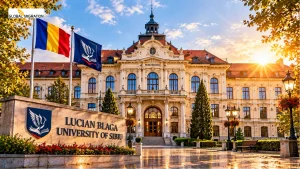
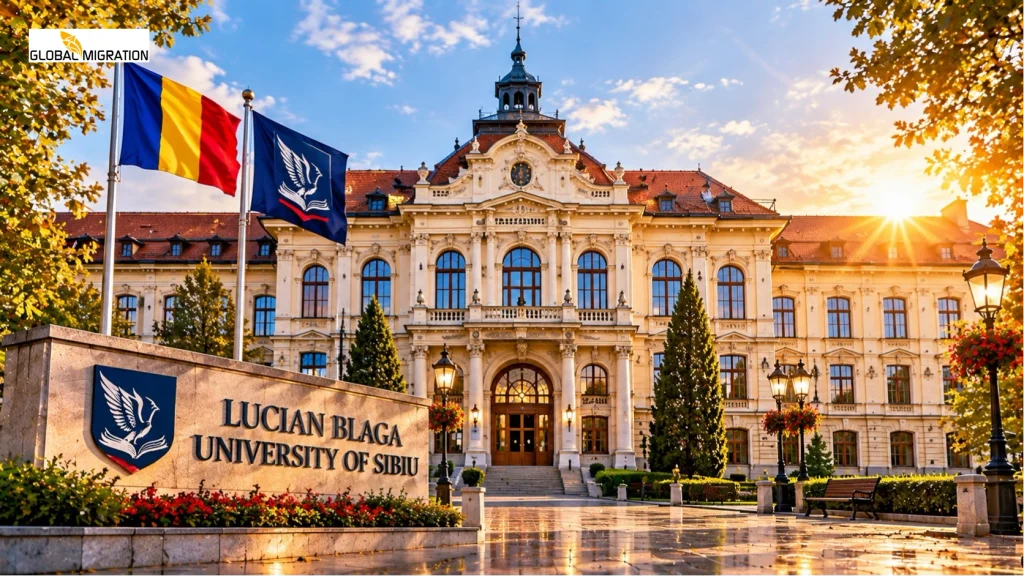
Lucian Blaga University of Sibiu, known as ULBS, is a public university in the Transylvanian city of Sibiu, and it has operated under its current name since 1990. Pakistani students usually look at it for its English-taught options, especially Medicine in English, and for its public-university fee structure. Because admission rules for non-EU students are specific, this guide uses the university’s own admission pages and Faculty of Medicine regulation to explain the programmes, documents, fees, deadlines and steps. If you are still comparing destinations or planning to study in Romania, it will help you prepare with accurate information instead of rumours.
Yes, Pakistani students can apply to ULBS as non-EU applicants. You apply through the university’s online admission platform, and the Romanian Ministry of Education issues the Letter of Acceptance to Studies. English-taught options include Medicine, Dental Medicine, Mechatronics, Biology, Business Administration and Economic Informatics, while programmes taught in Romanian start with a Romanian language preparatory year. For 2026–2027, annual non-EU tuition is €3,600 (about PKR 1.12 million) for most programmes and €7,000 (about PKR 2.18 million) for Medicine in English.
What Is Lucian Blaga University of Sibiu?
ULBS is a public university named after the Romanian philosopher, poet and playwright Lucian Blaga. It brings several faculties together in one city: Engineering, Economics, Law, Letters and Arts, Medicine, Sciences, Social Sciences and Humanities, Agricultural Sciences, Food Industry and Environmental Protection, and Theology. Its international relations office also lists participation in the FORTHEM alliance and in Erasmus+ exchange programmes.
The International Relations Office is the main contact for international applicants. Its listed address is Bd-ul Victoriei, Nr. 10, Sibiu, 550024, Romania, and its email is international@ulbsibiu.ro.
Why Sibiu? Where the University Is Located
ULBS is in Sibiu, a historic city of about 134,000 people (2021 census) in Transylvania, central Romania. It is known for its medieval old town and was a European Capital of Culture in 2007. Sibiu lies roughly 275 km north-west of Bucharest, in the Southern Carpathian foothills, and it has its own international airport with direct connections to Germany, Austria, the UK, Ireland and Spain.
Students live and study in a compact urban setting rather than a large metropolis. When you shortlist Romanian universities, think about the city as well as the programme, because it affects your daily costs, travel and lifestyle.
Simplified illustration, not to scale. Confirm travel routes and arrival plans with the International Relations Office before you book.
English-Taught Programmes at ULBS
Most programmes at ULBS are taught in Romanian, but the university’s international course list marks several as taught in English. At bachelor level, these are the ones Pakistani applicants most often review. For a wider view beyond one university, English-taught programs in Romania shows what else is available.
Medicine in English and Dental Medicine in English sit in the Faculty of Medicine (Dental Medicine is named in the Faculty’s 2026 admission regulation). Mechatronics is offered by the Faculty of Engineering, Biology by the Faculty of Sciences, and Business Administration and Economic Informatics by the Faculty of Economics.
At master’s level, the Faculty of Letters and Arts lists three English-taught programmes: studies in translation, interpreting and terminology studies; literary paradigms and linguistic evolution; and literary and linguistic paradigms in anglophone cultural contexts.
The list is based on the university’s international course page and the Faculty of Medicine’s 2026 admission regulation. Programme availability changes by year, so confirm it in the university’s catalogue of study programmes before you apply.
Admission Requirements for Non-EU Applicants
Non-EU applicants must hold documents that prove citizenship of a country outside the EU, and for bachelor’s studies they must be high-school graduates with a baccalaureate diploma or an equivalent that gives general access to accredited higher education. The university’s file checklist is set out below.
You complete the application for the Letter of Acceptance to Studies together with the university’s application form, and add your baccalaureate diploma or equivalent with a legally certified translation. If the programme needs it, you also add the studies document that gives access to it, such as a bachelor’s or master’s diploma.
The rest of the file covers your academic records and birth certificate (both with certified translations), proof of permanent residence in a foreign country, and a passport valid for at least 6 months after the date the Letter of Acceptance is issued. You also need a medical certificate, in a widely used international language, confirming that you do not have contagious diseases or other illnesses. Applicants in Pakistan can also check how the medical certificate for a Romania study visa in Lahore is arranged.
Study documents from countries that are party to the Hague Apostille Convention need the apostille, while documents from other countries must be authenticated through the competent authorities. The university also provides a list of diplomas recognised by the Romanian Ministry of Education, and the Faculty of Medicine regulation says diplomas completed abroad must be recognised through the national recognition centre. Ask the International Relations Office how your own qualification will be assessed before you pay any fee.
Pakistani Qualifications: FSc, A-Levels and IBCC Equivalence
Pakistani applicants usually apply with Matric and Intermediate (FSc) certificates, or with O-Level and A-Level results. These should be verified and equated by the Inter Board Committee of Chairmen (IBCC) before you submit your file. Pakistan is a party to the Hague Apostille Convention, so the verified documents then need an apostille and, where required, a certified translation.
The admission material this guide draws on does not include a Pakistan-specific equivalence table, so the university and the Ministry of Education assess your qualification when they evaluate your file. For Medicine in English, the regulation ranks non-EU candidates by a baccalaureate average that includes Biology, Chemistry, Physics or Natural Sciences, so FSc Pre-Medical is the closest match to those subjects. Request written confirmation that your exact qualification and number of schooling years are accepted from the International Relations Office (for Medicine, admitere.medicina@ulbsibiu.ro), and keep it with your file.
Legalisation and certified translation usually take the longest. Begin them first, and check the apostille or authentication route for your own documents before you submit your file.
The Application Process, Step by Step
Start by preparing your file with certified translations where required, then submit it on the university’s online admission platform, where non-EU candidates upload their application documents. If you are building a shortlist across several countries, understanding how university applications work abroad helps you keep your documents consistent.
After the admission process, the university sends the valid files of eligible candidates to the Ministry of Education, which issues the letter of acceptance to studies for each eligible candidate and sends it back to the university. At registration, you present your identification and study documents in original, the Letter of Acceptance and a passport with a valid study visa.
Medicine in English at ULBS: What Non-EU Applicants Should Know
Medicine and Dental Medicine in English are the programmes most Pakistani applicants ask about. The Faculty of Medicine issues a separate admission regulation for them, and its main points for 2026 are these. Citizens of EU member states, EEA countries, Switzerland and non-EU countries can apply, the exams are held in English, and applications go through the university’s admission platform with the required documents uploaded. Non-EU candidates are ranked by their baccalaureate average, where the baccalaureate includes Biology, Chemistry, Physics or Natural Sciences, and the application for the Letter of Acceptance is completed at the confirmation stage.
The regulation accepts English certificates at B2 level or above, including Cambridge exams, IELTS and TOEFL iBT, as listed in its equivalence table. Candidates who hold no recognised certificate take the proficiency test. For non-EU candidates, the test is taken online in front of the admission committee.
The 2026 calendar for Medicine and Dental Medicine in English gives a useful picture of how the cycle works:
- 15 May 2026Applications open for Medicine and Dental Medicine in English.
- 15 July 2026Application deadline for non-EU citizens (the EU deadline was 20 July).
- 27 July 2026English language proficiency test.
- 29 July to 1 August 2026Confirmation of places after the preliminary results.
- 7 September 2026Final results of the July session.
- 7 to 13 September 2026Applications for the September session.
The calendar above belongs to the 2026 cycle. The university normally announces its dates for the next intake on the admission platform, so check it before you plan your 2027 application. Pakistani students weighing medical degrees more broadly can compare options for MBBS in Romania from Pakistan, and should confirm the licensing rules of the relevant Pakistani regulator before you apply.
One protection is worth knowing: for non-EU applicants on the foreign-currency tuition places, the regulation says the registration fee and tuition fee already paid are refunded if the Ministry of Education does not issue the Letter of Acceptance. Keep your payment receipts safe.
Tuition Fees for Non-EU Students (2026–2027)
The university lists its non-EU tuition fees in euro per academic year. These are the figures for 2026–2027:
| Field of study | Bachelor and Master (per year) | PhD (per year) |
|---|---|---|
| Technical studies, engineering, agronomy, sciences, mathematics, applied mathematics and sport | €3,600 (≈ PKR 1,119,000) | €3,200 (≈ PKR 995,000) |
| Socio-human studies, psychology and economy | €3,600 (≈ PKR 1,119,000) | €3,000 (≈ PKR 933,000) |
| Medicine (Bachelor and Master), taught in Romanian | €6,000 (≈ PKR 1,866,000) | €5,000 (≈ PKR 1,555,000) |
| Medicine in English (non-EU) | €7,000 (≈ PKR 2,177,000) | – |
| Medicine (Residency) | – | €7,700 (≈ PKR 2,394,000) |
| Music and Arts | €5,400 (≈ PKR 1,679,000) | – |
| Theatre | €9,360 (≈ PKR 2,911,000) | €8,000 (≈ PKR 2,488,000) |
Source: the university’s official non-EU admission page (2026–2027 fees in euro per academic year). PKR figures are approximate conversions.
The university also charges an administrative fee for file processing, which is 500 RON (about €94, ≈ PKR 29,000), or 800 RON for Medicine (about €150, ≈ PKR 47,000). The tuition fee for the Romanian preparatory year is the same as the fee of the Romanian-taught programme you plan to join afterwards. Fees for 2027–2028 will be confirmed by the university, so treat these figures as the current reference. To compare costs across Romanian medical schools, you can also review MBBS in Romania fees, colleges and process.
What EU, EEA and Swiss citizens pay
EU, EEA and Swiss applicants are subject to the same admission and tuition fees as Romanian students, according to the university’s EU, EEA and SCC admission page, so their fees are set in Romanian lei rather than euro. The page does not list amounts, and they differ by faculty. As an example, the Faculty of Sciences lists 4,500 RON per year for its 2026–2027 undergraduate fee-paying places (about €842, ≈ PKR 262,000), with a first instalment of 1,800 RON on confirming the place, as shown in its 2026 tuition schedule.
For Medicine and Dental Medicine in English, the Faculty of Medicine regulation says EU candidates on tuition-paying places pay the first instalment (40%) of the annual fee, while non-EU candidates pay the full annual fee, but the amounts are set by the university Senate and are not printed in the regulation. Ask admitere.medicina@ulbsibiu.ro for the current figure in writing before you pay.
Conversions use the State Bank of Pakistan’s EUR rate of 310.96 PKR (10 November 2026) and the ECB rate of 5.343 RON per euro (9 November 2026). Exchange rates change daily, so check the current rate before you pay.
Scholarships for International Students at ULBS
It helps to be realistic here. The university’s international pages describe a Ministry of Education merit scholarship for foreign students who are already enrolled at ULBS, not an entry scholarship for new applicants. A selected student receives a tuition-free study place together with a scholarship, but the amount is not stated, so do not rely on figures from other sources.
To qualify, you must be a foreign student at ULBS who is not in the final year and has completed at least one year of full-time study (excluding the preparatory year) with an average of 7.00 or more. Files are scored out of 10 points, mainly on your average, with extra points for a motivation letter, extracurricular activities and a recommendation letter, and they are submitted in person to the International Relations Department. Calls are announced each autumn (in 2025–2026, submissions ran from 31 October to 14 November), so watch for the 2026–2027 call.
In practice, plan to pay your first-year tuition from your own budget, and ask the International Relations Office in writing whether any scholarship applies to new non-EU applicants.
The Romanian Language Preparatory Year
For programmes taught in Romanian, non-EU students generally begin with a Romanian language preparatory year, and the university’s non-EU admission page describes its application file in detail. The tuition for this year equals the tuition of the study programme you intend to join afterwards. If you are applying to an English-taught programme, ask the International Relations Office in writing whether the preparatory year applies to your case.
Visa and Registration: What Comes After the Letter of Acceptance
You need your Letter of Acceptance and a passport with a valid study visa to register at the university. Pakistani applicants apply for a long-stay Romania study visa, and the Romanian embassy in Islamabad handles visa applications for students. Requirements, fees and processing times are set by the Romanian authorities and can change, so check the current rules with the embassy and the Romanian Ministry of Foreign Affairs before you travel. Incomplete or inconsistent documents are a common reason applications struggle, so it helps to understand the Romania student visa refusal reasons before you apply. Your passport must also stay valid for at least 6 months after the date of the Letter of Acceptance.
Cost of Living in Sibiu and Proof of Funds for the Visa
Tuition is only part of your budget. The ULBS international student guide gives the planning ranges below for a month in Sibiu. The guide does not date them, so confirm current prices with the International Relations Office.
| Item | Estimated per month | Approx. PKR |
|---|---|---|
| University dormitory | 500–1,000 RON | ≈ 29,000–58,000 |
| Rented apartment | 1,200–2,500 RON | ≈ 70,000–146,000 |
| Groceries | 600–900 RON | ≈ 35,000–52,000 |
| Mobile data and internet | 30–60 RON | ≈ 1,700–3,500 |
Source: ULBS international student guide. PKR figures use the same rates as the fee note above (1 RON ≈ PKR 58.2) and are approximate. The guide gives dormitory costs as an estimate, so ask international@ulbsibiu.ro for the exact fee that applies to you. Dormitory applications for 2026/2027 ran from 7 to 30 August 2026 on the university’s accommodation platform.
For health cover, the ULBS guide states that non-EU students must have health insurance, arranged through the university or privately, and ULBS students can use the Student Medical Office free of charge. Romanian university visa guidance also commonly lists travel medical insurance for the whole stay, with a minimum cover of €30,000, so confirm both requirements with the embassy.
For the visa, Romanian university guidance states that you must show funds of at least the minimum monthly gross salary in Romania, covering the whole visa period. The figure changes, so check the current amount with the embassy. Our guide to Romania study visa financial requirements explains the requirements in more detail.
Budget for immigration fees as well. After arrival, you apply for the residence permit at the Immigration Office in Sibiu, as the ULBS guide notes. Guidance published by a Romanian university lists about 259–265 RON (≈ PKR 15,000) for the permit plus a visa fee of USD 350, for self-funded students whose tuition is set in euro, but that page is undated. Please confirm the current amounts with the embassy and the immigration office before you pay.
 Romania admission help
Planning to Apply to the University of Sibiu?
Global Migration Advisors is a Lahore-based study-abroad consultancy that helps Pakistani students with university admissions and visa processes for Romania, Lithuania, Sweden, Italy, Finland, Cyprus and the UK. Share your qualification and your preferred programme, and we will help you plan your documents and your next steps.
- Programme shortlist
- Document checklist
- Visa process support
Is ULBS the Right Choice for You?
ULBS can suit you if you want a public Romanian university with a wide range of faculties and a few English-taught options, especially in medicine. It may be less suitable if you need a large choice of English-taught programmes, because many courses are taught in Romanian and begin with the preparatory year. If you want a broader English-taught range, compare other Romanian universities before you decide.
It fits you if your programme is on the English-taught list and your qualification is recognised. Think twice if you need a programme taught only in Romanian and do not want a preparatory year, and always compare at least two or three universities on fees, language of study and city. If cost is your main filter, looking at affordable, low-risk study destinations for Pakistani students first can show whether Romania suits your budget. If your interest is pharmacy rather than medicine, note that it is not on ULBS’s English-taught list above, so the best pharmacy universities in Romania are worth shortlisting as well.
Mistakes to Avoid When Applying to ULBS
The most common mistake is assuming every programme is taught in English, so check the language of instruction for your exact programme. Students also start documents late, even though the apostille, authentication and certified translations take time, and some overlook that their visa and registration depend on the Letter of Acceptance.
Avoid unofficial fee lists and use the fees the university lists for your year of entry. Dates differ by programme and by citizenship, so check the platform early, and read the conditions and refund terms before you pay anything.
Your 6-Step Plan for the 2027 Intake
Begin by choosing your programme and checking that it is on the English-taught list, or plan for the preparatory year. Then confirm how your high-school qualification is treated and whether you need a recognised English certificate, and prepare your originals, certified translations and the apostille or authentication your documents need.
Next, apply on the admission platform before the non-EU deadline and keep your confirmation emails. Once you receive your place, follow the university’s instructions for confirming it and paying the fees due. After the Letter of Acceptance arrives, apply for the long-stay study visa and prepare for registration. For a wider starting point, study in Romania from Pakistan is a useful companion to this plan.
Questions Students Ask About the University of Sibiu
Is Lucian Blaga University of Sibiu a public university?
Yes. ULBS is a public university in Sibiu, Romania.
Does ULBS offer programmes in English?
Yes, several. The university lists Medicine, Mechatronics, Biology, Business Administration and Economic Informatics at bachelor level in English, and the Faculty of Medicine also offers Dental Medicine in English. Check the current catalogue before you apply.
Do I need a Letter of Acceptance to Studies?
Yes. The Romanian Ministry of Education issues the letter for eligible non-EU candidates, and you present it at registration with a passport that has a valid study visa.
Do I need IELTS for Medicine in English?
You need proof of English. You can present a recognised English certificate, or take the university’s English proficiency test, which is marked pass or fail.
What happens if the Letter of Acceptance is not issued?
Fees may be refunded. For non-EU candidates on foreign-currency places in Medicine in English, the regulation says the registration fee and the tuition fee paid are refunded if the Ministry does not issue the letter.
When should I apply for the 2027 intake?
As early as the admission platform opens. In 2026, the non-EU window for Medicine in English ran from 15 May to 15 July. Check the platform for the 2027 dates and prepare your documents before then.
Does ULBS offer scholarships to international students?
Yes, but mainly after you enrol. The university describes a Ministry of Education merit scholarship for enrolled foreign students with at least one completed year (excluding the preparatory year) and an average of 7.00 or more. Amounts are not stated on its pages.
Final Thoughts: Verify, Prepare and Apply Early
Lucian Blaga University of Sibiu offers Pakistani students a public-university route into Romania, with English-taught options in medicine and a few other fields. Your success depends on choosing the right programme, preparing legalised documents early and following the university’s official process.
Use the university’s own admission pages as your final reference, because fees, dates and requirements change each cycle. When you are ready to compare destinations, explore study in Romania and build your shortlist step by step. If you would like personal guidance on documents and applications, you can speak with professional study abroad consultants for Romania. No university or consultant can guarantee an offer or a visa.
Disclaimer: This guide was last updated on 17 November 2026 and is based on the University’s official 2026–2027 admission information and the Faculty of Medicine’s 2026 admission regulation. Fees, dates and requirements can change, so please confirm the latest details with the International Relations Office before you apply.