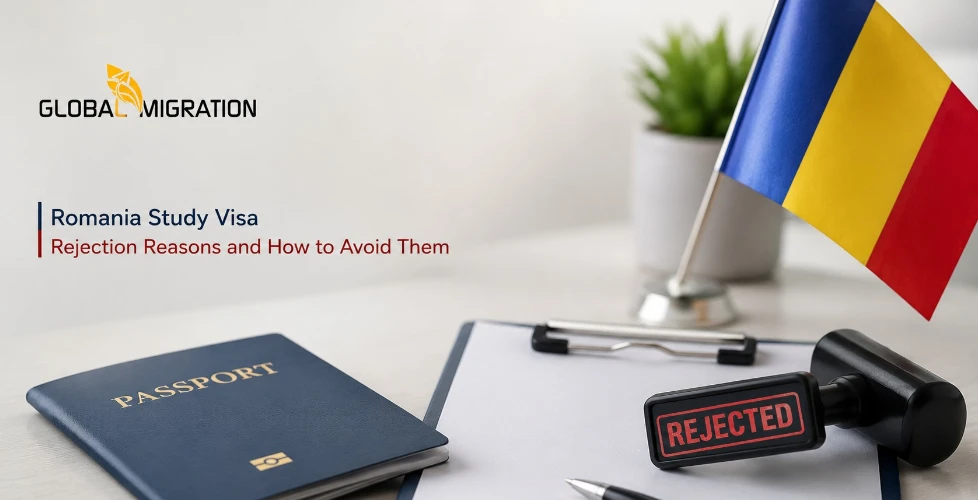
Every year, a large number of Pakistani students apply for a Romanian student visa, hoping to begin a new academic chapter in Europe through study in Romania from Pakistan. Most applications are genuine. Yet many are still refused, not because the applicant was unqualified, but because the visa file failed to clearly demonstrate what the embassy needed to see.
A student visa refusal is rarely about one small mistake. It is usually about a pattern: documents that don’t align with each other, explanations that feel vague, or a case that doesn’t tell a convincing, consistent story. Understanding exactly what embassy officers look for is the single best way to avoid a rejection.
This guide breaks down the most important reasons behind Romania student visa refusals, based on how the process actually works, so you can prepare a file that holds up to scrutiny.
How the Romania Student Visa Process Works
Pakistani students who plan to study in Romania apply for the country’s long-stay study visa, officially known as the D/SD visa. This is not processed through VFS Global. Applications are submitted directly at the Embassy of Romania in Islamabad, and the process also runs through Romania’s official e-Visa portal.
Because the embassy reviews every file personally, there is no room for guesswork or shortcuts. Officers compare your acceptance letter, financial documents, and personal statements against each other. If something doesn’t add up, the file gets flagged.
Once the visa is approved, it typically permits an initial stay of up to 90 days. Students must then apply for a temporary residence permit at the Romanian immigration office after arrival, which covers the remainder of the academic year and is renewable.
Main Reasons for Romania Student Visa Rejection
Three areas cause the majority of refusals for Pakistani applicants: financial documentation, genuine intent to study, and personal identity documents such as the birth certificate. Each deserves careful attention.
1. Weak or Inconsistent Financial Documentation
Financial proof is, by a wide margin, the most scrutinized part of any Romania student visa application. The embassy is not just checking whether you have money. It is checking whether that money is real, stable, and clearly capable of supporting your education and living costs for the full duration of your stay.
Stable and sustainable income over time. A single large deposit shortly before applying raises immediate concern. Officers want to see a financial history that shows consistent means over several months, not a one-time injection of funds designed to look impressive on paper.
Regular, traceable income with a clear source. Every rupee shown in your file should be explainable. If the sponsor is salaried, salary slips and bank credits should match. If they run a business, the income should be traceable through legitimate business records, not unexplained cash deposits.
Sponsor’s bank statements. When a parent, relative, or guardian is sponsoring the education, their bank statement becomes central to the case. It must show adequate, stable balances and activity that is consistent with the sponsor’s declared income.
Sponsor’s income proof. A bank statement alone is not enough. The sponsor should also provide proof of income, such as an employment letter and salary certificate, or business registration documents if self-employed.
Sponsor’s tax returns. Tax records add a layer of credibility that bank statements alone cannot provide. They confirm that the declared income is not just present in an account, but is also formally recognized and reported.
Taken together, these documents should clearly demonstrate the sponsor’s ability to cover both tuition fees and living expenses in Romania for at least the first academic year. A gap between what is claimed and what is proven is one of the fastest ways to trigger a refusal.
Consistency and transparency matter because embassy officers are trained to spot documents that were arranged only for the application, rather than reflecting a family’s real financial position. A financial file that tells one honest, coherent story is far stronger than one that simply hits a minimum number.
| Financial Document | What It Proves | Common Weakness |
|---|---|---|
| Sponsor’s bank statement | Available funds and account activity | Sudden large deposit with no history |
| Sponsor’s income proof | Regular, traceable earning source | Income source not clearly documented |
| Sponsor’s tax returns | Formal, reported income credibility | Missing or inconsistent with bank records |
| Relationship proof with sponsor | Legitimate sponsorship connection | Unclear or undocumented relationship |
2. Lack of a Genuine Intention to Study
Beyond finances, the embassy wants to understand why you, specifically, are pursuing this specific program. This is often referred to as demonstrating “genuine intent,” and it is where many otherwise strong applications fall short.
Relevance to your academic background. Your chosen course should logically connect to your previous education. A student moving from a completely unrelated academic path, without a clear explanation, can appear inconsistent to a reviewing officer.
A logical reason for choosing this course. “It was affordable” or “my friend is going too” are not compelling explanations. You should be able to explain, in your own words, why this specific field of study matters to you.
Why Romania, and why this university. Applicants should be ready to explain what drew them to Romania and to their chosen institution specifically, whether that’s the program structure, faculty reputation, curriculum, or cost of quality education relative to other destinations.
Alignment with future career plans. A strong application shows a clear line from your past education, through this program, to where you want to go professionally. When that line is missing or contradictory, it weakens your case.
Justifying the value of the degree. You should be able to explain, clearly and specifically, how this Romanian degree will benefit your career after graduation. Vague answers about “better opportunities” without specifics are far less convincing than a grounded explanation tied to your field.
It’s worth being clear about one thing: genuine intent is something the applicant must demonstrate through their own documents, statement of purpose, and interview answers. It is not something a university confirms or guarantees on your behalf. The responsibility to build a convincing, honest case rests with the applicant.
| Application Signal | Strong Application | Weak Application |
|---|---|---|
| Course choice | Clearly linked to prior academic background | Unrelated field with no explanation |
| Reason for Romania | Specific, researched, and personal | Generic or based only on low cost |
| Career alignment | Clear path from degree to career goal | No connection between course and future plans |
| Interview answers | Consistent with written application | Contradicts documents or sounds memorized |
3. Issues With the Birth Certificate
The birth certificate is a smaller document compared to financial proof or the acceptance letter, but it is still frequently a required part of the application, and errors here can delay or derail an otherwise solid file.
Your birth certificate must be officially issued by the relevant civil registration authority in Pakistan, and it must accurately reflect your legal name and date of birth exactly as they appear on your passport and academic documents. Any mismatch between these documents can raise unnecessary questions.
If the embassy requires the birth certificate to be translated or legalized, applicants should follow the embassy’s current document guidelines exactly, rather than relying on outdated information from previous applicants. Requirements around attestation and translation can be updated, so it’s best to confirm the latest instructions directly with the embassy or through the official e-Visa portal before submission.
Other Common Reasons for Refusal
While the three areas above account for most refusals, a few other issues consistently appear in rejected applications:
Unattested academic documents. Certificates and transcripts that haven’t been properly attested by HEC and the Ministry of Foreign Affairs are considered incomplete.
Incomplete document files. Missing even one required item, such as health insurance proof, a police clearance certificate, or passport-sized photographs, can hold up or reject an application.
Passport validity issues. Your passport should have at least six months of validity remaining beyond your intended stay, along with sufficient blank pages.
Inconsistent interview answers. If called for an interview, contradictions between your spoken answers and your written application documents are an immediate red flag.
How to Strengthen Your Application
Start early. Financial documentation, especially bank statements and tax records, should be gathered and reviewed well ahead of your application deadline, since sudden last-minute changes to your financial file often raise more questions than they answer.
Write a clear, honest statement of purpose. Explain your academic background, why you chose this course and university, and where you see yourself professionally after graduation. Avoid generic language that could apply to any student applying to any country.
Cross-check every document against every other document. Your name, date of birth, and personal details should match exactly across your passport, birth certificate, academic records, and application form.
If you’re working with a study abroad consultant, ask them to review your file specifically for consistency between your financial documents and your stated study plans. This is where most preventable refusals originate for students planning to study in Romania from Pakistan.
What Happens If Your Visa Is Rejected
A refusal is not automatically the end of the road. Under EU visa regulations, applicants have the right to appeal a refusal decision, generally within 30 days of receiving the official refusal notice. The refusal notice itself will state the specific grounds for rejection and outline how to proceed with a formal appeal.
In many cases, applicants choose to submit a fresh application instead of appealing, particularly if the issue was a document that can now be corrected or a circumstance that has genuinely changed. Whichever path you choose, it’s important to directly address the exact reason stated on your refusal notice rather than resubmitting the same file unchanged.
Frequently Asked Questions
1. What is the biggest reason Romania student visas get rejected?
Weak or inconsistent financial documentation is the most common cause, followed by unclear genuine intent to study.
2. Do I need a sponsor if I don’t have personal income?
Yes. A parent, relative, or guardian can sponsor you, but their bank statement, income proof, and tax returns must clearly support the sponsorship.
3. Is a birth certificate mandatory for the Romania student visa?
It is commonly required as part of the document checklist. It must be official, accurate, and match your other documents exactly.
4. Can I appeal if my visa is rejected?
Yes. You generally have 30 days from the refusal notice to file a formal appeal with the embassy.
5. How can I prove genuine intent to study in Romania?
Through a clear statement of purpose connecting your academic background, course choice, and future career goals, backed by consistent documents.
Final Thoughts
Most Romania student visa refusals come down to gaps in documentation and a case that doesn’t clearly explain itself, not a lack of genuine intent to study. Strong financial proof, a well-reasoned academic plan, and accurate personal documents form the backbone of a successful application.
If you’re preparing your application and want a second opinion on your documents or your study in Romania plan before submission, having an experienced consultant review your file can catch inconsistencies before the embassy does.
Still confused about your Romania visa file? Talk to the best study abroad consultants for Romania and get your application right the first time.