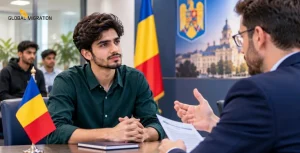
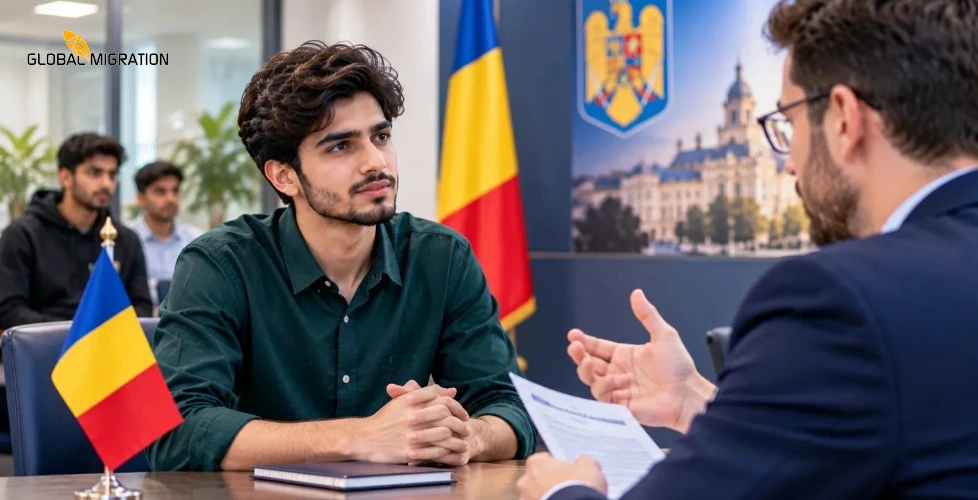
This Romania embassy interview is the real experience of a student applicant who attended the Romanian Embassy in Islamabad on 6 October 2026 for a Master’s in Artificial Intelligence. The questions, their order, the officer’s behaviour and the documents checked all come from the student’s own notes, and the sample answers were written by our team to help you prepare.
Applicant profileMaster’s in Artificial Intelligence
06-10-2026
Interview length: approximately 25 minutes. The officer also took fingerprints and a photograph at the end.
If you are applying for a Romania study visa from Pakistan, the Romania embassy interview in Islamabad is the step most students worry about. This account shows what it really looks like, from the first question to the final fingerprints.
Treat the sample answers as a guide only, and replace them with your own true details.
All 21 Questions, in the Exact Order They Were Asked
The interview opened with the purpose of the visit, then moved through documents, personal details, finances, knowledge of Romania and adaptation. Here is every question, one per line, in the order the officer asked them.
- Why are you visiting our embassy today?
- Why Romania?
- What is this UAE-based document?
- Are you married?
- Are you engaged?
- What is the duration of your study programme, and which university?
- What is your CGPA?
- From where did you do your bachelor’s?
- How much do you have in your bank account?
- Is the bank account under your name?
- How much do you earn?
- What is your current role?
- What do you know about Romania?
- Have you googled it?
- What about Bucharest?
- Are you married? (asked again)
- Are you engaged? (asked again)
- How will you fit yourself into Romanian culture?
- If you find a permanent job in Romania, will you stay there?
- Romania is very expensive. Will you be able to manage the budget there?
- Will you be able to adapt to Romanian culture, as it is different from Pakistan?
Sample Answers to Every Question
Here are the answers, grouped by topic. Where the applicant shared his real answer, it is included, followed by a sample answer prepared by our team.
Answer in one or two sentences, in your own words, and tell the truth. Wherever a sample contains a detail in [square brackets], replace it with your real information.
Purpose, university and programme
Why are you visiting our embassy today?
A sample answer is: “I am here to apply for a student visa for a Master’s in Artificial Intelligence at the Polytechnic University of Bucharest.” It works because it is one clear sentence with no extra story.
Why Romania?
A sample answer is: “Romania offers a recognised European Master’s in AI at a cost I can manage. The Polytechnic University of Bucharest has the programme that matches my background, and studying in the European Union will give me international exposure in my field.” It links the country to your programme, your budget and your career, so add one reason that is personal to you. If you are still comparing courses, English-taught programs in Romania are worth reviewing before you settle on an answer.
What is the duration of your study programme, and which university?
A sample answer is: “It is a [duration written in my admission letter] Master’s in Artificial Intelligence at the Polytechnic University of Bucharest.” Read your Letter of Acceptance carefully beforehand, because the programme name and duration in it are what the officer will compare with your answer.
Documents, bank account and sponsor
What is this UAE-based document?
The applicant explained that it was his brother’s employment contract with a company in the UAE, and that his brother was also co-sponsoring him. A sample answer is: “This is my brother’s employment contract with his company in the UAE. He is my co-sponsor and supports my education costs. I have also shown my own savings and income.” It explains whose document it is, how he is related to you and why it is in your file.
How much do you have in your bank account?
The bank statement showed PKR 2.2 million, so a sample answer is: “I have PKR 2.2 million in my account, as shown in my bank statement.” Quote the exact figure from your own file and never guess the number.
Is the bank account under your name?
A sample answer is: “Yes, the account is in my own name.” If it is not, say so honestly: “It is in my brother’s name. He is my co-sponsor, and his sponsor documents are in my file.” The officer is checking whose money it is, and a truthful, simple answer is always safest.
Marital status
Are you married? Are you engaged?
Answer according to your real status, for example: “No, I am not married,” and “No, I am not engaged.” When the officer asks the same two questions again, give exactly the same answer, calmly and without sounding annoyed. Officers repeat simple questions to check that your answers stay consistent, so repetition is normal and not a sign of a problem.
Academics, job and income
What is your CGPA?
The applicant answered 3.39, and a sample answer is simply: “My CGPA is 3.39.”
From where did you do your bachelor’s?
A sample answer is: “I completed my bachelor’s in [your degree] from [your university], in [city].” Give the degree, university and city exactly as they appear on your certificate.
How much do you earn?
The applicant said around PKR 170,000 to 180,000 per month after tax. A sample answer is: “My monthly salary is around PKR 170,000 to 180,000 after tax.” It should match your salary slips and bank entries.
What is your current role?
A sample answer is: “I work as [your designation] at [company], where I [one line about your main work].” Keep it to one sentence that matches your employment letter.
What do you know about Romania and Bucharest?
What do you know about Romania? Have you googled it?
When the student started to answer, the officer asked, “Have you googled it?” and the student said yes. A sample answer is: “Yes, I researched it online. Romania is a member of the European Union, its capital is Bucharest, its currency is the leu, and the official language is Romanian, which is a Romance language. I also read about its universities, student life and cost of living before choosing it.” Admitting that you searched is honest and perfectly fine, as long as you then add specific facts so the answer does not sound copied.
What about Bucharest?
The officer himself said the student must have googled this too, and the student agreed. A sample answer is: “Yes, I looked it up. Bucharest is the capital and the largest city, and a main centre for universities and technology companies. My university is located there, and I have checked [accommodation options and transport] near it.” Only mention what you have really checked, and read about your city properly before the interview.
Culture, future plans and budget
How will you fit yourself into Romanian culture?
A sample answer is: “I know the culture is different from Pakistan, so I will learn basic Romanian, respect local customs and join the international student community at my university. I am also ready to stay in touch with my family and balance both.”
If you find a permanent job in Romania, will you stay there?
A sample answer is: “My main goal is to complete my Master’s degree. After that, I will decide according to the rules and my situation. My family and professional ties are in Pakistan.” Say only what is true for you, because the answer is honest and does not promise something you do not mean.
Romania is very expensive. Will you be able to manage the budget there?
A sample answer is: “Yes. I have planned my monthly budget for rent, food, transport and university costs. I have PKR 2.2 million in savings, my own income, and my brother’s support as co-sponsor, so I can manage.” Pointing to real figures from your own file makes the answer credible, and understanding the financial requirements for a Romania study visa before the day helps every figure you quote match your documents.
Will you be able to adapt to Romanian culture, as it is different from Pakistan?
A sample answer is: “Yes. I am prepared for the differences. I will learn the language, follow local rules and respect the culture, and I have already read about daily life there.” It is the same idea as the earlier culture question, said briefly and calmly rather than as a new long speech.
The interview closed with some discussion about the Romanian budget, which was a conversation, not a question. Listen fully, then reply politely: “Yes, I understand, and I have planned my finances for that.”
How the Interview Went
Applicants were called in groups, and each person was then questioned individually at the counter. The officer was calm and patient. He never interrupted an answer and did not ask anything unrelated to the visa. The questions followed a clear pattern: why you are here, who you are, whether you can afford it, and whether you will adapt.
After the questions, the officer took the applicant’s fingerprints and photograph. While the applicant was standing there, the officer called a colleague, and the two discussed the file in Romanian. The colleague looked towards the applicant and said something to the officer, who then thanked the applicant and told him he could leave.
That final “thank you, you may go” is only the end of the interview, not a result. Embassy staff do not announce decisions at the counter, and the applicant himself says it is up to the embassy to grant the visa.
What the Officer Checked and What He Did Not Ask
The officer reviewed photocopies of the application file prepared for the Romania study visa during the interview. He asked for just one original, the police certificate, looked at it for about two seconds and returned it.
He did not ask about the sponsor in detail, the university or the course, because the student had already explained why he needed the course in his earlier answers. There were no irrelevant or trick questions either, and every question connected to the visa decision.
Another officer may ask about your university, your modules or your sponsor, so prepare all of them anyway. A complete, well-organised file helps, which is where proper university application support makes a difference. Applicants aiming for medicine rather than a Master’s follow a different route, explained under MBBS in Romania.
Key Lessons From This Romania Embassy Interview
The biggest lesson is consistency. Marital status was asked twice, and repeated questions are a simple way of testing whether your story stays the same. It also pays to know your file, because the officer noticed the UAE document at once, so you should be able to explain every page you submit.
Knowing Romania properly matters just as much. “Have you googled it?” shows that shallow answers are noticed, so read beyond a single search. Short, clear answers kept this conversation calm, while long speeches only add risk. Because the officer said Romania is expensive and talked about the budget, have a monthly cost plan ready, and carry every original in order even though only the police certificate was demanded this time.
Never prepare false answers or borrowed documents. Officers are experienced, and an inconsistency can cost more than a simple, honest answer. Use this guide to prepare, not to rehearse a script.
 Practise with us
We Will Help You Prepare
A calm interview starts with a strong file. Share your profile and Global Migration Advisors will tell you honestly what to fix before you apply.
Chat on WhatsApp- Mock interviewsPractise questions like the 21 above with a trainer and receive honest feedback.
- Document reviewWe check that your bank statement, sponsor papers and admission letter tell one consistent story.
- Spoken fluency practiceBuild clear, calm English answers with professional trainers.
Romanian Student Visa Interview Checklist
Begin with your admission file. Carry your offer or acceptance letter and know the programme duration, tuition fee and university location by heart. Applicants still comparing options in the capital can also look at the University of Bucharest alongside technical universities like UPB.
Next come your finances and personal papers. Bring bank statements, sponsor documents and a clear monthly budget for rent, food and transport, together with degree certificates, transcripts, your CGPA, employment letter, salary slips and the original police certificate.
Then prepare yourself. Read about Romania, Bucharest, student life, language and culture, and practise speaking clearly and calmly. Confidence in spoken English helps, and a spoken English course or IELTS and PTE coaching can build it. Finally, follow the current steps on the official Romanian e-visa portal, because requirements change.
Frequently Asked Questions About the Romanian Embassy Interview
Is this a real Romanian embassy interview?
Yes. The questions, order, officer behaviour and documents come from a real applicant who attended the Romanian Embassy in Islamabad on 6 October 2026. The sample answers are our team’s suggestions and are labelled as such.
How long is the Romanian student visa interview in Islamabad?
In this case about 25 minutes, including fingerprints and a photograph. It can vary by applicant and by day.
Will they ask about my university and course?
Not in this interview, but another officer may. Know your programme, duration and university well, and compare options such as English-taught programs in Romania before you apply.
Is the result announced at the embassy?
No. The officer thanked the applicant and told him he could leave. The decision comes after the interview, and processing time depends on the embassy.
Which original documents might be asked?
Here, only the original police certificate was requested. Carry all originals anyway, because requests can differ between officers.
Can a brother be a co-sponsor?
This applicant submitted his brother’s UAE employment contract as co-sponsor support and explained it when asked. Acceptance depends on each case, so confirm sponsor requirements before applying, or contact us for guidance.
Does this guarantee a visa?
No. It is one applicant’s account, and the final decision belongs to the embassy. Use it to prepare, not to predict.
Where can I compare other European countries?
Applicants still deciding between countries can compare destinations under study in Europe.
Final Thoughts: Be Clear, Consistent and Honest
This interview shows that the Romanian embassy process is straightforward when you are prepared. The officer wanted to know why the student was applying, whether he could fund his studies, whether his answers stayed consistent and whether he understood life in Romania. He never tried to trap him. At the end, the student knew that the decision rests with the embassy.
At Global Migration Advisors in Lahore, we guide Pakistani students from choosing a university to the visa decision, including visa assistance and a clear plan to study in Romania. If you want a professional opinion before you apply, speak with professional study abroad consultants for Romania who can review your file. Share your profile with us, and we will help you prepare a file and an interview you can be confident about.
This article is based on one applicant’s self-reported experience and is for general guidance only. Embassy procedures, requirements and officers change over time.