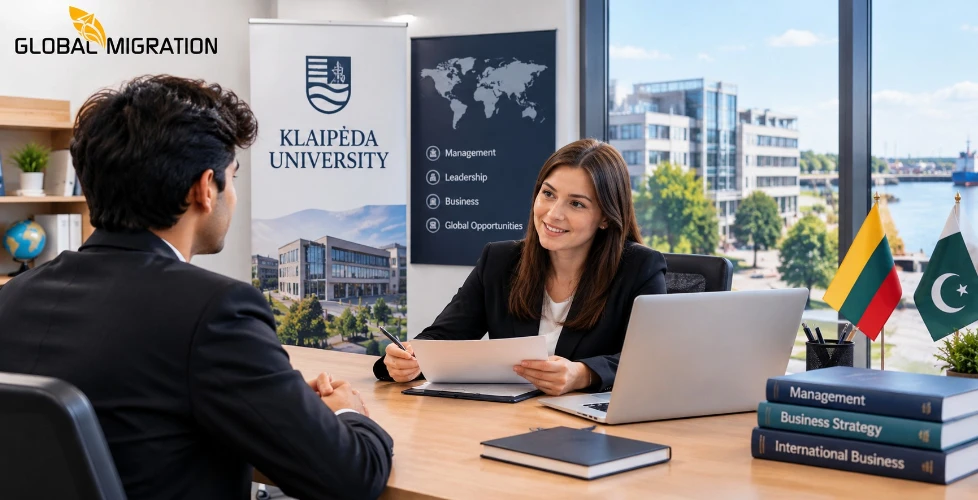
If you want to study in Lithuania, the university interview is one of the most important steps in your journey. Klaipėda University, in Lithuania’s port city on the Baltic Sea, interviews applicants to confirm that they understand the program, have genuine reasons for studying abroad, and can support themselves financially.
At Global Migration Advisors, we prepare Pakistani students for these interviews every intake. Below are the questions we see most often for the BSc Management program, why interviewers ask them, and how to answer well when you study in Lithuania from Pakistan.
A note before you start: do not memorize these answers word for word. Interviewers can tell when an answer is rehearsed. Use the samples as a structure, then put the answers in your own words with your own details.
1. “Show me your passport.” / “Show me all pages of your passport.”
Why they ask: To verify your identity and to see your travel history.
- Keep your original passport next to you, with every page clean and visible.
- Show each page slowly when asked, including the blank ones.
- If you have previous visa refusals or travel stamps, be ready to explain them honestly. Never hide anything.
2. “Introduce yourself.”
Why they ask: To check your English and see how clearly you communicate.
Sample answer: “Good morning. My name is [Name], and I am from [City], Pakistan. I completed my intermediate in [field] with [result]. My father is [profession], and he will be supporting my studies. I am interested in business and management because [genuine reason], and I want to build a career in [field]. I chose Klaipėda University because of its management program and its location in a busy port city.”
Keep it under a minute. Cover your education, your family background, and your goals as you plan to study in Lithuania.
3. “Why this course?”
Why they ask: To see whether you chose management deliberately or just picked something.
Sample answer: “I chose management because every organization, whether a small business or a large company, depends on people who can plan, organize, and make decisions. I enjoy solving problems and working with teams. This program will give me a strong foundation in business, and I plan to use it to [specific goal, such as working in operations, starting a business, or joining a family company].”
Connect the course to a real goal. “I like it” is not enough.
4. “What are the course curriculums?”
Why they ask: To check that you researched the program.
What to do: Read the program page on the Klaipėda University website and write down the main subjects. A BSc Management program typically covers areas such as principles of management, economics, accounting, marketing, statistics, business law, organizational behavior, and project management. Check the official curriculum for your intake and name the subjects as the university lists them.
Mention two or three subjects you are most excited about and explain why, something every student who wants to study in Lithuania from Pakistan should prepare in advance.
Lithuania Embassy Pakistan Student Visa
Understand the embassy side of the process that follows a successful university interview.
5. “What is business analytics?”
Sample answer: “Business analytics is the process of using data to understand what is happening in a business and to make better decisions. Instead of guessing, a company looks at sales figures, customer behavior, or costs, finds patterns, and uses those patterns to plan what to do next.”
6. “How do you analyze data?”
Sample answer: “First, I define the question I want to answer. Then I collect the relevant data and clean it, which means removing errors and duplicates. Next, I organize it, look for trends and patterns, and draw conclusions. Finally, I present the findings in a simple way, such as a chart or summary, so decision-makers can act on them. I can use tools like Excel for this.”
7. “How do you analyze data without using tools?”
Why they ask: To test your thinking, not your software skills.
Sample answer: “I can do it manually. I would write the data in a table, calculate simple measures such as totals, averages, and percentages, and compare them across time periods or categories. I would also look for the highest and lowest values and ask why they differ. Tools make the work faster, but the logic is the same.”
8. “Give me a real example.”
Sample answer: “Imagine a small clothing shop that records daily sales. By comparing sales across the month, the owner notices that weekends bring in much more revenue than weekdays. He decides to keep more stock for weekends and offer discounts on weekdays to attract customers. That is a decision based on data.”
Use a simple example from your own life or family business if you can. It sounds more genuine, especially when you study in Lithuania from Pakistan and your interviewer is testing authenticity.
9. “What is leadership?”
Sample answer: “Leadership is the ability to guide and motivate people toward a shared goal. A leader does not just give orders. A leader sets direction, listens to the team, takes responsibility, and helps others do their best work.”
10. “How do you become a good leader?”
Sample answer: “By communicating clearly, listening to others, being honest, and taking responsibility for mistakes. A good leader keeps learning and gives credit to the team. I try to practice this already, for example when [give a real example, such as a group project, a sports team, or helping in a family business].”
11. “Why did you choose Klaipėda University?”
Why they ask: To make sure you picked this university on purpose.
What to mention:
- The management program and its structure
- The university’s location in Klaipėda, a major Baltic Sea port, which makes it a good setting for studying business, trade, and logistics
- A smaller city environment with lower living costs than larger European capitals
- Lithuania’s membership in the European Union and the opportunities that brings
- Anything you actually found in your research, such as student life or international programs
Be specific. Generic answers like “it is a good university” are weak for anyone who wants to study in Lithuania.
12. “What opportunities does this university give students?”
Sample answer: “From my research, the university offers [programs, facilities, or student activities you found on its website]. I am especially interested in [for example, international student networks, exchange opportunities, or practical training].”
Research this on the official website before your interview, so you can name real opportunities.
13. “What opportunities does the university offer besides this course?”
What to do: Mention things outside your degree, such as student clubs, sports, language courses, exchange programs, and the chance to learn Lithuanian. This shows you plan to be an active student and want to integrate into life in Lithuania.
14. “What do you know about Lithuanian culture?”
What to know:
- Lithuanian is a Baltic language, one of the oldest living Indo-European languages.
- The Song Festival (Dainų šventė) is a major national tradition, recognized by UNESCO.
- Basketball is hugely popular, almost a national passion.
- Traditional foods include cepelinai (potato dumplings) and šaltibarščiai (cold beetroot soup).
- Amber is a well-known national symbol, found along the Baltic coast.
Pick two or three items and speak about them naturally. Do not recite a list, whether you study in Lithuania from Pakistan or anywhere else.
Lithuania Spouse Visa Documents List Pakistan 2027
If you’re bringing a spouse along, check this detailed documents checklist too.
15. “Explain the history of Lithuania.”
A short, accurate overview you can use: “Lithuania has a long history. The Grand Duchy of Lithuania was one of the largest states in medieval Europe, and later it joined Poland in a union. In the late 1700s, the territory was divided among neighboring powers. Lithuania declared independence on 16 February 1918. It was occupied by the Soviet Union during the Second World War and remained under Soviet control until it restored its independence on 11 March 1990, the first Soviet republic to do so. In 2004 it joined both the European Union and NATO, and in 2015 it adopted the euro.”
You can add a line about Klaipėda itself, which was historically known as Memel and became part of Lithuania in the 1920s. If you are unsure of a date, say “around” rather than guessing.
| Question | Why They Ask | What to Include | Category | Tip |
|---|---|---|---|---|
| Show me your passport | Verify identity and travel history | Clean, visible pages, honest explanation of any stamps | Identity check | Never hide previous refusals |
| Introduce yourself | Check English and communication clarity | Name, city, education, sponsor, goals | Communication | Keep it under a minute |
| Why this course? | Confirm a deliberate course choice | A real, specific goal tied to the course | Motivation | “I like it” is not enough |
| Why this university? | Confirm genuine research | Programme, location, EU membership, specific findings | Research | Avoid generic answers |
| Total monthly expenses | Test financial realism | Breakdown matching your financial documents | Financial readiness | Numbers must match your documents |
16. “What is your total monthly expense for living in Klaipėda?”
17. “Explain every expense step by step.”
This pair is where many students struggle. Interviewers want to see that you have a realistic plan and know where your money will go when you study in Lithuania from Pakistan.
A sample structure (figures are approximate, so check current costs before your interview):
| Expense | Approximate Monthly Cost | Category | Why It’s Asked | Note |
|---|---|---|---|---|
| Accommodation (dorm or shared room) | €120 to €250 | Housing | Largest single monthly cost | Confirm current rates before your interview |
| Food and groceries | €150 to €250 | Daily living | Tests realistic budgeting | Cooking at home keeps this lower |
| Local transport | €15 to €30 | Daily living | Shows awareness of student discounts | Students often get reduced public transport rates |
| Mobile and internet | €10 to €15 | Utilities | Small but expected detail | Easy to overlook in planning |
| Study materials and personal items | €30 to €60 | Academic and personal | Shows a complete, realistic plan | Include this alongside emergencies |
How to answer: “I have planned my expenses carefully. Accommodation will be about [amount], and I will [stay in a dorm or share a flat]. I expect to spend about [amount] on groceries by cooking most of my meals. Transport will be about [amount], since students can use public transport at reduced rates. Mobile and internet will be about [amount], and I have kept [amount] aside for study materials and emergencies. In total, I estimate [amount] per month. My father will support these costs, and he has arranged the required funds in his account.”
Your numbers must match your financial documents, so work them out with your consultant before the interview. Real prices change, so confirm the latest accommodation and living costs before you study in Lithuania.
18. “Do you have any questions for us?”
Never say “no.” Prepare one or two sensible questions, such as:
- “Does the university offer Lithuanian language courses for international students?”
- “Are there student clubs or events that help international students integrate?”
- “What support is available for international students during the first semester?”
Avoid asking about work permits or part-time jobs in a way that sounds like your main goal is to earn money, especially if you want to study in Lithuania from Pakistan with a genuine academic plan.
Quick Interview Tips
A short checklist to review before you go into any interview to study in Lithuania:
- Speak clearly and calmly. Confidence matters more than perfect English.
- Tell the truth. Inconsistencies between your answers and your documents cause problems.
- Know your documents. Be ready to explain your sponsor, your funds, and your education.
- Research the university and city. Specific details show genuine interest.
- Practice out loud. Do mock interviews with your consultant or a friend.
- Test your technology. Check your internet, camera, and microphone before an online interview.
- Dress professionally. Treat it like a real meeting.
Prepare with Global Migration Advisors
Interviews decide a lot, and nerves can undo good preparation. At Global Migration Advisors, we run mock interviews for each student, tailor questions to your chosen university and program, and help you build honest answers that fit your own background and documents.
Whether you are applying to Klaipėda University or another Lithuanian institution, our team supports you from admission to your Lithuania student visa, whether you study in Lithuania from Pakistan or any other country.
Lithuania Spouse Visa From Pakistan: Complete 2027 Guide
Planning to bring your spouse along after your interview? This covers the full process.
Contact Global Migration Advisors today to book your interview preparation session.
FAQs: Klaipėda University Interview Questions
It confirms you understand the program, have genuine reasons for studying abroad, and can support yourself financially, rather than just testing academic knowledge.
No. Interviewers can tell when an answer is rehearsed. Use sample answers as a structure, then put them in your own words with your own real details.
Be ready to explain it honestly if asked about your passport or travel history. Never hide it, since inconsistencies cause far more damage than an honest explanation.
Students typically budget roughly €350 to €650 a month in total, covering accommodation, food, transport, utilities, and study materials, though you should confirm current costs before your interview.
Never say “no.” Prepare one or two genuine questions in advance, such as asking about language courses or support for international students, before you study in Lithuania from Pakistan.
Final Thoughts
The Klaipėda University interview rewards students who know their course, their city, their budget, and their own story, and who can explain all of it honestly in their own words. Preparation and genuine research matter far more than a perfect accent or a memorized script.
If you’re getting ready for your own interview, practice out loud, know your documents, and treat it as a real conversation. Get personal advice today on your study in Lithuania plans.