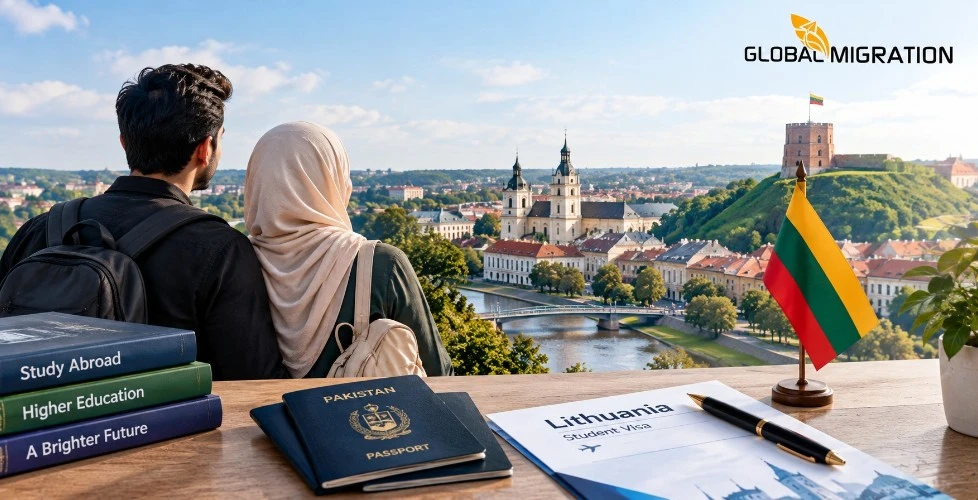
Studying abroad is a big step. For many Pakistani families, it becomes a joint decision. If you plan to study in Lithuania, you may also want to bring your spouse along. The good news is simple: Lithuania lets married Master’s and PhD students sponsor a spouse through family reunification.
At Global Migration Advisors, we guide students through every stage of this journey. We have helped many families who wanted to study in Lithuania from Pakistan with their spouse by their side. This guide gives you a clear, step-by-step roadmap. Read it fully before you start your application.
Why Lithuania Is a Smart Choice for Pakistani Families
Lithuania offers real value for Pakistani students. Tuition fees stay lower than in most Western European countries. Many programs are taught fully in English, so language is rarely a barrier. This combination is why more families choose to study in Lithuania from Pakistan each year.
A Lithuanian degree carries full EU recognition. Graduates can use it across Europe or back home in Pakistan. For families planning a long-term future together, the ability to study in Lithuania with a respected qualification counts for a lot.
Beyond academics, Lithuania is known for its safety and welcoming communities. Cities like Vilnius and Kaunas host growing numbers of international students. Settling in as a couple feels manageable when you study in Lithuania in a country built for newcomers.
Who Can Bring a Spouse to Lithuania?
Not every student can sponsor a spouse. Lithuania’s rule is clear on this point. Only Master’s and PhD students qualify for family reunification. So if you want to study in Lithuania with your spouse, aim for a postgraduate program from the start.
The financial rule is tied to Lithuania’s minimum wage, and this wage changes every year. In 2026, it stands near €1,153 per month. This number decides how much money you must show for your spouse and children when you study in Lithuania from Pakistan. We explain the exact math further below.
Always confirm your program level before applying. Only Master’s and PhD admissions unlock the spouse visa route. A quick check now saves months of stress later.
Step 1: Secure Your Own Student Visa First
This is the golden rule for anyone who wants to study in Lithuania with a spouse: never file your spouse’s visa alongside your own. Apply for your own residence permit first. Wait for approval. Only then start your spouse’s file.
Why does the order matter so much? Your spouse’s eligibility depends on your approved status. The Migration Department needs proof that you are already a legal student. This sequencing rule applies to every family hoping to study in Lithuania from Pakistan.
This order also protects your file. If something needs fixing in your own application, you can fix it without risking your spouse’s case. Two applications competing in the same queue, built on an unconfirmed base, almost always causes delays for those trying to study in Lithuania with their spouse.
- Apply for your Master’s or PhD program and secure your university offer letter.
- Submit your own national (D) visa or residence permit application through Migris.
- Wait for approval and receive your own student visa or TRP.
- Only then start your spouse’s family reunification application.
Skipping steps or rushing this order is the most common mistake we see. It almost always backfires. Families who patiently follow the correct sequence to study in Lithuania from Pakistan reach approval much faster.
Start your document apostille process the moment your own visa gets approved. Apostille queues in Pakistan move slowly, and early action avoids last-minute stress.
Step 2: The Spouse’s Family Reunification Application
Once your visa is confirmed, it’s time for your spouse. This application goes through Migris, Lithuania’s online migration portal. Every family that wants to study in Lithuania together must file this application digitally, before any visit to a visa centre.
The required documents are specific, and missing even one can delay the whole file. Below is the core checklist we use with clients who plan to study in Lithuania from Pakistan.
- Bank statement showing sufficient funds to meet the subsistence requirement
- Account maintenance letter from the bank, confirming the account is active
- Spouse’s TRP reference, since the application is built around your approved residency
- University offer letter, the primary applicant’s admission letter
- Family Registration Certificate (FRC)
- Marriage Registration Certificate (MRC)
- Police Clearance Certificate (PCC)
Every one of the FRC, MRC, and PCC must carry a MOFA apostille. This step is non-negotiable. Apostille processing in Pakistan can take days or weeks, so anyone who wants to study in Lithuania with their spouse should start this process early.
The Financial Requirement: How Much Money Do You Need?
This is the question every client asks first: how much money do you need to show? The answer follows a fixed formula tied to Lithuania’s minimum wage, and it applies whether you study in Lithuania from Pakistan alone or with your family.
Never rely on funds deposited right before your appointment. Show a stable account history, ideally three to six months old, to strengthen your file.
For the spouse, you must show funds equal to €1,153 multiplied by 12 months. For each child, the number is €577 multiplied by 12 months. These funds must look stable in the account, not freshly deposited, especially for families who plan to study in Lithuania together.
| Applicant | Monthly Amount | Months Required | Total Amount Needed | Extra Document Needed |
|---|---|---|---|---|
| Spouse (Adult) | €1,153 | 12 | €13,836 | Bank statement + maintenance letter |
| First Child | €577 | 12 | €6,924 | Same as spouse |
| Second Child | €577 | 12 | €6,924 | Same as spouse |
| Primary Student (You) | Per own TRP rule | 12 | Varies by university | University offer + TRP proof |
| Family of 4 (Example) | Combined | 12 | ≈ €27,684 | Full apostilled document set |
These figures update yearly with Lithuania’s minimum wage. Always check the latest number before you apply. A small gap in funds can lead to rejection, so budget with a safety margin if you want to study in Lithuania from Pakistan without financial surprises.
Preparing Your Application File Correctly
Paperwork mistakes are common and costly. Many families lose their appointment slot over small errors. VFS centres are strict about physical file preparation for every applicant who wants to study in Lithuania with a spouse.
You need two complete sets of documents to move forward smoothly with your plan to study in Lithuania.
- One original file, containing the genuine, apostilled originals
- One photocopy file, printed on 80-gram paper, in black and white
Skipping this rule can get your appointment rejected on the spot. Wrong paper weight or color copies cause real problems. Prepare both sets well before travel if you plan to study in Lithuania from Pakistan through a VFS centre abroad.
How Long Does the Whole Process Take?
Timing is one of the biggest questions for families planning to study in Lithuania together. University admission alone can take four to eight weeks after you submit your documents. Your own student visa review adds a few more weeks on top.
Once your visa is approved, your spouse’s family reunification file typically takes several more weeks through Migris. Add apostille processing time in Pakistan, and the full journey to study in Lithuania from Pakistan with your spouse can span three to six months in total.
This is why early planning matters so much. Start your university applications and document preparation as soon as possible. Families who plan ahead to study in Lithuania rarely face last-minute stress.
Health Insurance and Other Practical Requirements
Health insurance is another piece families often overlook. Your spouse will typically need valid health insurance coverage as part of the residence permit file. This applies to every family planning to study in Lithuania from Pakistan together.
Some universities also require proof of accommodation before releasing final admission documents. Booking even temporary housing early can prevent delays in your paperwork. Families who study in Lithuania with a spouse should treat this as one more item on the checklist, not an afterthought.
Language requirements for family members are usually minimal at this stage. Your spouse does not need Lithuanian language proof to receive a residence permit. This makes the process to study in Lithuania together more approachable for most Pakistani households.
Choosing a VFS Centre: Azerbaijan, Malaysia, or Thailand
Lithuania has no visa centre in Pakistan for this category. Spouses must travel to a regional VFS Global centre instead. Three options exist for families who study in Lithuania together: Baku, Kuala Lumpur, and Bangkok.
In Thailand and Malaysia, the centre collects both the VFS service fee and the €135 Migris fee together. This means a single payment at the counter, which keeps appointment day simple for anyone planning to study in Lithuania from Pakistan.
In Baku, the process works differently. The centre only accepts the VFS service fee, and the €135 Migris fee must be paid separately at a bank. Families choosing where to study in Lithuania with a spouse often prefer Thailand or Malaysia for this simpler payment setup.
Special Rules for Families With Children
If children are travelling too, one more detail matters. The rule for collecting a child’s Temporary Residence Permit card differs by centre. This detail matters for every family hoping to study in Lithuania from Pakistan with kids in tow.
- At the VFS Thailand centre, parents are generally permitted to collect their child’s TRP card.
- At the VFS Baku centre, the child is typically required to be present in person.
Because these rules can shift, always email the exact VFS centre first. Ask directly if the child must attend in person. A written confirmation avoids wasted travel for families planning to study in Lithuania together.
| VFS Centre | Country | Fee Collected On-Site | Migris Fee Payment | Child TRP Collection Rule |
|---|---|---|---|---|
| Bangkok | Thailand | Service fee + Migris fee | Paid at centre | Parent may collect on child’s behalf |
| Kuala Lumpur | Malaysia | Service fee + Migris fee | Paid at centre | Parent may collect on child’s behalf |
| Baku | Azerbaijan | Service fee only | Paid separately at bank | Child must be present |
| Any Centre (General) | Regional | Varies by centre | Confirm by email first | Confirm by email first |
| Recommended Approach | — | Prefer single payment | Budget extra time in Baku | Always verify in writing |
Choosing the right centre saves time, money, and stress. This small planning step matters a lot for families who study in Lithuania from Pakistan with young children. A short email today can prevent a wasted trip tomorrow.
Common Mistakes to Avoid
We have handled many real cases over the years, and certain mistakes appear again and again among applicants who want to study in Lithuania with a spouse. Most of these errors are avoidable with early planning and the right checklist.
- Applying for the spouse visa before the main applicant’s student visa is approved
- Submitting FRC, MRC, or PCC documents without MOFA apostille
- Underestimating how long apostille attestation takes in Pakistan
- Showing insufficient or recently-deposited funds that don’t reflect genuine stability
- Bringing photocopies that aren’t on the required 80-gram, black-and-white paper
- Assuming Migris fee payment works the same way at every VFS centre
- Not confirming in advance whether a child must be present for TRP collection
Avoiding these simple mistakes can save months of delay. A careful, well-planned file always moves faster through the system for anyone who wants to study in Lithuania from Pakistan without setbacks.
Life in Lithuania: Settling In With Your Spouse
Once your spouse’s TRP is approved, daily life begins. Finding accommodation near your university is usually the first task. Many students who study in Lithuania from Pakistan choose shared apartments to manage costs early on.
Spouses on a family reunification permit generally gain the right to work in Lithuania. This can ease the financial pressure on a single-income household. It is one more reason so many couples choose to study in Lithuania together rather than apart.
Cost of living stays moderate compared to Western Europe. Groceries, transport, and rent outside the capital are especially affordable. Planning your monthly budget early makes the move to study in Lithuania from Pakistan smoother for your whole family.
Why Work With Global Migration Advisors
Coordinating a Master’s or PhD admission with a spouse visa is a lot to manage alone. University requirements, MOFA apostille chains, Migris filings, and VFS centres across three countries all need attention when you study in Lithuania with your family.
At Global Migration Advisors, we specialize in exactly this kind of layered process. We help you choose the right program, sequence your visas correctly, and prepare your files to the exact VFS specification needed to study in Lithuania from Pakistan.
If you are serious about your plan to study in Lithuania with your spouse, expert guidance removes the guesswork. Our team has walked many families through this exact journey already.
Every family’s situation looks a little different. Your university choice, your financial profile, and your travel plans all shape the right approach. That is why families who study in Lithuania from Pakistan with our support get a plan built around their own timeline, not a generic checklist.
Frequently Asked Questions
Can Bachelor’s students bring their spouse to Lithuania?
No. Only Master’s and PhD students currently qualify for spouse sponsorship under family reunification rules. Bachelor’s applicants should plan for a postgraduate degree if this is a priority.
How much money do I need to show for my spouse?
You need funds equal to €1,153 multiplied by 12 months, based on the current minimum wage. This figure rises every year, so always confirm the latest rate before applying.
Where do Pakistani applicants submit the spouse visa?
There is no Lithuanian visa centre in Pakistan for this category. Applicants use VFS centres in Baku, Kuala Lumpur, or Bangkok, and each one has slightly different fee-collection rules.
Do I need to apostille my marriage certificate?
Yes. The Marriage Registration Certificate, Family Registration Certificate, and Police Clearance Certificate all need a MOFA apostille before submission, and this step often takes longer than applicants expect.
Can I apply for my spouse’s visa at the same time as mine?
No. Always wait for your own visa approval first, then start your spouse’s application. Filing both together is one of the most common causes of avoidable delays.
Final Thoughts
Studying abroad with your spouse takes careful planning. Every step, from admission to apostille to VFS appointment, connects to the next. Anyone who wants to study in Lithuania should treat this as one connected journey, not separate tasks.
This guide covers the full path to study in Lithuania from Pakistan with your family by your side. If you want expert help at every stage, our team of professional study abroad consultants for Lithuania is ready to guide you.
Ready to start your journey? Contact Global Migration Advisors today, and let us build your complete family application plan, step by step.