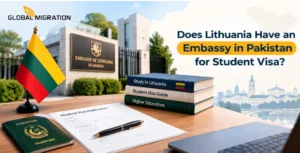
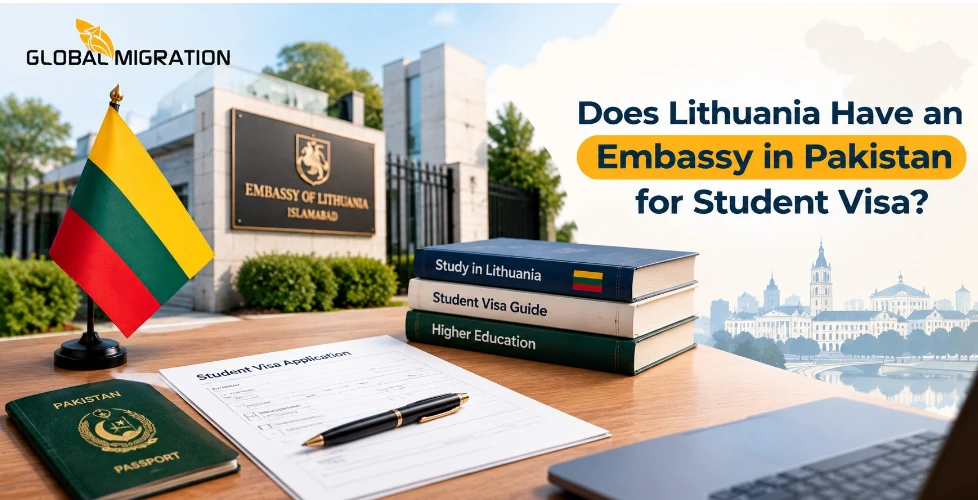
Searching for Lithuania’s embassy in Pakistan? Here is the short answer. There isn’t one.
Lithuania has no embassy or consulate anywhere in Pakistan. That single fact changes everything about how you study in Lithuania compared to countries like Romania or Italy.
Lithuania has quietly become a top pick for Pakistani students. The tuition is affordable. The degrees are EU-recognized. And it sits right inside the Schengen zone.
But before you fall in love with Vilnius or Kaunas, understand one thing. Without a local embassy, every plan to study in Lithuania from Pakistan runs through an online system, not an embassy counter.
The whole process runs through Migris. That’s Lithuania’s official online migration portal.
It also involves VFS Global centres. But not in Pakistan — in third countries. This is the real shape of the journey for anyone who wants to study in Lithuania this year.
At Global Migration Advisors, we’ve walked dozens of students through this exact process. We know where students save money. We also know where they lose it.
This guide breaks down the real steps. The Migris system. The VFS biometric centres. The “double trip” rule. And the FIA’s tighter checks on outbound travel.
Why Lithuania Doesn’t Have an Embassy in Pakistan
Unlike Romania, Sweden, or Italy, Lithuania never opened a diplomatic mission in Islamabad. That means no counter to walk into. No local biometric desk either.
Every national visa and residence permit case for students who study in Lithuania from Pakistan is handled online first, then finished at a VFS centre abroad.
This setup isn’t unique to Pakistan. Several countries without a Lithuanian mission follow the same third-country biometric model.
Still, it adds real cost. It adds planning. And it adds risk compared to countries with a direct embassy option.
Never book your third-country visit visa before Migris confirms your interview outcome. Students who jump ahead often end up with a visa window that expires before their biometric slot even opens.
So Where Do Pakistani Students Actually Apply?
Since there’s no embassy, the process breaks into three clear steps. No single visit covers it all.
First comes the online Migris application. Then biometric enrollment abroad. Then permit collection. That’s the real path to study in Lithuania as a Pakistani applicant.
Step one starts once you have your admission letter. You submit your application directly through Migris.
Step two is biometrics. You travel to an approved VFS Global centre in a third country. Step three is permit collection, back at that same centre.
In short, the usual “embassy visit” is replaced by two trips abroad plus one online application.
That’s exactly what makes plans to study in Lithuania from Pakistan more demanding than a typical European application.
| Step | What Happens | Where | Typical Duration | Who’s Involved |
|---|---|---|---|---|
| 1. Admission | University offer letter issued | Lithuania (online) | 2–6 weeks | University + student |
| 2. Migris Filing | Residence permit application submitted | Online portal | 1–2 weeks | Student / advisor |
| 3. Interview | Migris interview stage | Online / remote | 1 day | Student |
| 4. Biometrics | Fingerprints & photo submitted | Third-country VFS centre | 1 trip | Student (in person) |
| 5. TRP Collection | Residence permit card collected | Same VFS centre | 1 trip | Student (in person) |
Table 1: The five-step journey for Pakistani applicants who study in Lithuania without a local embassy.
What Is Migris, and Why It Matters
Migris is the digital backbone of Lithuania’s immigration system. Every application flows through it.
Once you have an admission offer, your next move is filing through Migris — not a physical counter.
During filing, you must pick a VFS Global centre from Migris’s own approved list. Not just any office.
Only the centres Migris authorizes will appear as valid options. Choosing right the first time saves weeks of delay for anyone trying to study in Lithuania on schedule.
Screenshot your approved VFS centre selection the moment Migris confirms it. Centres occasionally get reshuffled, and having proof avoids confusion later.
Which VFS Centres Do Pakistani Students Usually Pick?
Pakistan has no VFS centre for Lithuanian biometrics. So students travel abroad.
Based on approved Migris listings, most applicants pick from three countries when they plan to study in Lithuania from Pakistan.
- Malaysia — easier visit visa approval and solid VFS infrastructure.
- Thailand — accessible with reasonable approval rates.
- Azerbaijan — closer geographically, shorter and cheaper flights.
Each option has its own visit visa rules and costs. Weigh them before booking anything.
None of these routes are officially “easy.” Each still needs proper documentation and timing.
That’s why students who plan to study in Lithuania often work with an advisor for this stage specifically.
The Two-Trip Reality: Biometrics, Then TRP Collection
This is where many students get caught off guard. It’s not a one-trip process.
Anyone who plans to study in Lithuania from Pakistan must travel abroad twice, not once.
Trip one is for biometrics. Fingerprints and a photo, taken at your assigned VFS centre.
Trip two comes later, once the residence permit is approved. You return to the same centre to collect the physical card.
Some students try to save money with a connecting flight straight to Lithuania after trip one. Skipping the return leg entirely.
That shortcut sounds efficient. But recent FIA policy changes have made it far riskier for anyone hoping to study in Lithuania this way.
Always keep a refundable or flexible return ticket for your biometric trip. It satisfies FIA checks and protects you financially if plans shift.
FIA’s Tightened Return Ticket Policy: What Changed
Pakistan’s FIA has tightened checks at the airport. Especially for outbound “visa run” style travel.
Students flying to Malaysia, Thailand, or Azerbaijan are now commonly asked for a confirmed return ticket to Pakistan.
This applies even if your real intention is to continue onward toward Europe.
The old trick of booking a one-way or connecting ticket straight through is no longer reliable for those who plan to study in Lithuania from Pakistan.
Students who can’t show a clear, return-inclusive travel plan risk getting offloaded before departure.
That means losing the visit visa fee. The hotel booking. Sometimes even the entire VFS appointment slot.
Practical takeaway: budget for a return ticket, even if you never plan to use it.
Or better, work with an advisor who can structure a fully FIA-compliant itinerary from day one.
The Real Cost of a Third-Country Biometric Route
This is where Lithuania gets expensive compared to embassy-access countries.
Each trip to a biometric country typically costs PKR 300,000 to 400,000. That’s before tuition even starts.
That figure covers round-trip airfare, hotel stays, the third country’s visit visa fee, travel insurance, and local transport.
Since this cost repeats for both trips, the full visa-stage budget for anyone who wants to study in Lithuania can reach PKR 600,000 to 800,000.
The real danger shows up after a rejection. If Migris refuses the case post-biometrics, that trip’s cost is gone.
Same story if the third-country visit visa itself gets denied. Nothing to show for the spend.
This single risk is the biggest reason some students, despite real interest, choose other European destinations instead.
Careful planning is what separates a smooth case from a costly one for those set on Lithuania.
| Cost Item | Applies To | Estimated Range (PKR) | Refundable? | Risk If Rejected |
|---|---|---|---|---|
| Round-trip airfare | Both trips | 60,000 – 120,000 | Rarely | High |
| Hotel stay | Both trips | 25,000 – 60,000 | Sometimes | Medium |
| Third-country visit visa | Biometric trip | 15,000 – 40,000 | No | High |
| Travel insurance | Both trips | 5,000 – 12,000 | No | Low |
| Local transport & misc. | Both trips | 10,000 – 20,000 | No | Low |
Table 2: Approximate cost breakdown for the third-country biometric route to study in Lithuania.
Timing Your Visit Visa: A Detail Students Get Wrong
One of the most costly mistakes is bad timing. Between the Migris interview, the visit visa, and travel dates.
Getting this sequence right matters more than most students expect.
First, submit your Migris application and complete the interview. Migris usually takes about 30 days after that to respond.
Only once you know your approved biometric slot should you lock in visit visa dates for Malaysia, Thailand, or Azerbaijan.
Your visit visa validity must match your confirmed appointment. Not too early, not too tight either.
Apply too soon, and dates won’t line up. That forces a costly reapplication or a missed appointment for someone trying to study in Lithuania from Pakistan.
How Global Migration Advisors Helps
Given how layered this process is, having the right guidance changes outcomes.
We track which VFS centres are currently active on Migris. We know realistic visit visa approval patterns for Malaysia, Thailand, and Azerbaijan.
We help structure FIA-compliant itineraries with proper return tickets. We also sequence your Migris interview, outcome timeline, and visit visa dates correctly.
Full cost planning is part of the package too. No surprise expenses halfway through your plan to study in Lithuania.
Lithuania is still worth it. EU-recognized degrees. English-taught programs. Lower tuition than Western Europe.
It just needs the visa logistics planned correctly, from day one, if you want to study in Lithuania from Pakistan without losing money along the way.
Why Lithuania Still Makes Sense Financially
After reading about two trips and tighter FIA checks, some students hesitate. That’s fair.
But compare the full cost against Western Europe, and the numbers still favor those who study in Lithuania.
Tuition in Lithuania runs far lower than the UK, Germany, or the Netherlands for similar EU-recognized degrees.
Living costs are lower too. Even after adding the third-country visa expense, the total often stays competitive for students choosing to study in Lithuania from Pakistan.
Add the Schengen access after graduation, and the long-term value becomes even clearer.
The extra planning is a trade-off, not a dead end, for anyone determined to study in Lithuania.
Documents You’ll Typically Need for Migris
Paperwork trips up more students than the actual travel does. Get this part right early.
Most Migris filings ask for the same core set of documents, whether you’re applying from Lahore or Karachi to study in Lithuania.
- University admission letter, signed and dated.
- Valid passport with at least 18 months validity.
- Proof of tuition payment or a payment plan letter.
- Proof of funds to cover living costs in Lithuania.
- Health and travel insurance covering the Schengen area.
Missing even one document can stall your Migris review by weeks.
Translate and attest anything not already in English. Lithuanian authorities are strict about formatting.
Students who prepare this file properly the first time move through Migris faster on their way to study in Lithuania from Pakistan.
Common Mistakes That Delay a Lithuania Case
Most delays aren’t caused by Migris. They’re caused by avoidable errors on the student’s side.
Here are the ones we see most often with students trying to study in Lithuania.
Booking flights before Migris confirms a biometric slot. This locks students into dates that often don’t match.
Choosing a VFS centre based on flight price alone, without checking current processing speed at that centre.
Skipping a return ticket to save money, then getting stopped by FIA at the airport.
Not budgeting for a possible rejection, which leaves no backup plan for students set on their goal to study in Lithuania from Pakistan.
Every one of these mistakes is preventable. A short planning call before you commit money usually catches all of them.
It’s a small step that protects a large budget when your plan is to study in Lithuania.
FAQs
Does Lithuania have an embassy in Pakistan?
No. There is no Lithuanian embassy or consulate in Pakistan. Applications run through Migris, with biometrics at a third-country VFS centre.
Where do Pakistani students give biometrics?
Mostly at VFS Global centres in Malaysia, Thailand, or Azerbaijan — chosen from Migris’s approved list.
How many times must I travel abroad?
Twice. Once for biometrics, and again to collect your approved residence permit.
Can I apply without leaving Pakistan?
Not currently. In-person biometrics at a third-country VFS centre are mandatory for every applicant.
What’s the biggest financial risk in this process?
A rejection after your biometric trip. That trip’s full cost is lost with nothing to show for it.
Final Thoughts
Studying in Lithuania is entirely achievable. It just demands more planning than an embassy-access country.
No local mission means budgeting for third-country biometrics, tighter FIA checks, and precise timing around Migris.
If you’re serious about deciding to study in Lithuania from Pakistan, get a realistic cost and timeline picture before you book a single flight.
Talk to professional study abroad consultants for Lithuania before you make any bookings — it can save you an entire trip’s worth of money.
Ready to start your case the right way?
Contact Global Migration Advisors on WhatsApp