Last updated: 9 November 2026
Lithuania has quietly become one of the most affordable places in the EU to earn a degree in English, which makes it a popular choice if you want to study in Lithuania on a budget. But “cheap” only helps if the numbers are real, so we went to each university’s own fee page and compared the published 2026/27 tuition for non-EU students. Here is what the five most affordable options actually cost, who they suit, and what to watch out for before you apply.
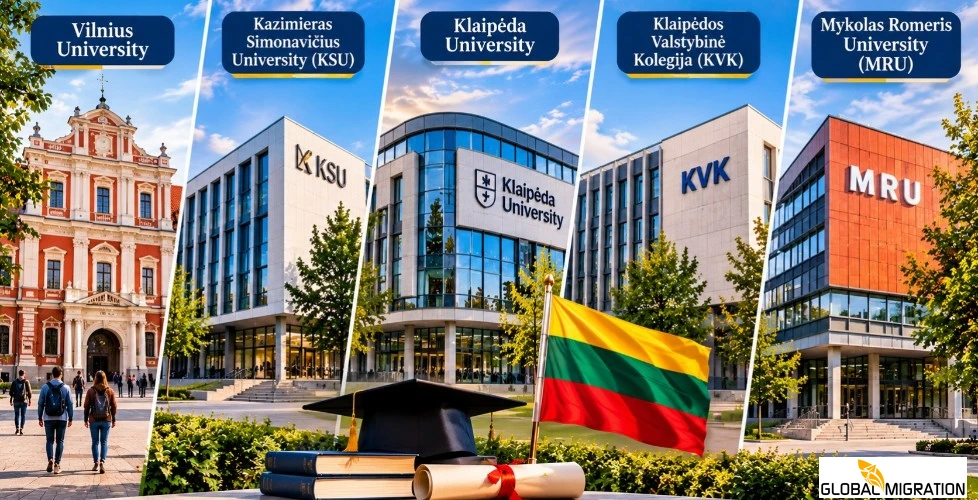
Klaipėda State University of Applied Sciences is the lowest at €2,750 a year. Vilnius University and Klaipėda University both start at €3,176, Mykolas Romeris University at €3,250 and Kazimieras Simonavičius University at €3,900.
Before the detail, here are the four numbers that frame this whole comparison.
Why Is Lithuania a Smart Choice for Budget-Conscious Students?
If you are comparing countries, our guide to studying in Lithuania as a Pakistani student covers the full picture. In short, four things set Lithuania apart:
- Fees that stay realistic. Many English-taught bachelor’s programmes at public universities start between €3,000 and €4,000 a year, far below what you would pay in most of Western Europe.
- An EU degree. Lithuanian universities follow European standards, so your qualification carries weight across the EU.
- Room to travel. With a Lithuanian residence permit you can make short trips within the Schengen Area, subject to the usual 90-days-in-180 rule.
- A path after graduation. Non-EU graduates can apply for a temporary residence permit of up to 12 months to look for work or start a business.
Looking for a wider list of options? The Lithuanian universities page lists more institutions to explore once you have finished this comparison.
Cheapest Universities in Lithuania at a Glance
Here is the quick comparison. Fees are the lowest published annual tuition for a full-time English-taught bachelor’s programme for non-EU students in 2026/27, so your own programme may cost more.
| University | City | Tuition from (per year) | Intake | Best for |
|---|---|---|---|---|
| Klaipėda State University of Applied Sciences (KVK) | Klaipėda | €2,750 | Autumn, limited places | The lowest fees and practical degrees |
| Vilnius University (VU) | Vilnius | €3,176 | Autumn | The strongest academic name |
| Klaipėda University (KU) | Klaipėda | €3,176 | September and February | Flexible intakes in a coastal city |
| Mykolas Romeris University (MRU) | Vilnius | €3,250 | Autumn | Law, business and social sciences |
| Kazimieras Simonavičius University (KSU) | Vilnius | €3,900 | September and February | Business, aviation and fashion programmes |
Ranked by the lowest published starting fee. This is a comparison of the five universities below, not a ranking of every university in Lithuania.
The 5 Cheapest Universities in Lithuania, Ranked by Starting Fees
Numbers alone do not tell you which one to pick, so here is how each of the five really plays out, from the lowest sticker price upwards.
Klaipėda State University of Applied Sciences (KVK)
If the goal is simply the lowest published price, KVK is where the list starts. Finance, Tourism Business and Management of Organizations each cost €2,750 a year in 2026/27, while Informatics is €3,600 and Nursing, Dental Hygiene and Physiotherapy are €3,540.
There is no entrance exam. Admission is based on your school-leaving marks in the required subjects, with a minimum of 50%, and Finance, for example, asks for Mathematics plus History, Information Technology or Geography. As a university of applied sciences, KVK teaches in a hands-on, practice-based way, which suits students who want a job-ready degree.
The catch is size. KVK’s 2025 admission rules capped first-year places at 10 to 30 per programme, and the university has paused applications before once places filled. Apply early.
Vilnius University (VU)
Vilnius University trades a slightly higher fee for one of Europe’s oldest names, founded in 1579, and a wide choice of subjects from social sciences to data and life sciences. At bachelor’s level, Politics of Global Challenges is €3,176, several economics and business degrees such as Management and Global Marketing are €3,660, and Software Engineering is €4,560.
Most English-taught master’s programmes fall between €4,600 and €6,550 a year, while the MBA and medicine are priced far higher.
Worth knowing: VU has offered full tuition waivers to five non-EU applicants for English-taught master’s programmes. Check its finance page for the next round.
Klaipėda University (KU)
KU matches Vilnius University on price, with BSc Management at €3,176 a year and BSc Economics listed at €3,250 on its application portal. Its real advantage is timing: studies start on 1 September or 1 February, with application deadlines of 1 June and 1 November, so missing the autumn round does not cost you a full year.
For English, the minimum level is B2, and the Economics page accepts IELTS 5.5 or higher, TOEFL 75+, Duolingo 110+ or PTE 59+. The application fee is €180 for most international applicants and €75 for EU and EEA citizens and some neighbouring-region countries.
Why choose it: a port city by the Baltic Sea usually means calmer, cheaper day-to-day living than the capital, plus a February intake if you miss the autumn one. Fees, intakes and admission steps are covered further in this complete 2027 guide to Klaipeda University, and many applicants also wonder about the acceptance rate of Klaipeda University.
Mykolas Romeris University (MRU)
MRU is the pick for law, business and social sciences. Business Management and Startup Building costs €3,250 a year in 2026–27, and other English-taught bachelor’s options include Law and Global Security, Psychology, Communication and Digital Marketing, and Game Development and Digital Animation. EU and non-EU students pay the same tuition, and you keep paying the fee set when you were admitted.
Budget for two one-off charges: a non-refundable €100 application fee for non-EU applicants and a €50 registration fee after acceptance. English level B2 is required. Duolingo 100–125 is recommended and IELTS 5.5–6.5 is accepted, and if you have no certificate, MRU offers a free online English test.
Write your own motivation letter. MRU states that it checks letters with specialised software and asks applicants not to use AI assistance.
Kazimieras Simonavičius University (KSU)
KSU is the most expensive of the five, but it is also the most career-flavoured. BA Business Management is €3,900 a year, and programmes such as Aviation Management and Fashion Industry are priced by course, so check each page. At master’s level it offers Organizational Innovation and Management and Integrated Communication.
The process has a personal touch: candidates are invited to a short 10 to 15 minute English interview on Teams or Zoom, and the €200 application fee is paid before you submit documents.
KSU recommends budgeting €250 to €350 a month for a shared flat, hostel room or dorm near Vilnius Old Town.
Every figure above is the lowest fee we found at that university. Your course may cost more, so always confirm the exact fee for your programme on the official page before you pay anything.
How Much Does It Really Cost to Study in Lithuania?
Tuition is only part of the budget. Here is a realistic first-year picture, using the published fees above and the European Commission’s living-cost estimate.
| Cost | Amount | Note |
|---|---|---|
| Tuition | €2,750–€3,900 a year | Lowest published fee at each of the five universities |
| Application and registration fees | €100–€200 once | MRU €100 (plus €50 registration), KU €180, KSU €200 |
| Living costs | €500–€800 a month | Covers housing, food, study materials, transport and personal costs |
| Health insurance | Required | Mandatory for international students, so budget for it separately |
Put together, tuition plus twelve months of living costs comes to roughly €8,750 to €13,500 a year. That is our own arithmetic from the figures above, and it excludes flights, insurance and one-off fees. Your city and lifestyle will move the total, so treat it as a planning range. Insurance is a separate cost, and the notes on travel insurance for a Lithuania student visa explain what the visa file expects.
Scholarships and Fee Waivers Worth Checking
- University waivers. Vilnius University has offered full tuition waivers to five non-EU applicants for English-taught master’s programmes.
- Merit-based funding. MRU publishes a scholarships and funding page, and other universities list theirs on their admissions pages.
- Erasmus+. Once enrolled, you may be able to study part of your degree at another European university with Erasmus+ support.
Deadlines for scholarships often fall before the main application deadline, so check them while you shortlist. For a wider overview of funding aimed at Pakistani applicants, see the list of scholarships in Lithuania for Pakistani students.

Admission Requirements for Pakistani Students
Each university sets its own checklist, but these items appear again and again on the official pages, and the Lithuania admission requirements guide explains them in more detail:
- Academic documents. A secondary school certificate with final grades for a bachelor’s, or your bachelor’s degree for a master’s.
- English proof. Usually level B2 through IELTS, TOEFL, PTE or Duolingo. Some universities waive it if your previous studies were fully in English. If you are still choosing a test, the comparison of IELTS vs Duolingo for study abroad may help.
- Passport copy and motivation letter. Write the letter yourself and keep it specific to the programme.
- Extras by university. KVK asks for one recommendation letter, and KSU holds a short interview.
- Legalisation and translation. Documents not in English, Lithuanian or Russian need an official translation, and an Apostille is requested where required. Lithuania is a Hague Convention member and did not object to Pakistan’s accession, so a Pakistani Apostille is valid there.
The full list of documents required for a Lithuania study visa from Pakistan sits in one checklist, which is useful once you have chosen your university. Keep both digital and printed copies of every paper, because the university and the Migration Department may each ask for them.
 Budget check
Not Sure Which Lithuanian University Fits Your Budget?
Share your grades, budget and preferred subject, and Global Migration Advisors will shortlist universities you can realistically afford and get accepted to.
- Budget-based shortlisting
- Application support
- Interview and MIGRIS preparation
- Visa guidance
From Offer to Flight: Your Step-by-Step Route
- Shortlist and check entry rulesMatch your grades and subjects to the programme, especially at KVK where school-leaving subject marks count.
- Apply online and pay the application feeUpload your documents through the university portal. Fees are usually non-refundable.
- Prove your English and attend any interviewSubmit your test score or take the university’s own test where offered.
- Accept the offer and pay first-year tuitionUniversities such as MRU and KSU invoice the first year before you start the residence permit process, so have the funds ready.
- Apply for your temporary residence permitNon-EU students generally apply through a VFS Global centre in their home country or a neighbouring one, with help from the university’s international office. Some applicants are also invited to an online MIGRIS interview, so it helps to read the real questions asked in a Migris 16 interview in advance.
- Travel and registerArrive by the date your university sets and bring your original educational documents.
Each stage has its own checklist. The university application, the visa file and the interview preparation stage are explained step by step on their own pages.
Can You Work While Studying in Lithuania? The 2026 Rules
This is where many older guides are now wrong. Lithuanian law changed on 22 May 2026, and the old “40 hours a week” claim no longer applies to everyone.
- Bachelor’s, years 1 and 2: up to 20 hours a week during the study period. Holidays and required practical training are excluded from the cap.
- Bachelor’s, years 3 and 4, master’s and PhD: up to 40 hours a week.
- Who it applies to: the cap applies to student residence permits issued on or after 22 May 2026, and a permit is needed before you can work.
These details come from Lithuanian law-firm and university briefings on the amended law, so confirm your own limit with the Migration Department and your university’s international office before you sign a job contract. Above all, do not build your budget around a student job.
Common Mistakes That Cost Students Money
- Choosing on price alone. The cheapest course is not the right one if you do not meet its entry requirements.
- Trusting old fee tables. Fees are set each year, and the 2027/28 rates may differ from the 2026/27 ones shown here.
- Forgetting the upfront payment. First-year tuition is often due before your residence permit application, so plan your funds early.
- Counting on work income. The new 20-hour cap makes part-time work a small extra, not a funding plan.
- Applying late. Small cohorts and fixed deadlines, such as KU’s 1 November cut-off for February, leave little room for delay.
- Submitting inconsistent documents. Names, dates and grades must match across every paper you upload. Inconsistency is one of the Lithuania student visa rejection reasons students run into.
Cheapest Universities in Lithuania: FAQs
Which is the cheapest university in Lithuania for international students?
Among the five compared here, Klaipėda State University of Applied Sciences has the lowest published tuition, at €2,750 a year for Finance, Tourism Business and Management of Organizations in 2026/27. Other universities in Lithuania may also offer low fees, so check your own subject.
Can I study in Lithuania for less than €3,000 a year?
Yes, but only on a few programmes. At the universities in this guide, KVK’s three business programmes are the only ones listed below €3,000. Most others start between €3,176 and €3,900.
How much money do I need for the first year?
Based on the published fees and the European Commission’s living-cost estimate, plan for roughly €8,750 to €13,500 before flights, insurance and one-off fees. Your exact total depends on the programme and where you live.
Do I need IELTS to study in Lithuania?
You need to show English at about B2. IELTS is one option, and the universities here also accept TOEFL, PTE or Duolingo. MRU offers a free online English test, and some universities waive proof if your earlier studies were in English.
How many hours can I work as a student?
Since 22 May 2026, first- and second-year bachelor’s students are capped at 20 hours a week during term, while later-year bachelor’s, master’s and PhD students can work up to 40. Confirm your own limit with the Migration Department.
Can I stay and work after my degree?
Non-EU graduates can apply for a temporary residence permit of up to 12 months to look for a job or start self-employment, subject to the conditions in force at the time.
Final Thoughts
The cheapest option is not always the smartest one, but in Lithuania a lower price rarely means a lower standard. Start with your budget and your subject, check the exact fee and entry rules on the official page, and apply before places fill.
For the wider process, the guide to study in Lithuania from Pakistan explains each stage, and you can also speak with professional study abroad consultants if you would like a second opinion on your shortlist, application or visa.
Please note: Fees, intakes, entry requirements and visa or work rules change from time to time. Please confirm the latest details with the university and the official Migration Department before you apply.