You have cleared your FSc with good marks. You want to become a doctor. But the seats in Pakistan’s government medical colleges are brutally competitive — and private colleges charge PKR 8 to 12 million just for tuition. The path forward feels impossible.
Thousands of Pakistani students every year find the answer in one country: China.
China is today home to more than 25,000 Pakistani medical students — the largest concentration of Pakistani students in any single country studying medicine. This is not a coincidence. It is the result of years of experience, trust, and proven outcomes.
In this guide, you will get every answer you need about MBBS in China — from fees and university rankings to scholarships, visa steps, and what happens after you graduate. This is not a generic article. This is a real, expert-written guide designed specifically for Pakistani families making this decision in 2026 and planning ahead for 2027.
Why Study MBBS in China? 8 Reasons That Actually Matter
Let us be honest — there are many countries offering MBBS to international students. So why do Pakistani students and families keep choosing China above all others? Here are the real reasons.
1. Internationally Recognized Degrees
Chinese medical universities are recognized by the World Health Organization (WHO), the Pakistan Medical and Dental Council (PMDC), the Educational Commission for Foreign Medical Graduates (ECFMG), and the General Medical Council (GMC) of the UK. This means a degree from a top Chinese medical university gives you the legal pathway to practice medicine in Pakistan, the UK, the USA, Canada, Australia, and dozens of other countries.
2. English-Medium Teaching — No Chinese Required for Core Subjects
All reputable Chinese medical universities offer MBBS programs completely in English for international students. You will study Anatomy, Physiology, Pathology, Surgery, and every other subject in English. Basic Mandarin language training is usually included in Year 1 — not for exams, but to help you communicate during clinical rotations.
3. Dramatically Lower Fees Compared to Pakistan’s Private Colleges
A full 6-year MBBS at a top Chinese university — including tuition, hostel, and living costs — typically costs between $30,000 and $55,000 total. Compare this to Pakistani private medical colleges that charge PKR 8–12 million for tuition alone, often equivalent to $28,000–$43,000, without the global recognition.
4. World-Class Clinical Exposure
Chinese teaching hospitals are among the largest in the world. The affiliated hospital of Wuhan University alone handles over 4 million patient visits per year. Medical students in China get exposure to a massive volume and variety of clinical cases — often far more than students in smaller Western teaching hospitals.
5. PMDC-Recognized Institutions
PMDC maintains an official list of foreign universities whose degrees are recognized in Pakistan. Most top-tier Chinese medical universities are on this list. This means graduates can appear in the PMDC licensing exam and ultimately practice as registered doctors in Pakistan.
6. Safe Country with a Friendly Environment for Pakistanis
China has one of the lowest crime rates in the world. Pakistani students consistently report feeling safe in university cities like Wuhan, Nanjing, Jilin, and Guangzhou. There are active Pakistani student associations at virtually every university, halal food is widely available, and the strong China-Pakistan friendship means you are genuinely welcomed.
7. Scholarships Available — Including Fully Funded
The Chinese Government Scholarship (CSC) covers tuition, accommodation, and provides a monthly living stipend — making it a fully funded option for qualifying students. University-level and provincial scholarships offer partial funding. These are real, accessible opportunities.
8. Smooth Visa Process
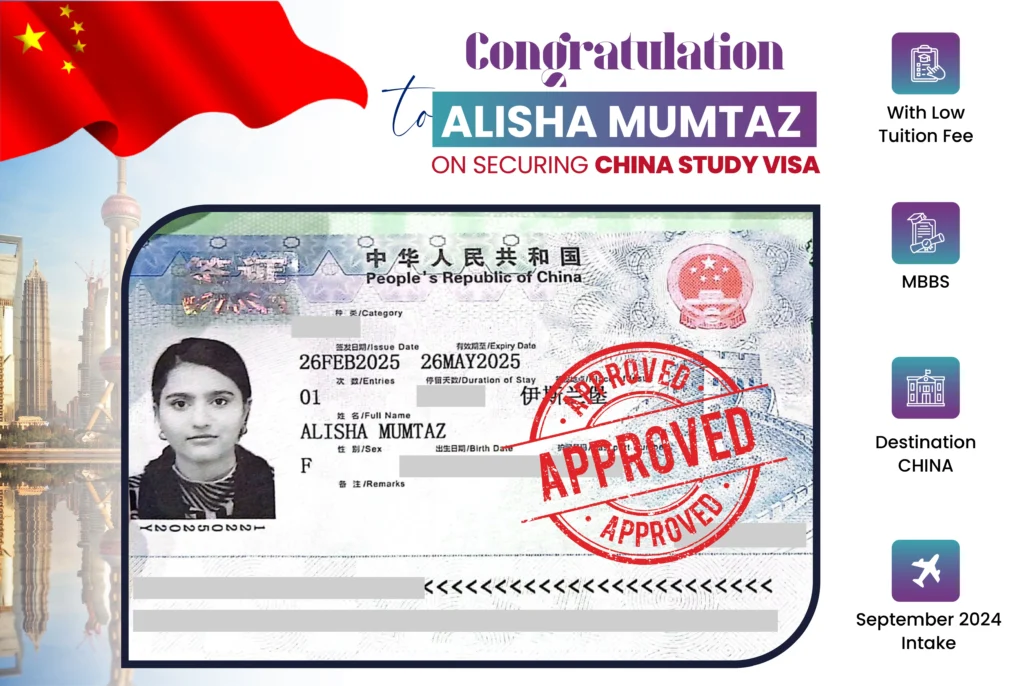
MBBS in China grants student visas (X1 visa) to Pakistani applicants efficiently, especially for universities that provide the JW202 admission form. The process is well-documented and takes 5–10 working days on average.
Read More: Cheapest Medical Universities in Romania for International Students
MBBS in China for Pakistani Students — What Makes It Different?
China is not just a good destination for MBBS in general — it has specific advantages that make it especially suited for Pakistani students.
PMDC Recognition — The Most Critical Factor
Before anything else, confirm that the university you are applying to is on the current PMDC-approved list. PMDC updates this list periodically. If you graduate from a university that is NOT on the PMDC list, you will not be able to register as a doctor in Pakistan — regardless of how good your education was. Always verify at pmdc.org.pk before finalizing any application.
Important: Never finalize admission at any foreign university without first confirming its PMDC recognition status on the official PMDC website. This is the single most important step.
Halal Food — No Compromise on Dietary Requirements
University campuses in cities like Wuhan, Nanjing, Jilin, and Guangzhou have dedicated halal canteens. Outside campus, halal restaurants run by local Muslim communities are easily found. Pakistani student associations have typically established strong connections with local halal food suppliers.
Pakistani Student Communities
At universities like Wuhan University, HUST, Jilin University, and Yangtze University, there are hundreds — sometimes thousands — of Pakistani students. These communities organize Eid celebrations, cricket matches, cultural events, and academic support groups. Senior Pakistani students actively guide juniors through the adjustment period.
For Pakistani female students, separate female-only hostel accommodations are also available to ensure a safe and comfortable living environment.
Direct Flight Connectivity
PIA and China Southern Airlines offer direct flights between Lahore, Karachi, Islamabad and major Chinese cities. Travel time is typically 4–7 hours. This makes it practical to come home during summer and winter holidays.
Low Living Cost Compared to Western Countries
Monthly living expenses in a Chinese university city — including food, transport, and personal expenses — typically range from $200 to $400 USD (PKR 56,000 to 112,000). This is significantly lower than the UK, Australia, or even Malaysia.
MBBS in China Fees 2026–2027 — Complete Breakdown in USD and PKR

Here is a fully detailed, honest breakdown.
Annual Cost Breakdown
| Expense Category | Low Estimate (USD) | High Estimate (USD) | Annual PKR (Approx.) |
| Tuition Fees | $3,000 | $8,000 | PKR 8.4L – 22.4L |
| University Hostel | $500 | $1,500 | PKR 1.4L – 4.2L |
| Food (Canteen/Self-Cook) | $900 | $1,800 | PKR 2.5L – 5.0L |
| Utilities & Internet | $100 | $200 | PKR 28K – 56K |
| Health Insurance | $120 | $220 | PKR 34K – 62K |
| Books & Study Material | $150 | $400 | PKR 42K – 112K |
| Local Transport | $100 | $200 | PKR 28K – 56K |
| Personal Expenses | $200 | $500 | PKR 56K – 140K |
| TOTAL PER YEAR | $5,070 | $12,820 | PKR 1.4M – 3.6M |
PKR figures based on approximately 280 PKR per USD. Exchange rates fluctuate. One-time admission, visa, and attestation fees (approx. $600–$1,200) are not included above.
Total 6-Year MBBS Cost
| Program Year | Key Focus | Est. Annual Cost (USD) | Est. Annual Cost (PKR) |
| Year 1 — Basic Sciences | Anatomy, Physiology, Biochemistry | $5,000 – $11,000 | PKR 1.4M – 3.1M |
| Year 2 — Para-Clinical | Pathology, Pharmacology, Microbiology | $5,000 – $11,000 | PKR 1.4M – 3.1M |
| Year 3 — Clinical Foundation | Internal Medicine Intro, Diagnostics | $5,000 – $11,500 | PKR 1.4M – 3.2M |
| Year 4 — Clinical Rotations | Surgery, Obs & Gynae, Pediatrics | $5,500 – $12,000 | PKR 1.5M – 3.4M |
| Year 5 — Advanced Clinical | Neurology, Emergency Medicine | $5,500 – $12,500 | PKR 1.5M – 3.5M |
| Year 6 — Internship | Supervised Hospital Practice | $2,500 – $5,000 | PKR 700K – 1.4M |
| GRAND TOTAL (6 Years) | $28,500 – $63,000 | PKR 8.0M – 17.6M |
Pro Tip: Apply for the CSC Scholarship in your first year. Even a partial scholarship covering 50% of tuition can save you PKR 500,000–1,200,000 per year over 5 years.
Top Universities in China for MBBS 2026–2027
Choosing the right university is the single most important decision in this journey. The table below covers the most recommended universities for Pakistani students, all verified for PMDC recognition, quality of teaching, clinical exposure, and value for money.
| University | City / Province | Annual Tuition (USD) | PMDC Recognized | Approx. Global Rank | Intake |
| Wuhan University | Wuhan, Hubei | $5,000 – $6,500 | Yes | Top 300 | Sept & Feb |
| Huazhong Univ. of Sci. & Tech. (HUST) | Wuhan, Hubei | $5,500 – $7,000 | Yes | Top 300 | September |
| Nanjing Medical University | Nanjing, Jiangsu | $4,500 – $6,000 | Yes | Top 500 | September |
| Capital Medical University | Beijing | $6,000 – $8,000 | Yes | Top 500 | September |
| Jilin University | Changchun, Jilin | $4,000 – $5,500 | Yes | Top 500 | September |
| Yangtze University | Jingzhou, Hubei | $3,500 – $5,000 | Yes | Ranked | September |
| Dalian Medical University | Dalian, Liaoning | $3,500 – $5,000 | Yes | Top 700 | September |
| Guangzhou Medical University | Guangzhou, Guangdong | $4,000 – $6,000 | Yes | Top 700 | September |
| Shandong University | Jinan, Shandong | $5,000 – $6,500 | Yes | Top 500 | September |
| Xi’an Jiaotong University | Xi’an, Shaanxi | $5,000 – $7,000 | Yes | Top 500 | September |
| Kunming Medical University | Kunming, Yunnan | $3,000 – $4,500 | Yes | Ranked | September |
| Hebei Medical University | Shijiazhuang, Hebei | $3,500 – $5,000 | Yes | Ranked | September |
Important: Always verify PMDC recognition status directly at pmdc.org.pk before paying any fee or signing any contract. Lists are updated regularly.
Yangtze University — Complete MBBS Guide for Pakistani Students 2026–2027
If you are looking for an affordable, PMDC-recognized university in China with a growing reputation among Pakistani students, Yangtze University is one of the strongest options to consider.
University at a Glance
- Full Name: Yangtze University (长江大学)
- Location: Jingzhou City, Hubei Province, China
- Founded: 2003 (merger of established institutions)
- Type: Public University — Ministry of Education, China
- Medium of Instruction: English (MBBS international program)
- PMDC Recognition: Yes — verify latest status at pmdc.org.pk
- MBBS Duration: 5 Years Academic + 1 Year Internship = 6 Years Total
- Annual Tuition (2026–2027): Approximately $3,500 – $5,000 USD
- Hostel: On-campus hostel available for international students
- Affiliated Teaching Hospital: Yangtze University First Clinical Medical College Hospital
Yangtze University MBBS Fee Structure 2026–2027
- Tuition Fee: $3,500 – $5,000 per year | PKR 9.8L – 14.0L
- Hostel (On-Campus): $500 – $800 per year | PKR 1.4L – 2.2L
- Food & Daily Living: $1,200 – $2,000 per year | PKR 3.4L – 5.6L
- Insurance & Misc.: $300 – $500 per year | PKR 84K – 140K
- Total Per Year: $5,500 – $8,300 | PKR 1.54M – 2.32M
- Total 6 Years: $30,000 – $46,000 | PKR 8.4M – 12.9M
Why Pakistani Students Choose Yangtze University

- Located in Hubei Province — same province as Wuhan University, with good transport connectivity to Wuhan
- Significantly lower tuition fees compared to Tier-1 universities — ideal for families with a tighter budget
- Established and active Pakistani student community on campus — seniors guide new students from day one
- English-medium MBBS program with experienced international faculty
- Affiliated teaching hospital provides solid clinical exposure during Years 4, 5, and 6
- University has been rapidly expanding its international medicine program since 2015
- Scholarship opportunities available through university-level merit awards
- The fee structure is very economical.
- Halal food is available.
- Separate hostels are available for male and female students.
City Life in Jingzhou
Jingzhou is a mid-sized, manageable Chinese city — quieter and significantly more affordable than major metros like Beijing or Shanghai. All necessary amenities are available. Cost of living here is lower than in Wuhan, making Yangtze University one of the most economical full-MBBS options in China. Halal food is accessible, and the local Pakistani student community has built strong connections with halal food providers in the city.
Pro Tip: Yangtze University is best suited for students with a total annual budget of PKR 1.5M – 2.3M (all-inclusive) who still want a quality, PMDC-recognized degree with proper clinical training. It is one of the best value-for-money options in China right now.
Read More: Romania Student Visa from Pakistan 2026: Documents & Process
Best MBBS Universities in China — Expert Analysis 2026–2027
1. Wuhan University — Best Overall
Consistently ranked in the global Top 300, Wuhan University is the gold standard for Pakistani MBBS students in China. Its School of Medicine has trained thousands of international doctors. The affiliated Zhongnan Hospital handles millions of patients annually, providing unmatched clinical exposure. It also has one of the largest Pakistani student communities of any university in the world.
- Best for: Students who qualify on academic merit and can manage fees of $5,000–$6,500/year
- Strength: Research output, clinical volume, global recognition, strong alumni network
- Challenge: Competitive admission, limited scholarship seats
2. Huazhong University of Science & Technology (HUST) — Best for Research
HUST’s Tongji Medical College is one of China’s most prestigious medical schools. Pakistani graduates from HUST have exceptional success rates in PMDC licensing exams and international entrance tests like USMLE.
- Best for: Students aiming for postgraduate studies, research careers, or international licensing
- Strength: Academic rigor, Tongji Hospital affiliation, world-class research facilities
- Challenge: High academic standards — requires consistently strong performance throughout
3. Nanjing Medical University — Best for Clinical Training
As one of China’s oldest dedicated medical universities (founded 1934), Nanjing Medical University has over 90 years of experience producing doctors. Students rotate through multiple affiliated hospitals during their final years — clinical exposure is a genuine strength.
- Best for: Students prioritizing hands-on clinical experience
- Strength: Long-standing reputation, strong clinical curriculum, reasonable fees
- Challenge: Nanjing winters are cold and require some adjustment
4. Jilin University — Best Budget-Premium Option
Jilin University is one of China’s 985 Project universities (the national elite program), yet its fees are lower than many smaller institutions. A well-organized Pakistani student community makes settling in easy.
- Best for: Students wanting a prestigious, well-ranked university at moderate cost
- Strength: National prestige, comprehensive facilities, value for money
- Challenge: Extremely cold winters — temperatures can drop to -20°C
5. Yangtze University — Best Affordable Option
For families with a tighter budget who still want a PMDC-recognized degree with solid clinical training, Yangtze University is the most recommended affordable option in 2026–2027.
- Best for: Cost-conscious students with strong academic commitment
- Strength: Low fees, PMDC recognition, growing international program, Hubei location
- Challenge: Less globally prominent than Tier-1 institutions, but fully functional for Pakistani medical practice
MBBS Scholarship in China for Pakistani Students 2026–2027
Scholarships are real, accessible, and meaningful. Here is the complete breakdown.
1. Chinese Government Scholarship (CSC Scholarship) — 2026–2027
| Feature | Details |
| Coverage | Full Tuition + Accommodation + Monthly Stipend (~1,700 RMB/month) |
| Type | Fully Funded (Type A) / Partially Funded (Type B) |
| Duration | Full MBBS duration — 5+1 years |
| Min. Academic Requirement | Minimum 70% in FSc Pre-Medical |
| Age Limit | Under 25 years at time of application |
| Application Route | Via Chinese Embassy in Pakistan OR through designated universities |
| Expected Deadline 2026 | February – April 2026 (confirm at csc.edu.cn) |
| Competition Level | Very high — apply as early as possible |
Pro Tip: Apply through BOTH the Chinese Embassy route and directly through the university simultaneously. This doubles your chances of securing the scholarship.
2. University-Level Scholarships — 2026–2027
Almost every major Chinese university offers its own merit-based scholarships separately from the CSC scholarship:
- Wuhan University Scholarship: Up to 100% tuition waiver for top applicants
- HUST Scholarship: 30%–80% tuition reduction based on academic performance
- Nanjing Medical University Scholarship: Multiple tiers ranging from 20%–100% tuition waiver
- Yangtze University Scholarship: Merit-based awards for FSc students with 65%+ marks
- Jilin University Scholarship: Available for students with strong FSc results
3. HEC Bilateral Scholarship (Pakistan) — 2026–2027
The Higher Education Commission (HEC) of Pakistan has bilateral scholarship agreements with China under the CPEC framework. These are announced periodically — check hec.gov.pk for current announcements. Applications are submitted through HEC Pakistan, not through the Chinese university directly.
4. Provincial Government Scholarships
- Hubei Government Scholarship: Relevant for Wuhan University, HUST, and Yangtze University — typically RMB 8,000–15,000 per year (PKR 320,000–600,000)
- Jiangsu Government Scholarship: Useful for Nanjing Medical University applicants
- Guangdong Provincial Scholarship: Available for students at Guangzhou Medical University
Scholarship Summary Table 2026–2027
| Scholarship | Coverage | FSc Requirement | Where to Apply |
| CSC (Fully Funded) | Tuition + Room + Stipend | 70%+ | Embassy / University |
| CSC (Partial) | Tuition Only or Partial | 65%+ | Embassy / University |
| University Award | 30%–100% Tuition | 60%–70%+ | University Directly |
| HEC Bilateral | Full (selected programs) | Merit-based | HEC Pakistan Portal |
| Hubei Provincial | RMB 8K–15K/year | 65%+ | Via University |
| Jiangsu Provincial | RMB 8K–12K/year | 65%+ | Via University |
MBBS in China Eligibility Requirements for Pakistani Students 2026–2027
Academic Eligibility
- FSc Pre-Medical (Biology, Chemistry, Physics): Minimum 60% overall marks
- Most mid-tier universities including Yangtze University: 60%–65% minimum
- Top-tier universities (Wuhan, HUST, Capital Medical): 65%–70%+ preferred
- A-Level equivalent qualifications: Accepted at all major Chinese universities
- Students currently in Year 2 of FSc: Can apply conditionally, finalize upon receiving results
MDCAT Requirement — Critical Update 2026
As per PMDC regulations, Pakistani students must qualify in the MDCAT to be eligible for PMDC registration after completing MBBS abroad. Chinese universities may not require MDCAT for their own admission, but without it, PMDC will not recognize your degree for licensing in Pakistan.
Important: PMDC has made MDCAT qualification mandatory for licensing foreign MBBS degrees in Pakistan. Always confirm the latest requirements directly on pmdc.org.pk before applying anywhere.
Age Requirements
- Minimum age: 17 years as of December 31 of the admission year
- Maximum age: No formal upper limit at most Chinese universities
- PMDC guideline: Completing MBBS by age 26–27 makes the licensing pathway smoother
Required Documents — Complete 2026–2027 Checklist
- Matriculation (SSC) result certificate and transcript — attested by IBCC and HEC
- FSc (HSSC) result certificate and transcript — attested by IBCC and HEC
- MDCAT scorecard — official copy
- Valid Pakistani passport — minimum 18 months validity remaining
- CNIC or B-Form
- Passport-sized photographs — white background, minimum 6 copies
- Medical fitness certificate — issued by a registered MBBS doctor
- HIV/AIDS test certificate — mandatory for Chinese visa
- Hepatitis B test certificate
- Police clearance certificate — attested by Ministry of Foreign Affairs (MoFA)
- Bank statement showing sufficient funds — minimum $5,000–$8,000 equivalent
- Completed university application form
- Personal statement / Statement of Purpose (required by some universities)
Pro Tip: Start the IBCC attestation process immediately after FSc results are announced. IBCC attestation alone can take 3–6 weeks. Do not delay this step.
Read More: MBBS in Romania: Fees, Colleges & Process 2026
How to Apply for MBBS in China 2026–2027 — Step-by-Step
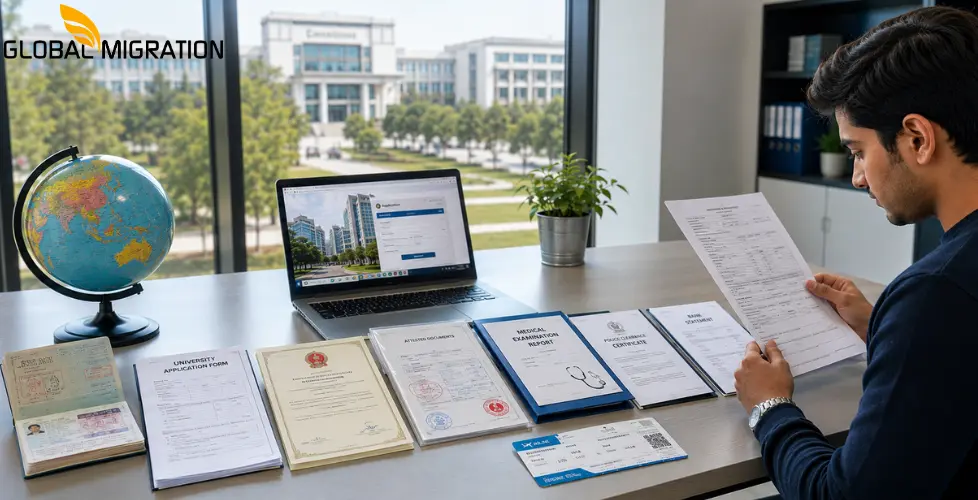
Stage 1: Research and Shortlisting (3–4 Months Before Deadline)
- Verify PMDC recognition of target universities at pmdc.org.pk
- Research each university: fees, location, facilities, Pakistani student community
- Shortlist 3–5 universities across different budget tiers
- Contact university international offices directly for the latest 2026–2027 fee structures
- Connect with Pakistani students currently enrolled — their real experience is invaluable
Stage 2: Document Preparation (2–3 Months Before Deadline)
- Collect all original academic certificates
- Get attestation done: IBCC → HEC → Ministry of Foreign Affairs (MoFA)
- Complete medical tests: HIV, Hepatitis B, fitness certificate
- Obtain police clearance certificate from local police station
- Get a bank statement with official stamp and signature
- Prepare passport-sized photographs on white background
Stage 3: University Application (1–2 Months Before Intake)
- Submit applications online through each university’s international student portal
- Upload scanned copies of all required documents
- Pay application fees — usually $50–$150 per university
- Follow up with admissions office after 2 weeks if no confirmation is received
Stage 4: Receiving Admission Documents
- Upon acceptance, the university issues an Official Admission Letter
- Government universities also issue a JW202 Form (for government scholarship applicants: JW201)
- These documents are essential for your Chinese student visa application
Stage 5: Chinese Student Visa (X1 Visa) Application 2026
| Visa Step | Details |
| Documents Required | Admission Letter + JW202 Form + Passport + Photos + HIV and HepB tests, Bank statement, Police certificate, passport size photo |
| Where to Apply | Chinese Embassy Islamabad, Consulates in Lahore and Karachi |
| Visa Fee | Approximately $70 to $140 USD |
| Processing Time | 5–10 working days (standard), 2–3 days (express — extra fee) |
| Visa Type | X1 Student Visa (for programs longer than 180 days) |
| Important Note | Arrive in China within 30 days of visa issuance — do not delay travel |
Stage 6: Arrival and University Registration
- Arrive 7–10 days before semester start for registration
- Complete mandatory medical examination at a designated Chinese hospital
- Register at the university international office with all original documents
- Receive dormitory/hostel room allocation
- Apply for Resident Permit at local police station within 30 days of arrival
- Open a Chinese bank account — UnionPay is recommended for Pakistani students
- Purchase a local SIM card — China Mobile or China Unicom recommended
- Attend all compulsory orientation sessions — do not skip these
MBBS Curriculum Structure in China — What You Will Actually Study
| Year | Phase | Key Subjects |
| Year 1 | Pre-Clinical / Basic Sciences | Anatomy, Physiology, Biochemistry, Medical Chinese (basic) |
| Year 2 | Para-Clinical Sciences | Pathology, Pharmacology, Microbiology, Immunology |
| Year 3 | Clinical Introduction | Internal Medicine Intro, Diagnostics, Medical Ethics |
| Year 4 | Core Clinical Rotations | Internal Medicine, Surgery, Obs & Gynae, Pediatrics |
| Year 5 | Advanced Clinical | Emergency Medicine, Neurology, Psychiatry, Electives |
| Year 6 | Clinical Internship | Supervised practice in affiliated teaching hospitals |
Examinations are held at the end of each semester using a combination of written papers (MCQs and essay-type), practical lab assessments, and OSCE (Objective Structured Clinical Examination) in later years.
Hostel Facilities and Student Life in China
On-Campus Hostel
- Almost all major Chinese universities offer dedicated hostels for international students
- Room types: Single rooms and shared double rooms — single rooms cost more but offer more comfort
- Standard facilities: Bed, study desk, wardrobe, air conditioning or heating, attached or shared bathroom
- Wi-Fi and wired internet available in all international dormitories
- 24-hour campus security is standard
- Monthly hostel cost: $40–$120 USD per month depending on room type and university
Food Options
- On-campus halal canteen available at most universities with Pakistani student populations
- Pakistani student associations coordinate halal food arrangements where official canteens are unavailable
- Self-cooking: Most dormitories have communal kitchens — rice, chicken, and vegetables are very affordable
- Pakistani and Muslim restaurants available in nearby city areas — especially in Wuhan, Nanjing, and Guangzhou
- Monthly food cost: $75–$150 USD (PKR 21,000–42,000) depending on eating habits
Recreational and Campus Life
- Sports facilities: Gymnasium, football fields, badminton courts, basketball courts
- Pakistani cricket tournaments are a regular feature of university social life
- World-class university libraries with extensive digital resources
- Student clubs: Academic, cultural, and sports clubs open to all international students
Career Opportunities After MBBS in China 2026–2027
Option 1: Practice in Pakistan via PMDC Licensing
After returning home, you must clear the PMDC Foreign Medical Graduates Examination (FMGE). This exam tests clinical knowledge across all major specialties. Upon passing, you receive PMDC registration and can work in Pakistani hospitals, start a private clinic, or pursue postgraduate specialization (FCPS).
- Preparation time: 3–6 months of dedicated study post-graduation
- Postgraduate path: FCPS is available after PMDC registration
Option 2: Practice in the United Kingdom (PLAB)
- PLAB 1: Knowledge-based exam, available at British Council centers globally including Pakistan
- PLAB 2: Clinical skills OSCE taken in Manchester, UK
- Upon passing: GMC registration and eligibility for NHS Foundation Year posts
- Chinese MBBS graduates regularly pass PLAB and build successful careers in the NHS
Option 3: Practice in the United States (USMLE)
- USMLE Step 1, Step 2 CK, and Step 3 are required
- After passing Steps 1 and 2: Apply for US Medical Residency through ECFMG certification
- Chinese medical university degrees are recognized by ECFMG for this process
- Highly competitive but a fully achievable pathway for high-performing graduates
Option 4: Practice in Canada (MCCQE)
- MCCQE Part 1 (written) and Part 2 (OSCE) required, followed by residency matching
- Open to international graduates from WHO-recognized institutions
Option 5: Practice in Australia (AMC)
- AMC MCQ Exam followed by AMC Clinical Exam
- Upon clearing: Provisional registration leading to general registration
Option 6: Postgraduate Studies and Research
- Return to China for MD, MS, or PhD — strong programs with scholarship support
- Research positions at Chinese medical institutions available to outstanding graduates
Read More: Why UK Universities Are Becoming Tougher on Pakistani Students in 2026
Why You Need a Trusted China MBBS Study Visa Consultant
Applying to Chinese medical universities and preparing your student visa documents is a detailed and time-sensitive process. A single mistake in your paperwork — whether it is an unattested document, a missed MDCAT requirement, or an incorrect visa form — can lead to unnecessary delays or a full refusal.
What Our China MBBS Consultants Do For You
Our experienced consultants guide you through every step of the process — from choosing the right PMDC-recognized university to settling into your hostel in China. Here is what we handle on your behalf:
- University Selection — We match you with the best PMDC-recognized Chinese university based on your FSc marks, budget, and career goals
- Admission Applications — We prepare and submit your application correctly to Wuhan University, Yangtze University, Jilin University, or your chosen institution
- Document Preparation — We ensure your IBCC attestation, HEC verification, police clearance, and medical certificates are complete and correctly formatted
- Visa Guidance — We walk you through the full X1 Chinese student visa process — from JW202 form to Embassy submission
- MDCAT & PMDC Compliance — We confirm your PMDC eligibility requirements are met before you apply anywhere
- Scholarship Assistance — We help you apply for CSC, university-level, and HEC bilateral scholarships simultaneously
- Accommodation Support — We assist you in securing on-campus hostel arrangements before your arrival in China
Work With Consultants You Can Trust
Choosing the right consultant makes all the difference. With the right team beside you, you save valuable time, avoid costly mistakes, and move through the entire MBBS application process — from FSc results to China arrival — with complete confidence and peace of mind.
Advantages and Disadvantages of MBBS in China — Honest Assessment
Advantages
- Globally recognized degrees — WHO listed, PMDC recognized, ECFMG eligible
- Significantly lower cost than UK, USA, Australia, or even Malaysian medical programs
- English-medium instruction — no language barrier for Pakistani students in core academics
- World-class clinical facilities in large affiliated teaching hospitals
- Generous scholarship ecosystem — CSC, university, provincial, and bilateral options
- One of the safest countries in the world with very low crime rates
- Strong Pakistani student community — you will never feel isolated
- Multiple career pathways globally after graduation
- Excellent food, transport, and digital infrastructure
- Direct flights from Pakistan — easy to visit home during holidays
Disadvantages and Challenges
- Daily life language barrier — Mandarin is essential outside campus, takes 6–12 months to adapt
- Cultural adjustment — takes time to settle into Chinese social norms
- PMDC licensing exam required before practicing in Pakistan — requires 3–6 months of serious preparation
- Some lower-tier universities have inconsistent teaching quality — choose carefully
- Cold winters in northern cities — Jilin and Changchun can reach -20°C
- Internet restrictions — Google, YouTube, and WhatsApp are blocked in China; VPN is required (widely used by international students)
- Time zone difference — PKT is 3 hours behind China Standard Time
- Student visa must be renewed annually — stay on top of documentation deadlines
MBBS in China vs. Other Destinations — 2026–2027 Comparison
| Factor | China | Russia | Malaysia | UK | Pakistan Private |
| Total Cost (6 years) | $30K – $55K | $30K – $50K | $45K – $70K | $150K+ | PKR 8M – 15M |
| PMDC Recognition | Yes (select unis) | Yes (select unis) | Yes (select unis) | Yes | Yes |
| English Medium | Yes | Partial | Yes | Yes | Yes |
| WHO Listed | Yes | Yes | Yes | Yes | N/A |
| Scholarship Available | Yes — generous | Limited | Limited | Limited | N/A |
| Safety Rating | Very High | Moderate | High | High | Moderate |
| Clinical Exposure | Excellent | Good | Good | Excellent | Good |
| Pakistani Community | Very Large | Large | Moderate | Large | N/A |
Frequently Asked Questions
Q1. Is MBBS from China valid in Pakistan?
Yes, but your degree must be from a PMDC-recognized Chinese university. You must also pass the PMDC Foreign Medical Graduates Examination (FMGE) after returning — without it, you cannot legally practice in Pakistan.
Q2. What is the total cost of MBBS in China for Pakistani students in 2026–2027?
The total 6-year cost — covering tuition, accommodation, food, and personal expenses — ranges from $28,500 to $63,000 USD (PKR 8.0M – 17.6M). Budget-friendly options like Yangtze University fall at the lower end at approximately $30,000–$46,000 total.
Q3. Which university is best for MBBS in China in 2026?
For value and strong PMDC recognition, Jilin University and Yangtze University are top choices, while Wuhan University and HUST lead in global reputation. Always prioritize PMDC recognition above every other factor when making your decision.
Q4. Is MDCAT required for MBBS in China?
From PMDC’s perspective, MDCAT qualification is mandatory for Pakistani students seeking to register a foreign MBBS degree back home. Chinese universities may not require it for admission, but without MDCAT, PMDC will not license your degree for practice in Pakistan.
Q5. How many years is MBBS in China and is English the medium of instruction?
MBBS in China follows a 5+1 structure — 5 years of academic coursework plus 1 compulsory clinical internship year, totaling 6 years. All lectures, exams, and textbooks are in English, with basic Mandarin taught separately to assist during clinical rotations.
Conclusion — Is MBBS in China the Right Choice?
After years of advising Pakistani families on MBBS in China , one thing is very clear: China offers a genuinely compelling, well-proven pathway to becoming a doctor — at a cost that is accessible, with a degree that is recognized, and in an environment that is safe and welcoming.
Whether you are looking at a globally ranked institution like Wuhan University or a budget-friendly and solid option like Yangtze University, China has a university that matches your academic profile, your family’s budget, and your career goals.
The journey requires commitment. You will need to study hard, adjust to a new culture, prepare seriously for the PMDC licensing exam upon return, and make smart decisions throughout — starting with choosing a PMDC-recognized university and applying through trusted channels.
But thousands of Pakistani doctors before you have walked this exact path. They are practicing today in hospitals across Pakistan, the UK, the USA, and Canada. Their MBBS from China opened the door. Your hard work will do the rest.
Ready to start your MBBS journey in China for 2026–2027? Get a FREE personalized consultation with our expert study abroad advisors. We will verify PMDC recognition, match you with the right university, prepare your documents, and guide you through every step from application to arrival. Contact us today on WhatsApp or call us now.