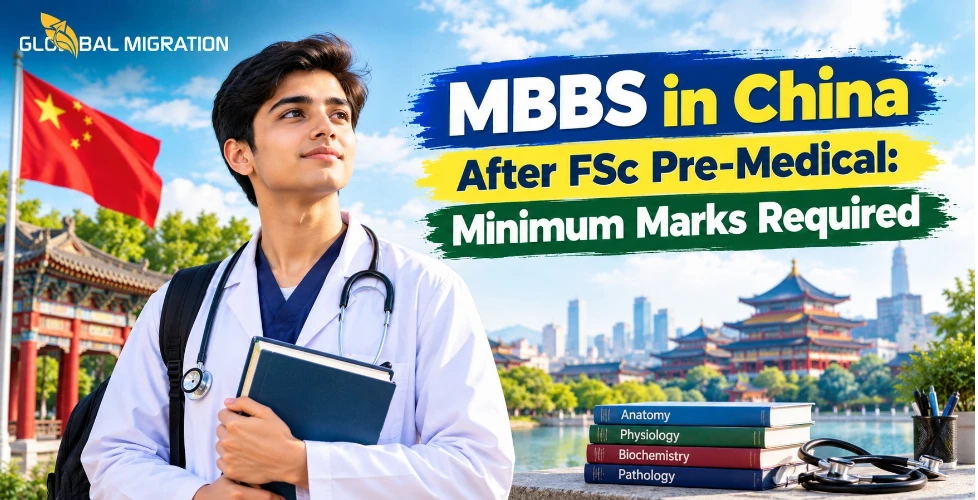
Every year, thousands of Pakistani students finish FSc Pre-Medical and face the same worry: “Will my marks be enough to become a doctor?” Public medical college merit in Pakistan keeps rising, and many capable students miss out by a few marks. MBBS in China has become a popular alternative because its admission system is flexible, many programmes are taught in English, and most universities do not ask for MDCAT.
This guide explains the marks you need if you want to study MBBS in China, the other requirements universities check, what happens if you have only 50%, and how to improve your chances of a scholarship.
Most Chinese medical universities ask for at least 50% in FSc Pre-Medical, with passing grades in Biology, Chemistry and Physics. Higher marks open better universities and scholarships, and MDCAT is not compulsory.
How Many Marks Are Required for MBBS in China?
Most Chinese medical universities ask for at least 50% in FSc (Pre-Medical) or an equivalent qualification. You also need passing grades in Biology, Chemistry, and Physics, and your certificate must come from a recognised board. Your percentage still decides which tier of university you can realistically reach:
| FSc Marks | What It Usually Means | University Level | Scholarship Chance |
|---|---|---|---|
| 50% | Minimum eligibility at many private or mid-level universities | Mid or lower tier | Low |
| 55%–60% | Satisfactory for most public universities | Public and mid-tier | Low to moderate |
| 60%–70%+ | Needed for top-ranking medical universities | Top-ranked | Moderate |
| 65%–75%+ | Required for most scholarship opportunities | Top-ranked and scholarship programmes | Good, though full awards are rare |
Think of 50% as the door and higher marks as the key to better rooms. A student with 70% has more choice in ranking, hospital exposure, and funding than a student with 50%, though both can apply.
Before you pay any fee, confirm that the university is approved by the relevant Chinese authorities and that its graduates are eligible for licensing in Pakistan. Check the latest rules with the Pakistan Medical and Dental Council (PMDC), because policies can change.
Marks Are Not the Only Factor
Admission in 2026 is no longer based on percentage alone. Many universities also look at the following:
- Biology and Chemistry marks. Strong results in these two subjects show you are ready for the first years of medicine.
- English communication. Since most programmes are English-medium, some universities hold a short online interview or communication test.
- A clean academic record. Large gaps between your last exam and your application may need an explanation.
- Complete documentation. A valid passport, verified certificates, and a medical report are non-negotiable.
A well-prepared student with 55% and perfect paperwork can sometimes do better than a student with higher marks and missing documents.
Is MDCAT Required for MBBS in China?
No. MDCAT is not compulsory for MBBS admission in China. The country has an international admission system designed for students from many education systems, so there is no single national entrance test for foreign applicants. Admission is mostly based on your FSc score, your science subjects, your passport, and your verified documents.
Some universities add their own screening, such as an academic review (a minimum of 50%–60% in FSc with strong Biology and Chemistry), a short online interview about your motivation and communication skills, and document verification covering your certificates, passport and medical fitness report. Certain scholarship programmes also offer an optional exam such as the CSCA, which draws on FSc Chemistry, Physics, and basic mathematics. It is not required for ordinary self-financed admission.
Excellent Biology and Chemistry results often stand out more than a high overall total. If you are still improving your marks, focus on these two subjects first, because admission teams and scholarship committees look at them closely.
Other Eligibility Requirements You Should Know
Meeting the percentage is only the first step. Check each of these before you apply to MBBS in China from Pakistan:
Academic background
FSc, A-Level, O-Level, or IB with Biology, Physics, and Chemistry. Transcripts should be verified through the relevant bodies, such as IBCC, MOFA, and HSCC.
Age
Typically 17 to 25 years. Some universities allow a year or two of flexibility, and 17-year-old applicants need parental consent.
Language
- English-taught MBBS: TOEFL or IELTS is usually not mandatory, and an English-medium school record is often accepted
- Chinese-taught programmes: HSK level 3-4 is generally required
Medical fitness
A health certificate from a recognised hospital covering general health, infectious disease screening, and vaccination records.
Passport and visa
Your passport should be valid for 6 to 12 months beyond your stay. Students usually travel on an X1 visa for the length of the programme.
Character documents
Police clearance certificate, personal statement, and recommendation letters.
Financial proof
A bank statement of around 1 million PKR showing one year of funds, commonly requested for the visa process.
Start collecting documents early. Attestation and medical reports often take longer than expected, and delays are a common reason students miss an intake. Our IBCC verification guide explains how to get your certificates verified without wasting weeks.
Can Students With 50% Marks Study MBBS in China?
Yes. If you have 50% in FSc Pre-Medical, studied all three science subjects, and hold a valid passport and the required papers, you can apply to most Chinese medical universities. Here is what to expect:
- Admission is realistic at mid-tier or lower-tier universities
- Top-ranked schools usually ask for 60% or more
- Self-financed admission is more likely than a scholarship
- It is still easier than competing for limited public-sector seats in Pakistan
If your marks are between 50% and 60%, do not simply choose the cheapest university. Compare ranking, teaching hospital facilities, language of instruction, clinical training, and recognition status. A low fee means little if the degree creates problems later.
Be careful with anyone who promises a guaranteed 100% scholarship, because no honest agent can guarantee one. Confirm scholarship terms directly with the university or the official scholarship body before you rely on them.
How to Get a 100% Scholarship in China?
A full scholarship can remove tuition fees and, in some cases, living costs. It is also the hardest form of funding to win, so it helps to understand how the system works. Here are the main types of funding:
| Funding Type | Usual FSc Marks | What It Covers | Competition |
|---|---|---|---|
| Government scholarships | 70%+ | The most prestigious awards, with a demanding selection process | Very high |
| University scholarships | 65%–70% | Part of the tuition fee, or more for exceptional candidates | High |
| Merit-based discounts | 60%+ | A fee reduction at some private universities, not a full scholarship | Moderate |
| Self-financed | 50%+ | Nothing; you pay the full fees yourself | Low |
Scholarship selection has become stricter. Most programmes now expect a minimum of 65%–75% FSc marks, strong science results, and sometimes an English test such as IELTS. Our complete guide to the MBBS scholarship in China 2026-2027 covers each programme in more detail.
Steps to Improve Your Chances
- Aim for the highest FSc marks possible. Scholarship committees start with your percentage. Every extra mark in Biology, Chemistry, and Physics helps.
- Build a strong science profile. Excellent Biology and Chemistry results often stand out more than a high overall total.
- Prepare for the CSCA or similar exams. If a scholarship offers an entrance test, practise FSc-level Chemistry, Physics, and basic mathematics.
- Get an English proficiency score. IELTS may not be mandatory, but a good score can set you apart from other applicants.
- Make your documents flawless. Verified transcripts, a sincere personal statement, and strong recommendation letters matter. Inconsistent paperwork can sink an otherwise strong application.
- Practise for interviews. Be ready to explain why you want to study medicine, why you chose China, and what you plan to do after graduation.
- Apply early and to several options. Scholarship seats are limited and early applicants often have better odds. Applying to multiple universities and programmes reduces risk.
- Verify every claim. Confirm scholarship terms directly with the university or the official scholarship body.
A Realistic Expectation
With 50% marks, scholarship chances are low. With 65%–75% or higher, your chances improve noticeably. Full scholarships are possible but rare, and partial support is the more common result for average students. Plan your finances so that a partial award, or none at all, does not derail your education.
Is China a Good Option for Average Students?
For many students, yes. China has become a preferred destination for aspirants who miss top medical colleges due to high merit competition. If you want to study MBBS in China, weigh the benefits and limitations honestly:
Benefits
- No high-pressure entry test like MDCAT in most universities
- A chance to study medicine even with average grades
- Lower tuition compared with many Western countries
- Many English-medium programmes
- A globally recognised degree, depending on the university’s approval status
Limitations
- Top-ranked universities may require 60%–70%+ marks
- Scholarships are harder to win with lower marks
- Some universities require interviews
- Quality varies significantly between institutions
Choose a Recognised University
This is the most important decision in the whole process. Before paying any fee, confirm that the university is approved by the relevant Chinese authorities and that its graduates are eligible for licensing in Pakistan. Check the latest rules with the Pakistan Medical and Dental Council (PMDC), since policies can change. Also ask about clinical training, hospital affiliation, and the share of international students.
After MBBS in China: PMDC Registration & NExT Exam
- Choose an MOE-Listed University: Before you study MBBS in China, verify that your chosen university is currently authorised to offer MBBS in English and check the latest PMDC recognition requirements.
- Meet PMDC Requirements: Confirm the latest rules regarding MDCAT, the No-Objection Certificate (NOC) and registration before travelling from Pakistan to study medicine abroad.
- Complete Your MBBS and Internship: Finish the six-year programme, generally consisting of five years of academic study and one year of clinical internship, and keep all academic records organised.
- Verify Your Documents: Prepare your degree, transcripts, internship certificate, passport copies and other required documents. Complete the applicable verification and attestation procedures before applying for registration.
- Apply for PMDC Registration: Submit your application through the official PMDC website and follow the current requirements for registration and medical licensing.
- Prepare for the NExT Exam: Stay updated on the latest PMDC announcements regarding the National Licensing Examination (NExT), including eligibility, syllabus and examination dates. Revise core medical subjects and strengthen your clinical knowledge to prepare for the licensing process.
Frequently Asked Questions
Can I study MBBS in China with 50% marks?
Yes. Many universities accept the minimum 50%, although your choices may be limited to mid-tier or lower-tier institutions.
What percentage is required for MBBS in China?
Generally 50% to 60% in FSc. Better universities may require 60%–70% or higher, depending on competition and ranking.
Is MDCAT compulsory for China MBBS?
No. Most universities focus on FSc marks and academic documents instead of entrance tests.
Which Chinese universities accept low percentages?
Several medical universities accept 50%–55% FSc marks, especially for international students. Higher-ranked universities prefer stronger results.
Can average students get scholarships in China?
It is difficult but possible. Scholarships usually require 65%–75% FSc marks. Average students may receive partial support, but full scholarships are rare.
Final Thoughts
The marks required for MBBS in China are flexible. 50% is the usual minimum, 60%–70% opens the door to better universities, and 65%–75% or higher makes you competitive for scholarships. MDCAT is not required in most cases, but strong Biology and Chemistry results, clear communication, and complete documents all improve your chances.
Success depends on choosing a recognised university, meeting the eligibility criteria, and planning carefully for your future licensing and career. If you are targeting the 2026 intake, start preparing your documents now, compare universities honestly, and ask questions before you commit. With the right guidance from professional study abroad consultants for China, your MBBS in China from Pakistan journey can be smooth and stress-free.
Ready to start your MBBS journey?
Share your FSc marks and goals with the team at Global Migration Advisors, and we will help you shortlist recognised universities.
Chat on WhatsAppGlobal Migration Advisors | Lahore, Pakistan | globalmigration.pk