Got an offer for a PhD or research-based Master’s in the UK, and someone just mentioned you’ll need an “ATAS certificate”? If you’ve never heard the term before, you’re not alone. It’s one of the most overlooked steps in the entire study in UK process, and missing it can delay your visa by weeks.
Here’s everything you actually need to know before you study in UK from Pakistan.
What Is an ATAS Certificate?
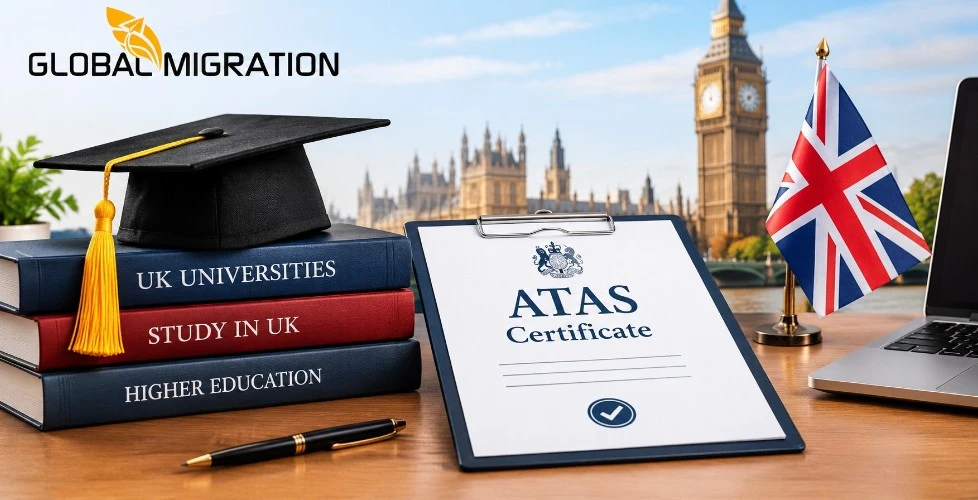
ATAS stands for Academic Technology Approval Scheme. It’s a UK government security clearance, not a university requirement, administered by the Foreign, Commonwealth and Development Office (FCDO).
In simple terms, it’s a background check confirming that your specific research or course of study doesn’t pose a risk around the transfer of sensitive knowledge or technology. If your course falls into an affected subject area, you generally can’t get your UK study visa documentation issued without it.
It’s separate from your university application, separate from your visa application, and it needs to happen at a specific point in between the two.
Why Is an ATAS Certificate Required?
This isn’t about distrust of individual students. It’s a broader UK government policy around protecting sensitive research areas, particularly ones with potential military, security, or dual-use technology applications.
Certain fields, advanced physics, some engineering disciplines, materials science, and specific computing and mathematics research, are considered sensitive enough that the UK government wants formal visibility into who’s studying them, and why. ATAS is the mechanism for that visibility.
It’s a routine, standard process for anyone in an affected field, not a red flag against you personally, whether you study in UK from Pakistan or elsewhere.
Who Needs an ATAS Certificate?
Two things determine whether you need one: your nationality, and your subject area, for anyone planning to study in UK.
- Nationality. ATAS applies to most non-UK, non-EU, non-EEA, non-Swiss nationals. Pakistani students are generally within the group required to obtain clearance for affected courses, though it’s always worth confirming your specific situation against the current official list, since exemptions do get updated
- Subject area. Even if your nationality falls into the affected group, you only need ATAS if your specific course is classified under one of the sensitive subject codes
If either condition doesn’t apply to you, for example, if your course is in business, arts, or standard humanities, you likely don’t need ATAS at all for your UK study visa.
UK Universities Withdrawing CAS for Pakistani Students
See how missing requirements like ATAS can affect your CAS, wherever you plan to study in UK.
Which Courses Need an ATAS Certificate?
ATAS generally applies to postgraduate study, research Master’s, MPhil, and PhD programmes, in a defined list of sensitive subject areas for students who study in UK from Pakistan. Commonly affected fields include:
- Physics, particularly advanced or applied physics
- Materials science and engineering
- Most engineering disciplines, including mechanical, electrical, and aeronautical engineering
- Certain areas of computer science, especially those involving advanced computing, AI, or cybersecurity research
- Mathematics, in some research-focused programmes
- Some biological, chemical, and medical research areas with dual-use potential
It generally does not apply to standard undergraduate degrees, business, law, arts, humanities, most social sciences, postgraduate taught diplomas, or PGCE courses.
Your university will confirm whether your specific course requires ATAS, and will provide you with a CAH3 subject code needed for your application. Don’t assume based on the subject name alone, always confirm directly with your admissions or international office before you study in UK.
How Much Does an ATAS Certificate Cost?
This is where a lot of students expect bad news, and the answer is genuinely good for anyone planning a UK study visa.
An ATAS certificate is completely free. There’s no application fee at all. The cost of your overall study plan still includes tuition, your visa fee, and other standard expenses, but the ATAS clearance itself doesn’t add anything to your budget.
Be cautious of any agent or third party who tries to charge you specifically for ATAS processing itself. The clearance is free; any fee you’re paying should be for genuine advisory or preparation support, not the certificate itself, whenever you study in UK from Pakistan.
How Long Does an ATAS Certificate Take?
This is the part that catches students out most often, because it takes real planning time for anyone who wants to study in UK.
- The standard processing time is around 20 working days, roughly four weeks
- During peak periods, typically April through September, when application volumes spike ahead of the main autumn intake, processing can stretch to 30 working days or more, closer to six weeks, and sometimes even longer in particularly busy stretches
- You cannot apply for ATAS more than six months before your course start date, so there’s a specific window in which you need to act
- Your CAS generally cannot be issued until your ATAS certificate reference number is confirmed, which means delays here push back everything that follows, including your visa application
If you’re applying during the busy season, build in extra time. Waiting until the last minute is one of the most common, and most avoidable, causes of visa delays for research students who study in UK from Pakistan.
How to Apply for an ATAS Certificate
Here’s the general process, once your university confirms you need one for your UK study visa:
- Get your CAH3 code and course details from your university. You’ll need this, along with a description of your intended research or study focus, before you can apply
- Prepare a research statement. For research-based courses, you’ll need to describe your intended area of study or research in reasonably specific terms
- Apply online through the official UK government website. The application asks for your personal details, passport information, and academic background
- Provide your history for the past five years. This includes your addresses, and your education and employment history over that period
- Wait for processing. Once submitted, your application goes through the standard processing window discussed above
- Receive your certificate and reference number. Once approved, pass this reference number to your university so it can be included on your CAS
Every step needs to be accurate and consistent with the rest of your application. Mismatched details between your ATAS application, your CAS, and your visa application can cause unnecessary delays or questions later, whether you study in UK from Pakistan or any other country.
Study in UK: Second Master’s After PSW Visa
If you’re extending your stay with a research-based course, check whether ATAS applies to your new programme too.
| Period | Processing Time | Approx. Duration | Risk Level | Note |
|---|---|---|---|---|
| Standard periods | Around 20 working days | ~4 weeks | Low | Typical processing window |
| Peak season (Apr–Sep) | Around 30 working days | ~6 weeks | Moderate | Volumes spike before autumn intake |
| Particularly busy stretches | 45 to 50 working days | ~7–8 weeks | High | Build in extra buffer time |
| Application window | Up to 6 months before course start | Not applicable | Not applicable | Cannot apply earlier than this |
| CAS issuance | Depends on ATAS confirmation | Not applicable | High if delayed | CAS can’t be issued without ATAS reference |
What Happens If You Don’t Get ATAS in Time?
If your course requires ATAS and you don’t have it, your university generally cannot issue your CAS, which means you cannot apply for your UK study visa. This isn’t a formality that can be skipped or caught up on later. It’s a hard checkpoint in the process.
Delays here have a knock-on effect on everything downstream, your visa appointment, your travel plans, and potentially your ability to start your course on time. Planning around the ATAS timeline from the moment you accept your offer is genuinely one of the most important early steps for affected students who study in UK.
Common Mistakes With ATAS Applications
A few patterns show up repeatedly among students who run into trouble, even those who otherwise plan well to study in UK from Pakistan.
- Assuming a course doesn’t need ATAS without actually confirming with the university
- Applying too close to the course start date, without accounting for peak-season delays
- Submitting a vague or generic research statement that doesn’t clearly match the intended course
- Changing course, research focus, or university after receiving ATAS clearance, without realizing a new certificate is required
- Paying a third party for something that should have been free
Every one of these is avoidable with early, accurate planning.
UK Student Visa Rejection Reasons
Learn the common mistakes that lead to refusals so your UK study visa stays on track.
How Global Migration Advisors Helps You Through This
ATAS is a small step in the overall process, but it can quietly derail your entire timeline if it’s missed or mishandled, whenever you study in UK from Pakistan.
At Global Migration Advisors, we help students:
- Confirm early whether their specific course and subject area actually require ATAS clearance
- Prepare an accurate, well-structured research statement that supports a smooth application
- Time the ATAS application correctly around university and visa deadlines, especially during busier processing periods
- Keep the entire process, from ATAS through CAS to visa application, consistent and moving forward without unnecessary delays
We’d rather you know about this requirement in week one of planning, not discover it two weeks before your visa appointment, whenever you study in UK.
MRes Admission in the UK: Study With Your Spouse Safely
If you’re applying for a research-based MRes, this is exactly the kind of programme that may need ATAS clearance.
FAQs: ATAS Certificate UK
A UK government security clearance confirming that your specific course or research area doesn’t raise concerns around sensitive knowledge or technology transfer. It’s required before your CAS can be issued for certain courses when you study in UK.
Generally, non-UK, non-EU, non-EEA, and non-Swiss nationals studying specific sensitive subjects at postgraduate level, mainly in STEM fields. Pakistani students in affected subjects typically need one if they study in UK from Pakistan, though it’s worth confirming your specific situation.
Nothing. The certificate itself is completely free. Be wary of anyone charging you specifically for the ATAS application process as part of your UK study visa.
Standard processing is around 20 working days. During peak season, typically April to September, this can extend to 30 working days, and in particularly busy stretches it can even reach 45 to 50 working days.
No. If your course requires it, your CAS generally cannot be issued without a confirmed ATAS reference number, which means your UK study visa application cannot proceed either.
Final Thoughts
ATAS is free, it’s routine, and it’s completely manageable, as long as you plan around it early. The students who run into trouble are almost always the ones who found out too late, not the ones who couldn’t meet the requirement. Confirm whether your course needs it the moment you receive your offer, and build the processing time into your overall timeline from day one, whether you study in UK from Pakistan or anywhere else.
If you’re not sure whether your course needs ATAS clearance, or want help managing the timeline properly, Global Migration Advisors can walk you through it, alongside the rest of your UK study visa process. Get personal advice today on your study in UK plans.