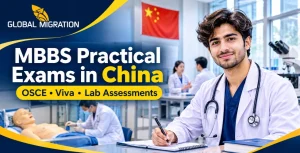
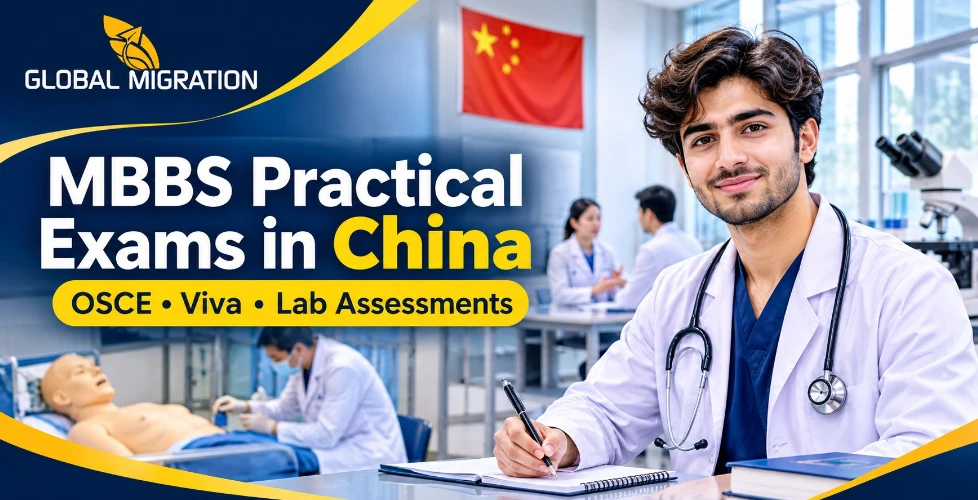
Studying MBBS in China offers international students an opportunity to develop medical knowledge alongside practical clinical skills. Medical education is not limited to attending lectures, reading textbooks and passing written examinations. Students must also learn how to examine patients, communicate effectively, perform laboratory procedures, interpret medical investigations and apply theoretical concepts in clinical situations.
Practical examinations play an important role in assessing these abilities throughout the MBBS programme. Students may encounter different assessment methods, including Objective Structured Clinical Examinations (OSCE), viva examinations, laboratory practicals and clinical demonstrations. Each assessment evaluates a different aspect of medical knowledge and professional development.
For Pakistani students planning to study MBBS in China, understanding these examination formats can make academic preparation easier. This guide explains how OSCE, viva and laboratory assessments work, what students may experience and how they can prepare for practical examinations during their medical studies.
Treat practical exams as skills you rehearse, not facts you memorise. Practise out loud and on your feet well before the exam, because knowing the answer and showing it are different abilities.
MBBS practical exams in China typically include OSCE (timed clinical stations), viva (oral questioning) and laboratory practicals (experiments and specimen identification). Formats, marking and requirements differ by university, so follow your faculty’s guidelines. Prepare through regular practical classes, checklists, speaking practice and mock examinations.
Understanding Practical Examinations During MBBS in China
Practical examinations evaluate whether medical students can apply classroom knowledge in practical situations. While written examinations generally test theoretical understanding, practical assessments focus on the ability to perform tasks, explain medical concepts, recognise clinical findings and demonstrate appropriate techniques. Depending on the university, academic year and medical subject, they may include:
- Objective Structured Clinical Examination (OSCE)
- Oral examinations or viva
- Anatomy and physiology laboratory assessments
- Pathology and microbiology practical examinations
- Biochemistry laboratory work
- Clinical examination demonstrations
- Medical equipment identification
- Interpretation of laboratory reports and diagnostic investigations
The examination structure, marking criteria and practical requirements can differ between Chinese medical universities. Students should follow their university’s official academic guidelines and the instructions of their faculty members. If you are comparing universities for MBBS in China from Pakistan, ask each one how its practical assessments are structured and marked.
1. What Is an OSCE in MBBS?
OSCE stands for Objective Structured Clinical Examination. It is a practical assessment method designed to evaluate clinical skills, communication, professional behaviour and the ability to manage specific clinical tasks. Unlike traditional written examinations, an OSCE measures what students can demonstrate rather than simply what they can remember.
An OSCE usually consists of several stations arranged in a particular sequence. Students move between the stations and complete assigned tasks within a specific time limit, and each station focuses on a particular clinical skill or medical scenario. For example, students may be asked to:
- Take a medical history from a patient
- Perform a cardiovascular or respiratory examination
- Interpret an ECG report
- Identify clinical findings
- Explain a medical procedure
- Demonstrate basic life support
- Interpret blood and urine test results
- Communicate medical information to a patient
Examiners generally use predetermined assessment criteria or checklists to evaluate students. The number of stations, time limits and scoring methods depend on the institution.
Common Types of OSCE Stations
History-taking stations
Collect medical information from a patient with symptoms such as chest pain, fever, headache, abdominal pain or breathing difficulty. Ask relevant questions, spot important symptoms and communicate professionally.
Physical examination stations
Perform systematic clinical examinations, such as cardiovascular, respiratory, abdominal, neurological and musculoskeletal examinations.
Clinical procedure stations
Demonstrate basic procedures, hand hygiene, venepuncture, injection techniques or basic life support, depending on your training level and curriculum.
Communication stations
Show how well you explain procedures, obtain informed consent, provide health education and respond to patient concerns.
Data interpretation stations
Study ECGs, X-rays, blood test results, urine reports or clinical photographs, identify important findings and explain their clinical significance.
How to Prepare for OSCE
Begin preparation well before the examination instead of depending on last-minute revision. Useful strategies include:
- Practise clinical examinations regularly with classmates
- Understand the marking criteria for different stations
- Use checklists to remember important examination steps
- Practise history-taking with different patient scenarios
- Improve communication and patient interaction
- Complete mock OSCE examinations under timed conditions
- Ask teachers and classmates for constructive feedback
A systematic approach matters. Introduce yourself, confirm the patient’s identity, explain the examination, obtain consent, maintain patient comfort, perform the task, communicate your findings and close the interaction professionally.
2. What Is a Viva Examination in MBBS?
A viva is an oral examination in which students answer questions directly from an examiner. It evaluates your understanding of medical subjects, your ability to explain concepts and your confidence in discussing scientific and clinical information.
During MBBS in China, viva examinations may be included in subject assessments, laboratory practicals, clinical examinations or other university examination formats. Unlike written examinations, students must explain their answers verbally, and examiners may ask follow-up questions to check that you understand the topic rather than simply memorising definitions.
Common Subjects Covered in MBBS Viva
Anatomy viva
Questions about organs, bones, muscles, nerves, blood vessels and body systems. You may also identify structures using models, charts or specimens.
Physiology viva
How organs and systems function, such as blood circulation, respiration, nerve impulses, hormonal regulation and kidney function.
Biochemistry viva
Carbohydrates, proteins, lipids, enzymes, vitamins, metabolism and biochemical reactions, and why they matter for normal body function.
Pathology viva
Disease mechanisms, inflammation, cellular injury, tissue changes and laboratory findings.
Microbiology viva
Bacteria, viruses, fungi, parasites, infectious diseases, laboratory identification methods and infection prevention.
How to Prepare for Viva Examinations
Successful viva preparation needs conceptual understanding and regular speaking practice. Focus on these techniques:
- Understand basic concepts. Learn the main principles of every subject instead of memorising isolated definitions.
- Prepare important questions. Review frequently discussed topics from lectures, practical classes and previous university assessments where available.
- Practise speaking. Explain medical concepts aloud to classmates or study partners.
- Use diagrams. Prepare anatomical drawings, flowcharts and labelled diagrams to understand complex topics.
- Answer clearly. Begin with a direct answer and add explanation when required.
- Stay calm. If you do not know an answer, remain professional and avoid giving unsupported information.
Confidence is important, but accuracy and understanding matter more than speaking quickly.
Start every viva answer with one clear sentence that directly answers the question, then add detail. Examiners find it easier to follow, and it shows you understand the point.
3. Laboratory Assessments During MBBS in China
Laboratory practical examinations are another important part of medical education. They let students apply scientific knowledge through experiments, demonstrations, specimen identification and diagnostic techniques. Laboratories help you understand how the human body functions, how diseases develop and how laboratory investigations support diagnosis. The requirements depend on the subject and academic stage.
Anatomy laboratory
- Bones and joints
- Muscles and their attachments
- Internal organs
- Nerves, blood vessels and specimens
- Structures on models and diagrams
Physiology laboratory
- Measuring blood pressure
- Examining pulse rate
- Studying respiratory functions
- Basic physiological measurements
Biochemistry laboratory
- Qualitative tests for carbohydrates and proteins
- Enzyme activity
- Glucose estimation
- Interpreting biochemical results
Pathology and microbiology laboratory
- Identifying blood cells
- Examining histopathological slides
- Recognising microorganisms
- Staining techniques and laboratory safety
Some anatomy assessments also ask about the location, function and clinical importance of structures, so attend practical sessions regularly and revise labelled diagrams. In physiology, understand the purpose of each experiment, the equipment, the procedure and the expected interpretation. In biochemistry, learn the scientific principle behind each experiment instead of memorising only the procedure. Pathology and microbiology practicals help you build observation skills and see how laboratory findings relate to disease.
4. Difference Between OSCE, Viva and Laboratory Assessments
Although all three formats evaluate practical knowledge, they focus on different abilities.
| Assessment Type | Main Focus | What Students Demonstrate | Typical Example |
|---|---|---|---|
| OSCE | Clinical skills | Patient examination, communication and procedures | Performing a cardiovascular examination at a timed station |
| Viva | Oral knowledge | Understanding, explanation and medical concepts | Explaining kidney function to an examiner |
| Laboratory practical | Experimental skills | Specimen identification, experiments and interpretation | Identifying blood cells on a prepared slide |
| Written examination (for comparison) | Theoretical knowledge | Recall and understanding on paper | Answering written questions on disease mechanisms |
What Each Practical Format Mainly Tests
Illustrative emphasis on a Low, Medium and High scale
This is an illustrative guide based on the format descriptions in this article, not official marking data. Weightings and assessment methods differ between Chinese medical universities.
An OSCE evaluates how students perform clinical tasks, while a viva examines how well they explain medical information. Laboratory assessments focus on practical scientific knowledge and the ability to perform or interpret laboratory activities. Together, these methods help universities evaluate different aspects of student learning.
5. Common Challenges Students Face During Practical Exams
Practical examinations can be challenging, particularly the first time. Even students with strong theoretical knowledge may struggle when they must demonstrate skills under examination conditions.
Lack of practical experience
Students who rely mainly on textbooks may find clinical procedures or laboratory tasks hard to perform confidently.
Examination anxiety
Being observed by examiners creates pressure and can affect concentration.
Poor time management
Spending too long on one task can leave the remaining requirements unfinished.
Difficulty explaining answers
Some students understand concepts but struggle to communicate their knowledge in a viva.
Weak understanding of laboratory procedures
Memorising experimental steps without understanding their purpose makes practical questions difficult.
Students can overcome these challenges through regular practice, faculty guidance, peer learning and structured revision.
6. Practical Preparation Strategy for MBBS Students in China
A consistent preparation routine helps you manage practical examinations throughout your medical education.
| Preparation Stage | Recommended Activity | Main Objective | Helpful Habit |
|---|---|---|---|
| Stages 1–2 | Review lecture notes and attend practical sessions | Understand concepts and learn correct techniques | Never skip practical classes |
| Stage 3 | Practise with classmates | Improve confidence | Take turns as examiner and student |
| Stage 4 | Prepare checklists | Remember essential steps | Keep one checklist per skill |
| Stages 5–6 | Attempt mock examinations and review feedback | Improve time management and find weaknesses | Note feedback and fix one weakness at a time |
Make the most of your clinical postings too. Observing experienced doctors helps you understand patient communication, history-taking, examination techniques and professional behaviour. During laboratory sessions, follow safety instructions, use equipment correctly and ask instructors for clarification whenever necessary. Students who choose MBBS in China should build these habits from the first semester instead of waiting for the clinical years.
Record yourself explaining a topic or performing an examination routine, then watch it back. You will quickly spot rushed steps, missing greetings and unclear explanations.
7. Tips for Practical Examination Day
Good preparation is important, but you should also keep a professional approach during the actual examination. Consider these tips:
- Arrive at the examination venue on time
- Read station instructions carefully
- Listen to the examiner’s questions before answering
- Follow laboratory safety procedures
- Maintain proper hand hygiene
- Obtain patient consent before clinical examinations
- Explain procedures in understandable language
- Manage the available time carefully and avoid rushing
- Stay calm if you make a minor mistake
Remember that each station or assessment may have different requirements. Following the specific instructions given by the examiner is essential.
Frequently Asked Questions
1. What are practical examinations in MBBS in China?
Practical examinations assess your ability to apply medical knowledge through clinical demonstrations, laboratory experiments, patient examinations and diagnostic activities. Common formats include OSCE, viva and laboratory practicals.
2. What is an OSCE examination in MBBS?
OSCE stands for Objective Structured Clinical Examination. It evaluates students through practical stations involving history-taking, physical examinations, communication skills, clinical procedures and medical data interpretation.
3. What questions are asked during MBBS viva examinations in China?
Viva questions depend on the subject and academic year. You may be asked about anatomy, physiology, biochemistry, pathology and microbiology, including definitions, body functions, disease processes and laboratory procedures.
4. Are laboratory practical examinations compulsory in MBBS in China?
Laboratory practicals are part of training in many MBBS programmes, and assessment requirements depend on the university curriculum and subject. You may perform experiments, identify specimens, examine slides and interpret laboratory results.
5. How can Pakistani students prepare for MBBS practical exams in China?
Attend practical classes, practise clinical skills, revise laboratory procedures, prepare for viva questions, take part in mock OSCEs and follow your teachers’ guidance. Regular practice improves confidence and performance.
Conclusion
Practical examinations are an important part of medical education and help MBBS students develop abilities beyond theoretical learning. During MBBS in China, students may meet different forms of practical assessment, including OSCE, viva and laboratory examinations, depending on their university and curriculum.
OSCE evaluates clinical performance, communication and practical procedures. Viva examinations assess conceptual understanding and the ability to explain medical knowledge, while laboratory assessments focus on scientific experiments, specimen identification and investigation techniques.
For Pakistani students planning MBBS in China from Pakistan, understanding these formats makes academic preparation more organised. Regular practical sessions, clinical exposure, peer learning, mock examinations and feedback from teachers can improve confidence and performance.
Ultimately, the purpose of practical assessments is not simply to earn good marks. They help students develop the clinical knowledge, technical abilities, communication skills and professional behaviour needed for a future career as a medical doctor. If you want help choosing a university, speak with professional study abroad consultants for China before you apply.
Planning MBBS in China?
Contact Global Migration Advisors for guidance on universities, admission requirements and what to expect in your first year.
Chat on WhatsAppGlobal Migration Advisors | Lahore, Pakistan | globalmigration.pk