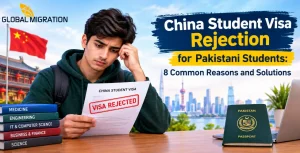
Every year, thousands of Pakistani students choose China for higher education in medicine, engineering, IT, business, finance and science. For students who want to study MBBS in China, several universities offer programs designed for international applicants, with modern facilities and real international exposure.
However, an admission letter does not automatically guarantee a student visa. Some Pakistani students face delays in getting appointments, requests for extra documents, or even refusals. These problems can disrupt academic plans, create financial pressure and cause real stress for families.
In many cases, trouble starts with incomplete paperwork, inconsistent personal information, weak financial evidence or a misunderstanding of the procedure. Other factors can also matter, depending on the applicant’s circumstances and the visa rules in force.
This guide explains eight common reasons a China student visa application may be rejected, with practical tips to help you prepare better for MBBS in China in 2027.
Why Is It Important to Understand China Student Visa Rejection?
A student visa application involves more than an admission letter and a passport. You must show that your identity, education, finances and purpose of travel all match the information in your application. Chinese visa authorities may look at:
- The authenticity and completeness of your supporting documents
- Your educational background and admission status
- Evidence of financial support
- Consistency of personal information across documents
- The validity of the university and visa paperwork
- Compliance with the applicable application procedures
A minor administrative error does not automatically cause rejection, but inconsistencies or missing information can lead to delays, questions or an unsuccessful application. Careful preparation reduces avoidable mistakes, although no consultant or applicant can guarantee approval.
Overview of Common Visa Application Problems
| Problem Area | Risk Level | Possible Consequence | How to Avoid It |
|---|---|---|---|
| Fake bank statements and insufficient funds | Very high | Visa refusal and possible further consequences | Submit genuine financial records that match the course cost |
| Incomplete documents and mismatched personal details | High | Delays, identity checks, requests for more documents | Follow the current official checklist and cross-check every detail |
| Invalid police certificate or missing attestations | High | Extra verification and processing delays | Confirm requirements and complete the correct authentication |
| Late application and unreliable guidance | Medium to high | Missed registration, incorrect paperwork, misleading advice | Start early and verify through official channels |
1. Submitting Fake or Manipulated Bank Statements
Submitting fraudulent financial documents is one of the most serious mistakes an applicant can make. Some students are persuaded by unauthorized agents who promise guaranteed admission or approval regardless of their real finances, which can encourage fabricated statements or altered balances.
If the authorities find that financial evidence is false, the student may face refusal and potentially more serious consequences under the applicable rules. Misrepresentation can also create difficulties for future applications.
- Obtain original bank statements from the issuing bank.
- Verify that account details and personal information are correct.
- Make sure sponsor documents are genuine.
- Keep supporting evidence for the source of funds where appropriate.
- Refuse any request to alter statements or fabricate records.
2. Showing Insufficient Financial Resources
Another common difficulty is weak evidence that you can afford tuition, accommodation, living costs and other expenses. The amount required can depend on the university, program, scholarship arrangements, length of study and the current requirements for your visa category.
An MBBS program in China generally lasts six years, so plan for the whole course, including tuition, accommodation, food, insurance, travel and personal expenses.
- Prepare a realistic budget and confirm the university’s tuition and hostel fees.
- If parents or another eligible sponsor will pay, prepare sponsorship documents and supporting records.
- Keep financial records genuine and consistent.
- Be ready to explain large recent deposits.
- Confirm whether scholarship documents count as proof of funding.
3. Incomplete or Incorrect Documentation
Missing or wrongly prepared documents can delay a visa application even after admission is confirmed. Depending on your case, you may need a valid passport, completed visa application, admission letter, JW201 or JW202 documentation, photographs and other supporting records. Common mistakes include:
- Leaving sections of the form empty
- Entering wrong passport details
- Submitting outdated or invalid documents
- Providing the wrong admission or visa document
- Missing required attestations
- Not providing documents requested by the authorities
Prepare a checklist from the current official instructions, not from an old list shared by a friend or agent. Compare each document with the requirements, check names, passport numbers, dates and signatures, and keep digital and physical copies.
Document Readiness Checklist
| Document | Purpose | What to Check | When to Start |
|---|---|---|---|
| Passport | Identity and travel | Validity, spelling of name, passport number | As soon as you decide to apply |
| Admission letter and JW202 | Proof of admission and visa basis | Correct dates, name and university details | After admission and fee payment |
| Educational certificates | Academic proof | Board verification, IBCC attestation, matching names | 2 to 3 months before intake |
| Police certificate and financial documents | Background and funding proof | Validity, authority, attestation, genuine records | Early, since authentication takes time |
4. Mismatched Personal Information
Your name, date of birth, passport number and other details must be consistent across every document. Differences between your passport, CNIC, certificates and admission letter can raise questions about identity or accuracy. For example, a passport may show a full name while a certificate uses an abbreviation. Spelling differences, missing middle names, reversed name order and wrong dates can all cause complications.
- Full name and spelling
- Date of birth
- Passport number and validity
- Educational institution and qualification details
- Admission information
If you find a discrepancy, contact the issuing authority or the university for the correct fix. Never alter official documents yourself.
5. Incorrect or Invalid Police Character Certificate
Some applicants must provide a police character certificate. Problems arise when it is missing, outdated, issued by the wrong authority or not authenticated. Requirements vary, so first confirm whether your application needs one at all.
- It contains accurate personal information.
- It is issued by the appropriate authority.
- It meets the validity requirements.
- It carries any required attestation.
- It is submitted in the requested format.
Start early, because getting and authenticating official certificates takes time.
6. Failure to Complete the Required Attestation Process
Educational and official records often need verification before they can be used for study abroad. Pakistani students are sometimes unsure which authority must authenticate which document. Depending on the document, the process may involve the education board, the Inter Board Coordination Commission (IBCC), the Ministry of Foreign Affairs (MOFA) or another authorized body. Confirm the sequence for each document instead of assuming it is the same every time.
What Is IBCC Verification and Why Does It Matter?
IBCC verifies and attests Pakistani matric and intermediate certificates for students planning to study abroad, including MBBS in China. Students generally need board verification before IBCC attestation, and depending on the destination, extra authentication through HEC, MOFA or an Apostille may be required. Prepare original certificates, mark sheets, CNIC or B-Form, the application form and the payment receipt, and make sure all details match your passport. For a full walkthrough, read our IBCC verification guide.
IBCC Online Application, Fees and Common Mistakes
You can apply through the official portal at attest.ibcc.edu.pk, choose an appointment, courier or express service, pay the fee and track your application online. Fees and timelines change, so check the latest details on the portal. Avoid skipping board verification, submitting incomplete documents, overlooking attestations, using inconsistent names and relying on unauthorized agents. Apply at least two to three months before your intake and keep all payment receipts.
7. Applying Too Late or Missing Important Deadlines
Students who wait until the last days before registration have little time to fix errors or collect missing documents. Delays can come from appointment availability, document authentication, university processing or extra verification requests.
Another problem is a passed registration deadline on the admission letter. Some students get an extension letter from the university and assume the issue is solved, but an extension letter does not guarantee acceptance. The authorities may still need to confirm whether the updated dates and documents meet the requirements.
- University registration deadlines
- Passport validity checks
- Document preparation and attestation
- Visa appointment arrangements
- Financial documentation
- Expected travel dates
If you need an extension, get official written confirmation and ask whether extra documents are required. Do not rely on informal assurances.
8. Relying on Inexperienced Consultants or Incorrect Guidance
Many students follow social media posts, unofficial agents, friends who applied under different circumstances or consultants who promise guaranteed approval. Procedures change, and advice that worked for one applicant may not suit another. A consultant who encourages fake documents, ignores official instructions or makes unsupported promises puts your plans at risk.
- Verify key requirements through official channels.
- Ask questions whenever instructions are unclear.
- Avoid anyone who promises guaranteed visa approval.
- Keep copies of submitted applications and documents.
- Stay in control of your personal records and decisions.
A responsible consultant explains the process clearly, flags potential problems, encourages genuine documents and is open about services, fees and limits. Professional help can organize the process, but the final decision always rests with the authorities.
What Happens If Your China Student Visa Is Rejected?
- Delayed admission: You may miss the registration deadline and need an extension or a later intake.
- Financial losses: Application charges, authentication fees and travel costs may already be spent. Refunds depend on each institution’s policy.
- Emotional stress: Uncertainty is hard on students and parents. Clear information and an organized response help.
- Future applications: A refusal does not mean every later application will fail, but false information or fraudulent documents can have serious consequences.
Understand the stated reason for a refusal and fix the underlying issue before applying again.
How Pakistani Students Can Reduce the Risk of Visa Rejection
- Use authentic documents: Never submit fabricated or altered records.
- Confirm the latest requirements: Check official instructions before you prepare documents.
- Prepare financial evidence carefully: Funding must be genuine and suited to the cost of study.
- Check every document: Review details, dates and signatures for consistency.
- Complete authentication: Follow the correct attestation process.
- Apply early: Leave time for appointments and corrections.
- Communicate with your university: Ask when anything is unclear.
- Keep records: Retain copies of forms, correspondence and evidence.
Frequently Asked Questions
Final Thoughts
Studying in China can be a big opportunity for Pakistani students in medicine, engineering, business, IT and other fields. But admission is only one part of the journey. You must also meet the visa requirements and make sure your documents honestly represent your situation.
Fake financial statements, weak funding evidence, incomplete paperwork, inconsistent details, certificate problems, missing attestations, late applications and unreliable guidance can all cause avoidable trouble. The best approach is to prepare early, verify current requirements, use genuine documents and ask whenever you are unsure. Working with professional study abroad consultants for China can help you stay organized, but remember that no agent can guarantee a visa. A well-prepared application only reduces avoidable mistakes.
Need Help With Your China Student Visa?
Talk to our team on WhatsApp for guidance on documents, attestation and your 2027 intake.
Chat on WhatsApp