Last updated: 20 October 2026
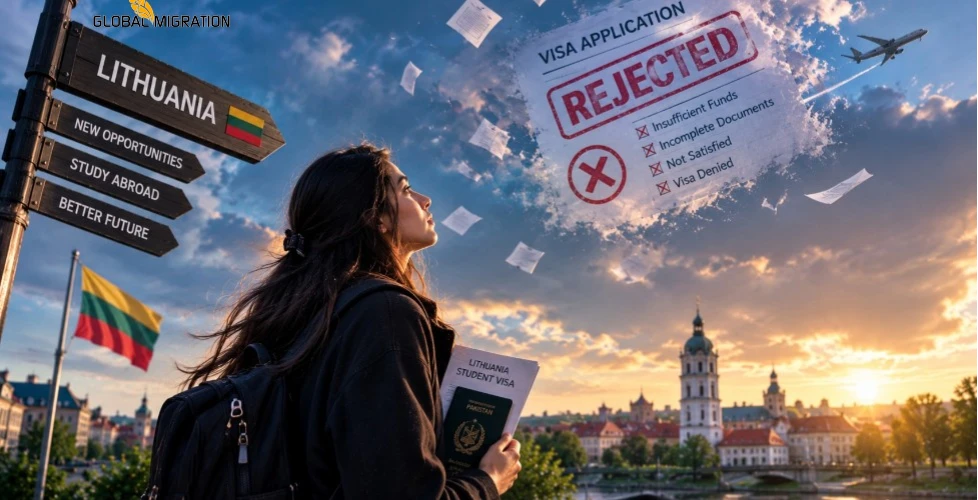
It is early morning, and your phone buzzes once. The subject line reads “Decision on your application.” You open it and take in a single word: refused.
The offer letter was real. The tuition was paid. Your bags were half packed, and your family had already started telling relatives about Europe. Now your Lithuania study visa is gone, and nobody around you can explain why.
Here is what makes this moment so painful: in many cases, it was avoidable. Pakistani students are among the largest groups of international students in Lithuania, according to Migration Department figures reported by RTE (October 2026), which means officers read file after file that looks a lot like yours. An application rarely falls apart because of one missing paper. It falls apart when the reader quietly stops believing the story behind the file.
That is the good news hidden inside the bad news, because a story can be fixed. This guide covers the real reasons Lithuania study visa applications fail, what the process costs, which documents you need, and exactly what to do in the first 14 days after a refusal. If you plan to study in Lithuania, read this before you submit anything, and you will know how an officer reads your file before they do.
The residence permit timing, permit validity and the appeal window are from the EU Immigration Portal page for students in Lithuania (updated 1 April 2025). The permit is granted for 2 years, or for the length of your studies if shorter, and can be renewed. The appeal deadline and procedure can depend on the type of decision, so always follow the instructions in your own refusal letter. All of this can change, so confirm it before you plan dates.
Why a Lithuania Study Visa Gets Refused
Most students blame a missing document, but refusals are usually about credibility. In one written refusal from Lithuania’s Migration Department, the officer found “reasonable doubts” about the applicant’s declared purpose and serious grounds to believe there was a risk of illegal migration. The paperwork was not the problem. The story was.
Behind every decision sit two questions. The first is whether you are really coming to study. The second is whether you can pay for it and live legally while you do. Every reason in the next section falls under one of these two questions, and once you see that, preparing your file becomes much more focused.
The 8 Reasons Applications Fail, and How to Fix Each One
1. A generic answer about your course
Saying “it is a good course with good scope” tells the officer you have not really studied what you applied for.
2. A field switch with no bridge
Moving from a health-related course to business, with only a work gap in between, looks like a route to a permit rather than a career plan.
3. Low fees and easy admission as the main reason
Cost is a fair practical factor, but when it is the only reason it reads as a shortcut to living in Europe rather than a decision about education.
4. A file with nothing to anchor it
With no travel history, no study or work history that fits the plan and no confirmed family connection, the officer has nothing to hold your story to.
5. Dates and details that do not match
Lithuanian immigration law lists misrepresented information and signs of forgery among the grounds for refusal. Even an honest mistake, like different dates on two forms, can look like this.
6. Money nobody can trace
Insufficient means of subsistence is also a legal ground for refusal. The EU portal asks for sufficient financial resources, such as a bank statement or regular income, but states no fixed amount, so the officer decides whether your funds look enough and believable.
7. A missing paper
The visa and the residence permit have different document lists. The most common gaps are the health insurance document, the mediation letter number from your university and, for a first permit, criminal record certificates.
8. A story that changed since last time
A previous application stays on your record, so a new explanation that does not match the old one will be noticed.
Lithuania Study Visa Fees and Costs
Knowing the costs in advance keeps your financial file clean and consistent. The table below shows the main amounts you should plan for.
| Cost | Details |
|---|---|
| Visa fee | EUR 160 for the national visa (D). A visa application centre or consultancy may charge a separate service fee on top, so ask for the full breakdown. |
| Residence permit (state fee) | EUR 80 in general order for a foreigner admitted to study at a Lithuanian institution. Other permit categories pay EUR 220 in general order. The permit card itself has a separate personalisation fee of EUR 75 in general order. Source: Migration Department state fees for residence permits (page updated 13 October 2026). |
| Short-stay Schengen visa (not for study) | EUR 90 for adults, EUR 45 for children aged 6 to 11, and free for children under 6. Source: Lithuanian Ministry of Foreign Affairs. The ministry also states that residents of Pakistan apply for a visa to Lithuania at the Embassy of Hungary in Islamabad, so confirm with that embassy which visa types it accepts. If a service provider such as VFS is used, a separate service fee applies. |
| University application fee | Set by each university. Check your university’s official admission page and keep the payment receipt. |
| Tuition fee | Set by your university and programme. Pay only through the channel named in your offer letter. |
| Health insurance | Required. The minimum insured sum is EUR 30,000 for the visa and EUR 6,000 for the residence permit. |
Fees and exchange rates change, so confirm every amount with the university and the Migration Department before you pay.
Pro Tip 1: Verify every fee at the official source and keep the receipts. Visa fees can differ depending on where and how you apply, and they are generally non-refundable if the visa is refused. Check the current amount on the Migration Department website or with the embassy or visa centre before paying, and keep every receipt so your payments match the story in your file.
Why Officers Look Harder at Files Now
Pakistan is listed among the largest sending countries for international students who study in Lithuania, alongside India, Bangladesh, Morocco and Belarus. According to the same Migration Department data, only about 12,000 of the more than 230,000 foreigners holding temporary residence permits came to study, which is roughly 5%. At the same time, the Migration Department has said some study programmes are used just to obtain residence permits, and it reported 780 student permits revoked by September 2025 because students abandoned their studies.
Lawmakers have also proposed tighter rules, including a government-approved list of universities and limits on student work. These are proposals, so check what is actually in force on the day you apply. The lesson stays the same either way: a real, specific and consistent study plan is your strongest document.
What Your Visa File Must Contain
Your documents depend on your route, so start by choosing the right checklist. A national long-term visa is applied for at a Lithuanian embassy or consulate, while a temporary residence permit is applied for only at the Migration Department, online through the MIGRIS system. Tick every line before you submit.
Checklist A: National long-term visa
Applied for at an embassy or consulate- Application form, completed electronically
- Valid passport and photo
- Mediation letter number from your institution
- Proof of sufficient financial resources
- Health insurance with an insured sum of EUR 30,000
- All hand fingerprints (biometrics)
- Fee payment receipt
Checklist B: Temporary residence permit
Applied for online with the Migration Department- Application in the prescribed format and valid passport
- Mediation letter number from your institution
- Bank statement and/or regular income
- Proof of accommodation
- Health insurance with an insured sum of EUR 6,000
- No-criminal-conviction certificates for countries lived in during the last 2 years (first permit)
- List of trips and stays abroad
- Biometrics: two fingerprints and a face image
Before you submit, also run a final check across both lists: every name, date and amount should match across all documents, and every payment receipt should be saved. Requirements change, so confirm the current list on the Migration Department website. Insurance is a frequent trouble spot, and the rules for travel insurance for a Lithuania student visa are worth reading before you buy.
Pro Tip 2: Build one master sheet of facts and check your file against it. List your full name, passport details, course title, university, dates of study and work, and every amount you will mention. Then compare each form, document and interview answer against that sheet. Most mismatch problems come from small differences that nobody noticed before submission.
The Interview: What Officers Really Ask
Applicants may be interviewed, sometimes remotely. In one written refusal, the interview covered identity, purpose of arrival, the chosen programme, plans and reasons for choosing Lithuania.
| Topic | What the officer is asking | A strong answer |
|---|---|---|
| Identity | Is everything in the file true? | Calm answers that match your documents exactly |
| Purpose | Are you really coming to study? | A clear academic reason linking your past to this course |
| Programme | Do you know what you applied for? | Specific modules and outcomes in your own words |
| Plans | What happens after graduation? | A realistic plan with a clear next step |
| Why Lithuania | Why here and not elsewhere? | Honest reasons, with cost as only one factor |
Keep every answer consistent with your file. For practice questions, see the Klaipeda University interview guide.
Pro Tip 3: Prepare a two-minute explanation in your own words. Practise explaining why you chose this course, why Lithuania, and what you will do after graduation, without reading from a script. Officers ask follow-up questions, and a natural, honest answer that matches your documents is far more convincing than a memorised one.
Get Your Lithuania Study Visa File Reviewed Before You Apply
Most refusals come from a file that does not explain itself. At Global Migration, we review your study plan, financial documents, document checklist and interview answers the way an officer would, and tell you honestly where the risks are. If you have already been refused, we study the decision, match it to your file and help you choose between an appeal and a stronger reapplication.
If you are planning to study in Lithuania from Pakistan, you can see the full admission and visa process on our page, or message us your profile directly.
Chat on WhatsAppRefused? Your First 14 Days Decide Your Options
A refusal is not always the end, but time matters. The EU portal says decisions are sent by email and can be challenged before the Vilnius District Administrative Court within 14 days of receipt. Your refusal letter should state the exact deadline and procedure that apply to your case, so read it carefully and take legal advice early.
On day one, save the decision, note the date you received it and read the stated reasons, not just the result. Over the next two days, match each reason to your file and interview answers, and be honest about the weak points. By day seven, decide with an adviser or lawyer whether to challenge the decision or fix the file and apply again. If you choose court, file well before day 14 instead of waiting for the last day.
Courts do look at the quality of the reasoning. In one reported case, the Supreme Administrative Court annulled a refusal that did not analyse the applicant’s individual circumstances or say which interview statements showed the study intent was not genuine. That does not mean every appeal succeeds, but a refusal must explain itself, and you have a right to test it. If you are unsure where to submit documents, see whether Lithuania has an embassy in Pakistan.
6 Mistakes That Make a Second Refusal Likely
The first is reapplying with the same story, because the same file usually gets the same answer. The second is the opposite: changing the story completely, when your earlier application is already on record. The third is missing the 14-day window while waiting for one more document. The fourth is submitting documents you cannot verify. The fifth is memorising answers, since scripts collapse at the first follow-up question. The sixth is trusting guarantees. No one can promise a Lithuania study visa, and anyone who does is selling, not advising.
Frequently Asked Questions
Why do Lithuania study visas get rejected?
Usually because the officer doubts the study purpose or cannot be sure of funds, documents or consistency. The law lists misrepresented information, forged documents, insufficient means of subsistence and missing health insurance among the grounds.
How long does a decision take?
A national visa decision usually takes about 15 to 30 days. A first residence permit is decided within 3 months at the latest, or within 45 days with the additional fee, according to the EU Immigration Portal.
Can I appeal a refusal?
According to the EU Immigration Portal, decisions can be challenged before the Vilnius District Administrative Court within 14 days of receipt, and then before the Supreme Administrative Court. The exact deadline and procedure for your case should be stated in your refusal letter, so seek advice quickly.
Can I reapply after a rejection?
Yes, but the earlier application stays on record, and no fixed waiting period is set. Fix the real weakness before you apply again.
Does an offer letter guarantee a visa?
No. The university admits you, but the Migration Department or the embassy decides the visa separately.
How much money do I need to show?
The EU portal states no fixed amount. Confirm the current figure with the Migration Department or the embassy and show funds with a documented source.
Final Thoughts: Win the Officer’s Trust Before You Apply
A Lithuania study visa is rarely lost because of one missing paper. It is lost when an officer stops believing the story. Know your programme, keep every document and answer consistent, show money you can explain and act fast if a refusal arrives. For an honest review of your file, speak with professional study abroad consultants for Lithuania.
Planning Your Lithuania Study Visa?
Send your profile, offer letter and any refusal decision, and we will tell you honestly what your options are.
Chat with Global Migration Advisors