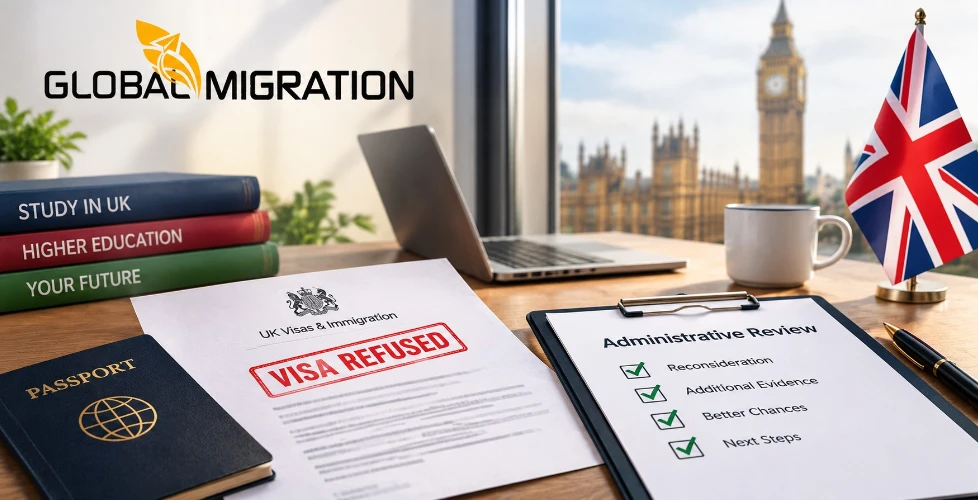
Getting a UK student visa refusal feels like the end of the dream, especially after paying fees, getting a CAS and preparing for months to study in UK. The refusal letter then mentions something called an “administrative review”, and the advice you hear from friends, agents and social media is confusing. Some say it is the only fix. Others say it is a waste of time and money.
The truth sits in the middle. If you want to study in UK and your visa was refused, an administrative review can be a powerful tool in the right situation and a poor choice in the wrong one. This guide explains what an administrative review is, who can apply, how long it takes, how to check its status, what the success rate really tells us, and why you must inform your university early.
What Is an Administrative Review for a UK Visa?
If you are asking “what is administrative review UK visa” or “what is administrative review in UK”, here is the plain answer. An administrative review is a request that the Home Office look again at your UK study visa refusal because you believe the decision-maker made a mistake in applying the rules. A different caseworker reviews the file. It is not a fresh application and it is not an appeal to a judge.
That distinction matters. An administrative review UK applicants use is designed to correct caseworking errors, such as a document being overlooked, a rule being misapplied, or a factual mistake about your evidence. It does not exist to give you a second chance to improve a weak file. If your refusal was fair under the rules, an administrative review is unlikely to change it for your UK study visa.
UK Student Visa Rejection Reasons
Not sure why your file was refused? Understand the common refusal reasons before choosing your next step for your UK study visa.
For most UK study visa refusals, administrative review is the route offered. Your refusal letter will state whether you have a right to an administrative review, a right of appeal, or neither, so read it carefully before doing anything else.
Who Can Apply and What Are the Deadlines?
According to GOV.UK, you can apply for an administrative review for your UK study visa from outside the UK only if you are outside the UK, you applied from outside the UK and your application was refused. You must apply within 28 calendar days of receiving the decision, and the fee is 80 pounds. If you applied from inside the UK, the deadline is shorter, at 14 days.
The 28 days run on calendar days, not working days, and there is very little flexibility. If your decision email arrived later than the date on the letter, the clock generally starts from the date the email was sent. Treat the deadline as urgent if you want to study in UK, because a late application is simply rejected.
If the review of your UK study visa refusal succeeds, the fee is refunded. If it fails or you withdraw it, it is not.
Administrative Review vs Reapplying: Which Is Better?
Many students who want to study in UK from Pakistan confuse the options, so here is a simple comparison.
| Aspect | Administrative review | Fresh application |
|---|---|---|
| Purpose | Correct a caseworker error | Submit a new, improved application |
| Can you add new evidence? | Generally no, decided on the original evidence | Yes |
| Cost | 80 pounds, refunded if it succeeds | Full visa fee and IHS again |
| Time | Currently 12 months or more per GOV.UK | Standard visa processing times |
| Best when | The refusal was clearly a mistake | The refusal reflects a genuine gap |
One rule trips people up badly: if you make any other immigration or visa application, including a new UK study visa application, while an administrative review is pending, the review is withdrawn. So you cannot run both routes in parallel. This is the single most important strategic decision, and we return to it below.
How Long Does UK Administrative Review Take?
This is the question students who want to study in UK ask most, and it is where the “waste of time” reputation comes from. If you search “how long does UK administrative review take” or “administrative review UK visa time”, you will find conflicting answers.
Some older articles and law-firm pages say the standard target is 28 days. The current GOV.UK guidance for UK study visa applicants outside the UK says it can take 12 months or more to receive a result, and that if you do not get a decision within 6 months, the Home Office will contact you with an update. GOV.UK also states that your rights are not affected by the delay.
That is a huge difference from the old target, and it is why many students feel the process is pointless. A student who needs a UK study visa for a September intake cannot realistically wait a year. This is a genuine drawback and any honest advisor should tell you so.
How to Check UK Administrative Review Status
Students who want to study in UK often search “how to check UK administrative review status” and “how to track administrative review for UK visa”, expecting something like a parcel tracker. Unfortunately, there is no simple public tracking tool with live case updates.
What you can do is keep your administrative review reference and payment reference safe, because any enquiry about your UK study visa will need them. Some legal guidance suggests applicants who applied from outside the UK can contact the visa application centre where the original application was processed. GOV.UK also publishes a Home Office email address for administrative review enquiries and withdrawal requests, and the confirmation you receive after applying may include the contact route that applies to your case. If you include your name, date of birth, nationality and reference number in any email, the team can identify your file.
Because tracking is limited, anyone who wants to study in UK from Pakistan should set a reminder for the six-month point. If you have heard nothing by then, expect an update from the Home Office, and follow up if it does not arrive.
Study in UK: Second Master’s After PSW Visa
Planning your next course in the UK? See how a second Master’s after the PSW visa works for students who study in UK from Pakistan.
UK Visa Administrative Review Success Rate: What Do We Actually Know?
Students who want to study in UK from Pakistan naturally want a percentage. The honest answer is that a reliable, current, single figure is not available. Law-firm commentary notes that the Home Office does not regularly publish clear administrative review outcome data, and the official immigration statistics do not present one headline success rate. Older figures that circulate online vary hugely. Some historic reports based on freedom of information requests cite very low overall success for general administrative reviews in 2015 to 2017, while other reports claim high overturn rates for overseas entry clearance refusals. Because the data is patchy, old and measured differently, none of these numbers should be quoted to a student as a prediction.
What matters more than any statistic is the reason for your UK study visa refusal. If the refusal letter shows a clear factual or procedural error, such as a document that was submitted but not considered, your case is much stronger. If the refusal is about credibility, finances that were genuinely insufficient, or missing documents, an administrative review rarely fixes it. Even a successful review is not an automatic grant of the visa, as the case may simply be reconsidered.
Is Administrative Review a Waste of Time? Busting the Myth
Many people who want to study in UK say “AR is useless” because they either waited a long time or got a negative result. That is understandable, but the full picture is more nuanced.
Administrative review is not useless. It is the formal way to challenge a UK study visa refusal that really was wrong, and it does not carry the risks of a second weak application. It can also protect a student who has a strong file and a clear caseworking error.
It is, however, slow and narrow. With waits of 12 months or more, it works poorly for students whose intake is soon, and it works poorly when the refusal of a UK study visa reflects a real weakness in the file. Being honest about both sides is how a good counsellor earns trust.
Study in UK with Spouse: MRes Admission
Applying with your spouse? Read how MRes admission works for families who want to study in UK.
A practical way to decide is to compare three things: is the error in the refusal letter clearly identifiable, can you afford to wait if the review takes many months, and would a fresh application with stronger evidence be a better route? If the refusal is clearly wrong and you can wait, administrative review makes sense. If the refusal points to a genuine gap and your intake is close, a carefully prepared fresh application is usually the more realistic path. Remember there is no mandatory waiting period before reapplying, but you must declare the refusal on every future UK and many other country applications, so any new UK study visa file must address the reasons for refusal directly.
Why You Must Inform Your University About the Administrative Review
This is the step many students forget, and it can quietly cost them their place. Your university issued a CAS for a specific course and start date. When your UK study visa is refused, the university needs to know what you plan to do next, because that affects your place, your CAS and your deposit.
If you are applying for an administrative review for your UK study visa, tell your international office straight away, and tell them in writing. A review can take many months, which means your intake date may pass. Ask the university whether it can hold your offer, defer you to a later intake, or reissue a CAS if needed. Universities often cannot keep a place open indefinitely, and a CAS has a limited validity window, so silence may lead to your place being withdrawn or your CAS being cancelled.
Keep the university updated at each stage of your plan to study in UK. Share your refusal letter, tell them whether you are applying for an administrative review or reapplying, and tell them if the review outcome arrives. If you eventually choose to reapply, the university will need to issue a fresh CAS, and early communication makes that much smoother. Also ask about their refund and deferral policies so that you are not surprised by deadlines on tuition deposits.
UK Universities Withdrawing CAS for Pakistani Students
Worried about your place? This blog explains CAS withdrawals, which is why keeping your university informed matters for your UK study visa.
Refused UK Visa? Talk to Global Migration Advisors
Global Migration Advisors (GMA) helps students who want to study in the UK, including those facing a UK student visa refusal. Our counsellors read your refusal letter line by line, help you decide whether an administrative review or a fresh application makes more sense, prepare the review submission within the 28-day deadline, and communicate with your university about deferral and CAS issues. We also offer IELTS coaching for students who need to strengthen their English test results. Visit globalmigration.pk or contact our team for a free consultation before you decide your next step for your UK study visa.
Step-by-Step: What to Do After a UK Student Visa Refusal
| Step | What to do |
|---|---|
| 1 | Read the refusal letter carefully and note the exact reasons and whether it offers an administrative review |
| 2 | Note the 28-day deadline and set a firm internal deadline well before it |
| 3 | Inform your university in writing and ask about deferral and CAS options |
| 4 | Decide between administrative review and a fresh application, remembering that a new application withdraws a pending review |
| 5 | Keep copies of everything and set a reminder for the six-month update point |
Common Mistakes Students Make After a Refusal
The most common mistake among those who want to study in UK from Pakistan is missing the deadline while debating what to do. The second is applying for a review with no real error to point to, which wastes the fee and months of waiting. The third is filing a new application while a review is pending and accidentally cancelling the review. The fourth is not telling the university, which can lead to a lost place. And the fifth is hiding or misdescribing a previous refusal in a later application, which can create a much bigger problem than the refusal itself.
FAQs: UK Administrative Review and Study in UK
It is a request that the Home Office look again at your refusal because you believe a mistake was made in applying the rules. A different caseworker reviews the file, and it is not a fresh application or an appeal to a judge.
If you want to study in UK and applied from outside the UK, you can apply if your application was refused. You must apply within 28 calendar days of receiving the decision, and the fee is 80 pounds, refunded if the review succeeds.
Current GOV.UK guidance says it can take 12 months or more to receive a result for a UK study visa. If you do not get a decision within 6 months, the Home Office will contact you with an update.
No, not without consequences. If you make any other immigration or visa application while you try to study in UK from Pakistan, the pending review is withdrawn.
Your university needs to know your plan because it affects your place, CAS and deposit. A CAS has a limited validity window, so silence may lead to your place being withdrawn while you try to study in UK.
Final Thoughts
professional study abroad consultants for UK agree that an administrative review is neither a magic solution nor a scam. It is a narrow, slow, formal route designed to fix genuine caseworking mistakes, and it works best when your UK study visa refusal letter contains a clearly identifiable error.
Act quickly, because the 28-day clock starts the moment you receive the decision. The smartest approach after a refusal is to analyse the reasons honestly, decide between review and reapplication with your intake date in mind, and keep your university informed throughout if you want to study in UK from Pakistan.