If you are a Pakistani student searching for a destination that combines world-class academic reputation, affordable tuition, and genuine cultural richness, there is no better place than Italy. To study in Italy is to gain access to some of Europe’s most prestigious institutions, a progressive income-based tuition system, and a Schengen residence permit that opens the door to 26 European countries. This guide covers everything Pakistani students need to know in 2026 — from universities and tuition fees to visa requirements, financial proofs, scholarships, and life after graduation.
Why Italy Has Become a Top Choice for Pakistani Students
Italy’s appeal goes far beyond its famous food and architecture. The country’s public university system is built around an income-based fee model called ISEE (Indicatore della Situazione Economica Equivalente), which means students from lower-income families — including most Pakistani applicants — often end up paying a fraction of what students pay in the UK, USA, Canada, or Australia. Italy also offers a high volume of fully English-taught degree programs at both undergraduate and postgraduate levels, meaning advanced Italian language skills are not always a requirement.
Italian universities are deeply embedded in international research networks, and degrees earned in Italy are fully recognised across the European Union and accepted by employers worldwide. Beyond academics, students gain the experience of living in one of the world’s most historically significant countries while building professional skills through legal part-time work of up to 20 hours per week during academic sessions.
Top Universities in Italy for Pakistani Students
Italy’s public university landscape is genuinely diverse. Whether a student is drawn to engineering, business, medicine, fashion, or the humanities, there is an institution built for that path. Below are the most prominent universities that regularly attract international and Pakistani students.
University of Bologna
Founded in 1088, the University of Bologna holds the distinction of being the oldest university in the Western world. It offers strong programs in Business, Economics, Engineering, Political Science, and International Studies, with a significant number of English-taught Master’s degrees.
Sapienza University of Rome
One of Europe’s largest universities by student enrollment, Sapienza covers Medicine, Engineering, Humanities, Social Sciences, and Computer Science. Its research output is among the highest in Italy.
Politecnico di Milano
Italy’s leading technical university, Politecnico di Milano is consistently ranked among the top engineering and design schools in Europe. It is particularly strong in Mechanical Engineering, Architecture, Industrial Design, and Computer Engineering.
Bocconi University
Bocconi is internationally recognised as one of Europe’s elite business schools, offering top-ranked programs in Business Administration, Finance, Economics, and Management. Note that as a private institution, its tuition fees are significantly higher than public universities — between €15,000 and €20,000 per year.
University of Padua, University of Pisa, University of Florence, Politecnico di Torino
These universities round out Italy’s most respected public institutions. The University of Padua excels in Biomedical Sciences, Engineering, and Psychology. Politecnico di Torino is a strong second option for engineering students after Politecnico di Milano. The University of Florence is especially admired for Architecture, Arts, and Humanities.
Tuition Fees in Italy – Accurate 2026 Breakdown
One of the most important things to understand about Italian university fees is that public universities do not charge a single flat rate. The ISEE system calculates each student’s fee based on their family’s financial situation. International students use a version called ISEE Parificato to access the same progressive fee scale available to Italian students.
| University Type | Annual Tuition Fee Range | Notes |
| Public Universities (low income) | €0 – €500 | Students with very low ISEE scores may pay nothing or a nominal amount |
| Public Universities (mid income) | €1,000 – €2,500 | Most international students fall in this bracket |
| Public Universities (higher income) | €2,500 – €4,000 | Maximum cap for public institutions |
| Private Universities (e.g. Cattolica) | €5,000 – €11,000 | Varies by program |
| Private Universities (e.g. Bocconi, LUISS) | €12,000 – €20,000 | Elite business and law schools |
Pakistani students should also be aware that living costs vary significantly by city. Students in Milan or Rome will spend considerably more on accommodation and daily expenses than those in Bologna, Padua, or Pisa. On average, monthly living costs including rent, food, transport, and personal expenses range between €700 and €1,000.
Scholarships Available for Pakistani Students
Italy offers multiple avenues for financial support. The DSU (Diritto allo Studio Universitario) regional scholarship program is the most significant, covering tuition fees, accommodation in university residences, and a monthly meal allowance for eligible students. Awards are based primarily on financial need and academic merit, and Pakistani students can apply through the same process as European students.
Beyond DSU, many universities — including Politecnico di Milano, University of Padua, University of Bologna, and Bocconi — offer merit scholarships to international students ranging from €5,000 to €12,000 per year. The Italian Government also provides a limited number of scholarships through the Italian Ministry of Foreign Affairs for non-EU students. Students should research specific deadlines carefully, as scholarship applications often open months before general admissions.
💡 Pro Tip: Apply for DSU scholarships before submitting your university application. Scholarship windows often open months earlier, and students who prepare their documents alongside their admission application have a much higher chance of securing funding.
Admission Requirements for Pakistani Students
Requirements differ between degree levels, but the core documents remain consistent across most Italian universities.
Undergraduate Admissions
Pakistani students applying for a Bachelor’s degree must hold their Secondary School Certificate (Matriculation) and Higher Secondary School Certificate (FSc/FA/ICS). Both must be attested by HEC (Higher Education Commission of Pakistan) and the Ministry of Foreign Affairs before submission. Most universities also require an online pre-enrollment through the Universitaly portal, which is Italy’s official government platform managed by the Ministry of University and Research.
Master’s Admissions
Applicants need a recognised Bachelor’s degree with official transcripts, a Statement of Purpose, a CV, and two or more letters of recommendation. Some competitive programs may also require GRE or GMAT scores.
Language Requirements
For English-taught programs, the most commonly accepted qualifications are IELTS (typically 6.0–6.5) and TOEFL iBT (around 80+). Some universities also accept PTE Academic or Cambridge certificates. Italian-taught programs require Italian language certification such as CELI or CILS, usually at B2 level or above.
Italy Student Visa Process for Pakistani Students
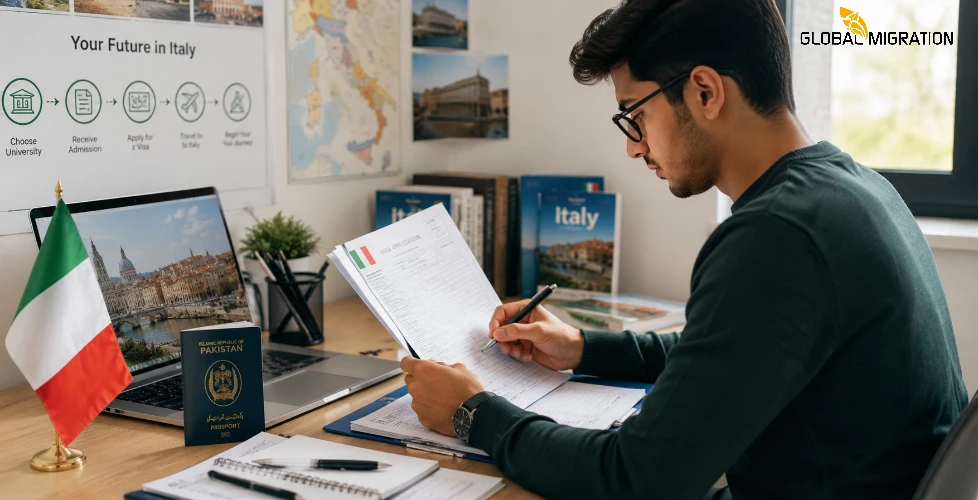
Understanding the visa process is critical. There are two types of Italian student visas relevant to Pakistani applicants: Type C for courses under 90 days (language programs, short workshops) and Type D for full degree programs lasting more than 90 days. Pakistani students enrolling in Bachelor’s, Master’s, or PhD programs must apply for a Type D national visa.
Updated Financial Proof Requirement for 2026
This is one of the most important changes in 2026 that many students are unaware of. Italy now requires international students applying for a Type D university enrollment visa to demonstrate financial capacity of €10,179.85 per year. This is a significant increase from the previously quoted figure of approximately €6,000 and applies to the 2026–27 and 2027–28 academic years. For Pakistani students, this translates to approximately PKR 3.2 million or more depending on the exchange rate at the time of application. Students with confirmed scholarship awards should carry official documentation as proof, since a scholarship application alone may not satisfy visa officers.
Required Documents for Italy Student Visa
- Valid passport (minimum 6 months validity beyond the intended stay)
- Completed Type D visa application form
- Official Letter of Acceptance from an Italian university
- Bank statements for the last 6 months showing sufficient funds (minimum €10,179.85)
- Proof of accommodation in Italy
- Valid health insurance for the duration of study
- NADRA-issued family registration certificate
- Police clearance certificate
- Attested educational certificates
- Sponsorship letter and affidavit (if funds are from parents or guardian)
Visa Fee and Application
The visa fee for a long-term Type D student visa from Pakistan is approximately €50. Applications are submitted at the Italian Embassy in Islamabad or the Consulate in Karachi. Students are advised to apply at least 90 days before their intended date of arrival in Italy.
After Arrival – Permesso di Soggiorno
Within 8 working days of arriving in Italy, every student must apply for a Permesso di Soggiorno (residence permit) by submitting the required kit at a designated post office. Failure to do so within this window is a legal violation. The Permesso di Soggiorno serves as your official right to remain in Italy for the duration of your studies and is required for opening a bank account, accessing healthcare, and part-time employment.
💡 Pro Tip–Prepare your Permesso di Soggiorno kit before you board the flight. Download the official kit from Poste Italiane’s website, have your passport photos and visa documents ready, and visit a Sportello Amico post office within your first two days in Italy — the 8-working-day deadline starts the moment you land.
Intakes and Application Timeline
| Intake | Start Month | Application Opens | Program Availability |
| Primary Intake | September / October | February – April (varies by university) | Full range of programs available |
| Secondary Intake | February | October – November (varies by university) | Limited programs; not all universities participate |
Students targeting the September intake should begin their Universitaly pre-enrollment and document preparation as early as January or February of the same year. Visa processing from Pakistan can take 4 to 8 weeks, and documents requiring HEC attestation should be submitted months in advance.
Popular Fields of Study for Pakistani Students

Italy’s academic strengths align well with the fields most sought by Pakistani students. Engineering and Technology programs — covering Mechanical, Civil, Electrical, Software Engineering, Artificial Intelligence, and Robotics — are offered at world-class institutions like Politecnico di Milano and Politecnico di Torino. Business Administration and Finance programs at universities like Bocconi and the University of Bologna draw students with management and economics ambitions.
Architecture is an especially compelling reason to study in Italy from Pakistan, given that Italy’s built environment — spanning Roman antiquity through Renaissance palaces to contemporary design studios — serves as a living classroom unlike anywhere else on earth. Fashion Design and Luxury Brand Management programs in Milan position graduates directly in the global capital of the fashion industry. Medicine, Biotechnology, and Environmental Sciences are also growing areas with internationally accredited programs at Sapienza and the University of Milan.
Part-Time Work and Post-Study Opportunities
International students holding a Type D visa are legally permitted to work up to 20 hours per week during their academic term and full-time during official university breaks. This allows students to offset living expenses while gaining professional exposure in a European labour market.
After completing a degree, graduates may apply for a post-study work permit (job-seeking visa) to remain in Italy and seek employment. Those entering sectors such as engineering, IT, finance, and design will find demand for qualified professionals across Italy and within the broader EU labour market. Italian residency through employment also opens pathways toward long-term settlement in Europe.
Cost Summary for Pakistani Students Planning to Study in Italy
| Expense Category | Estimated Annual Cost (EUR) | Notes |
| Tuition (Public University) | €200 – €4,000 | ISEE-based; most Pakistani students pay €1,000–€2,500 |
| Accommodation | €3,000 – €6,000 | Lower in smaller cities; higher in Milan/Rome |
| Food & Groceries | €1,800 – €2,400 | Approximately €150–€200/month from local supermarkets |
| Transport | €300 – €600 | Student discounts available on public transit |
| Health Insurance | €200 – €300 | Mandatory for visa; rates are low compared to other countries |
| Miscellaneous | €500 – €1,000 | Books, phone, personal expenses |
| Total Estimated Annual Cost | €6,000 – €14,300 | Varies greatly by city, lifestyle, and tuition bracket |
For Pakistani students who are serious about building an international career in Europe, few destinations offer the combination of academic prestige, cost accessibility, and cultural depth that Italy provides. Whether your goal is an engineering degree from Politecnico, a business qualification from Bocconi, or an architecture master’s in Florence, the decision to study in Italy is one that opens doors on a genuinely global scale. Begin your preparation early, ensure your documents are attested well in advance, and use the University portal as your primary application hub.
Frequently Asked Questions
1. How much money do I need to show in my bank account for an Italy student visa in 2026?
As of 2026, Italy requires international students applying for a Type D university enrollment visa to demonstrate a minimum of €10,179.85 per year. This figure is significantly higher than what was previously required and applies to the 2026–27 and 2027–28 academic years. Pakistani students should prepare well above this threshold to account for exchange rate fluctuations.
2. Can Pakistani students study in Italy without knowing Italian?
Yes. Italian universities offer hundreds of fully English-taught Bachelor’s, Master’s, and PhD programs, particularly in Engineering, Business, Computer Science, Economics, and International Relations. For Italian-taught programs, a language certificate such as CELI or CILS at B2 level is required.
3. What is the Universitaly portal and why does it matter?
Universitaly is the official Italian government pre-enrollment platform managed by the Ministry of University and Research. Most Pakistani students must complete their pre-enrollment through this portal before their host university processes their application. It is an essential step that many guides overlook.
4. What happens if I don’t apply for a Permesso di Soggiorno within 8 days of arrival?
Failing to apply for the residence permit within 8 working days of arriving in Italy is a legal violation under Italian immigration law. Students should apply immediately upon arrival at a designated post office using the official kit. The Permesso di Soggiorno is required for opening a bank account, accessing healthcare, and working part-time.
5. Are scholarships available for Pakistani students in Italy that cover full costs?
Yes. The DSU regional scholarship is the most comprehensive, covering tuition fees, university accommodation, and a meal allowance for eligible students. University merit scholarships from institutions like Politecnico di Milano, University of Bologna, and University of Padua typically range from €5,000 to €12,000 per year. Italian Government scholarships through the Ministry of Foreign Affairs are also available in limited numbers for non-EU students including Pakistanis.
Final Thoughts
Italy offers one of the most balanced and rewarding study experiences available to international students today — academically rigorous, financially accessible through its income-based tuition system, and culturally enriching in ways few countries can match. The key to a successful application in 2026 lies in careful, early preparation: completing University pre-enrollment well in advance, meeting the updated financial proof requirement of €10,179.85, submitting a complete Type D visa application, and registering for the Permesso di Soggiorno within eight working days of arrival. For any Pakistani student who has been considering the move, the decision to study in Italy from Pakistan can open the door to a world-class European education, freedom to travel across 26 countries, and a genuinely competitive global career — all at a cost that remains one of the most reasonable among major Western study destinations.
Apply Now
If you are planning to study in Italy from Pakistan, our expert education consultants can guide you through the entire process including university selection, application submission, visa processing, and scholarship assistance.Start your journey today and achieve your dream of studying in Italy.