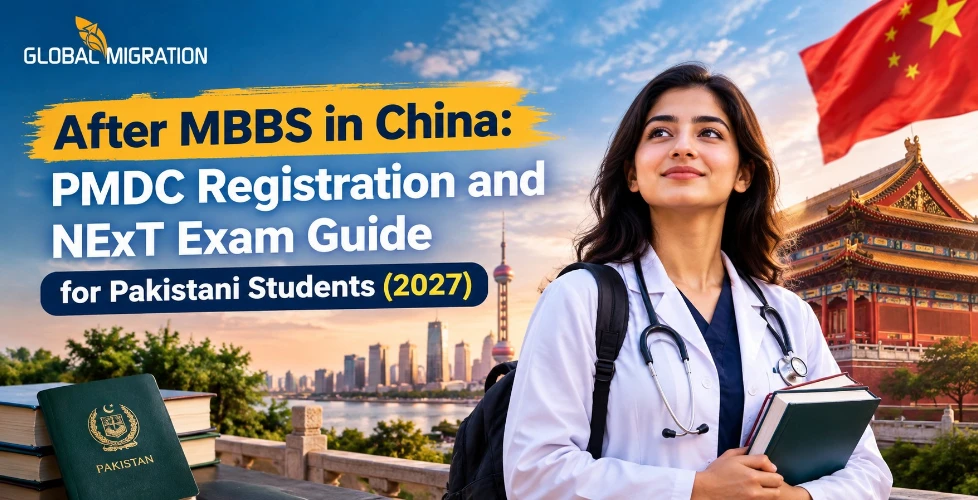
Every year, thousands of Pakistani students choose MBBS in China because of affordable fees, English-medium teaching and modern teaching hospitals. But a medical degree is only the first half of the journey. The second half happens back home: getting your qualification recognised, completing PMDC registration, clearing the licensing exam and finally practising as a doctor in Pakistan.
This guide covers both halves. You will learn which Chinese universities are approved, what the degree costs, how the Pakistan Medical and Dental Council (PMDC) is changing the system, and how to prepare for the NExT exam. If you are exploring MBBS in China from Pakistan, this is the roadmap to follow.
Why Pakistani Students Choose MBBS in China
The main attraction is value. Annual tuition and hostel costs at most approved universities fall between roughly 20,000 and 40,000 RMB, which is about USD 3,000 to 6,000, or around PKR 7.5 to 15 lakh per year. For many families, that is lower than a year at a private medical college in Pakistan.
The programme lasts six years: five years of academic study plus a one-year clinical internship, usually at the university’s affiliated hospital. Teaching is in English from day one, and graduates receive a Bachelor’s degree in Clinical Medicine (MBBS).
If you plan to study MBBS in China, budget for extras too. Visa fees, hostel deposits, flights and attestation costs are usually not included in the yearly figure. Families who plan for these from the start avoid stressful surprises in the first semester.
| Item | Details | Approx. Cost | Notes |
|---|---|---|---|
| Tuition + hostel (yearly) | 20,000 – 40,000 RMB | USD 3,000 – 6,000 | Around PKR 7.5-15 lakh per year |
| Programme length | 6 years | – | 5 years study + 1 year internship |
| Language of teaching | English from day one | – | HSK-4 needed before degree is conferred |
| Extra expenses | Visa, deposits, flights, attestation | Not included | Budget these separately |
What Is the MOE List and Why Does It Matter?
China’s Ministry of Education (MOE) has published a list of universities authorised to teach MBBS in English since 2007. Only these institutions may officially state “MBBS in English” on admission letters. A university outside the list may still advertise an English programme, but it does not have official authorisation. That can create serious problems when you apply for recognition in Pakistan.
For the 2026-2027 cycle, the MOE list includes 43 medical universities. Three institutions, China Three Gorges University, North Sichuan Medical University and Dali University, were dropped from the latest list. That is a useful reminder that a university can lose its status, so always verify the current list before paying any fee.
Well-known names on the list include Zhejiang University, Fudan University, Shanghai Jiao Tong University, Xi’an Jiaotong University, Wenzhou Medical University, Dalian Medical University, Ningxia Medical University, Shihezi University and Zhengzhou University. Seat numbers differ widely, from around 20 seats at smaller programmes to 180 at Zhejiang University, and quotas change between intakes.
Admission Requirements for Pakistani Applicants
Eligibility for MBBS in China from Pakistan is fairly straightforward:
- A minimum of 60% in FSc Pre-Medical, or an equivalent qualification with Biology, Chemistry and Physics.
- Some top universities, including Zhejiang, Fudan, Tianjin Medical University and Tongji, expect closer to 70% and may ask for IELTS or TOEFL scores.
- Many universities hold an interview to assess academic readiness.
- An HSK-4 Chinese certificate is typically required before the degree is conferred, not before enrolment. Basic Mandarin still makes clinical rotations much easier.
Understanding the New PMDC Landscape
Before looking at registration steps, it helps to understand the regulator you will be dealing with. According to its published statement, the PMDC was re-constituted under the PM&DC Act, 2022. It says it is committed to transparency, merit and global competitiveness in medical and dental education, and describes its mission as protecting students, empowering practitioners and upholding patient safety. The Council lists several milestones that matter to students who study abroad:
- International accreditation: PMDC reports a 10-year accreditation from the World Federation for Medical Education (WFME), which helps graduates pursue international careers.
- Digital services: Online portals handle provisional and full licences, good standing certificates, qualification additions, and faculty and experience certificates. Average processing time has been reduced to just 3-4 working days.
- Backlog cleared: Over 187,000 pending cases have been resolved.
- Structured MDCAT: A uniform syllabus, digital registration and a standardised question bank for merit-based admissions.
- Higher standards: Professionalism, Leadership and Ethics are now core subjects.
- Fee rationalisation and inspections: A tuition-fee framework and a structured inspection system protect students and parents.
For a student in China, the most important point is the Council’s recognition framework for foreign institutions. PMDC states that, in the interest of patient safety, no one is allowed to practise on a Pakistani citizen unless they hold a qualification from a recognised foreign institution. Recognition is not a formality. It is the gate between your degree and your career.
A guide published by Global Migration Advisors reports that PMDC has required a No-Objection Certificate (NOC) for students going abroad for medical or dental education since the 2024 session. The same guide says that, following a sub-committee meeting in May 2026, students intending to study medicine abroad must clear MDCAT and complete PMDC registration beforehand.
The practical lesson is to treat MDCAT as a requirement for every pathway, not only for Pakistani medical colleges. Requirements and deadlines can change, so confirm the latest rules with PMDC before accepting an offer. Preparing early, even while you are still planning your China application, is a smart move.
PMDC Registration After MBBS in China
Once you finish your six-year MBBS in China programme, your focus shifts to registration. Check exact document lists and fees on the official PMDC website. The general sequence looks like this:
| Step | Action | Where | Key Point |
|---|---|---|---|
| 1. Documents | Degree, transcripts, internship proof, passport copies | Your records | Keep them organised |
| 2. Attestation | Pakistani attestation and verification steps | Relevant offices | Needed before acceptance |
| 3. Online application | Apply through PMDC’s digital portal | PMDC portal | Processing about 3-4 working days |
| 4. Provisional to full | Provisional registration, then full licence | PMDC | Supervised clinical work first |
Your total timeline will also depend on document verification and the completeness of your file. Incomplete applications are the most common cause of delay.
The NExT Exam: What Foreign Graduates Should Know
The National Licensing Examination (NExT) is the exit-level assessment that graduates, including those from foreign universities, are expected to prepare for as part of the licensing pathway. Think of it as the final test between your degree and your full licence. Rules, eligibility conditions and exam dates are set by PMDC, so check its official channels for the current schedule. You can start preparing now:
- Build strong fundamentals. Revise anatomy, physiology, pathology, pharmacology, medicine, surgery, gynaecology and paediatrics throughout your six years.
- Practise clinical reasoning. Exams increasingly reward applied knowledge, so work through case-based questions regularly.
- Learn Pakistan-specific context. Local diseases, public health priorities and guidelines may differ from what you see in China.
- Use your internship well. Your final year is your best chance to sharpen history taking, examination and procedural skills.
- Create a revision calendar. Start at least 8 to 12 months before the exam and track your weak areas.
Common Mistakes Pakistani Students Should Avoid
- Choosing a university outside the MOE list.
- Ignoring PMDC requirements until graduation. Handle MDCAT, NOC and registration rules early.
- Skipping documentation discipline.
- Relying on unverified advice. Always cross-check with official sources.
- Neglecting language skills. Mandarin helps in hospitals and daily life.
How PMDC Protects Students and Patients
If something goes wrong, such as a delayed application or unclear guidance, PMDC invites students, parents, practitioners and faculty to raise concerns through its Online Complaint Portal. PMDC’s head office is at Mauve Area, G-10/4, Islamabad. You can reach it on +92-51-9190000 or through www.pmdc.pk.
Quick Checklist for Aspiring Doctors
- Check that your shortlisted university is on the current MOE list.
- Prepare for and clear MDCAT, following the latest PMDC guidance.
- Obtain a PMDC NOC before enrolling abroad.
- Budget for tuition, hostel, visa, flights and attestation.
- Keep every academic record organised for registration.
- Follow PMDC announcements about NExT and licensing.
- Use official channels for questions and complaints.
Frequently Asked Questions
How much does MBBS in China cost for Pakistani students?
Annual tuition and hostel costs at most approved universities fall between roughly 20,000 and 40,000 RMB (about USD 3,000 to 6,000, or PKR 7.5 to 15 lakh). Visa, flights and attestation are usually extra.
How long is the MBBS programme in China?
Six years: five years of academic study plus a one-year clinical internship, usually at the university’s affiliated hospital. Teaching is in English.
What is the minimum eligibility for MBBS in China from Pakistan?
At least 60% in FSc Pre-Medical or an equivalent with Biology, Chemistry and Physics. Some top universities expect around 70% and may ask for IELTS or TOEFL.
Do I need MDCAT and a PMDC NOC before going to China?
PMDC has required an NOC since the 2024 session, and recent guidance says students must clear MDCAT and complete PMDC registration beforehand. Rules can change, so confirm with PMDC before accepting an offer.
Is the NExT exam required for foreign medical graduates?
Foreign graduates are expected to prepare for NExT as part of the licensing pathway. Eligibility rules and dates are set by PMDC, so check its official channels for the current schedule.
Final Thoughts
Choosing to study MBBS in China can be a smart, affordable route into medicine, but success depends on planning for the whole journey, not just admission. Choose an MOE-listed university, respect Pakistan’s regulatory requirements, prepare early for MDCAT and the NExT exam, and keep your documents in order for PMDC registration.
PMDC says it is working to build a modern, technology-driven and transparent system, and that direction should make the process more predictable for students who prepare properly. Start early, verify every claim, and build your path step by step with professional study abroad consultants for china.