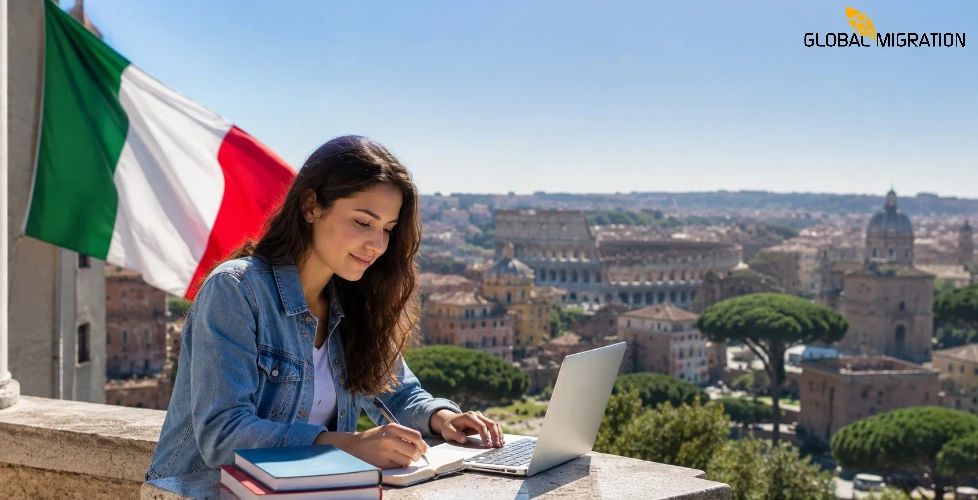
Italy is no longer just the land of ancient ruins and world-class cuisine. In 2026, it is one of the most sought-after study destinations in Europe — and for very good reason.
With over 90 accredited universities, including institutions like the University of Bologna (the world’s oldest university, founded in 1088), Politecnico di Milano, and Bocconi, Italy combines unmatched academic prestige with surprisingly affordable tuition. Public universities in Italy charge as little as €150–€4,000 per year in tuition, making it a fraction of the cost of studying in the UK, US, or Canada.
For Pakistani students specifically, Italy has become a top choice. Need-based regional scholarships like DSU and EDISU can cover tuition, accommodation, and daily meals — meaning some students effectively study in Italy for free. On top of that, international students are permitted to work 20 hours per week, offering financial flexibility that most other visa destinations do not allow.
But to make this dream a reality, you first need to navigate the Italy student visa process — and do it correctly. A single documentation error can delay your application by months or result in outright rejection. This guide is designed to ensure that doesn’t happen to you.
What Are the Italy Student Visa Requirements?
- Valid passport (at least 90 days validity beyond your visa’s expiry date)
- University acceptance letter from an accredited Italian institution
- University pre-enrollment confirmation (mandatory for degree programs)
- Proof of financial means — minimum €10,179.85 per year (updated for 2026–27)
- Proof of accommodation in Italy (rental agreement, dorm booking, or host declaration)
- Health insurance covering at least €30,000 for medical expenses and repatriation
- Completed Type D long-stay visa application form
- Biometric data (fingerprints — mandatory as of January 11, 2025)
- Academic documents (legalized, translated, apostilled where required)
- Visa fee of approximately €50 (paid in local currency at the application center)
Italy Student Visa Requirements 2026 — Detailed Breakdown
1. University Admission Letter
Your admission or enrollment letter is the cornerstone of your visa application. It must:
- Be addressed to the Italian Consulate/Embassy, not to you personally
- Be printed on official university letterhead with the institution’s seal or digital signature
- Confirm your enrollment, study program, start and end dates, weekly hours (minimum 20 hours/week for language programs), and accommodation details where applicable
For degree programs (Bachelor’s, Master’s, AFAM/music/art, SSML), University pre-enrollment is mandatory. International students must register through the Universitaly portal, which officially connects your acceptance to your visa file. Starting from Academic Year 2026/27, document submission requirements on the portal have become stricter.
2. Valid Passport
- Must be valid for at least 90 days beyond your visa’s planned expiry date
- Must contain at least two blank pages for visa stamps
- Color photocopy of the bio-data page is required
- Must be signed by the holder
3. Visa Application Form
- Type D (National Visa) for stays longer than 90 days — required for all degree-level programs
- Type C (Schengen Visa) for short courses under 90 days
- Must be duly completed and signed; available through the Italian consulate or Visa Application Center in Pakistan
4. Proof of Accommodation
You must prove where you will live for the entire duration of your study. Acceptable proof includes:
- University dormitory confirmation letter
- Signed and registered rental agreement covering your full study period
- Hotel or Airbnb confirmation for initial period, plus rental agreement for the remainder
- A signed hosting declaration from a private individual in Italy
Note: Rental agreements must be officially registered with the Italian Tax Agency (Agenzia delle Entrate). Students who use Universitaly can complete this step automatically through the portal.
5. Health Insurance
- Minimum coverage: €30,000 for medical expenses, hospitalization, and repatriation to Pakistan
- Must be valid for the entire duration of stay in Europe (the entire Schengen zone)
- Must clearly state your name, date of birth, coverage dates, and coverage amount
- Investment or employer-based insurance not accepted — must be travel/international health insurance
6. Financial Proof
See the dedicated section below for the latest 2026 figures and complete breakdown.
7. Visa Fee
- Type D (Long-stay, 90+ days): approximately €50 — paid in Pakistani Rupees at the application center (around PKR 16,742, though this fluctuates with exchange rates)
- Type C (Short-stay): approximately €80 (PKR 26,785)
- An additional service fee of approximately PKR 11,180 is charged by the Visa Application Center
8. Biometric Data
As of January 11, 2025, all Type D (National Visa) applicants must submit fingerprints at their in-person appointment, per Italian Decree No. 145 (October 2024). This is not optional and cannot be waived.
9. Academic Documents
- Degree certificates, transcripts, and marksheets
- Legalized, translated into Italian or English
- HEC attestation (for Pakistani students) is mandatory
- DOV (Declaration of Value) or CIMEA equivalency certificate required for degree recognition in Italy
- Standard notary attestations are not accepted — documents must go through the proper legalization chain
10. Passport-Sized Photographs
- 2 recent photographs
- Dimensions: 3.5 cm × 4.5 cm
- Full-frontal, white background
- Must match the face on your passport
Italy Student Visa Requirements for Pakistani Students
Pakistani students face a few unique requirements that differ from students from other countries. Understanding these in advance is critical to a successful application.
DOV and CIMEA — The Equivalency Requirement
Italian universities do not automatically recognize Pakistani degrees. You must obtain either:
- DOV (Dichiarazione di Valore): A Declaration of Value issued by the Italian Embassy in Islamabad that evaluates your Pakistani qualification and confirms its Italian equivalent. This is issued by the Embassy based on your documents.
- CIMEA Certificate: An independent Italian information center that provides a comparability statement for your foreign degree. Many universities now accept this as an alternative or supplement to the DOV.
Important: You cannot complete Universitaly pre-enrollment without confirming your academic qualification equivalency through one of these paths.
HEC Attestation
All Pakistani academic documents — degree certificates, transcripts, and marksheets — must be attested by the Higher Education Commission (HEC) of Pakistan before they can be accepted for the visa process. After HEC attestation, documents may further require attestation from the Ministry of Foreign Affairs (MOFA) Pakistan and then from the Italian Embassy.
Embassy Appointments
Pakistan has two Italian representation offices:
- Italian Embassy: Islamabad (primary visa-issuing authority)
- Italian Consulate: Karachi
Visa Application Centers (VACs) are managed through theitalyvisa.com. Appointment slots, particularly during peak intake seasons (August–September for the fall intake), fill up weeks or even months in advance. Book your appointment at least 90 days before your intended travel date.
Common Mistakes Pakistani Students Make
The most frequent mistakes that lead to rejection or delay include:
- Showing funds in a joint account without proper documentation
- Submitting bank statements that show sudden, large deposits without a clear income source
- Not having the DOV or CIMEA before starting the Universitaly process
- Incorrect insurance — the policy must include the repatriation clause
- Submitting copies instead of originals for bank statements and sponsorship documents
- Ignoring the Universitaly portal deadline (typically November 30 of the preceding year)
Italy Student Visa Documents Required — Complete Checklist Table
| Document | Purpose | Mandatory / Optional | Key Notes |
| Completed Visa Application Form (Type D) | Official application | Mandatory | Must be signed; available at VAC or consulate website |
| Valid Passport | Identity verification | Mandatory | Valid 90+ days beyond visa expiry; 2+ blank pages |
| Passport-Sized Photos (2) | Identity | Mandatory | 3.5cm × 4.5cm, white background |
| University Acceptance Letter | Proves enrollment | Mandatory | Addressed to consulate, on official letterhead |
| Universitaly Pre-Enrollment Confirmation | Government verification of intent to enroll | Mandatory (degree programs) | Print after completing online process |
| DOV or CIMEA Certificate | Degree equivalency in Italy | Mandatory | DOV issued by Italian Embassy; CIMEA is an alternative |
| HEC-Attested Academic Documents | Credential verification | Mandatory | Degree, transcripts, marksheets — all HEC-attested |
| Bank Statement (last 6 months) | Financial proof | Mandatory | Must show minimum €10,179.85; original, stamped, signed |
| Sponsorship / Affidavit of Support | Financial guarantee (if sponsored) | Mandatory (if applicable) | Notarized; sponsor’s bank statement + tax returns required |
| Proof of Accommodation | Shows where student will live | Mandatory | Registered rental agreement or university dorm confirmation |
| Health Insurance | Medical coverage | Mandatory | Minimum €30,000 coverage; must include repatriation clause |
| Tuition Fee Receipt | Proof of payment | Mandatory (if applicable) | Pre-enrollment fee or first-semester fee |
| Travel Itinerary | Arrival plan | Mandatory | Flight reservation (not necessarily a purchased ticket) |
| No Objection Certificate (NOC) | Release from current institution or employer | Mandatory (if employed/enrolled) | From current university or employer |
| Cover Letter / Statement of Purpose | Explains study plans and ties to Pakistan | Highly Recommended | Strong letters significantly help in borderline cases |
| Biometrics (Fingerprints) | Mandatory as of Jan 2025 | Mandatory | Collected in-person at the Visa Application Center |
Italy Student Visa Financial Requirements — Full Breakdown
Financial proof is the single most scrutinized element of an Italy student visa application. Italian consulates evaluate not only the amount in your account but also the source and history of those funds.
Updated Financial Requirement for 2026
Italy’s Ministry of University and Research officially updated the financial threshold for international student visa applicants via the Universitaly portal. For the 2026–27 and 2027–28 academic years, the requirement is: €10,179.85 per year
This is a significant increase from the previously cited figure of approximately €6,000, and the change has been confirmed across multiple official sources and consular guidance documents.
For Pakistani students, this translates to approximately Rs. 3.2–3.3 million, depending on the PKR/EUR exchange rate at the time of application.
What Financial Documents Are Required?
If you are self-funding:
- Original bank statement (last 6 months), stamped and signed by the branch manager on every page
- The statement must not be older than 31 days at the time of submission
- The account must be in your own name (joint accounts are not accepted at some consulates)
- Funds must remain consistently maintained — sudden large deposits are red flags
If sponsored by parents or a guardian:
- Notarized Affidavit of Financial Support, stating the sponsor’s relationship and financial commitment
- Sponsor’s bank statement (last 6 months), original and stamped
- Sponsor’s salary slips or income certificate (last 3 months)
- Sponsor’s tax returns for the last 2 years (NTN/FBR records in Pakistan)
- Property documents or other assets as supplementary evidence
- Birth certificate proving your family relationship with the sponsor
Pro Tip: Advisors consistently recommend showing €12,000–€15,000 for a one-year program to provide a buffer and demonstrate genuine financial stability, rather than just meeting the bare minimum.
Living Costs in Italy — What to Budget
| Expense Category | Monthly Estimate (€) |
| Accommodation (shared apartment) | €250–€600 |
| Food and groceries | €200–€350 |
| Transportation (monthly pass) | €30–€50 |
| Books and academic materials | €30–€80 |
| Miscellaneous (personal, phone, etc.) | €100–€150 |
| Total estimate | €610–€1,230/month |
Cities like Milan and Rome are at the higher end; smaller university cities like Pisa, Perugia, and Trento are significantly more affordable.
How Much Bank Statement Is Required for Italy Student Visa?

This is the most-searched question from Pakistani students planning to study in Italy — and the answer has changed significantly in 2026.
The New Official Figure
According to the Universitaly portal (Italy’s Ministry of University and Research), the updated minimum financial requirement effective for 2026–27 and 2027–28 is:
€10,179.85 per year
This replaces the older, widely-circulated figure of €6,000. The new figure is approximately 70% higher than the previous requirement and represents a major policy tightening from the Italian government.
Quick Reference for Pakistani Students
| Duration of Study | Minimum Required (EUR) | Approximate PKR (at current rates) |
| 1 Year | €10,179.85 | ~ Rs. 3.2–3.3 million |
| 2 Years | €20,000+ (recommended) | ~ Rs. 6.4–6.6 million |
| Short course (under 90 days) | €500/month of stay | Variable |
Bank Maintenance Period
- Your statement must cover the last 6 months
- The balance must not drop below the required amount at any point during the 28 consecutive days before submission
- The statement must be issued within 31 days of your visa application date
Scholarship Impact on Financial Requirements
If you hold a confirmed scholarship award (DSU, EDISU, MAECI, or a university merit scholarship), the scholarship letter can reduce or supplement your bank statement requirement. However, an “application pending” letter is not sufficient — you need a confirmed award letter.
Is IELTS Required for Italy Student Visa?
One of the biggest misconceptions among Pakistani students is that Italy requires IELTS for the visa itself. Here is the accurate picture:
IELTS and the Italian Embassy
The Italian Embassy and consulates do not require IELTS as part of the visa application process. The visa officer will not reject your application solely because you don’t have an IELTS score.
However, Italian universities do have their own English proficiency requirements for English-taught programs, and you must meet these to receive the acceptance letter that the visa requires.
University Language Requirements
| Program Level | Typical IELTS Requirement |
| Bachelor’s (English-medium) | 5.5–6.0 |
| Master’s (English-medium) | 6.0–6.5 |
| PhD Programs | Varies; often 6.5+ |
| Italian-taught programs | Italian B2 level required |
IELTS Alternatives Accepted by Italian Universities
Many Italian universities accept alternatives to IELTS for Pakistani students:
- Medium of Instruction (MOI) letter: A letter from your previous university confirming that your education was conducted in English. Widely accepted, especially for students from English-medium institutions in Pakistan.
- PTE Academic: Some universities accept a score of 50–58.
- TOEFL iBT: Generally a score of 72+ for Master’s programs.
- Duolingo English Test: Increasingly accepted at select institutions.
Recommendation: Always verify the specific English proficiency requirements on your target university’s official admissions page. Don’t rely on general information — requirements vary significantly between institutions.
Italy Student Visa Application Process — Step by Step
Step 1: Secure University Admission
Apply to Italian universities through their official portals. Most universities have intakes in October (fall) and sometimes February (spring). Research your chosen program’s requirements, deadlines, and English proficiency criteria well in advance.
Internal resource: For a comprehensive overview of universities and programs available in Italy, visit Study in Italy.
Step 2: Complete Universitaly Pre-Enrollment
Register on universitaly.it and complete your pre-enrollment form. This is mandatory for all degree programs and should be submitted ideally by November 30 of the year preceding your intake. Print your pre-enrollment confirmation once the process is complete.
Step 3: Obtain DOV or CIMEA
Apply to the Italian Embassy in Islamabad for a Declaration of Value (DOV) for your Pakistani degree, or obtain a CIMEA certificate through the official CIMEA portal. This is a prerequisite for Universitaly and university enrollment.
Step 4: Prepare Your Documents
Gather all required documents as listed in the checklist above. Have your academic documents attested by HEC, then MOFA Pakistan, then the Italian Embassy. Arrange financial documents (bank statements, affidavits, sponsor documents). Purchase health insurance.
Step 5: Book a Visa Appointment
Book your appointment through the Italy Visa Application Center (theitalyvisa.com). Centers are located in Islamabad and Karachi. Book at least 90 days before your intended departure. During peak season (August–September), appointments can be scarce — book as early as possible.
Step 6: Submit Application and Biometrics
Attend your appointment in person. Submit all documents, pay the visa fee (in PKR), and have your fingerprints scanned. The VAC will forward your application to the Italian Embassy for processing.
Step 7: Wait for Decision
Processing for Type D student visas takes 45–90 days for Pakistani applicants. Avoid booking non-refundable flights until your visa is approved.
Step 8: Arrive in Italy and Register
Within 8 days of arriving in Italy, you must register at the local Police Department (Questura) and apply for your Permesso di Soggiorno (Residence Permit). Bring copies of all documents submitted for your visa, bearing the consulate’s seal.
Italy Student Visa Processing Time
| Visa Type | Standard Processing Time | Notes |
| Type D (Student, long-stay) | 45–90 days | Pakistani applicants; can extend if documents are incomplete |
| Type C (Short-stay, under 90 days) | ~15 days | For language courses and short programs |
Factors That Cause Delays
- Missing or incomplete documents (the 90-day processing clock can be suspended)
- Requests for additional information from the consulate
- Peak application season (August–September, January–February)
- Document legalization delays
Tips to Avoid Delays
- Apply at least 3 months before your program start date
- Double-check every document against the embassy’s latest checklist
- Ensure your bank statement is less than 31 days old on the date of submission
- Book your VAC appointment early — do not wait until you have all documents ready
Common Reasons for Italy Student Visa Rejection
Understanding why applications are rejected is just as important as knowing what to submit.
1. Financial Issues
Inconsistent bank balances, sudden large deposits with no clear income trail, or funds in a joint account without proper documentation are the most common financial red flags. The embassy can ask for proof of the source of funds — not just their availability.
Solution: Maintain your bank balance consistently for at least 6 months before applying. If you receive large transfers (from family, a property sale, etc.), document the source clearly.
2. Weak Accommodation Proof
Many students overlook this or submit temporary booking confirmations that don’t cover their full stay.
Solution: Submit a properly registered rental agreement or an official university dormitory confirmation letter that covers your entire program duration.
3. Incomplete or Incorrectly Legalized Documents
Missing apostille, HEC attestation, or submitting photocopies instead of originals.
Solution: Follow the full legalization chain: HEC → MOFA Pakistan → Italian Embassy → Certified Italian Translation.
4. Insurance Policy Not Meeting Requirements
Submitting insurance that lacks the repatriation clause or has coverage below €30,000.
Solution: Purchase a dedicated international student insurance policy that explicitly mentions medical emergency, hospitalization, and repatriation to Pakistan.
5. Weak Cover Letter or Unclear Study Purpose
Failure to demonstrate genuine study intent and strong ties to Pakistan (showing you plan to return after your studies).
Solution: Write a detailed, personal statement of purpose explaining your academic goals, why you chose Italy, and your post-study plans in Pakistan.
Italy Student Visa Success Tips — Expert Recommendations
Drawing from the experience of students who have successfully obtained Italy study visas from Pakistan, here are the most impactful tips:
1. Start the process 6–9 months early. Between HEC attestation, DOV application, University pre-enrollment, and visa processing, the timeline is longer than most students expect.
2. Show more than the minimum. Showing €12,000–€15,000 when the minimum is €10,179.85 significantly strengthens your application and demonstrates genuine financial stability.
3. Use Universitaly, not informal channels. All degree-level admissions for non-EU students must go through the official Universitaly portal. Applications outside this system will not be recognized.
4. Get a confirmed scholarship — it changes everything. A DSU, EDISU, or university merit scholarship letter can dramatically reduce your financial burden and strengthen your visa file. Apply for scholarships immediately after receiving your admission offer.
5. Prepare for the interview, even if it’s not guaranteed. Common questions include: Why Italy? Why this university? What are your plans after graduation? Ensure your answers are consistent with your application documents.
6. Keep your bank account in your own name. Joint accounts with parents are not accepted by all consulates. If needed, transfer funds to your personal account and document the transfer source clearly.
7. Verify your insurance covers repatriation. Many students purchase general travel insurance without this clause and have their applications delayed or rejected.
Italy Scholarships for International Students
One of Italy’s biggest advantages for Pakistani students is its generous scholarship ecosystem. Here are the main funding opportunities:
DSU Regional Scholarships (Diritto allo Studio Universitario)
DSU is Italy’s flagship need-based scholarship program, administered by regional agencies. It is not a competitive scholarship — every student who meets the income and merit criteria receives the grant.
Key benefits:
- Tuition fee waiver (full)
- Annual cash stipend: up to €6,806–€7,200 per year (deposited in two installments)
- Free accommodation in university dormitories (where available) or a housing allowance
- Free meals at university canteens
Regional DSU agencies include:
- DSU Toscana — Florence, Pisa, Siena: dsu.toscana.it
- EDISU Piemonte — Turin: edisu.piemonte.it
- DiSCo Lazio — Rome: discostudenti.it
- ER.GO — Bologna and Emilia-Romagna: er-go.it
Application window: Mid-July to early September each year. Deadlines for 2026–27 are expected to follow the same calendar.
Eligibility: Students from developing countries like Pakistan typically have a low ISEE Parificato (the Italian equivalent economic indicator for international students), making them strong candidates for DSU.
Italian Government (MAECI) Scholarships
The Ministry of Foreign Affairs and International Cooperation (MAECI) offers scholarships for international students for master’s, PhD, and research programs. Benefits include:
- Monthly stipend
- Health insurance
- University tuition exemption
- Italian language course upon arrival
Check the latest cycle at: esteri.it/maeci-scholarships
Invest Your Talent in Italy (IYT)
A government-funded scholarship-plus-internship program targeting students from specific developing countries. Benefits include:
- Full tuition waiver
- €900/month stipend for up to 2 years
- 3–6 month guaranteed internship at an Italian company post-graduation
- Fields: Engineering, Economics, Design, ICT, Scientific Research
Partner universities include Politecnico di Milano, Politecnico di Torino, University of Bologna, and Bocconi.
University Merit Scholarships
Top Italian universities offer their own merit-based awards. Examples:
- University of Bologna: Excellence scholarships for top international Master’s students
- Politecnico di Milano: Full and partial fee waivers for high-achieving applicants
- Bocconi University: ISU Bocconi need-based assistance covering tuition, meals, and housing
- University of Pisa: DSU scholarship of up to €7,200/year for enrolled students
Why Study in Italy? The Complete Case
If you are still weighing your options, here is why Italy stands apart from other popular study destinations in 2026:
World-class academic reputation. Italy is home to some of Europe’s most respected universities, including the University of Bologna, Sapienza Rome, and Politecnico di Milano. Italian degrees are recognized globally and across the EU.
Remarkably low tuition. Public Italian universities charge between €900 and €4,000 per year — among the lowest in Western Europe. Private universities range from €6,000 to €20,000, still far below comparable institutions in the UK or US.
Generous scholarships accessible to Pakistanis. Unlike many countries, Italy actively funds international students through regional and government scholarship programs. Students from lower-income backgrounds have a genuine advantage in DSU applications.
The right to work while studying. Italy allows up to 20 hours of work per week during the academic year — essential for students who want to cover day-to-day living expenses independently.
Post-study opportunities. After graduation, international students in Italy can apply for a job-seeking permit allowing them to remain in Italy for up to 12 months while searching for employment. Italy’s growing technology, fashion, food, and manufacturing sectors offer genuine career prospects.
Schengen access. An Italian study visa grants you visa-free access to the entire Schengen zone, making it possible to travel across 26 European countries during your studies.
Cultural richness. Living in Italy is a transformative experience — from world-class art and architecture to a Mediterranean lifestyle that balances study with genuine quality of life.
Need Expert Guidance for Your Italy Student Visa?
Navigating Italy’s visa process alone — from DOV applications and HEC attestation to University pre-enrollment and financial documentation — can be genuinely complex, particularly for first-time applicants.
Choosing the right consultancy can make the difference between a successful application and a preventable rejection.
Global Migration Advisors is a Pakistan-based education consultancy with a strong track record of helping students successfully secure admissions to Italian universities and obtain their student visas. Their team guides students through every step of the process, from selecting the right university and applying for scholarships to preparing a visa-ready documentation file.
The reviews reflect the experiences of real students who have studied in Italy through their guidance — a transparent way to assess their reliability before making any commitment.
For more information on studying in Italy, including university options and scholarship guidance, visit: globalmigration.pk/study-in-italy/
Frequently Asked Questions (FAQs)
Q1: What are the Italy student visa requirements for Pakistani students?
You need a valid passport, university acceptance letter, Universitaly pre-enrollment confirmation, bank statement showing at least €10,179.85, proof of accommodation, health insurance with €30,000 minimum coverage, HEC-attested academic documents with a DOV or CIMEA certificate, and a completed Type D visa application form.
Q2: How much bank statement is required for an Italy student visa in 2026?
The official minimum is €10,179.85 per year (approx. Rs. 3.2–3.3 million) for 2026–27 and 2027–28, up from the old €6,000 figure. Advisors recommend showing €12,000–€15,000 for a stronger application. Funds must be lawful, traceable, and consistently maintained.
Q3: Is IELTS required for the Italy student visa?
The Italian Embassy does not require IELTS for the visa itself. However, most universities require IELTS 5.5–6.5 for English-taught programs. A Medium of Instruction (MOI) letter from your previous institution is accepted as an alternative by many universities.
Q4: What is the Italy student visa processing time for Pakistanis?
Type D (long-stay): 45–90 days. Type C (short-stay, under 90 days): ~15 days. Book your VAC appointment at least 90 days before your course start date — slots fill fast during peak seasons.
Q5: Can I work while studying in Italy?
Yes — up to 20 hours per week during term time and full-time during holidays. No separate work permit is needed; it is included in your Permesso di Soggiorno (Residence Permit).
Q6: What is the Italy student visa success rate for Pakistani students?
Approximately 90%. Most rejections are caused by inconsistent bank statements, missing DOV/CIMEA, weak accommodation proof, or insurance without a repatriation clause — all easily avoidable with proper preparation.
Q7: What is the DSU scholarship and can Pakistani students apply?
DSU (Diritto allo Studio Universitario) is Italy’s need-based regional scholarship covering full tuition, a cash stipend of up to €7,200/year, free accommodation, and free meals. It is not competitive — every eligible student receives it. Pakistani students typically qualify easily. Applications open mid-July each year.
Final Word
Italy is a genuinely exceptional study destination in 2026 — academically prestigious, financially accessible, scholarship-friendly, and culturally irreplaceable. The student visa process, while detailed, is navigable with the right preparation and accurate information.
The most important things to get right: start early, show strong and well-documented finances (at least €10,179.85 for 2026–27), complete University pre-enrollment, get your academic credentials properly attested and evaluated, and confirm your accommodation before applying.
For Pakistani students especially, Italy’s visa success rate of around 90% is a testament to the fact that a well-prepared application has an excellent chance of approval. The key is preparation, not luck.