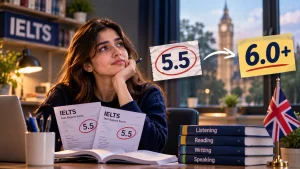

Your biggest IELTS Speaking hurdle isn’t grammar.It’s translation.
Before every sentence, your brain quietly thinks in Urdu and translates word by word, and the conversation moves on without you. That is why your IELTS speaking slows down even when you know the grammar. This translation habit is one of eight that hold students at Band 6, and every one is fixable. The first fix takes ten seconds. If you would rather fix them with a teacher, look for a good spoken English course in Lahore built around IELTS Speaking practice.
Try it right now. Look around you and say three things you can see, out loud, in English: “I can see a chair.” “The door is open.” “Someone is knocking.” Did you feel a tiny delay before the first word? That delay is your inner translator, and it is exactly what this guide fixes.
Jump toThe problemThe testScoring8 problemsPhrase bank7-day planFAQs
The 3-Second Detour: What Your Brain Does Before You Speak
Someone asks, “How was your weekend?” You know the answer, but your brain runs a secret five-step relay first: think in Urdu, translate each word, rearrange the order, check the grammar, and finally speak. By then, the conversation has moved on.
آپ دماغ میں پہلے اردو میں سوچتے ہیں، پھر ترجمہ کرتے ہیں، پھر بولتے ہیں، اور یہی وقفہ پریشانی بنتا ہے۔
An illustration of the idea, not a lab measurement.
That is why grammar is rarely the real villain. You can know every tense and still freeze, because the bottleneck is the detour, not the knowledge. Urdu and English also build sentences in a different order, so word-by-word translation scrambles everything:
The cure is not studying more. When you look at a chair and say “chair”, your brain links the object straight to the English word, with no “kursi” in the middle. Start with easy sentences, then move to natural conversation. It will feel strange at first, but your fluency and score will rise soon.
How the IELTS Speaking Test Works: Your 14 Minutes, Minute by Minute
IELTS Speaking is a one-to-one conversation with a trained examiner. It lasts 11 to 14 minutes, it is audio-recorded, and it has three parts that get harder as the clock moves. The examiner opens by checking your ID and asking your name, so the very first thing you say is something you already know. Use it to warm up your voice.
Everyday questions about home, family, work, studies and a couple of familiar topics. Short and friendly.
“Do you prefer tea or coffee?”
You get a cue card, one minute with paper and pencil, then up to two minutes alone. The examiner may add one or two short rounding-off questions.
“Describe a meal you will never forget.”
Deeper questions linked to your Part 2 topic. You are expected to explain, compare and justify, not just describe.
“Why do families eat together less than before?”
How Examiners Score You: Four Criteria and One Big Secret
IELTS Speaking is scored on four equally weighted criteria, each judged across your whole test, not answer by answer. The secret: a habit that repeats in every answer costs you more than a mistake you make once.
Do you keep going, and do your ideas follow in order?
Do you have the right word, or a smart way around it?
Do you mix sentence types, and do slips get in the way?
Can the examiner follow you without effort?
Grammar alone is a full quarter of your score, so a few repeated slips add up. If that is your weak spot, start with our guide to IELTS grammar. As IDP explains, pausing is natural, but it becomes a problem when it dominates your speech. Here is how fluency climbs across the bands:
Paraphrased from the official fluency descriptors as explained by IDP.
One question, three levels of answer
Same Part 1 question, three levels. These are our own illustrations, not official scoring.
“Do you like your hometown?”
“Yes. Lahore is good. It is big. I like it.”
Correct, but too short to mark.“Yes, I do. I live in Lahore, which is a busy city, and I like it because my family is here. The only problem is the traffic.”
A reason and a small contrast.“Honestly, I’m quite attached to it. Lahore is crowded and the traffic can be a nightmare, but the food and the old city, and the fact that half my family lives nearby, make it feel like home. In smog season, though, I might say no.”
Natural, precise and personal.What changes is not the grammar rules but the amount of useful language. It matters because many universities set a minimum score for each skill. Aiming high? See what is 7 band in IELTS for what examiners expect.
Why Is Speaking the Hardest Module for Many Pakistani Students?
If Reading and Writing feel easy but IELTS Speaking feels like walking into a cold swimming pool, you are not imagining it. Most of us learn English from books and tests, and speaking is the one skill that cannot be done quietly. Four things usually get in the way:
- You write far more English than you speak.On paper you can pause, erase and rethink. In the test, the clock keeps running while you think.
- You think in Urdu or Punjabi first.Your brain translates before it speaks, and that time shows up as pauses.
- Mistakes feel public.Silence feels safer than a wrong tense, so many students stop early or say very little.
- Few places to practise.At home, at work and with friends the conversation is in Urdu, so spoken English never gets its daily workout.
None of these is about talent. They are habits, and habits change with small daily practice.
Why writing feels easy but speaking freezes, and how to change it.
10 Urdu-to-English Slips Pakistani Speakers Often Make (and What to Say Instead)
Word-for-word translation, the classic IELTS translation habit, is the quiet villain behind many grammar slips. Urdu puts the verb at the end and English puts it in the middle, so a sentence built in Urdu comes out slightly off. You may not make all ten, so treat this as a checklist, not a label.
| What students often say | Why it sounds off | Say this instead |
|---|---|---|
| I am agree with you. | Agree is already a verb, so it needs no “am”. | I agree with you. |
| My age is 22 years. | English says how old you are, not what your age is. | I am 22 years old. |
| I am having cold since two days. | A state that started in the past and continues needs “have had” with “for”. | I’ve had a cold for two days. |
| He is my cousin brother. | In English, “cousin” carries no gender or “brother” label. | He is my cousin. |
| We discussed about the plan. | “Discuss” already means talk about, so it takes no “about”. | We discussed the plan. |
| I have done my graduation. | Graduation is the ceremony. People say they graduated, or that they hold a degree. | I graduated last year. / I have a bachelor’s degree. |
| I am doing job in a bank. | The natural English uses the verb “work” or the phrase “have a job”. | I work in a bank. / I have a job at a bank. |
| Where you live? | English questions need the helper verb “do”. | Where do you live? |
| I have a doubt about this topic. | In English, “doubt” means you are not sure something is true. A question is a “question”. | I have a question about this topic. |
| I am going to home now. | “Home” works like “there” here, so it needs no “to”. | I am going home now. |
Do not memorise the table. Look for the pattern behind it: before you speak, ask how an English speaker would say this from the start, not how Urdu would say it. If that habit is your main problem, how to stop translating from Urdu or Punjabi gives nine daily strategies to break it for good.
Game time: spot the slip
Each sentence has one mistake that learners make all the time. Find it in your head first, then tap the sentence to check.
1. “She is more taller than her sister.”
Fix: “She is taller than her sister.” Short adjectives take -er, so “more” is one comparison too many.
2. “I didn’t went to the office yesterday.”
Fix: “I didn’t go to the office yesterday.” After “did” or “didn’t”, the main verb goes back to its base form.
3. “He don’t like spicy food.”
Fix: “He doesn’t like spicy food.” With he, she and it, the helper verb is “does”.
4. “The informations on this website are useful.”
Fix: “The information on this website is useful.” Information is uncountable, so it has no plural and takes “is”.
Which of These 8 IELTS Speaking Problems Is Yours?
Pick the one that sounds most like you, check the before and after, then try its 30-second challenge before you scroll on.
Translating from Urdu in your head
- Why it happens
- Two grammars take turns in your head (“Main… kaam… karta hoon…”), and it shows up as the slips in the table above.
- Fix it
- Narrate what you see in simple English for two minutes a day, with no Urdu in between: “I am sitting on the bed. The fan is on.”اردو سے ترجمہ کرنے کے بجائے سیدھا انگریزی میں سوچیں۔
- Before → after
- Before“In my house, we are five persons.”After“There are five of us at home.”
- 30-second challenge
- Say three things you see, then what is happening at home right now, with no Urdu in between.
Long pauses before every answer
- Why it happens
- Your brain hunts for the perfect word (“Umm… how to say…”). Examiners do not need perfect, they need flow.
- Fix it
- Learn phrases in chunks (“to be honest”, “it depends on…”) and open every answer with a starter like “Well, I’d say…”.
- Before → after
- Before“Umm… my favourite… umm… how to say… food is biryani.”After“Well, I’d say biryani is my favourite, mainly because it reminds me of family gatherings.”
- 30-second challenge
- Describe your breakfast for 20 seconds, restarting at every pause. Three clean attempts in a row wins.
One-line answers
- Why it happens
- Fear of mistakes makes you stop early (“Yes. I like it. STOP.”), so the examiner hears very little language to mark.
- Fix it
- Use Answer, Reason, Example: say your answer, explain why, then add one small example. Aim for two to three sentences in Part 1.
- Before → after
- Before“Yes. I like cricket.”After“Yes, I’m a big cricket fan, mostly because it brings my whole street together. Last month we played a night match with a tape ball and nobody wanted to go home.”
- 30-second challenge
- Answer “Do you enjoy cooking?” in exactly three sentences: answer, reason, example.
Running out of ideas in Part 2
- Why it happens
- You plan sentences instead of ideas, or have no story structure, so silence arrives after fifteen seconds.
- Fix it
- Use your one minute to note four keywords: who, what happened, how you felt, why it matters. Then talk through them in order. A personal story is easier than a list of facts, and nobody checks whether it is true.
- Before → after
- Before“I helped my neighbour with her phone. She was happy. That’s all.” (12 seconds)AfterSame story, plus what she said, how the evening felt and what you learned. (90 seconds)
- 30-second challenge
- Pick the last time you laughed hard. Note four keywords in 60 seconds, then talk for one minute.
The same simple words again and again
- Why it happens
- Under pressure you only recall the safest words (“It was very good. The food was very good.”).
- Fix it
- Build small word sets by topic and swap “very good” for exact words such as “delicious” or “welcoming”. If you forget a word, explain it: “It is the place where people wait for the bus.” This paraphrasing counts under Lexical Resource.
- Before → after
- Before“The hotel was very good, the food was very good, the staff was very good.”After“The hotel was spotless, the food was delicious and the staff were incredibly welcoming.”
- 30-second challenge
- Write five sentences using “very good”, then rewrite each with a more exact word.
Grammar mistakes when you speak fast
- Why it happens
- You know the rule on paper, but speaking leaves no time to check it (“Yesterday I go to market.”).
- Fix it
- Record one-minute answers, find your top two repeated mistakes and practise only those aloud. An occasional self-correction is normal, but constant restarts break your flow. For the rules behind your slips, revise IELTS grammar a little every day.
- Before → after
- Before“Yesterday I go to the market and buy some fruits.”After“Yesterday I went to the market and bought some fruit.”
- 30-second challenge
- Record 60 seconds about yesterday and count how many past-tense verbs you got right.
Nerves on test day
- Why it happens
- You treat the test like an exam instead of a conversation, so the voice shakes and the mind goes blank.
- Fix it
- Remember that Part 1 is a warm-up, take one slow breath before you answer, and politely ask for a repeat if needed: “Sorry, could you repeat that, please?” If a live examiner worries you most, you can also look at computer-based tests such as the Duolingo English Test, but check that your university and visa route accept it first.
- Before → after
- Before“Ihaveasisterandabrotherandwelivetogether.” (one breath, no pauses)After“I have a sister and a brother. (breath) We all live together.”
- 30-second challenge
- Take three slow breaths (four seconds in, six out), then answer one question in full.
Nobody to practise with
- Why it happens
- Reading and listening are easy to practise alone, but speaking needs a listener (“I’ll practise when I find someone to talk to”).
- Fix it
- Talk to yourself, record voice notes and shadow short clips, then add a teacher or partner for feedback. A structured IELTS preparation in Lahore and a dedicated spoken English course in Lahore are built for exactly this stage.
- Before → after
- Before“I’ll practise when I find someone to talk to.”After“Tonight I’ll record a one-minute voice note and send it to a friend.”
- 30-second challenge
- Send a one-minute voice note to a friend about your day, in English only.
The Pocket Phrase Bank: What to Say When Your Mind Goes Blank
Do not memorise whole answers. Examiners are trained to notice rehearsed responses, and follow-up questions cannot be predicted. Memorise tools instead: short phrases that buy time, open an answer or rescue a lost word.
Buy a little time
That’s an interesting question…Let me think for a second…Well, it’s not easy to say, but…Give your opinion
In my view…As far as I’m concerned…I’d say that…Explain why
The main reason is…That’s because…One thing behind this is…Add an example
For instance…A good example is…Take my cousin, for example…Compare two sides
On the one hand… on the other hand…Compared with…It depends on…Rescue a forgotten word
It’s a kind of…It’s the thing you use to…What I mean is…Use each phrase aloud in three different sentences today. A phrase you have said ten times stays in your mouth under pressure. For more topic ideas and ready-made structures, keep these IELTS speaking tips open while you practise.
A Part 2 Answer, Taken Apart: Four Keywords, One Mini Story
Here is how the four-keyword method turns a cue card into a real answer. Notice how each coloured part has a job. This is our own example, written to show the structure.
Your 60-second notes: neighbour (Mrs Saleem) · fixed her phone · proud · small help matters
OpeningI’d like to talk about a time I helped my elderly neighbour, Mrs Saleem. StoryLast winter she knocked on our door looking worried, because her phone had stopped working and she couldn’t video-call her son, who lives in Canada. I sat with her for almost an hour, updated the app and showed her, step by step, how to start the call. When his face appeared on the screen, she smiled so widely that I forgot how cold the evening was. FeelingHonestly, I felt proud and a little emotional, because such a small thing meant so much to her. Why it matteredIt taught me that helping doesn’t always need money or time. Sometimes it just needs patience, and since then I check on her every week.
3 IELTS Speaking Myths That Quietly Cost Students Marks
A 7-Day Plan to Fix Your Speaking (15 Minutes a Day)
This is our own suggested plan, not an official IELTS method. Record every session on your phone so you can hear your progress. If you are still around Band 5 and want a gentler runway, start with this 4-week plan to reach Band 6.
- Day 1: Narrate your roomTen simple English sentences about what you can see. Win: no Urdu words at all.
- Day 2: Narrate your routineFrom waking up to leaving the house. Win: one full minute without stopping.
- Day 3: Answer, Reason, ExampleAnswer five Part 1 questions out loud. Win: every answer has three sentences.
- Day 4: One-minute voice noteRecord, listen once, and count your long pauses. Win: fewer pauses than yesterday.
- Day 5: Part 2 practiceOne minute to note four keywords, then up to two minutes of speaking. Win: you reach the full two minutes.
- Day 6: Part 3 opinionsAnswer “why” and “how” questions with opinion, reason, example and the other side. Win: use at least one phrase from the bank.
- Day 7: Mock testDo a full practice test, then list the two mistakes you repeated most. Win: you know exactly what to fix next week.
Train your ear too. Once a day, repeat a short English clip out loud, copying its rhythm rather than just the words. These IELTS Listening tips will help you catch the sounds you currently miss.
Remember that Speaking is only one of four modules, so your overall band never hangs on this skill alone. Once Listening feels steadier, give IELTS reading preparation the same daily attention, so all four skills move together instead of just one.
When this seven-day week is done, don’t let the momentum drop. Carry it straight into the 30-day spoken English plan and keep building from there.
Send one minute of your English. We will name your problem.
No institute can promise a band score. What we promise is honest feedback and a clear plan.
- Send a one-minute answerWe tell you which of the eight problems it shows.
- Try a free demo classOnline or in Lahore, before you decide.
- Practise in a small batchUp to four students, so every person gets corrected.
- Test, then plan aheadMock tests, then university, visa and interview help.
Self-Practice or a Class? How to Choose Honestly
Self-practice may be enough if…
You can record yourself and spot your own repeated mistakes, you have a partner to talk with, and the gap between your level and your target is small.
A class helps most if…
You cannot hear your own errors, you have been stuck at the same band for weeks, or you want mock tests and honest feedback on pauses, pronunciation and structure.
If you decide to join one, start by learning how to choose IELTS coaching near you, so you walk into any academy already knowing what good coaching actually looks like.
From there, line up the top 10 IELTS institutes in Lahore against your budget, and check the IELTS course fees in Lahore so there are no surprises later. Ask every institute for a demo class before you pay anything.
And if you’re still not convinced IELTS is even the right test for your situation, see which English test is easier to pass in 2026 before you commit to either path.
How to choose the learning route that fits your schedule and goal.
These skills travel: a clear answer, a reason and an example also work in visa interviews, not just in the test room.
Your test-day checklist
- Carry the same ID you used to book. The name must match your booking.
- Arrive early. A calm start helps your first answers more than extra revision.
- Know your target score. Universities and visa routes ask for different bands, so confirm the exact one on your offer or the official requirement page.
- Treat it as a conversation. Breathe, and answer like you are telling a friend.
Frequently Asked Questions About IELTS Speaking Problems
Why do I freeze in IELTS Speaking even when I know English?
Knowing English and speaking it under pressure are different skills. Freezing usually comes from translating in your head, fear of mistakes or too little speaking practice. Daily speaking drills build the second skill.
How long is the IELTS Speaking test, and what are its parts?
It lasts 11 to 14 minutes and has three parts: an introduction and interview of about 4 to 5 minutes, a long turn of about 3 to 4 minutes where you speak alone from a cue card, and a discussion of about 4 to 5 minutes. The test is audio-recorded.
How long does it take to improve IELTS Speaking?
It depends on your starting level and how often you practise. Many learners notice shorter pauses within a few weeks of daily practice, but there is no fixed timeline. Fifteen minutes a day works better than one long session a week.
Will grammar mistakes lower my Speaking score?
Grammar is one of four criteria, so accuracy matters. But fluency carries the same weight, and even higher bands allow some mistakes. Speak naturally, review your recordings, and use our guide to improve IELTS grammar to fix repeated errors.
What should I do if I forget a word during the test?
Explain it in simpler English instead of going silent. For example, say “It is a kind of cloth you wear in winter”. IELTS rewards this paraphrasing skill under Lexical Resource.
Can I improve my speaking without a coaching class?
You can make good progress alone with daily self-talk, recordings and shadowing. A teacher helps most with honest feedback on pauses, pronunciation and structure. In Lahore, ask about IELTS preparation in Lahore.
Fix One Problem at a Time
You do not need a perfect accent or a huge vocabulary to improve your IELTS Speaking score. You need to find the habit that holds you back, and fix it with a small daily drill. Start with the problem that sounds most like you, do its 30-second challenge today, and record yourself to see the change.
If you would like structured feedback, compare the best IELTS and PTE coaching centers in Lahore and choose the one that fits your schedule and goals.