
You found the same word in the paragraph and in the heading. It felt like proof. It was bait.
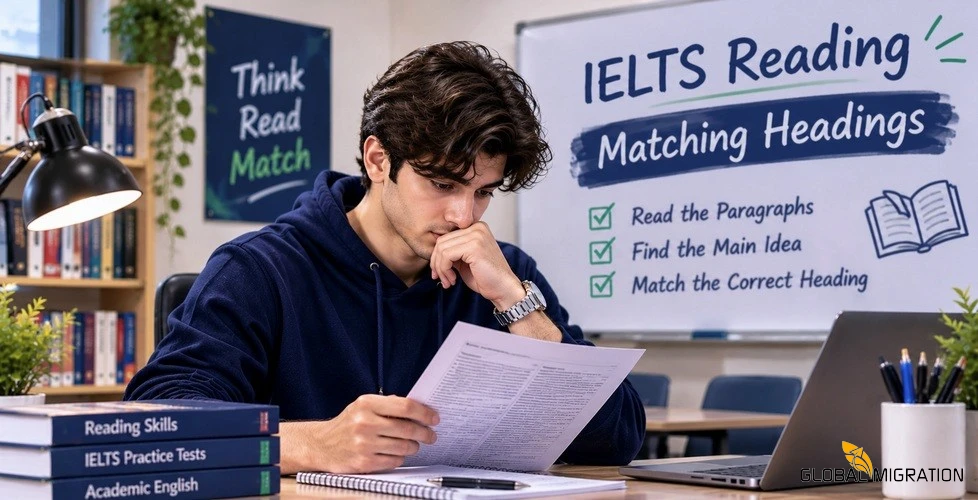
IELTS Reading Matching Headings: how to find the main idea in two or three words and stop choosing the wrong heading.
Many students make the same silent mistake in IELTS Reading Matching Headings. They see a familiar word from the paragraph sitting inside a heading, feel sure, and move on. A single Matching Headings set in the IELTS Reading test can be worth several marks, and that one reflex can cost you many of them, even when your English is strong. The task was never about finding words. It asks something quieter: can you say what this paragraph is about in two or three words? If you can, the right heading almost announces itself. If you cannot, every heading starts to look correct.
So we will not start with theory. First comes a 20-second test, to show you how easily the bait works. Then you get a six-step routine, a four-paragraph drill, the traps that cost the most marks, and a five-day plan. By the end, a heading that merely repeats the paragraph’s words will look suspicious instead of attractive.
Can You Spot the Bait? Try an IELTS Matching Headings Question Cold
You have 20 seconds. Read the paragraph and tap the heading you believe is correct. There is no score and no penalty, only a lesson.
When the town of Redbrook introduced free bicycle hire in 2019, officials expected cyclists to fill the roads. Instead, the biggest change was in the car park. Within a year, the number of cars entering the centre each day had fallen by a quarter, shop owners reported calmer streets, and the council quietly cancelled its plan for a second multi-storey car park.
Which heading carries the paragraph’s main idea?
Whatever you picked, notice the pattern: the correct heading used different words, and the wrong ones used the paragraph’s own words. That is the design of the task, and it is why matching words fails.
What Is Matching Headings in IELTS Reading? Format, Marks and Wording
You get a list of headings and a passage split into lettered paragraphs. Your job is to choose the best heading for each one, and the instructions usually read “Choose the correct heading for each paragraph from the list of headings below.” The task sits inside the Reading test, which gives you 60 minutes for 40 questions, and each correct match earns one mark. If you are aiming for a 7 band in IELTS, it is worth mastering, because it rewards understanding rather than luck.
- Decoys: there are usually more headings than paragraphs, and each heading is normally used once.
- Example: if one paragraph is already matched for you, that heading cannot be used again.
- Do not confuse it with Matching Information: that task asks where a detail appears. Here you need the overall idea.
Why Do Students Lose Marks in IELTS Matching Headings?
Because your eyes are faster than your thinking. Headings are written to tempt you: some repeat a word from the paragraph, some match one example, and some are simply too big or too small.
Picture a student, Hira (an invented example). She reads a paragraph about the cost of a new bridge, spots the word “bridge” in a heading about bridge design, and ticks it in five seconds. The word matched. The idea did not. Students often ask is IELTS difficult to pass. For Reading, it is rarely English that stops you. It is technique, and technique can be fixed in a week.
The Core Strategy: Find the Main Idea With the 2-3 Word Test
If you cannot state a paragraph’s main idea in two or three words, IELTS Reading Matching Headings will keep troubling you. So train that one skill with three small steps for every paragraph.
- Read onceRead the paragraph at a steady pace. Do not hunt for words that match a heading.
- Ask yourself“What is this paragraph really about?” Not what it mentions, but what it is about.
- Answer in 2-3 wordsThen choose the heading that is closest in meaning, even if it shares no words.
You are not looking for matching words. You are looking for the central idea. Check the first and last sentences, watch for linking words such as “however”, and skip examples, numbers and names.
Matching Headings mein sirf lafzon ki mumasilat nahi dhoondni. Paragraph ka markazi khayal samajhna hota hai.
یاد رکھیں، Matching Headings میں صرف الفاظ کی مماثلت نہیں ڈھونڈنی… پیراگراف کا مرکزی خیال سمجھنا ہوتا ہے!
Pro tipWrite your 2-3 words in the margin. On the question paper, jot your two or three words next to each paragraph before you look at the headings. Then you are matching your own summary to the list, not letting the list steer you.
Step by Step: How to Answer Matching Headings From Start to Finish
Turn the strategy into a routine you can run on every passage.
- Step 1Read the instructionsCount the paragraphs and headings, and check for an example or a reuse rule.
- Step 2Scan the headingsSpend about a minute underlining the main idea of each one.
- Step 3Summarise a paragraphRead it once and jot 2-3 words in the margin.
- Step 4Match by ideaPick the closest meaning, and check it covers the whole paragraph, not one detail.
- Step 5Cross out and continueMark any paragraph that will not settle and move on. Fewer headings remain for it later.
- Step 6Check before you leaveReturn to marked paragraphs and confirm each answer is recorded correctly.
Expect the same idea in new words, because headings paraphrase on purpose:
| Paragraph says | Heading may say | What changed | What to do |
|---|---|---|---|
| Cars entering the centre fell by a quarter. | A drop in traffic | A number became a trend. | Turn figures into the trend they show. |
| Some believe a myth; experiments show otherwise. | A common belief challenged | An argument became its role. | Name what the paragraph does. |
| Night opening attracted visitors but raised costs. | Benefits and drawbacks | Specifics became categories. | Match the category, not the examples. |
So ask what the paragraph does as well as what it says, and the right heading becomes much easier to see.
Train Your Brain: The 3-Word Drill With Four Mini Paragraphs
Read each invented paragraph, say its idea in two or three words, and only then tap to compare. Judge your answer by one test: does it describe the idea, not a single detail?
1. Many cafés now charge extra for takeaway cups. Customers who bring their own mug pay less, and the recycling bins have stopped overflowing.
Model answer: cutting cup waste. A heading about “café prices” would be only one detail.
2. In the 1990s, only one household in ten owned a computer. By 2010 it was nearly nine in ten, and schools began to move homework online.
Model answer: computers become common. “Online homework” is a result, not the main idea.
3. Some people believe goldfish remember for only three seconds. Experiments, however, show they can learn routes and recognise feeding times.
Model answer: a memory myth. The word “however” shows the paragraph turns against the first belief.
4. The museum’s new night opening attracted young visitors, but it also raised electricity costs and forced staff to work later hours.
Model answer: night opening: gains and costs. A heading about young visitors alone is too narrow.
Found three or four easily? Your habit is forming. If you froze, the 5-day plan below is built for exactly this.
The Four Matching Headings Traps That Cost the Most Marks
Almost every wrong answer comes from the same four traps. Learn their shape and you will spot them quickly.
| Trap | What it looks like | Why it fools you | How to beat it |
|---|---|---|---|
| Word-match bait | A heading repeats a word from the paragraph. | Your eye finds the word and your brain stops checking. | Ask whether the paragraph is about that word or only mentions it. |
| Detail heading | A heading matches one example, name or number. | Specific details feel certain, so they feel right. | Choose the heading that covers the whole paragraph, not one line. |
| Too wide or too narrow | A heading is bigger or smaller than the paragraph. | Both versions sound close to the topic. | Compare the scope of your 2-3 words with the heading. |
| Two headings fit | Two headings both look possible. | Each one matches a part of the paragraph. | Mark both, move on, and return once the other paragraphs are matched. |
The last trap has a useful side: because each heading is normally used once, matching the easy paragraphs first can settle the difficult ones for you.
Stuck on a Paragraph? An Exam-Day Rescue Plan
Every student meets a paragraph that will not settle. Lose seconds, not minutes, by working in this order:
- Reread the first and last sentences. The point is often in one of them.
- Check the linking words. “But” and “although” often show the turn that the heading describes.
- Narrow it to two headings. Pick the one that covers more of the paragraph without going beyond it.
- Mark it and move on. If it takes more than a minute or two, come back later.

How to Improve at Home: A 5-Day Matching Headings Practice Plan
- Day 1The habitRead five short paragraphs from any article and say each one in 2-3 words.
- Day 2Topic sentencesUnderline the sentence that carries the main idea in each paragraph.
- Day 3Trap huntingOn a solved set, find why each wrong heading looked tempting.
- Day 4ParaphraseRewrite five headings in your own words, then match them to paragraphs. Paraphrasing comes easier when your sentence structure is steady, so revise a little IELTS grammar alongside.
- Day 5Timed setDo one full passage in 20 minutes and review every mistake.
Keep timed practice on real exam-style passages, such as the official Cambridge IELTS practice books, and use short invented paragraphs for the daily habit. A trainer can also spot patterns you cannot see, such as always trusting the first matching word. If you want guided practice, look at IELTS coaching in Lahore, and if you prefer a nearby option, follow our guide to IELTS coaching near me in Lahore.
Timing and Test Format: How Long Should Matching Headings Take?
With 60 minutes for three passages, think of roughly 20 minutes per passage as a guide, not a rule. The 2-3 word habit protects that time because you stop rereading paragraphs. On paper there is no extra time to copy answers, so write each one directly, usually as a roman numeral such as ii or vi. On the computer you usually drag each heading onto its paragraph, so practise in the format you will sit. If you are weighing online vs classroom IELTS preparation, studying online is also a natural way to get used to the screen.
If one paragraph will not settle, circle it and move on. A wrong guess costs nothing extra compared with a blank, but a stuck minute can cost you a later question. And if your Reading score keeps stalling at the same band despite good practice, our guide on whether to retake IELTS or switch to PTE can help you decide your next step.
Beyond Matching Headings: Where the 2-3 Word Habit Helps Next
Summarising an idea quickly is the thread running through the whole test, so use it to level up the rest of your preparation.
- ReadingGo deeper into the paper
The other Reading tasks, from True/False/Not Given to sentence completion, reward the same habit of reading for ideas under the pressure of the clock.
- ListeningCatch paraphrase by ear
Hearing an idea in different words is what scores marks in Listening, and the habit of noting the main point in a few words runs through good IELTS Listening tips for band 7.
- SpeakingPlan a cue card in seconds
Two or three words per point is how strong candidates plan a talk, and it is the idea behind many IELTS Speaking Part 2 tips: note the key points on your cue card, then speak from them. The same habit supports your overall IELTS speaking tips too, because short, clear ideas make it easier to stay fluent.
- Choosing a trainerFind the right support
Start with our list of the top 10 IELTS institutes in Lahore to see who offers what. Then look at how a structured IELTS preparation academy in Lahore runs its classes and mock tests, and check that it covers the whole Reading paper, not only Matching Headings.
Stuck on Matching Headings? Let a Trainer Watch You Work
Reading techniques are easy to understand and hard to spot in yourself. At Global IELTS and PTE in Lahore, a trainer works through a real passage with you and shows exactly where your thinking drifts: a trap you always trust, a paragraph you summarise too narrowly, or minutes lost on one question.
- Trap diagnosis
- Free demo class
- Online or in Lahore
- Honest feedback
No institute can promise a band score. What you can expect is honest feedback and a clear plan for your next practice session.
- Bring a passage that beat youSend it on WhatsApp or bring it to class. Any Reading passage with Matching Headings works.
- See which trap catches youThe trainer runs the 2-3 word test with you and names your pattern: bait words, detail headings, wrong scope, or two headings that both fit.
- Join a free demo classOnline or in person in Lahore, so you can judge the teaching before you decide anything.
- Get a plan for your weak spotsTargeted drills and timed practice for the parts that cost you marks, across Reading, Writing, Listening and Speaking.
- Plan beyond the testPlanning to study abroad? Global Migration and Student Consultancy can guide you on admissions once your score is ready.
Global IELTS and PTE | globalmigration.pk | Lahore, Pakistan
IELTS Matching Headings FAQs: Quick Answers for Students
What is Matching Headings in IELTS Reading?
You match each lettered paragraph to the heading that best states its main idea. There are usually extra headings that do not belong.
Why do I get Matching Headings wrong?
Most students match words instead of ideas. Headings that repeat the paragraph’s words are often the traps.
Should I read the headings or the paragraphs first?
Many teachers suggest summarising the paragraph first so the headings cannot steer you. Try both in practice and keep the method that gives you fewer errors.
How do I find the main idea of a paragraph quickly?
Check the first and last sentences, then ask what the paragraph is about in two or three words. Skip examples, numbers and names.
Can I think about the main idea in Urdu first?
While you are learning, yes. But aim to move to two or three English words, because the headings are in English and that is what you are matching.
Should I switch to PTE if Reading keeps costing me marks?
Not necessarily, because technique is usually the problem and technique can be fixed. When you are ready to compare, read IELTS vs PTE in 2026, and see which English test is easier to pass for your own profile.
Final Thoughts: Ideas Beat Words
IELTS Reading Matching Headings is a skill, not a lottery. Say the paragraph in two or three words, choose the heading that carries that idea, and treat any heading that only repeats the paragraph’s words with suspicion. Practise daily and the task turns from your most stressful question type into a dependable source of marks. To plan the rest of your preparation, read our must-know IELTS preparation tips for 2026, and compare the best IELTS academy in Lahore before you choose a trainer.
If you would like a trainer to guide your practice, talk to Global IELTS and PTE Coaching Center Lahore, who offer free demo classes online and in person. Ask about the fee structure up front, and compare it with the usual IELTS course fees in Lahore so you can plan your budget with confidence.
Read the paragraph, ask “what is it really about?”, answer in two or three words, then pick the heading with the same idea, not the same words.