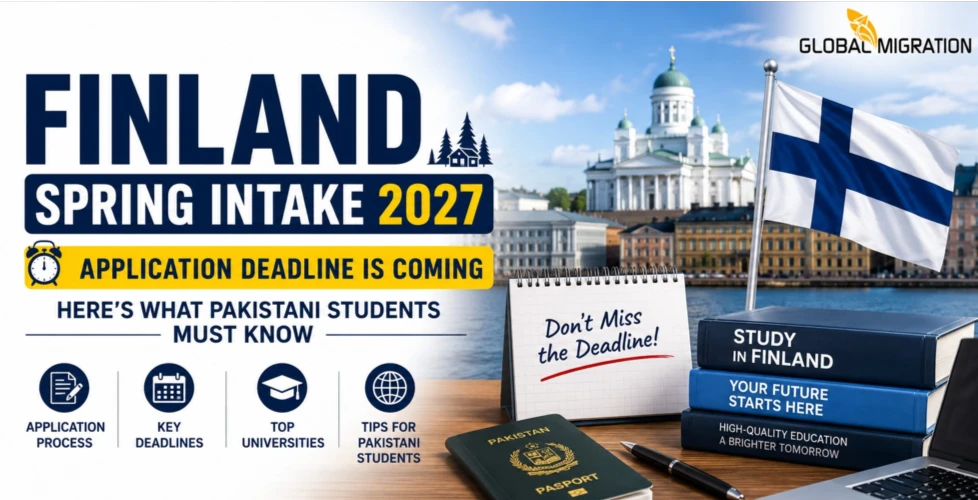
Planning to study in Finland from Pakistan? Finland’s spring intake is smaller than the autumn intake. But it’s still a real chance to start your degree early. Seats are limited. Deadlines come fast. This guide gives you every fact you need, in one place.
We’ve double-checked every detail below against official sources. No guesswork. No outdated numbers. Just what’s true right now, for the 2026-2027 cycle.
A lot of blogs recycle old dates and old office addresses. That’s risky when a country changes its rules mid-year, which Finland just did. We’ll cover that update too, so you don’t submit an application to the wrong place.
By the end of this guide, you’ll know the real deadline window, the documents to prepare, realistic costs, and the updated visa process. No filler. Just what you need to move forward with confidence.
What Is Finland’s Spring Intake?
Finland runs two main intakes for international students. The autumn intake starts in August or September. It’s the primary intake with the widest program choice. The spring intake starts in January or February. It’s smaller. Fewer universities offer it.
If you want to study in Finland from Pakistan without waiting a full year, spring intake is worth exploring. Not every program runs it, though. You must check each university separately on Studyinfo.fi.
Spring intake seats are usually reserved for select Master’s programs and Universities of Applied Sciences (UAS). Bachelor’s programs mostly stick to the autumn cycle. Keep this in mind before you build your shortlist.
Finland Spring Intake 2027: Key Dates and Deadline
For a January or February 2027 start, applications typically open in September 2026. Deadlines usually fall between late September and early October 2026. Some Universities of Applied Sciences run rolling admissions that stretch into March.
Exact dates differ by university and program. Always confirm the precise deadline on the official Studyinfo.fi portal or the university’s own admissions page before you plan your study in Finland journey.
Admission results for spring intake are usually announced in November or early December. That leaves a short window to arrange your residence permit before classes begin. Plan your document collection early so you’re not rushing in December.
Why Study in Finland From Pakistan?
Finland ranks consistently among the world’s best education systems. Teaching is practical and student-centered. Class sizes are small. Professors are approachable.
Beyond academics, Finland is one of the safest countries globally. Crime rates are low. Public services work well. For Pakistani families, this matters a lot when sending a child abroad.
Finland also allows part-time work during studies. Most students work up to 30 hours per week on average. After graduation, you get time to find a job or start a business. This makes it easier to plan a long-term future when you study in Finland from Pakistan.
Add to this a strong tech and engineering job market, and Finland becomes more than just a degree. For many students, it’s a genuine pathway to a stable European career.
Finnish degrees are also recognized across the EU, which opens doors beyond Finland itself if you decide to work elsewhere in Europe after graduation.
Spring Intake vs Autumn Intake: Quick Comparison
Here’s how the two intakes actually compare, side by side.
| Factor | Spring Intake (Jan/Feb) | Autumn Intake (Aug/Sept) |
|---|---|---|
| Program availability | Limited, mostly select Master’s & UAS programs | Widest range, most Bachelor’s & Master’s |
| Application window | September – early October | Early January (2-week window for most Bachelor’s) |
| Competition level | Lower, fewer applicants | Higher, most popular intake |
| Admission results | November – December | May – June |
| Best suited for | Students ready to apply early | Students wanting maximum program choice |
Neither intake is objectively “better.” It depends on your program, your readiness, and how soon you want to start.
Eligibility Criteria for Pakistani Students
Requirements vary by program, but most Finnish universities expect the following basics.
You need a completed Bachelor’s degree for Master’s programs, or FSC/A-Levels for Bachelor’s programs. English proficiency proof is required — usually IELTS or an equivalent test. Some programs also ask for a Statement of Purpose, CV, and academic references.
Every detail matters when you apply to study in Finland. A missing document can delay your whole application, sometimes by weeks.
Some technical programs also request a portfolio or entrance exam, especially in design and architecture. Check your specific program page early, since these extra steps take time to prepare.
Age limits are generally not strict, but younger applicants with recent academic records tend to have smoother evaluations. If there’s a gap in your education history, be ready to explain it briefly in your application.
Documents You’ll Need
Keep this checklist close as you prepare.
You’ll need: a valid passport, academic transcripts and degrees, English test scores, admission letter from the university, proof of funds (around €560 per month, or roughly €6,720 for one year), and proof of paid tuition fees where applicable.
In Pakistani Rupees, that minimum works out to roughly PKR 2,150,000 at current exchange rates. Many students show more for a safer margin — for example, a bank statement of PKR 30,00,000 (30 lakh) converts to approximately €9,380 at today’s rate (1 EUR ≈ 319.76 PKR), which comfortably clears the minimum requirement. Exchange rates shift daily, so check the live rate close to your application date.
Also prepare passport-size photos, a motivation letter, and any program-specific forms. Certified translations are required if your original documents aren’t in English.
Keep both digital scans and physical copies of everything. Universities and immigration authorities may request either format, and having both ready saves you from last-minute scrambling.
Popular Universities Offering Spring Intake Programs
Not every Finnish university runs a spring intake. Here are a few that regularly do, along with what they’re known for.
| University | Known For | Intake Type |
|---|---|---|
| LUT University | Engineering & Business | Rolling admission, Nov–March window |
| University of Helsinki | Research-driven Master’s programs | Select programs, January window |
| Various UAS institutions | Applied Sciences, Business, IT | Spring intake more common here |
Always verify current program-specific intake availability directly with the university, since offerings change yearly. A program open in one cycle might close for spring the next year.
Xamk (South-Eastern Finland UAS, Kouvola) — Spring 2027 Intake Details
Xamk is one of the strongest, most reliable options if you want to study in Finland from Pakistan through rolling admission. Its Kouvola campus offers both Bachelor’s and Master’s programs for the spring 2027 intake.
| Detail | Information |
|---|---|
| Application fee | €100 (non-EU/EEA applicants) |
| Rolling admission window | 15 May – 15 August 2026 |
| English test accepted | IELTS 6.0, TOEFL iBT/Home Edition, PTE Academic (Online accepted), Oxford ELLT, Duolingo — confirm exact minimum score per programme |
| Bachelor’s tuition fee | €10,700 per academic year |
| Master’s tuition fee | €13,500 per academic year |
| Application link | Opintopolku application portal |
Programs open for spring 2027: Bachelor of Business Administration (Digital International Business), Bachelor of Engineering (Game Technologies), Master’s in Electrical Engineering Product Development, Master’s in Digital Industry and AI, Master’s in Disaster Management, Master’s in International Business Management, and Master’s in Strategic Supply Chain Management.
Note: Xamk’s official tuition page lists the Master’s fee at €13,500 per year, not €12,000 — a figure that circulates in a few outdated screenshots. Always check the live fee page before budgeting.
Vaasa University of Applied Sciences (VAMK), School of Technology — Intake Details
VAMK is based in Vaasa, a hub for energy technology companies in the Nordics. It’s a solid option for students who want to study in Finland in a smaller, industry-connected city.
| Detail | Information |
|---|---|
| Application fee | €100 (non-EU/EEA applicants) |
| Joint Application (Energy Technology & Industrial Engineering, Bachelor’s) | 31 August – 10 September 2026 |
| Rolling Admission (IT, International Business, Nursing, Bachelor’s) | 1 October 2026 – 30 April 2027 |
| English test accepted | IELTS 6.0, TOEFL iBT ~79–80 (550 paper-based), PTE Academic — confirm exact minimum per programme |
| Bachelor’s tuition fee | €10,500 per academic year |
| Master’s tuition fee | €12,000 per academic year |
| Application link | VAMK Rolling Admission portal |
Programs: Bachelor of Engineering in Industrial Engineering, Bachelor of Engineering in Energy Technology, Master of Business Administration in Crisis Leadership and Innovation (1.5 years), Master of Engineering in Crisis Leadership and Innovation (1 year), and Master of Healthcare and Social Services in Crisis Leadership and Innovation. Master’s programs typically expect prior relevant work experience — confirm the exact requirement (often 2–3 years) on the specific program page.
Note: the Bachelor’s Energy Technology and Industrial Engineering programs run through the Joint Application window above, not year-round rolling admission — apply within that exact window.
Life in Finland for Pakistani Students
Adjusting to Finland takes a little time, but most Pakistani students settle in within a semester. Winters are long and cold, so warm clothing is essential from day one.
Halal food is available in most major cities, especially Helsinki, Tampere, and Turku. Local Pakistani and international student communities also make the transition easier.
English is widely spoken, so daily life doesn’t require fluent Finnish. Still, learning basic Finnish phrases helps with part-time jobs and local errands.
Public transport is reliable and clean across most cities. Students usually get discounted travel cards, which cuts monthly costs significantly. Cycling is also common, even in colder months.
Accommodation is usually arranged through student housing organizations. Applying early improves your chances of getting an affordable room close to campus, especially in Helsinki where demand is high.
Best Cities in Finland for Pakistani Students
Helsinki is the top choice for most students. It has the largest Pakistani community, the most job opportunities, and the widest range of programs.
Tampere offers a quieter, more affordable lifestyle with strong technology and engineering programs. Turku and Oulu are smaller, but both have solid universities and lower living costs than the capital.
Your ideal city depends on your program, your budget, and how much city life matters to you personally.
Tuition Fees and Cost of Living
Budget planning is key before you decide to study in Finland from Pakistan. Here’s a realistic breakdown.
| Expense | Estimated Cost (per year) |
|---|---|
| Tuition fee (non-EU students) | €4,000 – €18,000 |
| Living costs (rent, food, transport) | Approx. €6,720 minimum (Migri requirement) |
| Residence permit fee (online) | €350 |
| Residence permit fee (paper application) | €450 |
These are estimates only. Actual tuition varies a lot by university and program, so always check the exact fee before applying.
Part-time work income can offset some living costs once you settle in, but it shouldn’t be counted as your main funding source when you apply. Immigration authorities expect your proof of funds to stand on its own.
Post-Study Work Opportunities in Finland
Graduates get a real advantage after finishing their degree. Finland grants a residence permit of up to two years to search for a job or start a business after graduation.
Demand is especially strong in IT, engineering, healthcare, and renewable energy. Many students transition from part-time work during studies into full-time roles at the same company after graduating.
This post-study window is one of the biggest reasons Pakistani students choose to study in Finland instead of countries with shorter or stricter post-graduation rules.
Finland vs Other European Study Destinations
Compared to the UK or the US, Finland is significantly more affordable, both in tuition and living costs. Compared to Germany, Finland offers more English-taught programs at the Bachelor’s level.
Finland also stands out for safety, quality of life, and a straightforward residence permit process, even though the recent embassy change adds one extra step for Pakistani applicants to track.
For students focused on long-term value rather than just brand-name universities, Finland is a strong, practical choice.
Scholarships for Pakistani Students
Finland offers real scholarship opportunities, though competition is strong. Many universities give tuition waivers ranging from 50% to 100% based on academic merit. Look at the Finland Scholarship program and individual university grants when researching.
Pakistani students can also check HEC-linked funding opportunities and Erasmus+ programs. Apply early, since scholarship deadlines are often earlier than the main admission deadline.
Strong academic records, a clear motivation letter, and relevant experience all improve your scholarship chances. Don’t leave this application for the last week.
Finland Visa Process From Pakistan: Important 2026 Update
Here’s something many blogs haven’t updated yet. The Embassy of Finland in Islamabad officially closed on 16 June 2026. Consular and residence permit matters for Pakistan are now handled through the Embassy of Finland in Doha, Qatar.
Student residence permit applications are still submitted online through the Enter Finland portal. But biometrics and any in-person steps now follow the updated process tied to Doha. Always confirm current steps before you finalize your plan to study in Finland, since procedures can shift with short notice.
For short-term Schengen visit visas, Finland continues to be represented by the Netherlands Embassy in Pakistan, with VFS Global centres in Islamabad, Karachi, and Lahore. This is separate from the student residence permit process, so don’t confuse the two.
Step-by-Step Application Process
Follow this order to stay on track.
First, shortlist programs on Studyinfo.fi. Second, prepare all documents in English or certified translation. Third, submit your application before the deadline. Fourth, wait for the admission decision.
Fifth, once accepted, apply for your residence permit through Enter Finland. Sixth, pay the required fees and track your application status online. Seventh, once approved, arrange travel and accommodation before your intake begins.
Common Mistakes to Avoid
Many applications get delayed or rejected for avoidable reasons.
Common mistakes include submitting incomplete documents, missing the short application window, and using an incorrectly formatted bank statement.
Another frequent error is applying to programs without checking if a spring intake actually exists for that specific course. Always confirm intake availability before you invest time in an application.
Some students also underestimate how long certified translations take. Start this process weeks in advance, not days. A rushed translation can carry small errors that trigger extra review time from the university.
Finally, don’t submit your proof of funds at the last minute. Bank certificates sometimes take a few working days to issue, especially during busy application periods.
Why Work With a Study Abroad Consultant?
Finland’s application system is spread across multiple portals, each with its own rules. Studyinfo.fi handles university applications. Enter Finland handles residence permits. Universities set their own scholarship deadlines separately.
A consultant who works with Finland applications regularly can catch errors before they cost you a deadline. They also stay updated on changes like the recent embassy closure, so you’re not left guessing.
If you want expert support at every step of your study in Finland journey, working with an experienced consultancy can save you real time and stress.
Frequently Asked Questions
1. Is Finland’s spring intake available at every university?
No. Only select universities and programs offer it, mostly Master’s degrees and Universities of Applied Sciences. Always check Studyinfo.fi for confirmation before you build your shortlist.
2. What is the exact deadline for spring intake 2027?
It varies by university, generally falling between late September and early October 2026. Confirm the exact date on the official program page.
3. Can Pakistani students work part-time in Finland?
Yes. Students can work up to an average of 30 hours per week alongside their studies.
4. Where do Pakistani students handle visa matters now?
Since the Islamabad embassy closed on 16 June 2026, residence permit and consular matters are handled via the Embassy of Finland in Doha, Qatar. Short-term Schengen visit visas still go through the Netherlands Embassy in Pakistan.
5. How much money do I need to show for a Finland student visa?
Roughly €560 per month, or about €6,720 for a full year, is the standard requirement.
6. Is spring intake easier to get into than autumn intake?
Often yes, since fewer students apply. But program options are far more limited compared to autumn.
Final Thoughts
Finland’s spring intake is a smaller door, but it’s still open. If your target program runs it, applying early gives you a real advantage. Start preparing documents now, not after the deadline is announced.
Whether you choose spring or autumn intake, the plan to study in Finland takes preparation, correct paperwork, and updated information. Don’t rely on outdated blog posts — rules and offices change, as we saw with the Islamabad embassy closure.
Start early. Confirm every detail with official sources. And keep your documents ready well before any deadline lands.
Need personal guidance for your application? Talk to the best study abroad consultants for Finland to plan your intake, documents, and visa process the right way.