Planning to study in Lithuania? Getting your visa file right is the first real step. One missing paper can delay your whole plan.
This guide breaks down every document you need. It’s written for students who want to study in Lithuania from Pakistan without confusion or wasted time.
We keep it simple. Short points. Clear steps. No jargon.
By the end, you’ll know exactly what to collect, how to apply, and what mistakes to avoid. Let’s get started on your journey to study in Lithuania.
Every year, more Pakistani students look toward the Baltic region. Lithuania stands out for its blend of quality education and affordability.
This blog focuses purely on documentation. We won’t waste your time with vague advice. Instead, you’ll get a practical roadmap you can follow today.
Why Pakistani Students Choose to Study in Lithuania
Lithuania is part of the European Union. That means your degree carries real weight worldwide.
Tuition fees are lower than the UK or USA. Living costs are affordable too. This makes it easier for Pakistani families to plan a budget.
English-taught programs are common at Lithuanian universities. You don’t need to learn Lithuanian to study there.
Many students choose to study in Lithuania from Pakistan because of the Schengen access it offers. Once you have a valid visa, traveling across Europe becomes simple.
Safety is another big factor. Lithuania is known for low crime rates and a calm student lifestyle.
The country also has a growing international student community. This makes settling in much easier for newcomers.
Cities like Vilnius and Kaunas host thousands of foreign students already. You’ll find Pakistani student groups and communities in most major campuses.
Public transport is reliable and affordable across Lithuanian cities. Getting around campus and town doesn’t require a car.
Universities in Lithuania are recognized across Europe. Many offer strong programs in engineering, business, IT, and medicine.
Part-time work options exist for students too. This helps manage daily expenses while you study.
Overall, the combination of cost, safety, and quality makes it a smart pick to study in Lithuania.
Understanding the Lithuania TRP System
Before we list documents, understand the system. Pakistani students can’t just fly in and study.
Here’s the important part most guides get wrong. For study purposes, Pakistani applicants generally get a Temporary Residence Permit (TRP) directly — a separate National Visa (D) is not the route used.
The TRP is what actually allows you to legally stay in Lithuania for your full study period. It is applied for before you travel, through the Migration Information System (MIGRIS).
This single-permit approach makes the process more straightforward once you understand it. You prepare one complete file, submit it once, and wait for the TRP decision.
Knowing this from day one helps you prepare the right file to study in Lithuania from Pakistan without confusion.
The TRP route suits students with a clear admission and financial plan. It also comes with defined work rights once approved.
This is why students planning to study in Lithuania from Pakistan should prepare a master document folder from the start.
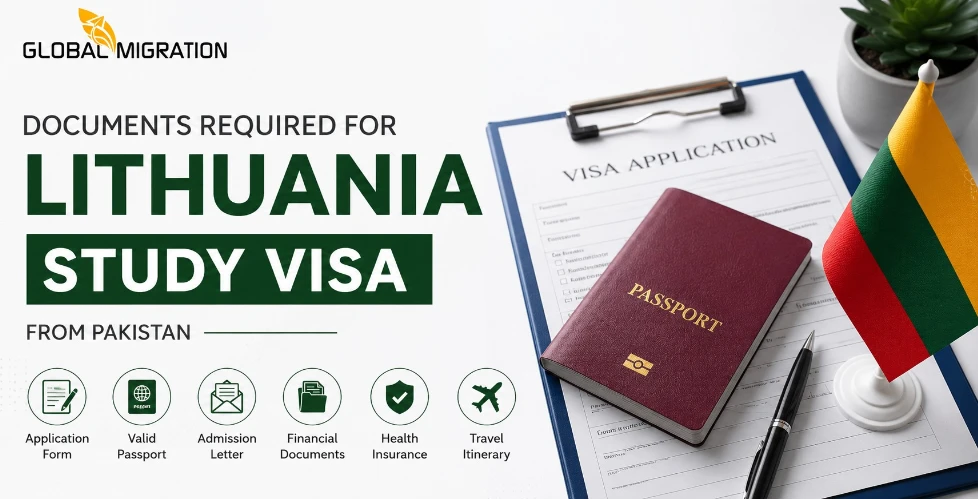
Complete Checklist: Documents Required for Lithuania Study Visa
Here’s the full list you need to gather. Keep both originals and copies of each item.
- Valid passport (must stay valid at least 3 months beyond your visa period)
- One recent color photo (35x45mm, white background, taken within 6 months)
- Completed and signed national visa application form
- University acceptance/admission letter
- Mediation letter from your Lithuanian university (submitted electronically by the school)
- Proof of paid tuition fee or fee waiver, if applicable
- Proof of sufficient funds for living expenses
- Health insurance valid in Lithuania and the Schengen zone
- Educational certificates and transcripts (attested)
- Academic English proficiency proof, if required by your program
This is your master list to study in Lithuania from Pakistan without last-minute panic.
Academic Documents You Need
Your academic file proves you’re a genuine student. This matters most to the visa officer.
Start with your official acceptance letter from a recognized Lithuanian university. This confirms your enrollment.
Next comes the mediation letter. Lithuanian universities submit this electronically through the migration system. You’ll receive a reference number to include in your application.
Keep your previous degree certificates ready too. These should be attested by HEC and the Foreign Office in Pakistan.
If your program requires English proficiency, attach your IELTS or equivalent score. Many students preparing to study in Lithuania also check university-specific language rules first.
Some universities take longer than others to issue this letter. Follow up politely every few days once you’ve applied.
Delays here are the single biggest reason applications slip past intended deadlines. Staying proactive protects your timeline to study in Lithuania.
If you studied abroad before, include those transcripts too. This builds a stronger academic profile for the visa officer.
Financial Proof for Lithuania Student Visa
Money matters carry real weight in visa decisions. Lithuania sets a clear financial standard.
You must show funds equal to the required monthly living amount for each month of your stay. This currently stands at €650 per month in 2026.
You also need return travel funds. This should equal one month’s living amount on top of your living cost proof.
A clean bank statement from a parent or sponsor works well here. Avoid sudden large deposits right before applying, since this raises suspicion.
Income tax returns of your sponsor for the last few years add extra strength. This is common advice for anyone planning to study in Lithuania from Pakistan.
Keep your bank statement recent, ideally within 30 days of your appointment. Older statements often raise unnecessary questions.
If a relative is sponsoring you, add a signed affidavit of support. Include their relationship to you and their financial capacity.
Consistency matters more than a big number. Visa officers look for a steady financial pattern, not a one-time deposit.
Health Insurance and Personal Documents
Health insurance is mandatory, not optional. Skipping this leads to instant rejection.
Your policy must cover at least €30,000. It needs to be valid across Lithuania and the wider Schengen area.
Buy insurance only from providers recognized for Schengen visa purposes. Local Pakistani insurers rarely qualify unless they partner with European underwriters.
Along with insurance, keep your accommodation proof ready. This can be a rental agreement, university dormitory confirmation, or an invitation letter.
Personal documents like your CNIC copy, birth certificate, and passport-size photos should also be part of your file. These small items often get forgotten by students trying to study in Lithuania.
Compare a few insurance providers before buying. Prices vary, but coverage terms matter more than the cheapest option.
Keep a printed policy document along with a digital copy. Some embassy staff prefer paper copies during verification.
Accommodation proof doesn’t need to be expensive housing. A confirmed dorm booking or a simple rental agreement is enough.
Table 1 — Temporary Residence Permit (TRP) at a Glance| Feature | Temporary Residence Permit (TRP) |
|---|---|
| Purpose | Legal stay for your full study period |
| Validity | Usually 1 year, renewable each year |
| Applied From | Pakistan, via nearest VFS Global center |
| Processing Time | 45 to 90 calendar days |
| Fee (approx.) | €160 (standard) / €320 (expedited) |
| Work Rights | Part-time work allowed once approved |
Step-by-Step Application Process
Step one: get your university acceptance letter confirmed. This is your foundation document.
Step two: request the mediation letter from your university. Wait for the electronic submission and reference number.
Step three: gather financial and insurance documents. Double-check every figure matches current requirements.
Step four: since Lithuania has no visa center in Pakistan, book your appointment at the nearest VFS Global center handling Lithuania applications, commonly in Thailand, Azerbaijan, or Malaysia. Submit your complete file on the scheduled date.
Step five: wait for processing. Most decisions come within 45 calendar days, though it can extend up to 90 days in some cases.
Students who plan early rarely face delays trying to study in Lithuania.
Table 2 — Document Checklist by Category| Category | Required Documents |
|---|---|
| Academic | Acceptance letter, mediation letter, transcripts, English test score |
| Financial | Bank statement, sponsor tax returns, minimum wage proof |
| Personal | Passport, photo, CNIC copy, application form |
| Health & Housing | Schengen health insurance, accommodation proof |
| Fees | Tuition payment proof |
How to Apply From Pakistan
Lithuania doesn’t have its own visa processing center in Pakistan. This surprises many first-time applicants.
Instead, Pakistani students submit their TRP application through VFS Global centers that serve Lithuania abroad. Thailand, Azerbaijan, and Malaysia are among the nearest and most commonly used centers.
You first apply and get an appointment slot through the Lithuanian Migration Information System, MIGRIS. The system then directs you to book a slot at the VFS Global branch in Thailand, Azerbaijan, or Malaysia.
Your biometrics and documents are collected at the chosen center. The file is then forwarded to the Lithuanian Migration Department for the final decision.
Always confirm the latest center details before traveling, since procedures can shift. This step is essential for anyone serious about planning to study in Lithuania from Pakistan.
Table 3 — Visa Fees and Processing Timeline| Item | Approximate Cost/Time |
|---|---|
| Bank Statement Requirement | Recent statement, within 30 days |
| Standard Processing Time | 45 calendar days |
| Extended Processing Time | Up to 90 calendar days |
| Health Insurance Coverage | Minimum €30,000 |
| Monthly Living Fund Proof | €650 (2026 figure) |
| Return Travel Fund | Equal to 1 month living fund |
Common Mistakes to Avoid
Many rejections happen due to small, avoidable errors. Let’s cover the most common ones.
Submitting an incomplete financial file is the top mistake. Always match your bank statement to the exact required amount.
Another issue is outdated photos or wrong photo dimensions. Follow the 35x45mm white background rule strictly.
Some students forget to request the mediation letter early. This delays the entire visa timeline unnecessarily.
Weak health insurance coverage is another silent rejection reason. Confirm your policy meets the €30,000 Schengen-wide requirement before submitting.
Careful preparation makes the difference between approval and delay when you study in Lithuania.
Language and translation errors also cause trouble. Get official documents translated by a certified translator, not a casual one.
Missing the appointment date is another avoidable slip. Set calendar reminders and confirm your slot a day before attending.
Double-submitting duplicate paperwork can confuse reviewers too. Organize your file in the exact order the checklist requests.
Best Time to Start Your Application
Timing affects your success rate more than most students realize. Late applications often mean rushed, weak documents.
Lithuanian universities usually run two intakes: September and February. Start your paperwork at least three months before your intended intake.
Early preparation gives you time to fix bank statement issues. It also allows your university enough time to send the mediation letter.
VFS Global appointment slots in Thailand, Azerbaijan, and Malaysia fill up quickly during peak season. Booking early protects you from last-minute stress.
Students who begin preparing early consistently report smoother approvals. This single habit makes the biggest difference when you aim to study in Lithuania.
Life After Visa Approval
Once your visa is stamped, a few more steps remain. Don’t assume the process ends there.
You’ll need to register your address with local authorities after arriving in Lithuania. This is usually done within a set number of days.
If you plan to stay beyond your first year, start your TRP renewal at least 2 months before it expires. Don’t wait until the last moment.
Keep digital copies of every document you submitted. Universities and immigration offices often ask for them again later.
Staying organized after arrival is just as important as before it. This mindset helps students who study in Lithuania from Pakistan avoid unnecessary stress during their first semester.
5 Short FAQs
Final Thoughts
Getting your documents right is half the battle won. The other half is timing and accuracy.
Start early, double-check every figure, and keep both digital and physical copies of your file. This approach makes it far easier to study in Lithuania from Pakistan without stress.
Lithuania offers real value: EU degrees, lower costs, and a safe student life. With the right paperwork, that opportunity is well within reach.
Thousands of Pakistani students have already made this move successfully. Careful planning is really the only thing separating you from the same result.
Treat your document file as a living checklist. Update it, review it, and confirm every requirement before your appointment date.
Need expert help with your visa file?
Talk to our Professional Study Abroad Consultants for Lithuania