A complete, fact-checked breakdown of affordable tuition fees, top low-cost universities, and budget-friendly living costs in Cyprus.
For thousands of Pakistani families exploring affordable European education, Cyprus has quietly become one of the smartest choices on the map. With English-taught degrees, simplified admissions, and tuition fees that are a fraction of what you’d pay in the UK or USA, it’s no surprise that more students each year choose to study in Cyprus instead of more expensive destinations. This guide walks you through the genuinely cheapest universities on the island, what they actually charge, and how to plan your budget without any surprises later.
Cyprus is the third-largest island in the Mediterranean and is split into two regions: the Republic of Cyprus in the south (an EU member state) and the Turkish Republic of Northern Cyprus in the north. Both regions host universities that welcome international students, but tuition fees, degree recognition, and admission processes differ between them. If you’re trying to study in Cyprus from Pakistan on a tight budget, understanding this north-south split is the first step before you compare fees.
Why Cyprus Is a Budget-Friendly Choice for Pakistani Students
Cyprus consistently ranks among the countries that invest the most in education relative to the size of its economy, and that investment shows in modern campuses, internationally recognized faculty, and a genuinely multicultural student body. For students who want to study in Cyprus, the appeal isn’t just the scenery — it’s the math. Annual tuition for many bachelor’s programs runs well below what comparable degrees cost in Western Europe, and shared accommodation keeps monthly expenses manageable.
Universities in Cyprus set their own tuition fees, which means costs vary significantly depending on the institution, the city, and whether the university is public or private. Generally speaking, bachelor’s degrees range from around €1,400 to €10,000 per year, while master’s programs typically fall between €1,200 and €10,000 depending on the specialization. Pakistani students planning to study in Cyprus should treat these as a starting range, not a fixed number, since business administration and medical-related postgraduate programs tend to sit at the higher end.
Another reason Cyprus appeals to budget-conscious students is the straightforward visa process and high approval rate reported by several Pakistani education consultants. Combined with low entry barriers — many universities accept students without a mandatory IELTS score if their previous education was in English — Cyprus removes several of the financial and bureaucratic hurdles that make other European countries harder to access for students who want to study in Cyprus from Pakistan.
Pro Tip: Always ask universities for their official 2026 fee schedule directly, since published figures online can be a year or two out of date.
Cheapest Universities in Cyprus: Side-by-Side Comparison
Below is a comparison of some of the most affordable, accredited universities for international students who want to study in Cyprus. Figures are approximate annual tuition ranges and can shift depending on your chosen program, so always confirm directly with the admissions office before applying.
| University | Location | Bachelor’s Fee (per year) | Master’s Fee (per year) |
| Near East University | North Nicosia | €1,400 – €5,600 | ~€2,400 – €3,700 |
| European University of Lefke | Lefke | €2,500 – €6,000 | €3,000 – €6,500 |
| Cyprus International University | North Nicosia | €4,000 – €7,000 | €5,000 – €10,400 |
| Eastern Mediterranean University | Famagusta | €3,500 – €7,500 | €4,000 – €8,000 |
| University of Nicosia | Nicosia | €6,800 – €9,000 | €5,400 – €10,250 |
| Cyprus University of Technology (Public) | Limassol | €6,000 – €9,000 | €5,000 – €8,000 |
| University of Cyprus (Public) | Nicosia | €3,400 – €6,500 | €5,125 – €10,250 |
Notice that public universities in South Cyprus, such as the University of Cyprus and Cyprus University of Technology, often sit closer to the lower end of fees for South Cyprus, while private institutions like the University of Nicosia charge more but carry stronger EU recognition. For students who specifically want to study in Cyprus from Pakistan on the lowest possible budget, the North Cyprus universities listed above generally offer the most affordable entry point, especially for the first one or two years.
It’s worth noting that the Open University of Cyprus does not charge tuition fees for undergraduate citizens under its national framework, though international and non-EU students are typically charged a per-module administrative fee instead, which still works out cheaper than most private universities. If flexibility and online-friendly study matter to you while you study in Cyprus, this is an option worth researching further with your consultant.
Pro Tip: North Cyprus universities are generally cheaper, but always confirm HEC Pakistan recognition before you apply, especially for medical or engineering degrees.
North Cyprus vs South Cyprus: Which Is Actually Cheaper?
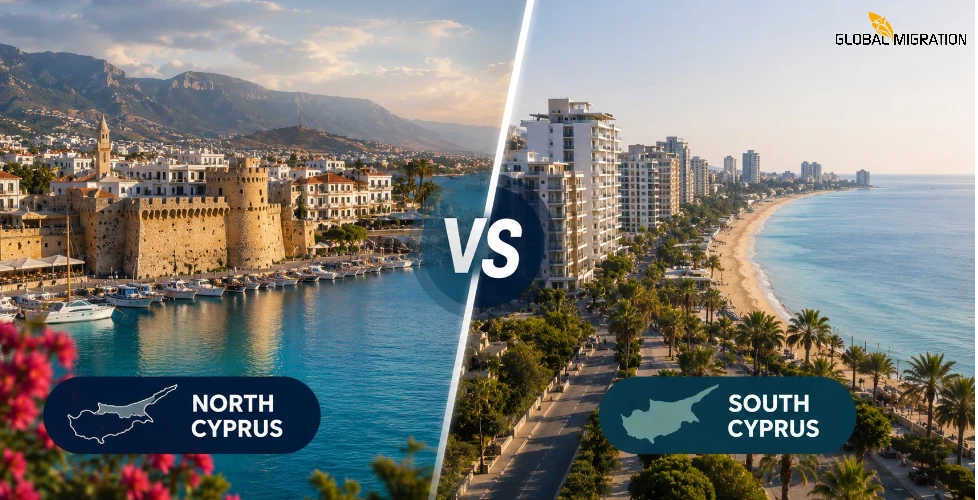
One of the most common questions Pakistani students ask before they study in Cyprus is whether North Cyprus or South Cyprus offers better value. The honest answer is that North Cyprus is usually cheaper upfront, but South Cyprus offers stronger EU-wide degree recognition since the Republic of Cyprus is an EU member state. Here’s how the two compare on the factors that matter most to your budget.
| Factor | North Cyprus | South Cyprus |
| Average Tuition Fee | €1,400 – €7,500/year | €3,400 – €9,000/year |
| Degree Recognition | Internationally accredited; varies by program for EU mobility | EU-recognized under the Bologna Process |
| Monthly Living Cost | €350 – €500 | €450 – €650 |
| Visa Process | Generally simpler; often processed after arrival | Requires Cyprus Embassy visa prior to travel |
| Best For | Budget-conscious undergraduate students | Students prioritizing EU-wide recognition |
Students who want to study in Cyprus from Pakistan purely to minimize cost often lean toward North Cyprus universities like Near East University or the European University of Lefke. However, if your long-term plan includes working or further studying elsewhere in the EU, the slightly higher fees in South Cyprus may be worth the investment for the stronger degree recognition.
Cost of Living: Budgeting Beyond Tuition
Tuition is only part of the picture. To genuinely study in Cyprus affordably, you need to plan your monthly living costs too. Most universities offer on-campus dormitories that are noticeably cheaper than renting a private apartment, and sharing accommodation with other international students can cut your housing costs significantly.
| Expense Category | Estimated Monthly Cost |
| Shared Accommodation / Dormitory | €150 – €300 |
| Food & Groceries | €150 – €250 |
| Local Transport | €30 – €50 |
| Utilities & Internet | €40 – €70 |
| Miscellaneous & Personal Expenses | €50 – €100 |
For a Cyprus student visa, applicants typically need to show financial proof of roughly €5,000 to €7,000 to cover living expenses for the year, alongside university fee payment proof, health insurance, and academic transcripts. This is one of the more achievable financial thresholds compared to other European study destinations, which is exactly why Cyprus continues to attract students who want to study in Cyprus from Pakistan without taking on excessive debt.
Pro Tip: Choose university-managed dormitories in your first year — they’re cheaper than private rentals and make it far easier to find roommates and settle in quickly.
Scholarships That Make Cyprus Even Cheaper
Beyond naturally low tuition, many universities in Cyprus offer scholarships specifically aimed at reducing costs for international students. These can meaningfully change your total budget if you plan to study in Cyprus on a strict budget.
- Academic Merit Scholarships: 10%–50% discount on tuition fees for high-achieving undergraduate applicants.
- University of Cyprus Master’s & PhD Scholarships: Full scholarships can cover tuition entirely and include an annual stipend; partial scholarships typically cover 50% of fees.
- Cyprus International University Scholarships: Full or partial tuition coverage available for both undergraduate and postgraduate applicants.
- Near East University & European University of Lefke Scholarships: Merit-based discounts that can range from 25% to 100%, depending on academic performance and entrance assessments.
Since scholarship availability and percentages change every intake cycle, it’s worth applying early and asking your consultant to check current offers before you finalize your decision to study in Cyprus. Combining a scholarship with a lower-fee North Cyprus university is often the single most effective way to cut your total cost of education.
Admission Requirements You’ll Need to Prepare
Admission requirements across Cyprus universities are fairly consistent, which makes planning easier whether you’re applying for a bachelor’s, master’s, or doctoral program to study in Cyprus.
- Bachelor’s Degree: Higher Secondary School Certificate (or equivalent), a scanned passport copy, and IELTS/TOEFL (optional at many universities).
- Master’s Degree: Bachelor’s degree certificate and transcripts, CV or personal statement, scanned passport, and English proficiency proof (often waivable).
- PhD Programs: Master’s degree certificate and transcripts, a research/thesis proposal, CV, and passport copy.
Most universities process applications quickly, often issuing offer letters within days, which is part of why so many students from Pakistan are now choosing to study in Cyprus from Pakistan instead of waiting months for admissions decisions elsewhere in Europe.
Pro Tip: Get your transcripts attested early — document attestation delays are the single biggest cause of late or rejected applications.
Frequently Asked Questions
1. What is the cheapest university in Cyprus for international students?
Near East University in North Nicosia is generally considered the most affordable, with undergraduate fees starting around €1,400 per year.
2. Is North Cyprus or South Cyprus cheaper to study in?
North Cyprus is typically cheaper for tuition and living costs, while South Cyprus offers stronger EU-wide degree recognition under the Bologna Process.
3. Do I need IELTS to study in Cyprus from Pakistan?
Not always. Many universities waive IELTS/TOEFL requirements if your previous education was conducted in English or after an internal English assessment.
4. How much bank balance is required for a Cyprus student visa?
Most applicants need to show financial proof of approximately €5,000 to €7,000 to cover a year’s living expenses.
5. Are scholarships available for Pakistani students in Cyprus?
Yes, many universities offer merit-based scholarships ranging from 10% to 100% tuition discounts, along with some fully funded postgraduate options.
6. Can international students work while studying in Cyprus?
Yes, but with restrictions — most countries limit non-resident students to part-time hours, so work income should support, not replace, your study budget.
Final Thoughts
If affordability is your top priority, Cyprus genuinely delivers — from sub-€2,000 starting tuition at some North Cyprus universities to manageable monthly living costs and a visa process that’s far less stressful than many alternatives. Whether you choose a public university in the south for stronger EU recognition or a private university in the north for lower upfront costs, the opportunity to study in Cyprus on a realistic budget is well within reach for Pakistani students in 2026.
Want personalized guidance on the cheapest universities, scholarships, and visa process for Cyprus? Talk to our Cyprus study experts today.