
Are you preparing for the IELTS exam and want to achieve a high band score in 2026? The right strategy, resources, and preparation techniques can significantly improve your performance. Whether you’re a beginner or retaking the test, understanding how to prepare effectively is the key to success. This detailed guide covers expert-approved IELTS preparation tips, practical study methods, and smart exam strategies. If you follow these proven techniques consistently, you can boost your confidence and performance in all four modules.
Read till the end to discover powerful tips that can transform your preparation. Let’s begin your journey toward IELTS success.
What Is IELTS
IELTS (International English Language Testing System) is a globally recognized English proficiency exam used for studying abroad, professional work, and immigration purposes. The test assesses four essential language skills: Listening, Reading, Writing, and Speaking, measuring your ability to use English in real-life contexts. IELTS is available in two formats — Academic, for higher education and professional registration, and General Training, for work experience and migration. Each module has a specific format and scoring criteria, so your preparation strategy must align with your chosen test type. Understanding the test structure, question types, and timing is crucial for achieving your target band score efficiently.
Read More: IELTS vs PTE 2026: Which Is Easier to Score Higher?
Best Tips for IELTS Exam
Preparing for IELTS is not just about putting in long hours—it’s about studying smart and strategically. Top scorers focus on understanding the test format, practicing with authentic materials, and continuously improving language skills in all four modules: Listening, Reading, Writing, and Speaking. Consistency and targeted practice matter more than sheer study time.
Key tips for IELTS success:
- Understand the exam format – Know the sections, question types, and timing.
- Practice with real IELTS questions – Familiarity with official test patterns reduces surprises on exam day.
- Review and analyze mistakes – Identify recurring errors and focus on improving weak areas.
- Enhance vocabulary daily – A strong vocabulary helps across reading, writing, and speaking modules.
- Time management practice – Simulate exam conditions to answer questions efficiently.
By combining structured practice, focused improvement, and smart exam strategies, you can maximize your chances of achieving a high band score.
How to Prepare for IELTS Fast
If you have limited time, your preparation should be focused and strategic. Start by identifying your weak areas through a mock test. Instead of studying everything, concentrate more on modules where you score low. Use structured practice materials and learn answering techniques rather than memorizing content. Practicing under timed conditions helps build speed and confidence quickly.
IELTS Exam Tips for Beginners
Beginners should first build a strong foundation in grammar, vocabulary, and comprehension skills. Understanding question types is essential because each section follows specific patterns. Beginners often struggle not due to lack of English knowledge, but because they don’t understand the test format.
Focus areas:
- Learn exam pattern
- Build grammar basics
- Practice simple English conversations
IELTS Preparation Plan
A well-structured preparation plan is the key to achieving a high IELTS band score. Planning helps you manage time, focus on weak areas, and track your progress effectively. Whether you have weeks or just days, a clear strategy ensures consistent improvement across all four modules.
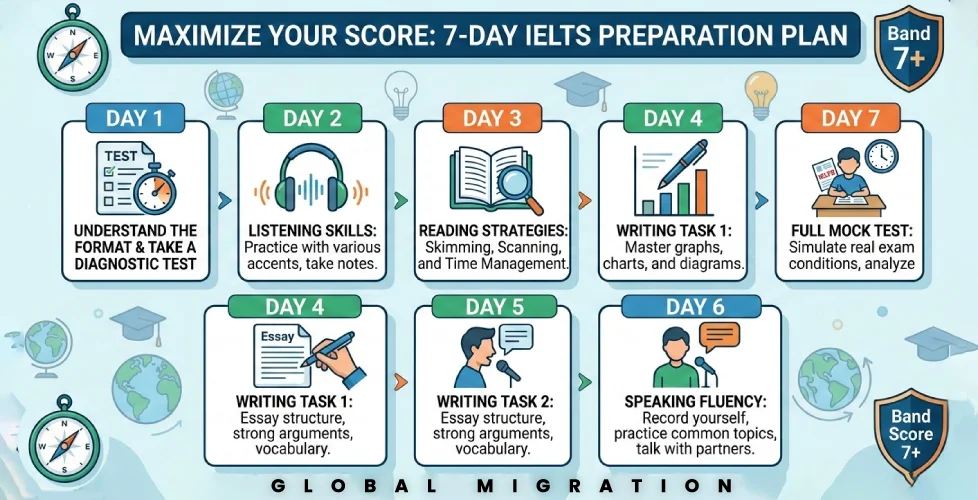
IELTS Preparation Tips for 7 Days
For those with only a week to prepare, a focused 7-day plan can help revise key concepts and practice efficiently. Divide your time wisely across Listening, Reading, Writing, and Speaking, dedicating extra attention to your weaker sections. Each day should include both practice exercises and review of mistakes to maximize improvement.
7-Days Plan:
- Day 1: Understand test format + take a diagnostic test
- Day 2: Listening practice + vocabulary enhancement
- Day 3: Reading strategies + timed reading practice
- Day 4: Writing Task 1 & 2 practice
- Day 5: Speaking practice + mock interview
- Day 6: Full-length test simulation
- Day 7: Revision + analysis of errors
This intensive plan is ideal for quick preparation or last-minute revision, helping you boost confidence and performance before the exam.
IELTS Writing Tips
Writing requires clarity, organization, and correct grammar usage. Examiners look for logical structure, task response, vocabulary range, and coherence. Planning your answer before writing helps avoid confusion and improves flow. Always write in a formal academic tone and avoid informal expressions.
IELTS Writing Task 2 Tips
Task 2 carries more weight than Task 1, so it deserves more preparation time. Your essay should clearly present your opinion and support it with logical arguments. Structure plays a major role in scoring well.
Essential reminders:
- Follow proper essay structure
- Address all parts of question
- Support ideas with examples
IELTS Writing Band 7 Tips
To reach Band 7, your writing must show variety in sentence structure and vocabulary. Your ideas should be well organized and easy to understand. Avoid repeating words and use synonyms naturally. Accuracy matters more than complexity.
IELTS Writing Mistakes to Avoid
Many students lose marks due to simple but common mistakes such as writing irrelevant ideas, ignoring word limits, or making grammar errors. Overusing difficult vocabulary incorrectly can also reduce your score. Always proofread your answer before submission.
IELTS Speaking Tips
Speaking tests your ability to communicate clearly and confidently. Examiners evaluate fluency, pronunciation, lexical resource, and coherence. The key is to sound natural rather than memorized. Practicing speaking regularly improves both confidence and fluency.
Important habits:
- Speak daily in English
- Record your answers
- Improve pronunciation
IELTS Speaking Part 2 Tips
Part 2 requires you to speak for two minutes on a given topic. Use the preparation time to note key ideas instead of full sentences. Try to extend your answers by adding examples, reasons, and small details. This shows fluency and confidence.
How to Improve IELTS Speaking Score
Improving speaking score requires consistent practice. Try discussing common IELTS topics like education, technology, travel, and environment. Focus on speaking clearly rather than quickly. Listening to fluent speakers also helps improve pronunciation and expression.
Common IELTS Speaking Mistakes
Many candidates lose marks because they give very short answers, memorize scripts, or speak too fast. Overthinking grammar can also cause pauses and hesitation. Confidence and clarity matter more than perfection.
Read More: Difference Between IELTS and PTE: Which Test Is Better 2026
IELTS Listening Tips
Listening is about attention, prediction, and quick understanding. Before audio starts, read the questions carefully and predict possible answers. Understanding synonyms is important because the recording rarely uses the same words as the questions.
Must-remember tips:
- Read questions first
- Listen for keywords
- Check spelling carefully
IELTS Listening Tricks
In the listening test, answers always come in order. Speakers may correct themselves, which can confuse candidates. Pay attention to signal words like “however” or “actually” because they often indicate correct answers.
IELTS Listening Answer Techniques
Write answers immediately while listening and ensure they follow word limits. Check spelling, plural forms, and numbers carefully when transferring answers to the sheet.
How to Improve IELTS Listening Score
Daily listening practice is essential. Listening to English news, interviews, and podcasts helps you understand different accents and speaking speeds. Reviewing transcripts after practice helps identify mistakes and improve comprehension.
IELTS Reading Tips
Reading requires speed and accuracy. Instead of reading passages word-by-word, focus on understanding main ideas and locating keywords. Question types vary, so you should practice each type separately to master strategies.
IELTS Reading Time Management Tips
Time management is critical because the reading section is lengthy. Avoid spending too much time on one question. Move ahead and return later if needed. Always leave time at the end to check answers.
IELTS Reading Strategies
Strong readers use techniques like skimming for general meaning and scanning for specific information. Matching keywords with synonyms in the passage is one of the most effective strategies for finding correct answers quickly.
IELTS Essay Tips and Tricks
Essay writing in IELTS becomes much easier when you start with a clear plan. Spend a few minutes outlining your ideas before you begin writing, as this helps organize your thoughts logically and ensures your essay flows smoothly. Focus on presenting clear, relevant arguments and support each point with examples or evidence. Maintain an academic tone, avoid emotional language, and keep your writing formal.
Additional tips for higher scores:
- Stick to the word limit and avoid unnecessary repetition
- Use linking words naturally to connect ideas
- Ensure each paragraph has a single main idea
- Review your essay for grammar and punctuation errors before submitting
By combining planning with clarity and structured writing, you can craft essays that meet IELTS scoring criteria and improve your band score.
IELTS Preparation Course Tips
Joining an IELTS preparation course can be highly beneficial, especially if you need structured guidance and expert support. A quality course does more than just teach theory—it provides personalized feedback, regular mock tests, and targeted strategies to improve your weaker areas. Look for courses that offer practical exercises for all four modules, track your progress, and give tips on time management and exam techniques.
Tips for choosing the right course:
- Ensure the instructors are certified and experienced in IELTS coaching
- Check if the course includes speaking practice and writing evaluations
- Opt for small batch sizes for better individual attention
- Look for courses that simulate real exam conditions for practice
By enrolling in the right IELTS preparation course, you can accelerate your learning, correct mistakes efficiently, and build confidence for exam day.
IELTS Coaching Tips
Enrolling in IELTS coaching can speed up your preparation when chosen wisely. The right program provides structured guidance, personalized attention, and practical strategies to improve your overall performance.
| Focus | Tips |
| Why Coaching | Personalized attention, targets weak areas, accelerates preparation. |
| Key Features | Speaking practice, writing evaluations, full-length mock tests. |
| What to Look For | Individual feedback, mock exams, doubt-clearing sessions. |
| Best Approach | Combine coaching with self-study for balanced preparation and confidence. |
Professional IELTS Coaching in Lahore
Choosing the right institute is crucial to achieving your desired IELTS score. Global IELTS/PTE Coaching, located at 160, near Kalma Chowk, Ali Block Garden Town, Lahore, is one of the leading institutes in the city for IELTS training.
The institute has built a strong reputation for helping students successfully reach their target scores for academic admission, professional registration, or immigration. With experienced instructors, personalized lessons, regular practice tests, and practical strategies, students are prepared to improve their skills and perform confidently in the IELTS exam.
Common Mistakes to Avoid in IELTS
Many candidates lose valuable marks due to avoidable mistakes. Recognizing and correcting these errors is crucial to achieving a high band score. Here are some common pitfalls across all four modules:
- Not Understanding the Question Properly: Misinterpreting instructions in Reading, Writing, or Listening can cost marks. Always read carefully and underline key points.
- Poor Time Management: Spending too much time on one section can leave you rushing at the end. Practice pacing yourself in mock tests.
- Overusing Memorized Answers: In Speaking, memorized scripts sound unnatural and can reduce your score. Focus on fluency and coherence instead.
- Weak Vocabulary and Grammar: Repeated grammar mistakes or limited vocabulary in Writing and Speaking lower your band score. Use varied sentence structures and precise words.
- Ignoring Task Requirements: For Writing Task 1 and 2, always address all parts of the question. In Listening and Reading, follow word limits carefully.
- Lack of Practice Under Exam Conditions: Practicing casually without timing or test conditions may not prepare you for real exam pressure.
Tip: Regularly review mistakes from practice tests and focus on improving weak areas to avoid repeating them in the actual exam.
Read More: IELTS Coaching Near Me in Lahore: Your Smarter 2025 Guide
How to Assess Your Current English Level
Before starting IELTS preparation, it’s important to evaluate your current English proficiency. Knowing your strengths and weaknesses helps you focus your study effectively.
- Take a full-length practice test under exam conditions.
- Identify which modules (Listening, Reading, Writing, Speaking) need more attention.
- Review your grammar, vocabulary, and sentence structures.
- Track your accuracy and timing to see if you can complete tasks within limits.
- Consider using online placement tests or language assessment tools for a benchmark score.
Assessing your level early allows you to create a targeted study plan and track improvement over time.
Daily Habits to Improve English Quickly

Consistent daily practice is key to improving your English skills for IELTS. Simple habits can make a big difference over time.
- Read English content daily such as news, blogs, or short stories
- Listen to English podcasts, news, or audiobooks to improve comprehension and pronunciation.
- Write short paragraphs or diary entries to enhance writing skills.
- Speak English daily, even in front of a mirror or with a partner.
- Learn and use new vocabulary in sentences every day.
- Review grammar rules regularly and apply them in practice.
By incorporating these habits consistently, you’ll notice steady improvement in all four IELTS skills.
How to Track Your Progress Effectively
Monitoring your improvement is crucial for focused IELTS preparation. Regular tracking helps identify weak areas and measure performance gains.
- Take regular practice tests under timed conditions.
- Record your scores for each module to spot trends.
- Analyze mistakes and focus on recurring errors.
- Set weekly or monthly targets for improvement.
- Use journals or apps to track vocabulary, grammar, and speaking practice.
- Compare your performance over time to adjust your study plan.
Consistent tracking ensures you study efficiently, stay motivated, and reach your target band score.
Benefits of Online vs Physical IELTS Course
Choosing between online and physical IELTS courses depends on your learning style, schedule, and resources. Both have unique advantages.
Online IELTS Courses:
- Flexible timing; study anytime, anywhere.
- Access to a wide range of digital resources and practice tests.
- Option for recorded sessions to revisit lessons.
- Often more affordable than in-person classes.
Physical (Offline) IELTS Courses:
- Face-to-face interaction with instructors for instant feedback.
- Structured classroom environment helps maintain discipline.
- Regular speaking practice with peers in real-time.
- Easier to clarify doubts immediately and get personalized guidance.
Tip: Combining online learning with physical sessions, as offered by Global IELTS/PTE Coaching, ensures flexible study options while still getting personal attention and practice, making it ideal for effective IELTS preparation.
Achieve Your Target Band in 2026
Achieving your target IELTS band in 2026 requires a combination of strategy, consistent practice, and smart preparation. By focusing on your weak areas, tracking progress, and following proven tips, you can significantly improve your performance. Success comes from preparation, persistence, and staying goal-oriented throughout your IELTS journey.
Stay Consistent and Focused on IELTS
- Create a daily study schedule and stick to it without skipping modules.
- Set small, achievable goals for each week to track progress.
- Practice all four skills regularly – Listening, Reading, Writing, and Speaking.
- Review mistakes after every practice session and avoid repeating them.
- Minimize distractions during study time for maximum focus.
- Stay motivated by tracking progress and celebrating small improvements.
Consistency and focus are the keys to turning your IELTS preparation into success and achieving the band score you aim for in 2026.
Tips to Stay Motivated During Preparation
Maintaining motivation throughout your IELTS preparation is crucial, especially when balancing multiple modules and practice sessions. Staying positive and consistent helps you make steady progress and reach your target band.
- Set clear goals – Know your target band and why you want it.
- Break study sessions into smaller tasks to avoid burnout.
- Reward yourself after completing practice tests or study milestones.
- Track progress visually using charts or journals to see improvement.
- Mix up study activities – alternate between reading, listening, writing, and speaking to stay engaged.
- Join a study group or partner to stay accountable and motivated.
- Visualize success and remind yourself of the opportunities a high band can bring.
Following these strategies will keep your preparation consistent, focused, and positive until exam day.
FAQs
Q1. What is the best way to start IELTS preparation?
Begin by assessing your current English level, understanding the test format, and identifying weak areas to create a focused study plan.
Q2. How long does it take to prepare for IELTS?
Preparation time varies, but consistent daily practice for 6–12 weeks is generally enough for most learners to achieve a good band score.
Q3. Can I improve my IELTS score quickly?
Yes, by focusing on weak modules, practicing under timed conditions, and learning exam-specific strategies, you can boost your score efficiently.
Q4. Should I take online or offline IELTS courses?
Both have advantages; online offers flexibility and resources, while offline provides personal guidance and real-time speaking practice.
Q5. How can I stay motivated during IELTS preparation?
Set clear goals, track progress, reward small achievements, and mix study activities to maintain focus and positivity.
Final Thoughts: Start Your IELTS Success Journey Today
Achieving your target IELTS band in 2026 is absolutely possible when you combine the right strategy with consistent effort and smart preparation. Master the exam format, practice each module regularly, and learn from your mistakes to steadily improve. Stay focused, track your progress, and build confidence through daily practice. Whether you choose self-study or expert guidance, dedication is your strongest advantage. Begin your preparation today and stay committed to your goal. Your desired IELTS score isn’t just a dream—it’s a result waiting for your effort.