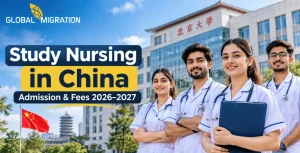
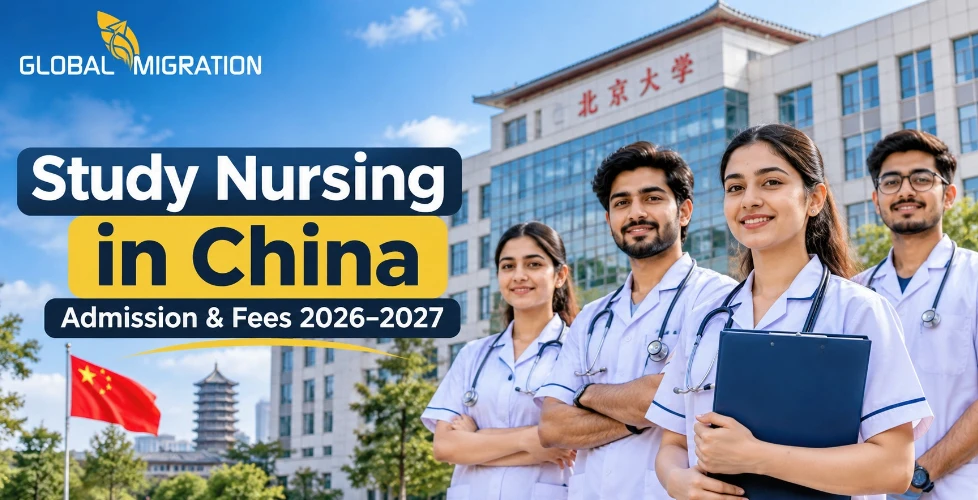
China has become an attractive destination for international students who want a career in healthcare. With modern medical universities, advanced hospitals and affordable tuition, it offers a strong option for nursing education. The Bachelor of Science in Nursing (BSN) combines academic knowledge, clinical experience and professional nursing skills.
For Pakistani and other international applicants, nursing in China can be a cost-effective alternative to the UK, USA, Canada and Australia, and several universities offer English-taught programmes. Global Migration Advisors helps students compare universities, understand admission rules and prepare applications. This guide covers eligibility, documents, fees, scholarships, duration and deadlines for 2027–2028, and you can compare it with MBBS in China if you are also considering medicine.
A Bachelor of Nursing in China usually takes four years. The university figures supplied run from 11,000 to 40,000 RMB a year in tuition. Typical requirements are Grade 12, about 60% marks, age 18–30, a valid passport and English proficiency. Confirm fees, teaching language and professional recognition before paying.
Why Study Nursing in China?
China combines affordable education, modern healthcare facilities and an international learning environment. The main benefits are:
- Affordable tuition. Fees are generally lower than in Western countries.
- English-taught programmes. Selected universities teach nursing in English.
- Clinical training. Practical sessions and supervised placements build professional skills.
- Scholarship options. Eligible students may apply for university scholarships and other support.
Treat all fees as indicative. Ask each university for a written fee breakdown for your intake, including tuition, hostel and any scholarship, before paying.
Is a Chinese Nursing Degree Recognised Abroad?
Nursing is recognised internationally, but studying at a Chinese university does not automatically give professional registration in every country. Recognition depends on the university, degree structure, clinical training and the rules of the destination country’s nursing authority. If you plan to work abroad, check the relevant regulator first:
Examples include the Nursing and Midwifery Council (NMC) in the UK, State Boards of Nursing and NCLEX in the USA, the Nursing and Midwifery Board of Australia (NMBA), the South African Nursing Council (SANC), the Nursing Council of Kenya (NCK) and the Nursing and Midwifery Council of Nigeria (NMCN), plus provincial regulators in Canada.
Course Duration and Subjects
The BSN generally takes four years. The first two years focus on basic medical sciences and foundational nursing, while the final two years cover specialised subjects, practical training and clinical placements. Typical subjects include Anatomy and Physiology, Pharmacology, Fundamentals of Nursing, Medical and Surgical Nursing, Paediatric Nursing and Emergency Nursing.
Some universities also require a level of Chinese, such as HSK-4, before graduation or clinical training. This varies by institution.
Nursing Fees in China for 2027–2028
The general estimate supplied is 14,000–25,000 RMB a year in tuition, about 800–1,000 RMB a month for food, and extra costs for transport, insurance and study materials. Some universities bundle tuition and accommodation, while others charge them separately. The table shows university figures supplied for this guide.
| University | Annual Tuition | Annual Hostel | Note |
|---|---|---|---|
| Jinzhou Medical University | 11,000 RMB | 3,000 RMB | Lowest combined cost |
| Ningxia Medical University | 20,000 RMB | 5,000 RMB | Compare clinical training |
| Wenzhou Medical University | 20,000 RMB | 4,400 RMB | Rough figure |
| Shandong University | 32,000 RMB | 12,000 RMB | Highest hostel fee |
| Xuzhou Medical University | 30,000 RMB | 4,400 RMB | Rough figure |
| Jilin University | 40,000 RMB | 6,000 RMB | Highest tuition |
| Zhejiang Chinese Medical University | 20,000 RMB | 2,250 RMB | Lowest hostel fee |
Please note: These figures are indicative, supplied for this guide from 2026–2027 information, and are not confirmed 2027–2028 quotations. Confirm programme availability, teaching language, accommodation and fees directly with each university.
Annual Tuition vs. Hostel Fees by University
Indicative figures in RMB per year (k = thousand)
Based on the indicative figures in the table above, not confirmed quotations. Confirm current fees with each university.
Jinzhou Medical University is among the affordable options, advertised at about 14,000 RMB a year including tuition and shared-room accommodation, though the breakdown may be revised between sessions. Ningxia Medical University is another option worth comparing.
Combined Annual Cost: Tuition Plus Hostel
Indicative total in RMB per year, lowest to highest
Each total adds the indicative tuition and hostel fees from the table. Food, insurance, transport and other costs are not included. The lowest total is highlighted.
Nursing in China for Pakistani Students
Selected universities teach in English, so you can begin without advanced Chinese. The estimated annual cost for Pakistani students is about 600,000 to 1,000,000 PKR including tuition and accommodation, plus around 40,000 PKR a month for food and personal expenses, depending on city and exchange rate. Before applying, check that:
- The university offers an English-taught BSN
- The degree meets the relevant professional requirements in Pakistan
- The qualification is acceptable to the applicable nursing regulator
- Clinical training is included and tuition covers accommodation, or not
If you plan to return to Pakistan, ask the relevant nursing regulator in writing whether your chosen degree will be accepted before you pay admission fees.
Eligibility Criteria
- Qualification: Grade 12, Intermediate, A-levels or equivalent.
- Marks: Generally at least 60%.
- Age: Commonly 18–30 years.
- Passport: A valid foreign passport with at least one year of validity.
- English: Some universities accept an MOI certificate, while others ask for IELTS or TOEFL.
- CSCA: Check the China Scholastic Competency Assessment rules for your intake, as they differ by university.
Documents and English Requirements
Prepare a valid passport copy, a white-background photo, Matriculation and Intermediate certificates, transcripts, a Foreigner Physical Examination Form, a Police Character Certificate and a financial guarantee. You may also need a parent’s income certificate or a self-introduction video in English. Make sure documents are stamped, translated or authenticated where required.
Accepted English evidence may include IELTS Academic, TOEFL, an English Proficiency Certificate or an MOI certificate. Some requirements mention IELTS 6.0 overall with no band below 5.0, but this is not universal.
Scholarships
Options include university scholarships based on performance and conduct, excellent student scholarships, the Chinese Government Scholarship (not every programme participates) and presidential scholarships at some institutions. Coverage varies, so verify conditions through official university sources and get any award in writing.
How to Apply
- Choose a university. Compare fees, accommodation, clinical facilities and requirements.
- Check eligibility. Review academic, age, English and CSCA rules.
- Prepare documents. Collect certificates, transcripts, passport, photos and medical paperwork.
- Submit your application. Use the official admission channel.
- Pay the application fee. Some universities charge about 1,000 RMB.
- Receive your admission letter. Successful applicants may get a pre-admission or acceptance letter.
- Complete visa documents. Follow instructions for the JW201 or JW202 form where applicable.
- Prepare to travel. Arrange accommodation, travel and other preparations.
Application Deadline and Timeline
Most universities admit undergraduates in September. The commonly advertised application period runs from April to August, but some universities open earlier or close once seats are full. The timeline below comes from the 2026–2027 cycle and shifts one year for 2027–2028, so confirm current dates.
| Admission Stage | Expected Period | What to Do | Note |
|---|---|---|---|
| Application opening | April | Shortlist universities | Some open earlier |
| Document submission | April–August | Send complete documents | Seats may fill early |
| University evaluation | About 7–10 working days | Respond to any requests | Varies by university |
| Admission letter and visa documents | After evaluation | Follow visa instructions | Whole process may take 30–40 working days |
Career Opportunities After a BSN
Graduates may explore roles in hospitals, clinics and community healthcare, such as Registered Nurse (subject to registration), Paediatric Nurse, Emergency Care Nurse or Community Health Nurse. Working abroad means meeting each country’s licensing and examination rules, such as NMC registration in the UK or the NCLEX-RN in the United States. A Chinese degree is an educational foundation, and professional registration is a separate process.
Apply early and keep digital copies of every document. Name, date of birth and passport details should match across all papers to avoid delays.
Frequently Asked Questions
1. How long is a Bachelor of Nursing in China?
A BSN generally takes four years, covering medical sciences, nursing subjects, practical skills and clinical training.
2. What is the BSN fee for Pakistani students?
The estimate is 600,000 to 1,000,000 PKR a year including tuition and accommodation, depending on the university, housing and exchange rate.
3. Can Pakistani students study nursing in China in English?
Yes, selected universities offer English-taught nursing. Confirm the teaching language and clinical training requirements before applying.
4. Is IELTS required?
Not at every university. Some accept an English-medium instruction certificate, while others require IELTS or TOEFL.
5. Is a Chinese nursing degree recognised internationally?
It depends on the university, qualification and the nursing regulator where you intend to work, so check registration requirements before admission.
Conclusion
A Bachelor of Nursing in China can be an affordable route into healthcare. Choose carefully by weighing teaching language, entry requirements, clinical training, degree recognition and future licensing.
If you plan to study nursing in China for 2027–2028, contact Global Migration Advisors in Lahore for admission guidance, or speak with professional study abroad consultants for China for a second opinion.
Planning to study Nursing in China?
Send your results and budget to Global Migration Advisors and we will help you compare universities.
Chat on WhatsAppGlobal Migration Advisors | Lahore, Pakistan | globalmigration.pk