Do you need a separate Apostille for every country you apply to?
If you are planning to study in Lithuania from Pakistan and are also applying to other European countries such as Estonia and Italy, you may worry that your apostille documents must be stamped separately for each country. They do not. Here is how it works, why the UK does not need an Apostille, and the one exception you should know about.
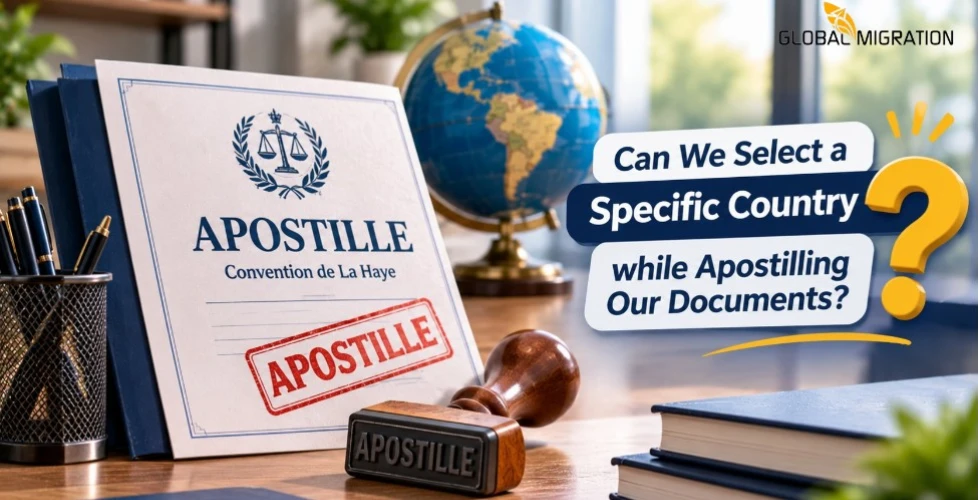
An Apostille is not country-specific. One Apostille on your document is enough for European study destinations such as Estonia, Italy and Lithuania, whichever country you pick on the application form. The UK is different: an Apostille is not needed for UK study unless a university or organisation specifically asks for it.
Can You Select a Specific Country When Applying for an Apostille?
When you apply through the Ministry of Foreign Affairs (MOFA) Apostille portal, the application asks you to choose a destination country. That can make it look as if the stamp will only work there. It will not. The Apostille is a standard certificate, and the country you choose on the form does not change the stamp you receive.
So if you are targeting several countries, you do not need a separate application for each. Select any one of your target countries. The Apostille you get on each document will be accepted in the others as well, as long as those countries are covered by the rule explained later in this guide.
How Long Do Apostille Documents Take in Pakistan?
Timing is one of the first things students ask, because admission and visa deadlines do not wait. In our experience, the Apostille usually takes about 30 days, and in some cases it can take longer, for example when a document needs extra checking. MOFA does not publish a fixed timeline, so the time can vary from case to case.
As of 7 November 2026, apostilles in the files we handle at Global Migration Advisors have been coming back within 15 to 20 days. That is faster than the usual 30 days, but it is our own observation, not an official MOFA timeline. Timelines can vary with workload, so always leave a buffer.
Planning tip: Your HEC or IBCC attestation comes first, so count its time as well. Start early, and leave a buffer before your university or visa deadline instead of planning for the fastest case.
Apostille Requirements in Pakistan: What Applicants Need to Know
Why is an apostille necessary, and what does it do (and not do)?
A foreign university, embassy or visa office cannot easily tell whether a Pakistani degree, certificate or birth record is genuine. They do not know the signature of your board official or the seal of your university. An Apostille solves this problem. It is an official certificate, issued by the Ministry of Foreign Affairs (MOFA), that confirms the signature, the signer’s capacity and the seal on your document are genuine.
In practice, this is why it matters:
Your documents are accepted as authentic. The receiving country does not need to check your papers with Pakistani offices, so there is less room for doubt.
You avoid embassy legalisation. In member countries, the Apostille replaces the older, slower process of getting each document legalised by that country’s embassy.
You avoid delays and rejections. If a university or visa office requires an Apostille and your document does not have one, the file can be put on hold or returned, and that can cost you an intake.
What it does not do. An Apostille does not confirm that the content of a document is correct, and it does not replace a certified translation. A university or embassy may still ask for translations or other documents of its own, so always read each institution’s requirements. Not every institution asks for an Apostille, but where it is required, it is not optional.
Attestation is the first step, done inside Pakistan. Your board, IBCC or HEC verifies that your certificate, degree or transcript is genuine and was issued by that institution.
Apostille is the last step, issued by MOFA. It confirms the signature and seal of the official who attested your document, so it is accepted in Hague Convention member countries without embassy legalisation.
One does not replace the other. Attest first, then get the Apostille.
Which documents need an apostille in Pakistan?
It depends on the university or embassy, so always follow their document list. This table shows the usual first step in Pakistan and what the Lithuania and Romania student routes commonly ask for.
| Document | First step before MOFA | Lithuania | Romania |
|---|---|---|---|
| Matric and intermediate certificates | Board verification, then IBCC attestation | Yes (school certificate for bachelor’s) | Yes |
| Degrees and transcripts | HEC attestation | Yes (degree and transcript) | Yes |
| Police character certificate | Issued by the District Police Officer (DPO); confirm any extra step with MOFA | Yes, for the residence permit (paper original) | Check with your university |
| Birth certificate | NADRA-issued documents are attested directly at MOFA | Not a standard student requirement | Required. Get it apostilled too |
| Marriage certificate (Nikkah Nama) | MOFA also asks for the Marriage Registration Certificate and CNIC | Only for spouse applications | Only if applicable |
Romania: if you plan to study in Romania, a birth certificate is part of the admission file, so get it apostilled along with your education documents. Romanian universities usually ask for a legalised translation as well. Requirements differ by university and embassy, so follow your offer letter.
Can an apostille be done in one day in Pakistan?
No. Educational documents need HEC or IBCC attestation first. MOFA then requires you to submit your application online, wait for its approval, pay the challan and visit on the date allotted to you. These steps cannot be completed in a single day.
How much does an apostille cost per document in Pakistan?
According to MOFA’s official Consular Services page, the Apostille fee is Rs. 3,000 per document for personal and educational documents. Legal documents cost Rs. 4,500 and commercial documents Rs. 12,000 per document. HEC and IBCC attestation fees are separate, and courier charges are extra if you use one of MOFA’s authorised courier companies.
Can I get my apostille online in Pakistan?
The application is online, but the process does not end there. According to MOFA’s official notice, since 27 July 2026 apostille requests are not entertained without prior online registration. You create an account on the MOFA Apostille portal, submit your application with your documents and CNIC, and wait for approval by email. MOFA then sends a challan, you pay it, and you visit the selected office on the date given. MOFA also lists authorised courier companies that handle apostille requests for an additional service charge.
Sources: MOFA’s official notice, the official Consular Services page and the MOFA Apostille portal.
Why One Apostille Works Across Europe, Including Estonia, Italy and Lithuania
The Apostille comes from the Hague Apostille Convention. Under it, a document authenticated with an Apostille in one member country is accepted in every other member country, without further embassy legalisation. According to the HCCH status table (last updated 30 June 2026), the Convention has 130 contracting parties, so this is not limited to a few countries. Pakistan and the three European study destinations in the table below are all among them.
| Country | Member of the Convention | In force since |
|---|---|---|
| Pakistan | Yes | 9 March 2023 |
| Estonia | Yes | 30 September 2001 |
| Italy | Yes | 11 February 1978 |
| Lithuania | Yes | 19 July 1997 |
These three are only examples, because they are popular study destinations for Pakistani students. The Apostille is accepted in all contracting parties where the Convention applies between that country and Pakistan, including European countries such as France, Spain and Ireland. You can check any country on the official status table of the Hague Conference on Private International Law. If a country is not a member, an Apostille is not enough, and you will need the longer embassy legalisation route instead.
This is good news if you are comparing options before you study in Lithuania or elsewhere in Europe, because you can prepare one set of documents and use it for all your applications.
One Important Exception: Countries That Objected to Pakistan
“Valid in all Hague countries” is almost right, but not completely. When Pakistan joined the Convention, eight countries formally objected to its accession, as recorded in the HCCH notifications on Pakistan. Between Pakistan and an objecting country, the Convention does not take effect, so a Pakistani Apostille is not the right route for documents going there.
- Germany
- Austria
- Finland
- Czech Republic
- Poland
- Netherlands (including Aruba, Curaçao and Sint Maarten)
- Denmark
- Greece
Estonia, Italy and Lithuania are not on this list, so your Apostille is valid in all three. If you are also considering one of the countries above, check with that country’s embassy which legalisation process it expects before you apply.
Country rules are where a file check matters most, because an Apostille that is right for one destination can be the wrong route for another. A short review before you submit anything saves a second trip.
 Document review
A Quick Check Before You Apply to MOFA
If you would like a second look at your file, Global Migration Advisors can review your attestation order and target-country requirements before you submit anything.
- Attestation order
- Country requirements
- Document consistency
Apostille for Lithuania
Lithuania is a Convention member and did not object to Pakistan, so your Apostille is valid there. Many Lithuanian universities expect your final degree or certificate and its transcript to carry an Apostille when your country is a Convention member. Scans are usually enough at the application stage, but you will be asked to present the originals, or notarised copies, when you arrive, and some universities state that scans are not accepted for registration. Check your university’s own rules. Follow the usual order: board or HEC/IBCC attestation first, then MOFA. The Apostille is only one part of the full set of documents required for a Lithuania study visa, so plan the rest alongside it.
Apostille for the UK: Not Needed
UK universities and the UK student visa do not require an Apostille. Use it for European destinations such as Lithuania, Estonia, Italy and Romania.
Get Your Documents Attested Before You Apply to MOFA
The Apostille is the last step, not the first. Your documents must be attested by the relevant education authority before MOFA will process them.
- Verify and attest your educational documentsFor matric and intermediate certificates, first get them verified by the board that issued them, then attested by IBCC. Degrees and transcripts are attested by HEC. Our IBCC verification guide explains the first part.
- Apply on the MOFA Apostille portalCreate your account on the official portal, attach both sides of your CNIC and upload your documents. Select any one of your target countries as the destination. As explained above, this does not limit where the Apostille can be used.
- Wait for approval and pay the challanMOFA notifies you by email once your application is approved. You then receive a challan by email and pay it online or through a bank.
- Visit on your allotted date and collectGo to the selected MOFA office on the date and time given, and only after approval. MOFA attaches the Apostille to each document. Check every document carefully as soon as you receive it.
Tip: Order matters. Documents that have not been attested by HEC or IBCC first can be returned at MOFA, which costs you time and another visit.
Common Apostille Mistakes
The most expensive mistake is making a separate MOFA application for every country, which repeats fees and visits for no benefit. Close behind is applying to MOFA before HEC or IBCC attestation, and assuming the Apostille works everywhere without checking the countries that objected to Pakistan. Finally, some students treat the Apostille as proof that the content is correct, when it only authenticates the signature and seal.
Frequently Asked Questions
Is a Pakistani Apostille valid in Germany?
Not under the Convention. Germany is one of eight countries that objected to Pakistan’s accession, so check with the German embassy which process it requires.
Do I need an Apostille for the UK or for Europe?
You do not need one for the UK as a general rule, unless your university or another UK organisation specifically asks. You do need one for European study destinations such as Lithuania, Estonia, Italy and Romania, where universities and embassies commonly require apostilled documents.
Does an Apostille prove that my document is true?
No. It only confirms the signature, the signer’s capacity and the seal or stamp. It does not certify the content of the document.
Does an Apostille expire?
MOFA’s published guidance says that attestation of documents of a permanent nature, such as educational certificates and birth certificates, remains valid. Some universities or embassies may still prefer recently issued documents, so check their rules before you apply.
Do I need to visit MOFA for an Apostille?
You must apply online first. After your application is approved and the challan is paid, you visit the selected MOFA office on your allotted date. MOFA also lists authorised courier companies for apostille requests, which charge a service fee in addition to the Apostille fee. Details are on MOFA’s Consular Services page.
Final Thoughts
The simple rule is this: attest first, apply on the MOFA portal once, pick any one of your target countries, and use the same apostilled documents for the European countries that accept Pakistan’s Apostille. The UK does not need an Apostille unless it is specifically requested. Just remember the eight exceptions, and leave a buffer before your university or visa deadline.
If you want your file checked before you apply to MOFA, speak with professional study abroad consultants who guide Pakistani students through the process.
Disclaimer: This guide is based on current MOFA procedures and Hague Convention rules, and is intended to help you plan. It is not legal advice. Fees and country requirements are set by the issuing and receiving authorities and are updated from time to time, so please confirm your specific case with MOFA and your university or embassy before applying.