Every year, more Pakistani students choose to study in Romania instead of the traditional UK, US or Australia route — and it’s easy to see why. Public university tuition often runs between €2,000 and €5,000 a year, dozens of programmes are taught entirely in English, and a Romanian degree carries full EU recognition.
There’s official momentum behind this shift too. In a recent meeting with Romania’s ambassador, Pakistan’s Minister of State for Federal Education spoke about diversifying students away from the usual UK, US, Germany and China circuit, specifically naming Romania and praising its medical education as among the best in the world. For students exploring how to study in Romania from Pakistan, this is genuinely one of the best moments to apply.
The Application Process Looks Simple — The Interview Is Where It Gets Hard
On paper, the road to a Romania student visa is straightforward: get accepted by a university, receive your Letter of Acceptance once the Ministry of Education forwards your file, pay your first year’s tuition, and then apply for the D/SD long-stay study visa. That visa currently costs $350, payable in cash at the interview — up from the roughly €120 it carried until recently.
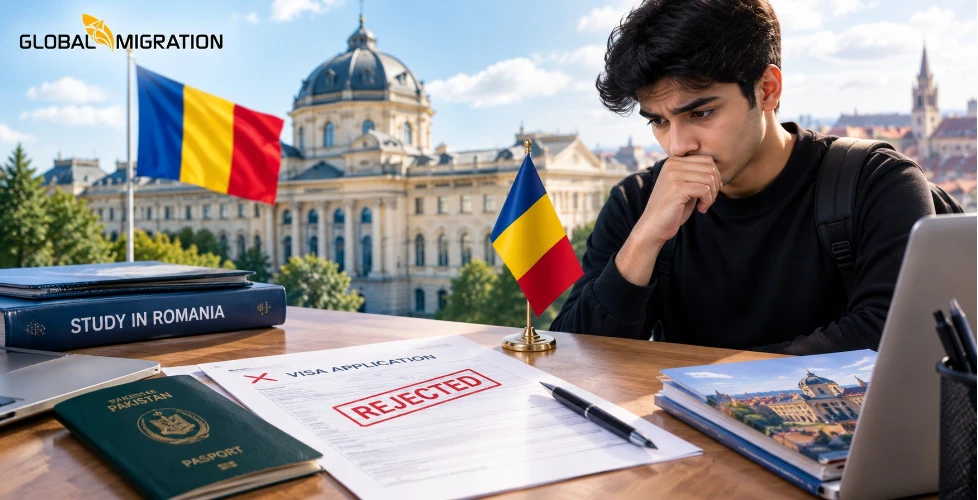
None of that paperwork, however, is what decides your outcome. The real gatekeeper for anyone planning to study in Romania is the short interview conducted by a small panel at the Romanian Embassy in Islamabad. Students describe it as brief but intense, with follow-up questions designed to test whether your answers hold up under pressure.
💡 Pro Tip #1: Never memorise a “model answer” for the interview. Panels are trained to spot scripted responses and will cross-question you from a different angle the moment something sounds rehearsed. Practise explaining your plan in your own words instead.
What Romanian Embassy Interviewers Are Actually Assessing
Based on what our team hears directly from recently interviewed applicants, the panel is really only weighing two broad things: whether your intent to study is genuine, and whether your family can realistically afford it. Almost every refusal traces back to a weakness in one of these two areas — even when the refusal letter itself gives no specific reason.
Interviewers want clear evidence that you actually researched your options before choosing this path — that you compared countries, universities, and courses, and arrived at your choice for real reasons rather than because an agent told you to apply. Expect direct questions such as why Romania and not Pakistan, why this university, and why this specific course.
This questioning gets noticeably sharper around Romania’s more affordable, high-application-volume universities such as West University of Timișoara. Students who can only say “because it’s affordable” are among the most likely to be refused, simply because that answer alone doesn’t demonstrate genuine intent to study in Romania from Pakistan for the right reasons.
- Two core things assessed: whether your intent to study is genuine, and whether your family can realistically afford it
- Almost every refusal traces back to a weakness in one of these two areas — even when the refusal letter gives no specific reason
- Real research matters: panels expect you to show you compared countries, universities and courses, not just followed an agent’s advice
- Direct questions to expect: why Romania, why this university, why this specific course
- Extra scrutiny applies to affordable, high-application-volume universities like West University of Timișoara
- Career fit and English communication are weighed heavily — the panel wants to see you think and speak clearly under pressure, not just pass a written test
| Category | Requirement | Current Figure | Applies To | Risk If Ignored |
|---|---|---|---|---|
| Tuition Fees | Annual public university cost | €2,000–€5,000 | All applicants | Low |
| Visa Fee | Paid in cash at interview | $350 | All applicants | Medium (budgeting) |
| Monthly Support | Legal minimum wage floor | RON 4,050 (~€795), rising to RON 4,325 in July 2026 | All applicants | High |
| English Proficiency | IELTS/PTE or equivalent | Recommended, not just MOI letter | Weak academic profiles | High |
| Document Consistency | Identical name on every document | CNIC, passport, bank, tax return | All applicants | High |
- Tuition: €2,000–€5,000 per year at public universities
- Visa fee: $350, paid in cash at the interview
- Monthly support required: RON 4,050 (~€795), rising to RON 4,325 from July 2026
- English proficiency: IELTS/PTE recommended, especially for weaker academic profiles
- Document consistency: Name must match exactly across CNIC, passport, bank and tax records
Interviewers also probe your future plans in detail — how this degree fits into your career and what you intend to do with it. English communication matters enormously here, arguably more than most applicants realise. This isn’t only about passing a test on paper; it’s about whether you can hold a real conversation and think on your feet under pressure.
Financial Affordability — Not Just a Bank Balance
The second pillar is whether your family can genuinely afford it, and it’s assessed more carefully than most applicants expect. Two problems show up again and again: insufficient funds to cover realistic living costs, and funds that exist but come from an income that isn’t consistent or traceable. Interviewers want a pattern of regular deposits that matches a real, ongoing income source.
Ownership of the funds matters just as much as the amount. If the money shown is sitting in a father’s or relative’s account rather than the student’s own personal account, the application is very likely to be rejected — even when the family’s finances are genuinely strong. Funds should be transferred into the student’s own account well ahead of the interview so a real balance history can build up.
A smaller but equally costly mistake is a name mismatch across documents. If a bank statement reads “Muhammad Ali” but the account maintenance certificate reads “M. Ali,” that inconsistency alone can trigger a rejection, because it breaks the paper trail the interviewer is trying to verify.
💡 Pro Tip #2: Move sponsor funds into the student’s own bank account at least 3–6 months before the interview. A short, sudden balance spike right before applying is one of the fastest ways to raise doubts about the source of the money.
For a deeper breakdown of exactly how much money you need and how officers verify it, see our guide: Romania Study Visa Financial Requirements. It walks through the minimum wage rule, tax return matching, and how to avoid the “too much unexplained money” trap.
Other Common Reasons Behind a Romania Study Visa Refusal
Beyond the two core pillars, a handful of other factors show up repeatedly in refused cases. Unverifiable work experience claims are common — if you tell the interviewer you worked somewhere to explain a study gap, you need salary slips and a bank account showing that salary was actually received.
A weak academic profile combined with no English proficiency test is another red flag. Applicants relying only on a Medium of Instruction letter, with no IELTS or PTE score, are taking on unnecessary risk. Answers that don’t sound like your own — generic, rehearsed, or identical to what other applicants are saying — are an immediate concern for the panel.
| Issue | Why It Happens | Risk Level | Quick Fix | Best Prepared By |
|---|---|---|---|---|
| Funds in relative’s account | Family sponsors haven’t transferred funds yet | High | Move funds to student’s own account early | 3–6 months before |
| Name mismatch | Different name formats across documents | High | Standardise name on every document | Before applying |
| Unverifiable work claims | No salary slips or bank proof | Medium | Collect payslips and bank credit records | Before applying |
| Scripted answers | Coached “model” responses | High | Practise answering in your own words | 1–2 weeks before |
| Weak English | No test score, low fluency | Medium | Take IELTS/PTE and practise conversation | 2–3 months before |
- Funds in a relative’s account — move money into the student’s own account 3–6 months before the interview
- Name mismatch across documents — standardise your name everywhere before applying
- Unverifiable work claims — keep salary slips and matching bank credit records
- Scripted answers — practise explaining things in your own words, 1–2 weeks before
- Weak English — take IELTS/PTE and practise real conversation, 2–3 months before
It’s also worth being honest about the limits of a refusal letter itself: these letters are typically brief and formulaic, often citing general language about purpose of stay rather than spelling out exactly what went wrong. That vagueness is precisely why understanding the two assessment pillars matters — it’s usually your only real diagnostic tool.
How to Fix It: Preparing for a Romania Student Visa From Pakistan
Almost every weakness above is fixable with real preparation, not just paperwork. Start by moving sponsor funds into your own account early, and let the balance build a real, traceable history before you apply. Make sure your name appears identically on every document — bank statement, account maintenance letter, CNIC, passport and tax return.
💡 Pro Tip #3: Practise for cross-questioning, not just the first question. Run mock interviews where someone deliberately follows up and challenges your answers from different angles — that’s exactly what happens in Islamabad.
If you’re preparing specifically for the interview stage, our companion guide covers real questions and how to answer them without sounding scripted: Romania Student Visa Interview Questions and Answers.
Build an honest research trail. Be able to explain, in your own words, why you compared Romania against at least one or two other options, and why you landed on your specific university and course.
If Bucharest is on your shortlist, our university-specific breakdown is a good starting point: Study in Romania: University of Bucharest Guide.
This is exactly the gap our team at Global Migration Advisors closes for students in Lahore, Pakistan and beyond. Beyond university and course selection, we help you prepare your documents — especially the financial documents that trip up the most applicants — and put you through structured interview preparation before you ever sit in front of the panel in Islamabad.
Frequently Asked Questions
1. Why are Romania student visas from Pakistan being refused more often in 2026?
Most refusals trace back to weak proof of genuine intent to study or financial documentation that doesn’t hold up under questioning, not missing paperwork.
2. How much money do I need to show for a Romania study visa?
Romanian law requires proof of monthly support at least equal to the minimum wage — currently RON 4,050 (about €795), rising to RON 4,325 from July 2026.
3. Can I use my father’s bank account to show funds?
It’s risky. Funds should ideally sit in the student’s own account with a traceable history, since sponsor-only accounts are a common reason for refusal.
4. Is IELTS mandatory to study in Romania?
Not always mandatory, but applicants without a recognised English test and a weak academic profile face noticeably higher refusal risk.
5. How long is the Romania student visa interview?
Often just a few minutes, but with sharp follow-up questions designed to test whether your answers stay consistent under pressure.
Final Thoughts
A Romania study visa refusal in 2026 is rarely about a missing document — it’s almost always about whether the interview panel believed your intent was genuine and your finances were credible, traceable and correctly documented. Students who prepare specifically for the conversation, not just the paperwork, are the ones getting approved this cycle.
If you’re serious about how to study in Romania from Pakistan, start early. Prepare your documents well before your interview date, not after a refusal.