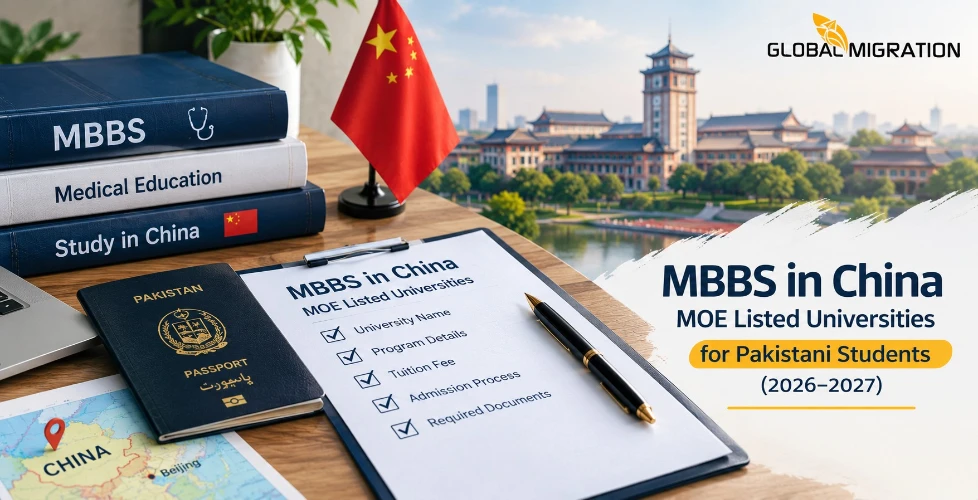
Every year, thousands of Pakistani students set their sights on MBBS in China — and for good reason. Tuition costs are a fraction of what private medical colleges charge at home, English-medium programs remove the language barrier, and Chinese medical universities are backed by decades of infrastructure investment, modern teaching hospitals, and internationally recognized degrees. But not every Chinese university offering an “MBBS in English” is equal in the eyes of Pakistan’s regulators. This is where the Ministry of Education (MOE) list comes in — and understanding it properly can be the difference between a smooth, recognized medical career and years of complications later.
At Global Migration Advisors, we work with students and families across Lahore and Pakistan every intake cycle to help them study MBBS in China from Pakistan the right way. This guide breaks down what the MOE list actually is, which universities are on it for 2026–2027, what it costs, what the admission requirements look like, and — just as importantly — what has changed in Pakistan’s own regulatory landscape that every aspiring MBBS student needs to know before applying.
Always cross-check a university’s name against the official Chinese MOE list before paying any admission or processing fee. A confirmed seat means nothing if the college isn’t on the current list.
What Is the MOE List, and Why Does It Matter?
China’s Ministry of Education began publishing an official list of medical schools authorized to teach Clinical Medicine (MBBS) in English back in 2007, following the introduction of national quality-control standards for international medical education. The list isn’t a marketing badge — it’s the result of an ongoing evaluation carried out by China’s National Western Medical Education Expert Group, which reviews teaching quality, faculty, facilities, and outcomes before granting a university the right to enroll international students into an English-taught MBBS program.
In practical terms, this means only universities on the MOE list are permitted to state “MBBS in English” on their official admission letters. Any Chinese university outside this list that claims to offer a fully English-medium MBBS in China is not authorized to do so by the Chinese government itself — regardless of what an agent or a glossy brochure might promise. For a Pakistani student, this distinction has real consequences for licensing exams, degree recognition, and — as of the past two years — for whether the Pakistan Medical and Dental Council (PMDC) will even permit the degree to be equated at all.
The 2026–2027 MOE List: 43 Recognized Medical Universities
For the current admission cycle, China’s Ministry of Education has confirmed a revised list of 43 medical universities authorized to teach MBBS in English. A few notable changes from the previous cycle are worth flagging for students planning their applications:
- Shihezi University raised its international enrollment quota from 100 to 120 seats, reflecting its growing reputation among South Asian and African applicants.
- China Three Gorges University, North Sichuan Medical University, and Dali University have all been removed from the latest MOE list — a reminder that this list is reviewed and revised regularly, and universities can lose their English-medium authorization.
- Shandong University, Zhejiang University, Anhui Medical University, and Xiamen University increased their enrollment quotas for the new session.
Only five universities among the 43 have consistently been permitted to enroll more than 120 English-medium MBBS students per year, reflecting a sustained track record of maintaining teaching standards. Shihezi University and Ningxia Medical University are widely regarded as two of the strongest and most established options for students who plan to study MBBS in China from Pakistan, drawing students from more than 40 countries including Pakistan, India, Bangladesh, Sri Lanka, Nigeria, and several other nations across Asia and Africa.
Here is the current MOE-approved list along with the 2026–2027 enrollment plan for each institution:
| University | Approx. Seats (2026–2027) |
|---|---|
| Jilin University | 100 |
| China Medical University | 50 |
| Dalian Medical University | 120 |
| Capital Medical University | 70 |
| Tianjin Medical University | 100 |
| Shandong University | 80 |
| Fudan University | 40 |
| Xinjiang Medical University | 60 |
| Nanjing Medical University | 60 |
| Jiangsu University | 70 |
| Wenzhou Medical University | 120 |
| Zhejiang University | 180 |
| Wuhan University | 50 |
| Huazhong University of Science and Technology | 80 |
| Xi’an Jiaotong University | 120 |
| Southern Medical University | 100 |
| Jinan University | 30 |
| Guangxi Medical University | 60 |
| Sichuan University | 70 |
| Chongqing Medical University | 100 |
| Harbin Medical University | 60 |
| Beihua University | 20 |
| Jinzhou Medical University | 40 |
| Qingdao University | 30 |
| Hebei Medical University | 40 |
| Ningxia Medical University | 100 |
| Tongji University | 40 |
| Shihezi University | 120 |
| Southeast University | 30 |
| Yangzhou University | 30 |
| Nantong University | 30 |
| Soochow University | 30 |
| Ningbo University | 50 |
| Fujian Medical University | 60 |
| Anhui Medical University | 80 |
| Xuzhou Medical University | 40 |
| Zhengzhou University | 40 |
| Guangzhou Medical University | 80 |
| Shantou University | 20 |
| Kunming Medical University | 70 |
| Southwest Medical University | 40 |
| Xiamen University | 50 |
| Shanghai Jiao Tong University | 30 |
This table is a useful reference point, but seat numbers and quotas do shift slightly between intakes, so we always recommend confirming current availability directly before finalizing an application.
What Does an MOE-Listed MBBS Actually Cost?
One of the biggest draws of studying MBBS in China is affordability compared to private medical colleges in Pakistan or English-medium options in Europe. Annual tuition and accommodation at most MOE-listed universities falls in the range of roughly 35,000 to 40,000 RMB per year, which works out to approximately USD 5,200 to 6,000 annually. Converted to Pakistani rupees, that’s typically around PKR 14 to 15 lakh per year covering both tuition and hostel accommodation — a figure that is often lower than a full year’s fee at a private medical college in Lahore or Karachi.
The program itself runs for six years: five years of academic coursework followed by a mandatory one-year clinical internship, usually completed at the university’s affiliated teaching hospital in China. Graduates who successfully complete this pathway receive a Bachelor’s degree in Clinical Medicine (MBBS), taught entirely in English.
Budget for hostel deposits, visa fees, and a return flight on top of tuition — the “PKR 14–15 lakh per year” figure usually covers tuition and accommodation only, not one-time onboarding costs.
Admission Requirements for Pakistani Students
Eligibility criteria are fairly consistent for students who want to study MBBS in China from Pakistan, though a handful of top-tier universities set a slightly higher bar:
- A minimum of 60% marks in FSc Pre-Medical (or an equivalent Senior Secondary / A-Level qualification with Biology, Chemistry, and Physics). A small number of universities — including Zhejiang University, Fudan University, Tianjin Medical University, and Tongji University — set the requirement closer to 70% and may also ask for IELTS or TOEFL scores as supporting evidence of English proficiency.
- Many universities conduct an entrance interview to assess a candidate’s academic readiness and motivation.
- Chinese language requirements are relaxed in the first year, since teaching is conducted in English from day one. Students are typically only asked to submit an HSK-4 Chinese language certificate before their MBBS degree is finally conferred, rather than before enrollment — though building basic Mandarin skills early makes clinical rotations and daily life considerably easier.
Important: Pakistan’s New PMDC Regulations for 2026
This is the part of the process that has changed the most in recent years, and it’s where working with an experienced consultancy matters most.
Since the 2024 academic session, the Pakistan Medical and Dental Council (PMDC) has required every Pakistani student pursuing medical or dental education abroad to obtain a No-Objection Certificate (NOC) before enrolling in a foreign institution. This was introduced specifically to stop students from unknowingly enrolling in unrecognized colleges and universities that would later cause problems with degree equivalence back home.
The regulatory environment has tightened further heading into 2026. Following a high-level Sub-Committee meeting on the accreditation of medical and dental colleges in May 2026, PMDC made it compulsory for any student intending to study medicine or dentistry at a foreign university — including for those pursuing MBBS in China — to have cleared the Medical and Dental College Admission Test (MDCAT) and completed PMDC registration beforehand. In other words, MDCAT is no longer just a gateway into Pakistani medical colleges; it is now a prerequisite for any medical career pathway, whether the degree is earned in Lahore or in Zhengzhou. The 2026 MDCAT exam window, registration deadlines, and fee structure are set annually by PMDC, and missing these dates can delay an entire admission cycle.
This is precisely the kind of regulatory detail that catches families off guard — an offer letter from a good MOE-listed university means little if the PMDC and MDCAT side of the process hasn’t been handled correctly and on time.
Apply for your PMDC NOC as soon as you accept an admission offer, not after your visa is stamped. NOC delays are one of the most common reasons students miss an intake.
Why MOE-Listed Universities Matter for Licensing and Recognition
Beyond Pakistan’s own requirements, the MOE listing carries weight internationally. Degrees earned from the 43 MOE-listed medical universities are recognized in a way that allows graduates to sit for major medical licensing examinations abroad, including PM&DC’s own equivalence process, USMLE (USA), UKMLA/PLAB (UK), GMC pathways, AMC (Australia), and ECFMG certification. India’s National Medical Commission (NMC) and Bangladesh’s Medical & Dental Council similarly restrict recognition to graduates of these same 43 institutions when it comes to English-taught MBBS programs — which underlines just how central this list is across South Asia’s entire medical education pipeline, not only Pakistan’s.
Top MOE-Listed Universities Pakistani Students Should Consider
While all 43 universities are officially authorized, a handful consistently stand out for students planning to study MBBS in China from Pakistan, based on cost, safety, facilities, and community support:
- Shihezi University — one of the longest-running English-medium MBBS programs in China (since the early 2000s), popular for its affordability, strong hostel facilities, sizable Pakistani and South Asian student community, and reputation as one of the safer campuses for female students.
- Ningxia Medical University — known for competitive scholarship policies and a large, well-established international student body drawn from 40-plus countries.
- Zhengzhou University — home to one of the largest affiliated teaching hospitals in China, with a long track record of accepting international medical students.
- Jiangsu University and Ningbo University — both consistently well-ranked, with growing international departments and solid clinical training facilities.
The right choice ultimately depends on a student’s budget, academic profile, and personal priorities — proximity to a larger Pakistani community, university ranking, campus safety, or scholarship eligibility can all tip the decision in different directions.
Why Work With Global Migration Advisors
Choosing an MOE-listed university is only the first step. What actually determines whether a Pakistani student’s medical degree is smoothly recognized back home is how carefully the entire documentation chain is handled — from IBCC attestation of academic transcripts, to HEC verification, MOFA attestation, and now the added layer of PMDC NOC and MDCAT compliance introduced for the 2024 session onward. Add to that the visa application, financial sponsorship documentation, and university-specific admission requirements, and it becomes clear why so many families choose not to navigate this process alone.
At Global Migration Advisors, based in Lahore, we specialize in exactly this kind of layered, document-heavy process — not just for China, but across our full range of study destinations including Romania, Lithuania, Sweden, Italy, Finland, and Cyprus. Our team stays current with regulatory changes on both sides: China’s MOE list updates and quota changes, and Pakistan’s evolving PMDC and MDCAT requirements. We also support students with IELTS, PTE, and Duolingo test preparation where an English proficiency score is required.
If you or your child is considering an MBBS in China and want to make sure the university you choose is properly MOE-listed, that your NOC and MDCAT requirements are handled correctly, and that your entire attestation chain is in order before you fly out — contact Global Migration Advisors and our team will walk you through the current list, current fee structures, and the exact paperwork sequence you’ll need for a smooth admission and an internationally recognized degree.
Ready to start your MBBS journey in China the right way?
Contact Global Migration Advisors on WhatsAppThis guide reflects publicly available information on China’s MOE list and Pakistan’s PMDC/MDCAT requirements as of the 2026–2027 admission cycle. Enrollment quotas, fee structures, and regulatory requirements are subject to change — always confirm current details with your consultant before finalizing an application.
Looking for guidance you can trust from start to finish? Work with professional study abroad consultants for China to handle your university shortlisting, NOC, MDCAT compliance, and visa process end to end.