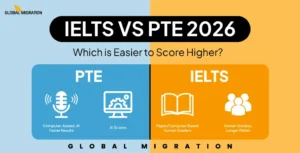
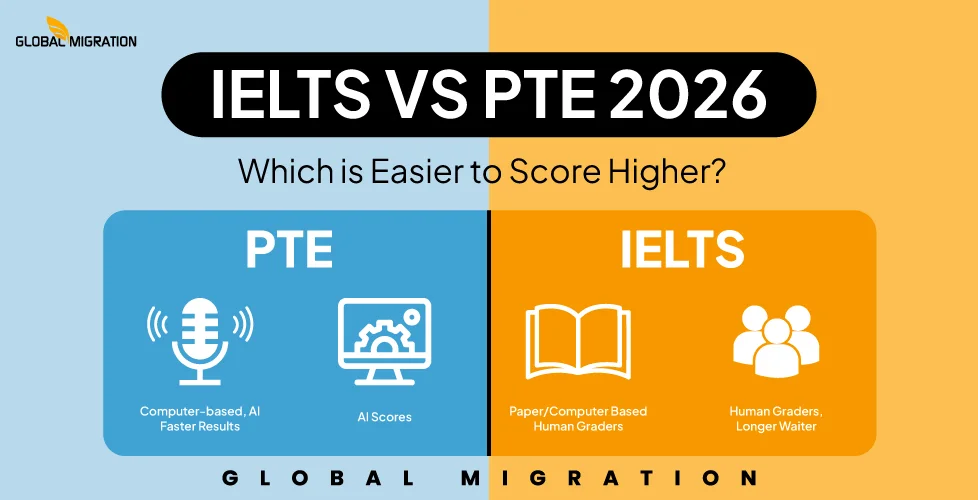
If you’re planning to study or work abroad, choosing between IELTS and PTE can feel overwhelming. Both exams assess English proficiency, but their format, scoring, and difficulty levels differ significantly. Understanding these differences is essential to score high quickly and efficiently. In this detailed guide, we break down the IELTS and PTE score comparison, scoring systems, difficulty levels, and which test may be easier for you. By the end, you’ll know exactly which exam aligns best with your strengths and goals. Let’s dive in and simplify your decision.
What Is IELTS
IELTS (International English Language Testing System) is one of the most widely accepted English proficiency exams globally. It evaluates four skills: Listening, Reading, Writing, and Speaking. The test is available in two versions: Academic and General Training. Scores are reported in bands from 0 to 9, with 9 indicating expert-level English proficiency. The speaking section is conducted face-to-face with an examiner, which many test-takers find more natural but sometimes nerve-racking.
What Is PTE
PTE (Pearson Test of English Academic) is a computer-based English proficiency exam designed for academic and immigration purposes. It also assesses Listening, Reading, Writing, and Speaking but uses automated scoring powered by AI. Scores range from 10 to 90, and results are typically released faster than IELTS. Because the test is fully computerized, it eliminates human bias but requires strong typing and microphone skills.
Read More: Difference Between IELTS and PTE: Which Test Is Better 2026
IELTS and PTE Score Comparison Chart
Understanding how IELTS and PTE scores compare is essential for setting realistic goals. Both exams use different scales, but equivalency charts help you map PTE scores to IELTS bands. This guide will simplify the comparison and help you target the score you need.
| IELTS Band | PTE Score | Proficiency Level |
| 9 | 86–90 | Expert |
| 8.5 | 83–85 | Very Good |
| 8 | 79–82 | Very Good |
| 7.5 | 73–78 | Good |
| 7 | 65–72 | Good |
| 6.5 | 58–64 | Competent |
| 6 | 50–57 | Competent |
| 5.5 | 42–49 | Modest |
| 5 | 36–41 | Modest |
PTE Score vs IELTS Band
When comparing IELTS and PTE scores, the main difference lies in the scoring scale. IELTS uses a 9-band system, while PTE uses a 90-point scale. This difference can make it confusing for students to know which exam aligns better with their goals. To simplify this, universities and immigration authorities provide equivalency charts that map PTE scores to IELTS bands, helping applicants understand their performance across tests.
- PTE 65 equals IELTS 7: This score is widely recognized for university admissions, professional licensing, and visa applications, reflecting a competent command of English.
- IELTS 7 equals PTE 65–72: Depending on the institution or country’s standards, this range indicates that the test-taker has strong English skills suitable for academic and professional environments.
Understanding this equivalency is essential for planning your exam strategy, setting target scores, and choosing the test that maximizes your chances of success.
IELTS vs PTE Scoring System
The scoring systems of IELTS and PTE differ significantly, which can affect how easy it is to achieve a high score:
- IELTS: Writing and Speaking are assessed by human examiners, while Listening and Reading are computer-scored. Scores are reported in 0.5 band increments from 0 to 9.
- PTE: The entire exam is AI-scored, providing consistent, unbiased results. Scores range from 10 to 90 in single-point increments, allowing more precise measurement of your language skills.
This difference makes PTE more predictable in scoring, while IELTS allows for human interaction in Speaking and Writing, which some test-takers find more flexible or natural.
IELTS vs PTE Which Is Easier
Deciding which exam is easier depends largely on your personal strengths and test-taking style:
- IELTS: Ideal for strong speakers who feel comfortable with face-to-face interaction. The live Speaking test allows natural conversation and clarification if needed.
- PTE: Suited for candidates who are comfortable with computers and typing quickly. The test is fully computerized, and AI scoring ensures consistency.
- Listening Differences: If you find varied accents challenging, PTE’s standardized recordings may be easier to follow than IELTS’ mix of British, Australian, and North American accents.
Ultimately, the easier test is the one that matches your communication style, comfort level, and familiarity with technology.
Difference Between IELTS and PTE Exam
| Feature | IELTS | PTE |
| Format | Paper or Computer | Fully Computer |
| Speaking | Face-to-face | Recorded |
| Scoring | Human + AI | AI only |
| Results | 3–13 days | 1–5 days |
| Score Range | 0–9 | 10–90 |
Which Exam Is Better: IELTS or PTE?
There’s no one-size-fits-all answer—neither exam is inherently better than the other.
- IELTS: More widely recognized globally, especially in the UK, Canada, and other traditional destinations. Its face-to-face Speaking section and familiar format appeal to those comfortable with human interaction.
- PTE: Gaining popularity due to faster results, fully computerized testing, and unbiased AI scoring. It’s ideal for tech-savvy candidates who prefer a consistent, automated evaluation.
Your choice should depend on university or visa requirements, your strengths in speaking and typing, and comfort with a digital versus human-assessed exam.
Why People Succeed with IELTS

Many test-takers achieve high scores in IELTS because the exam structure rewards practical English skills rather than memorization. With the right preparation strategy and understanding of the format, candidates can perform confidently across all sections. Here are the key reasons why people succeed:
- Clear test format — The predictable structure makes it easier to prepare strategically.
- Real-life communication focus — Tasks mirror everyday academic and professional English use.
- Face-to-face speaking test — Allows natural conversation, which benefits confident speakers.
- Widely available preparation resources — Practice tests, courses, and study materials are abundant.
- Band scoring transparency — Candidates know exactly what is required to reach each band.
- Flexible test options — Choice between paper-based and computer-based formats.
- Skill-based scoring — Strong performance in one section can balance a weaker area.
Which Test Is Better for Student Visa
Both IELTS and PTE are widely accepted for student visa applications, but preferences vary by country:
- United Kingdom: IELTS is generally preferred and widely recognized by universities and immigration authorities.
- Australia & New Zealand: Both IELTS and PTE are accepted, giving candidates flexibility in choosing the test that suits their strengths.
- Canada: IELTS remains the primary choice for most immigration and study programs, though PTE acceptance is gradually increasing.
Before booking your exam, always check the specific visa and university requirements of your destination country to ensure your test score is valid.
PTE vs IELTS Result Time
One major difference between the exams is how quickly you receive your results:
- PTE: Results are typically available within 1–5 business days, making it ideal for applicants with tight deadlines.
- IELTS: Results take 3–13 days, depending on whether you take the computer-based or paper-based test.
If you’re on a short timeline for university admission or visa applications, PTE’s faster turnaround can provide a significant advantage.
Read More: Top 5 Countries with High Student Visa Rates in 2026
PTE vs IELTS Test Format
Both IELTS and PTE assess the four core English skills—Writing, Speaking, Listening, and Reading—but their formats differ significantly. Understanding these differences can help you choose the test that aligns with your strengths.
Writing
- IELTS: Essay plus a task based on a report or letter (Academic or General Training).
- PTE: Summarize written text and type an essay on a computer.
Speaking
- IELTS: Face-to-face interview with an examiner.
- PTE: Speak into a microphone for tasks like reading aloud, repeating sentences, and describing images.
Listening
- IELTS: Various question types with note-taking; includes different accents.
- PTE: Integrated tasks that combine listening with reading and writing, using standardized recordings.
Reading
- IELTS: Traditional passages with comprehension questions.
- PTE: Interactive tasks such as drag-and-drop, reordering paragraphs, and multiple-choice questions.
By knowing the test format, you can prepare strategically and focus on tasks where you are strongest.
Speaking Test: IELTS vs PTE
The Speaking sections of IELTS and PTE differ in format and evaluation style:
- IELTS: Conducted as a live face-to-face interview with an examiner, allowing natural interaction and the chance to clarify answers.
- PTE: Done entirely via microphone, with strict timing and AI-based scoring, offering consistent but automated evaluation.
Which is easier?
- If you’re comfortable with conversing with a person, IELTS may feel more natural.
- If you prefer no human judgment and faster scoring, PTE is often a better fit.
IELTS vs PTE Difficulty Level
The difficulty of IELTS and PTE largely depends on your individual strengths, as each test emphasizes different skills:
- IELTS Writing: Often considered harder due to strict human marking criteria for grammar, coherence, and task completion.
- PTE Speaking: Can be challenging because of time pressure and the need to speak clearly into a microphone for AI scoring.
- IELTS Listening: Some test-takers struggle with varied accents (British, Australian, American), which can make comprehension tricky, while PTE uses standardized recordings.
- Reading: IELTS reading passages can be longer and more complex, requiring careful time management and scanning skills, whereas PTE reading tasks are often shorter, interactive, and task-based, which some candidates find easier to navigate.
Ultimately, the perceived difficulty depends on whether you excel in writing, speaking under timed conditions, listening comprehension, or reading efficiently.
IELTS vs PTE Exam Duration
The total exam time differs between IELTS and PTE:
- IELTS: Approximately 2 hours 45 minutes, with the Speaking test sometimes scheduled on a separate day.
- PTE: Around 2 hours, completed in a single continuous session.
Many candidates prefer PTE’s shorter, one-sitting format, as it reduces scheduling stress and allows for a more streamlined test experience.
PTE vs IELTS: Which Exam Should You Pick?
Choosing between PTE and IELTS can be confusing, especially since both exams evaluate your English proficiency for study, work, and migration purposes. Neither test is inherently easier or harder—the right choice depends on your strengths, preferences, and test-taking style. The comparison table below highlights their key differences to help you decide.
| Feature | PTE | IELTS |
| Format | Computer-based | Paper or Computer |
| Sections | Integrated skills | Separate skills |
| Scoring | 10–90 scale | Band 0–9 |
| Results | 5 days | Up to 13 days |
| Duration | 2h 15m | 2h 45m |
| Acceptance | Global | Global |
Why English Test Scores Matter
If you’re planning to study abroad, proving your English proficiency is a major admission requirement. Both PTE and IELTS are widely accepted, so choosing the right exam can directly affect your chances of meeting university or visa criteria. Understanding score conversions and exam formats helps you prepare more effectively and aim for your target score with confidence.
Still Unsure Which Test to Choose?
If you’re uncertain about whether IELTS or PTE is the right fit for you, getting expert guidance can make the decision much easier. Professional mentors can assess your strengths, recommend the best exam for your goals, and help you build a focused preparation strategy. If you need personalized support, you can visit Global IELTS/PTE Coaching, where experienced trainers will guide you step-by-step—from choosing the right test to achieving your target score with confidence.
Can I Switch From IELTS to PTE?
Yes, switching from IELTS to PTE is possible and fairly common. Many candidates make the switch if they feel the IELTS format doesn’t suit their strengths.
Since both exams assess the same core English skills—Listening, Reading, Writing, and Speaking—much of the preparation overlaps. Students often switch to PTE for faster results, AI-based scoring, and a more predictable testing experience.
Why Choose PTE Over IELTS
You might opt for PTE over IELTS if you value:
- Faster results: Receive scores in 1–5 days.
- Fully computerized testing: Complete the entire exam on a computer.
- Objective AI scoring: Ensures consistent and unbiased evaluation.
- Flexible test dates: Easier scheduling compared to IELTS.
- Shorter exam duration: Approximately 2 hours in a single sitting.
PTE is especially suitable for tech-savvy candidates and those who prefer a predictable, streamlined testing experience.
Read More: IELTS Coaching Near Me in Lahore: Your Smarter 2025 Guide
IELTS or PTE: Which Is Better for Beginners?

For beginners, PTE is often considered easier due to:
- Predictable AI scoring: Automated evaluation reduces uncertainty.
- Integrated tasks: Partial credit is given for partially correct answers.
- No face-to-face speaking: Eliminates speaking anxiety in front of an examiner.
However, beginners who are less comfortable with computers or prefer human interaction may find IELTS a better choice.
Tips to Score Higher in IELTS and PTE
Scoring high in IELTS and PTE requires more than just basic English skills. With the right strategies and focused practice, you can boost your performance in every section. Here are practical tips to help you achieve your target score efficiently.
Writing
- Understand the task and plan your essay/report.
- Use formal language and varied vocabulary.
- Practice grammar and complete tasks within time limits.
Speaking
- Practice speaking aloud to improve fluency and pronunciation.
- Focus on clarity and use a range of sentence structures.
- Familiarize yourself with prompts (interview style for IELTS, read-aloud for PTE).
Listening
- Take effective notes and listen for keywords.
- Practice different accents for IELTS; use PTE recordings.
- Do timed mock tests to improve focus.
Reading
- Skim and scan passages; manage time per question.
- Understand question types and build academic vocabulary.
General Tips
- Take regular mock tests to track progress.
- Practice typing and using a microphone for PTE.
- Stay calm, confident, and use official practice materials.
Following these strategies can help maximize your score and reduce exam stress.
Best Preparation Resources for IELTS and PTE
Using the right resources can make your IELTS and PTE preparation more effective and targeted. Here are some recommended tools and materials:
1. Official Practice Tests
- IELTS: Cambridge IELTS series, IELTS Official Practice Materials.
- PTE: Pearson PTE official practice tests and online mock exams.
2. Online Courses & Tutorials
- Websites like E2Language, Magoosh, and EdX offer structured courses for both exams.
- YouTube channels with tips, strategies, and sample questions are also helpful.
3. Apps for Practice
- Vocabulary and grammar apps like Quizlet, Grammarly, and IELTS Prep App can boost daily practice.
- PTE-specific apps provide timed exercises and speaking simulations.
4. Sample Papers & Mock Tests
- Regular practice with past papers and mock tests helps track progress and improve time management.
- Focus on section-specific practice for Writing, Speaking, Listening, and Reading.
5. Study Groups & Tutors
- Join study groups or forums to discuss strategies and share tips.
- Professional tutors can help identify weak areas and provide personalized guidance.
Using these resources consistently will build confidence, improve skills, and increase your chances of scoring higher in both IELTS and PTE.
Future Trends: IELTS vs PTE 2026
In 2026, both IELTS and PTE are moving toward digital delivery, faster results, and improved accessibility. PTE is enhancing AI scoring and adaptive testing, while IELTS is expanding computer-based options. Awareness of format updates and recognition policies will help candidates choose the right test and achieve higher scores.
Read More: Want to Study in the UK With Your Family? Here’s What You Need to Know
Professional IELTS & PTE Coaching in Lahore
To achieve your dream score, choosing the right institute is crucial. Global IELTS/PTE Coaching, located at 160, near Kalma Chowk, Ali Block Garden Town, Lahore, is the leading institute in the city for IELTS and PTE training.
Over the years, it has built a strong reputation for helping candidates successfully achieve their target scores, whether for academic admission, professional registration, or immigration. With experienced instructors, personalized lessons, practice tests, and practical strategies, the academy equips students to boost their skills and perform confidently in both exams.
FAQs
Q1. Which is easier to score, IELTS or PTE?
It depends on your strengths: IELTS favors strong speakers comfortable with face-to-face interaction, while PTE suits tech-savvy candidates who prefer computerized testing.
Q2. How long do IELTS and PTE results take?
PTE results are usually available in 1–5 days, while IELTS results take 3–13 days, depending on the test format.
Q3. What score do I need for universities?
Most universities require IELTS band 6.5–7 or PTE 58–65, but check each institution’s specific requirements.
Q4. Can I switch from IELTS to PTE?
Yes, many candidates switch to PTE for faster results and AI-based scoring, as both exams assess the same English skills.
Q5. Which test is better for immigration?
Both are widely accepted, but IELTS is preferred in the UK and Canada, while PTE is popular in Australia and New Zealand.
Q6. Are there computer-based IELTS tests?
Yes, IELTS offers computer-delivered exams in many locations, combining traditional format with faster results.
Q7. How can I improve my score quickly?
Focus on mock tests, practice specific sections, and use official resources to identify weak areas and improve efficiently.
Final Thoughts
Choosing between IELTS and PTE depends on your strengths, comfort with technology, and test-taking style. IELTS offers face-to-face speaking and a familiar format, while PTE provides faster results and consistent AI scoring. Understanding the differences, score equivalencies, and exam strategies will help you maximize your score efficiently. With focused preparation, mock tests, and the right resources, you can confidently tackle either exam. Start planning your strategy today and take the first step toward achieving your study or work goals in 2026.